Paper’s 2021 Series C deck is a high-velocity narrative that prioritizes scale and retention over granular product features. Raising $100M on the back of this presentation, the Montreal-based startup highlights a massive 'Equity Gap' where 90% of families cannot afford academic support (Slide 2). The deck leans heavily on its 'effectively the 2nd largest school district' status with 800,000 students (Slide 5) and impressive Net Revenue Retention (NRR) reaching 154% in 2020 (Slide 7). While many financial figures are redacted in this version, the operational efficiency—hiring educators in 12 d…
Key takeaways
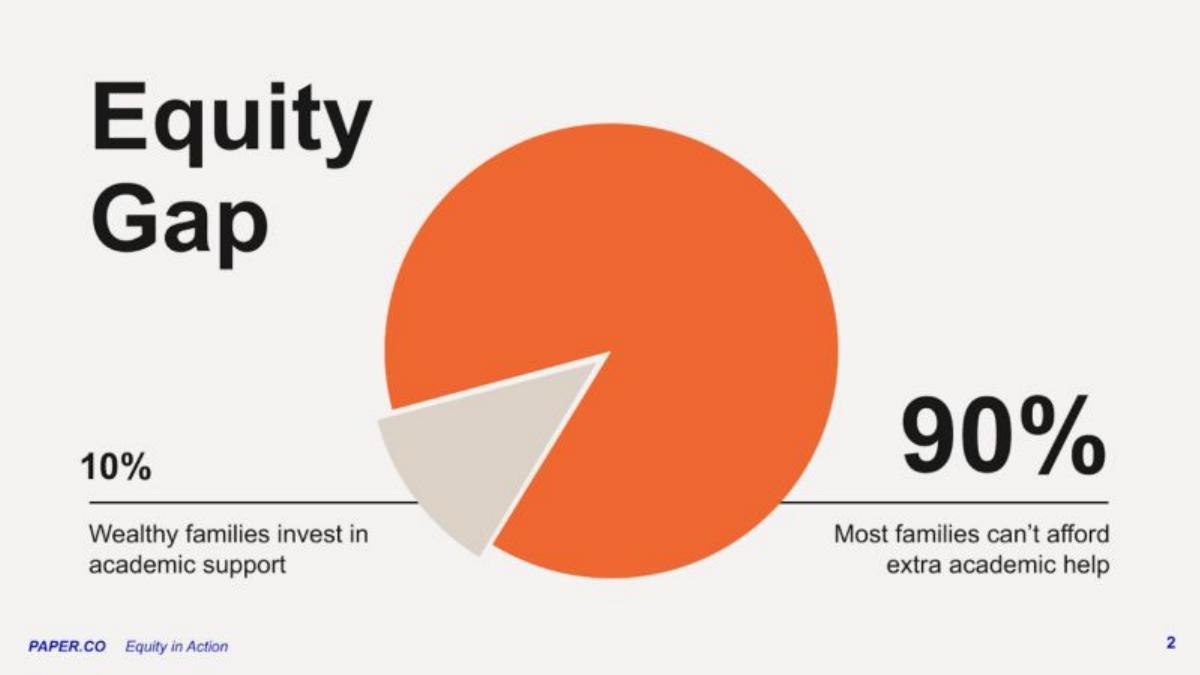
- The 'Equity Gap' slide establishes a moral and market imperative by noting 90% of families lack access to extra help (Slide 2).
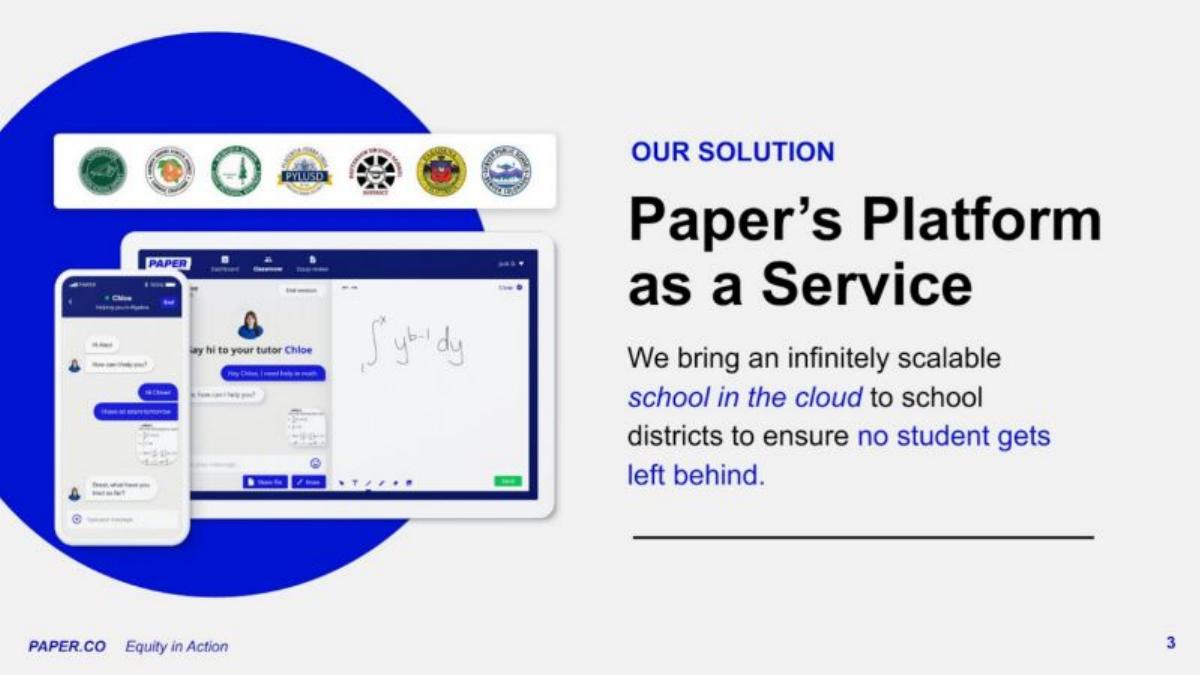
- Paper positions itself as 'Platform as a Service,' selling to districts rather than individual parents (Slide 3).
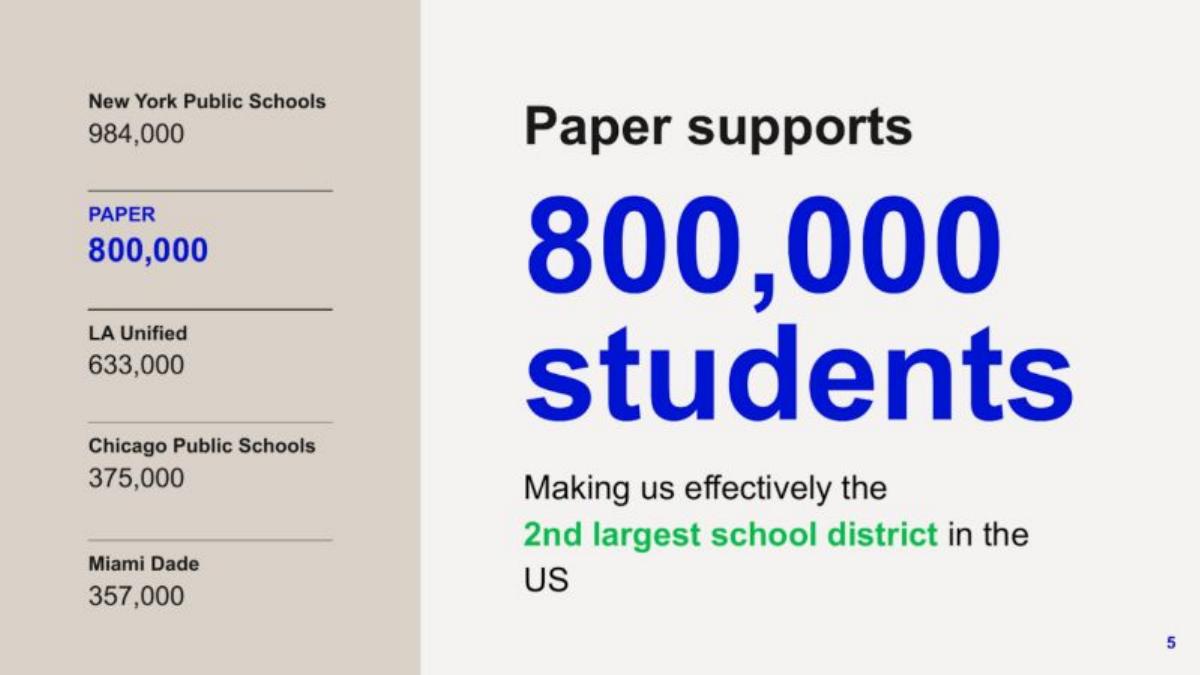
- The company claims to be the 2nd largest school district in the US by student count, supporting 800,000 students (Slide 5).
- Sales efficiency is a core highlight, with the sales cycle dropping from 300 days to 96 days (Slide 8).
- The business model relies on high NRR, which grew from 140% in 2019 to 154% in 2020 (Slide 7).
- Operational scalability is proven by a 12-day time-to-hire for educators who can manage up to 5 students simultaneously (Slide 10).
- The deck emphasizes capital efficiency, noting $19M raised across Seed, Series A, and B while maintaining 18+ months of runway (Slide 13).
- The team slide features a 'Strong Leadership Team' with seven key executives but lacks detailed bios or previous exit history (Slide 12).
The Narrative of Equity and Scale
Paper’s Series C pitch deck is a masterclass in transition. It moves the company from a 'startup with a good idea' to a 'critical infrastructure provider' for the North American public school system. The deck is characterized by bold typography, high-contrast visuals, and a relentless focus on the 'Equity Gap.' By framing their product as a solution to educational inequality, they tap into both the social mission and the massive budgets of public school districts.
Slide 1-2: The Mission and the Gap
The deck opens with a minimalist title slide featuring the brand name and the tagline 'Equity in Action.' This immediately signals that Paper is not just a tutoring company; it is a social-impact-driven enterprise. Slide 2, titled 'Equity Gap,' uses a simple pie chart to illustrate a stark reality: 10% of wealthy families invest in academic support, while '90% of families can’t afford extra academic help.' This slide defines the Total Addressable Market (TAM) not in dollars, but in human need, which is a powerful hook for Series C investors looking for companies that can dominate an entire sector.
Slide 3-4: The Solution as Infrastructure
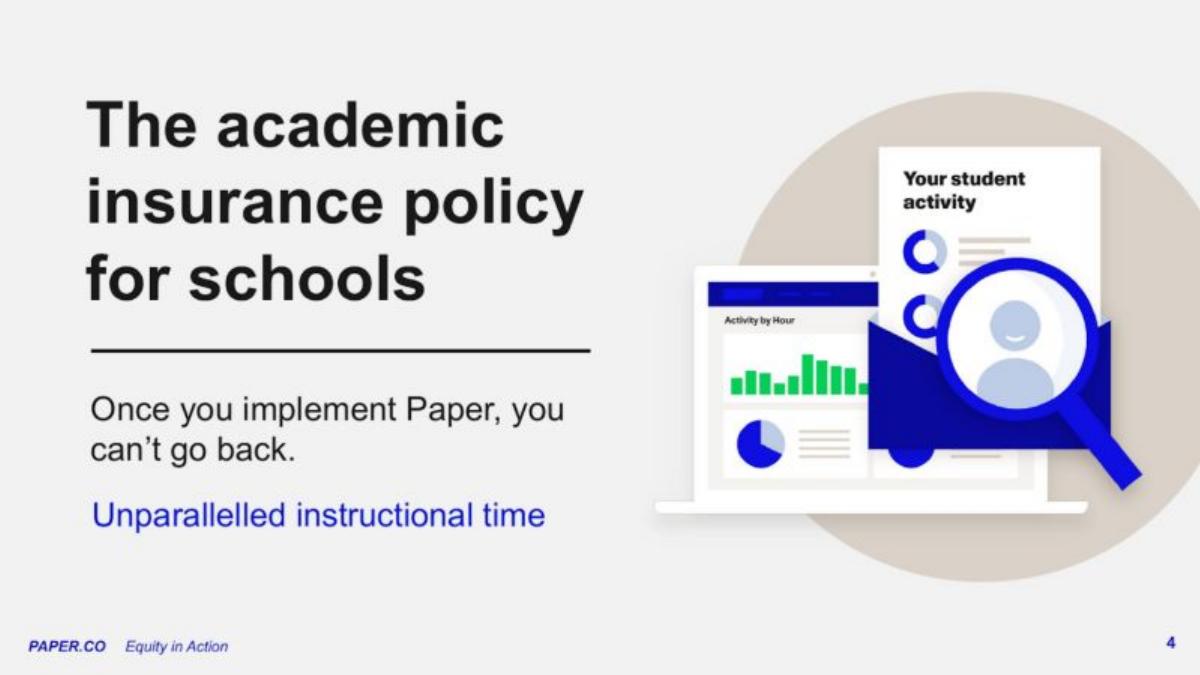
Slide 3 introduces 'Paper’s Platform as a Service.' It uses a 'school in the cloud' metaphor to describe an infinitely scalable solution. The slide includes logos of several school districts, providing immediate social proof. Slide 4 takes the positioning a step further, calling Paper 'The academic insurance policy for schools.' This is a brilliant bit of sales psychology—it suggests that once a district implements Paper, it becomes an essential utility that they 'can’t go back' from. It promises 'unparalleled instructional time' for teachers and students alike.
Slide 5: The Power of the Number
Slide 5 is perhaps the most important slide in the deck for establishing scale. It states that 'Paper supports 800,000 students,' which, according to the slide, makes them 'effectively the 2nd largest school district in the US.' By comparing their user base to the size of the New York Public Schools (984,000) and LA Unified (633,000), Paper reframes its market position from a software vendor to a peer of the largest educational institutions in the country.
Slide 6-7: Growth and Retention Metrics
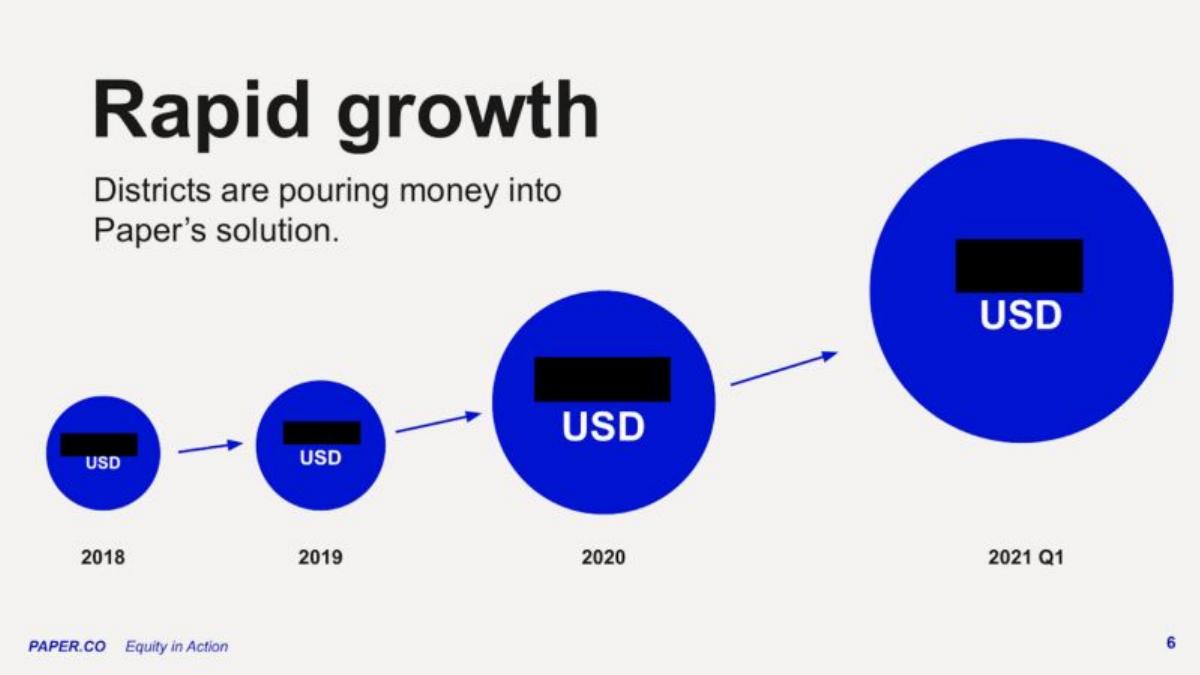
Slide 6, titled 'Rapid growth,' shows four blue circles representing revenue from 2018 to Q1 2021. While the specific USD figures are redacted, the visual growth in the size of the circles is exponential. Slide 7, 'Customers don’t leave,' provides the 'why' behind the growth. It highlights 'multi-year renewals' and cites a Net Revenue Retention (NRR) of 140% in 2019 and 154% in 2020 . In the world of SaaS, an NRR over 150% is elite, indicating that existing customers are significantly expanding their contracts over time.
Slide 8-9: Sales and Unit Economics
Slide 8 focuses on the efficiency of their Go-To-Market (GTM) strategy. They claim to know their '13,500 buyers' (Superintendents, Assistant Superintendents, and CAOs) and have successfully reduced their 'sales cycle from 300 days to 96 days.' For a B2G (Business to Government) model, a 96-day sales cycle is remarkably fast. Slide 9, 'Elite Execution, Impactful Deals,' compares Average Contract Value (ACV) to Acquisition Cost. The bar chart shows that while acquisition costs stayed relatively flat from 2019 to 2020, the ACV exploded, suggesting massive operating leverage.
Slide 10-11: Operations and Margins
Slide 10, 'Efficient Service,' addresses the supply side. Paper employs educators rather than contractors, which they claim creates a 'new career for educators.' Key metrics include a '96% quarterly retention' for staff and a '12 days' time to hire. They also note that one educator can work with up to 5 students simultaneously, allowing for a ratio of '1 educator for every 1000+ students under contract.' Slide 11, 'Operational Excellence,' shows a gross margin chart from 2019 through a 2021 forecast. Although the numbers are redacted, the trend line suggests a move toward significant profitability as the platform scales.
Slide 12-14: Team, Capital, and Vision
Slide 12 introduces the 'Strong Leadership Team,' including CEO Philip Cutler and COO/CTO Roberto Cipriani. The slide is clean but lacks the 'pedigree' logos (e.g., former Google, Harvard) often seen in Silicon Valley decks, focusing instead on the functional roles. Slide 13, 'Track record of capital efficiency,' notes that the company had '$19M raised' prior to this round and maintained '18+ Months' of runway. The deck concludes on Slide 14 with the goal 'To build the world's largest education company.'
What Works in This Deck
The 'Insurance Policy' Framing: By positioning the product as an insurance policy, Paper moves the conversation away from 'discretionary spending' to 'essential infrastructure.' This is a key distinction for selling to government entities with fixed budgets.
The 2nd Largest District Comparison: Comparing student count to the size of major US school districts is a genius way to visualize market share. It makes the 800,000 student figure feel much more significant than it would in isolation.
NRR as a Growth Engine: Highlighting 154% NRR is the strongest possible signal for a Series C investor. It proves that the product is 'sticky' and that the company has a clear path to expansion within its existing customer base without needing to constantly find new districts.
What Is Missing
Product Depth: There is very little information on how the tutoring actually works. We see one screenshot of a chat interface on Slide 3, but there is no mention of the pedagogy, the subjects covered, or the AI/ML backend that might be assisting the tutors. For a $100M round, investors usually want to see the 'moat' in the technology.
Competitive Landscape: The deck completely omits a competitor slide. While Paper may feel they are in a category of one by selling to districts, they still compete for budget against traditional tutoring centers, other EdTech platforms, and in-house district programs. Ignoring the competition can sometimes come across as overconfident in a late-stage deck.
Detailed Financials: While this is a public version of the deck, the total redaction of revenue and margin figures makes it difficult to assess the true health of the business. However, the trend lines and percentage growth (like the NRR) provide enough of a proxy to understand why it was successful.
What a Founder Should Copy
The 'Problem First' Approach: Start with a moral or systemic problem (the Equity Gap) that makes your solution feel inevitable. If you can convince an investor that the current system is broken, your product becomes the only logical fix.
Focus on Sales Velocity: If you are in a sector known for slow sales (like Education or GovTech), showing a reduction in the sales cycle (from 300 to 96 days) is a massive green flag. It proves you have 'cracked the code' on a difficult GTM strategy.
Supply-Side Metrics: If your business involves a human element (like tutoring or coaching), don't just show customer metrics. Show supply-side metrics like 'time to hire' and 'staff retention.' This proves that your business won't break as you scale.
Final Thoughts
Paper’s deck is a textbook example of how to pitch a Series C. It focuses on the 'machine' of the business—how it sells, how it scales, and how it retains. By the time an investor reaches the final slide, the message is clear: the model works, the market is huge, and the company is ready for a massive infusion of capital to capture the remaining 13,500 buyers.
Frequently asked questions
- What is Paper's primary business model?
- Paper operates on a B2B 'Platform as a Service' model, selling directly to school districts. Unlike traditional tutoring companies that charge parents, Paper provides its services for free to students through district-wide contracts, which they describe as an 'academic insurance policy' for schools (Slide 4).
- How does Paper handle the supply of tutors?
- Paper employs educators as full-time or part-time employees rather than 1099 contractors. They have optimized their hiring process to a 12-day cycle and use a technology platform that allows one educator to work with up to five students simultaneously, achieving a ratio of 1 educator per 1,000+ students under contract (Slide 10).
- What are the key growth metrics shown in the deck?
- The deck highlights a massive jump in student support to 800,000 (Slide 5) and a significant increase in Net Revenue Retention (NRR) from 140% to 154% (Slide 7). Additionally, they demonstrate 'Elite Execution' by showing a dramatic increase in Average Contract Value (ACV) from 2019 to 2020 while keeping acquisition costs relatively stable (Slide 9).
- Who is the target audience for Paper's sales team?
- Paper identifies 13,500 specific buyers in their market. They target three key personas: Superintendents, Assistant Superintendents, and Chief Academic Officers. Their refined sales process has reduced the time to close these high-level stakeholders from 300 days down to 96 days (Slide 8).
- What was the outcome of this specific fundraising round?
- According to the catalogue facts, Paper raised $100M in a Series C round in 2021. This followed a total of $19M raised across their Seed, Series A, and Series B rounds as noted on Slide 13.