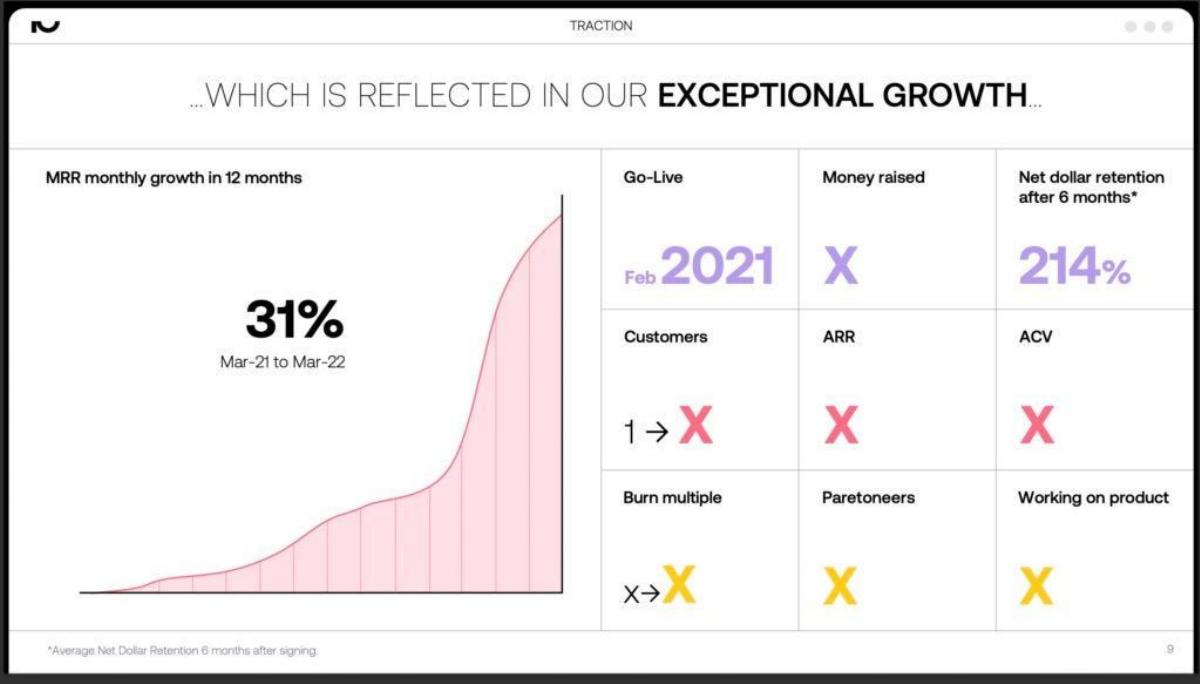
Paretos, a German AI-based SaaS platform, successfully raised a $6.8M Seed round in 2022 by positioning itself at the forefront of the 'Decision Intelligence' trend. The 15-slide deck focuses heavily on the inefficiency of current business decision-making—often driven by 'strongest personality' or 'messy Excel sheets'—and proposes a four-stage automated workflow: Design, Predict, Execute, and Track. The most compelling evidence in the deck is its traction slide, which boasts a 214% net dollar retention after six months and a customer expansion rate where users pay 4x the initial price after j…
Key takeaways
- The deck identifies a specific market shift from BI & Analytics to Decision Intelligence, citing a Gartner prediction that 33% of large organizations will practice decision modeling by 2023 (Slide 6).
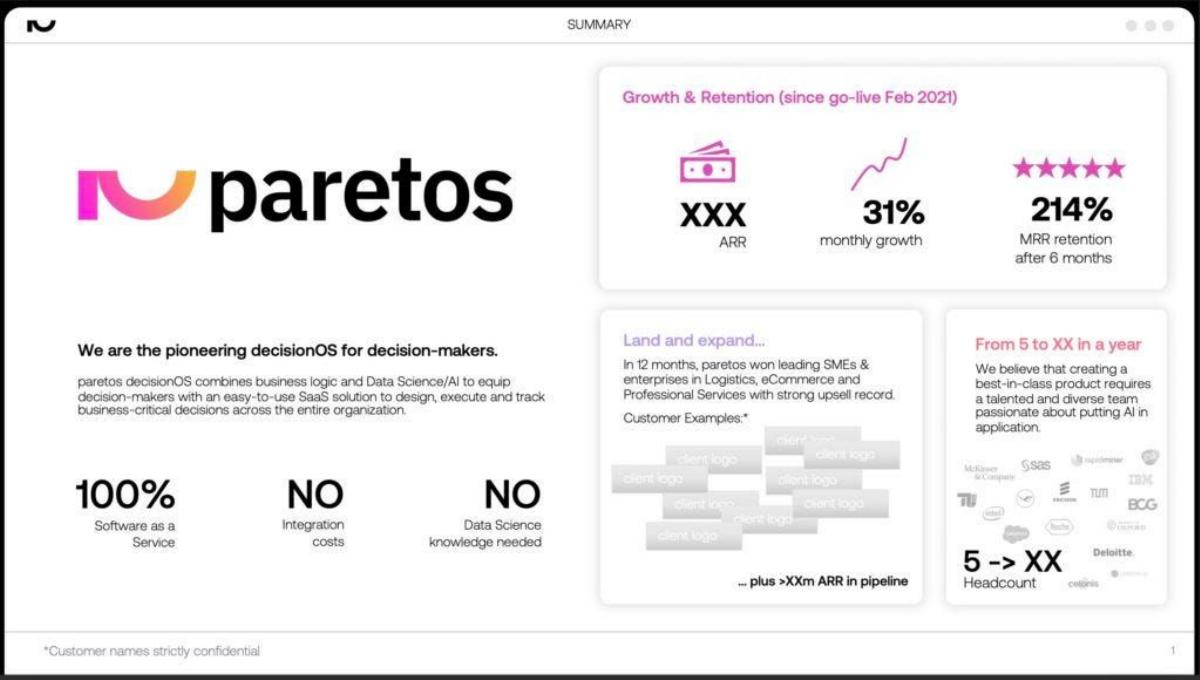
- Paretos claims a massive 214% net dollar retention after six months, a metric that likely served as the primary hook for their $6.8M Seed round (Slide 10).
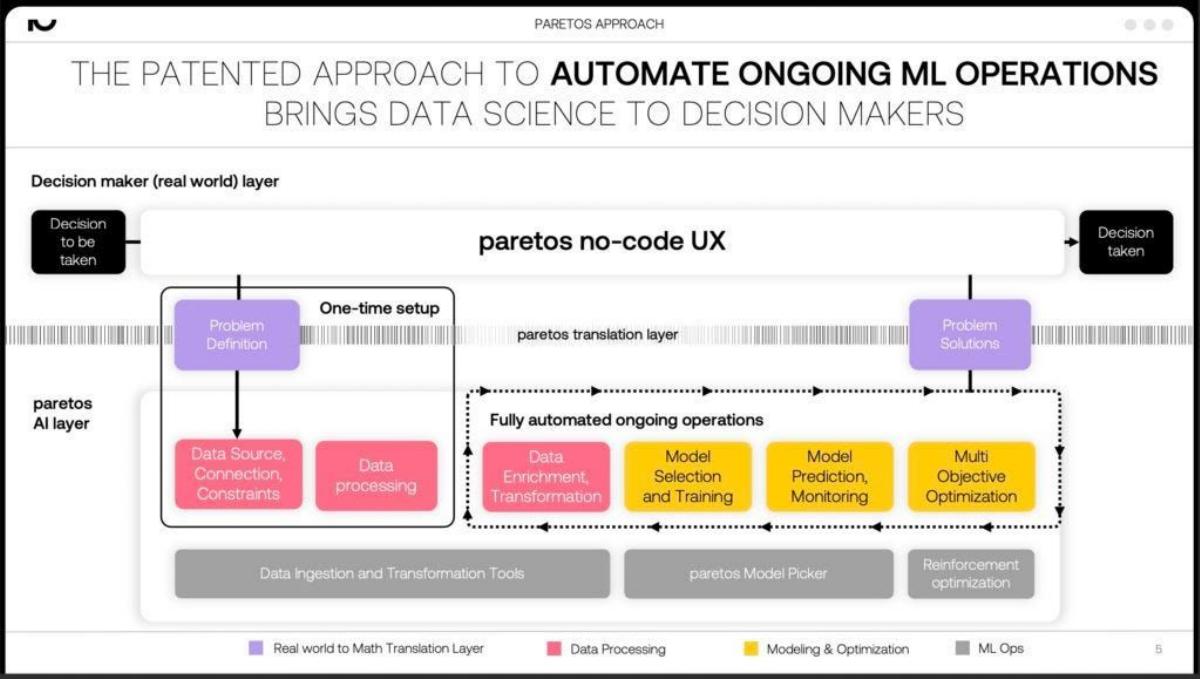
- The platform's value proposition is built on four pillars: Design, Predict, Execute, and Track, aiming to move companies away from 'gut feeling' decisions (Slide 4).
- Customer success is quantified with specific outcomes, including a 30% margin increase in five months and 95% accuracy for 15k daily predictions (Slide 8).
- The 'Land & Expand' strategy is proven through data showing customers pay 2x the initial price after 5 months and 4x after 10 months (Slide 10).
- The team slide highlights deep domain expertise, featuring a CEO who was a Top 50 AI CEO in 2021 and a CTO with a background in multi-objective optimization (Slide 12).
- The deck omits a traditional 'Ask' slide or a detailed breakdown of how the $6.8M will be allocated, focusing instead on the 'Why Now' and 'Traction' (Slides 6, 10).
- Paretos positions its market opportunity as a $36BN sector by 2030, growing from a $10BN base today (Slide 6).
The Paretos Pitch Deck: Selling the Future of Decision Intelligence
Paretos raised $6.8M in Seed funding in 2022, a period when the 'Decision Intelligence' category was just beginning to gain mainstream traction. Their pitch deck is a clinical example of how to frame a new category by contrasting it against the failures of legacy systems. The deck is light on fluff and heavy on two things: market timing and explosive retention metrics.
Slide 1: The Hook
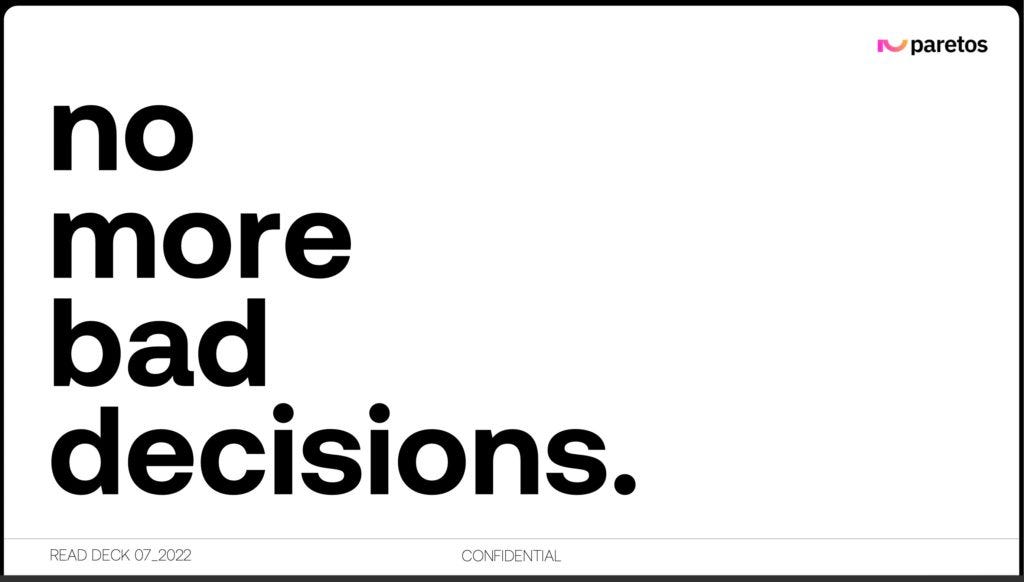
The cover slide is minimalist, featuring the company logo and a bold, lowercase statement: "no more bad decisions." This immediately establishes the value proposition not as a technical tool, but as a solution to a universal business pain point. The footer notes the deck is from July 2022 and marked as confidential.
Slide 2: The Problem - Broken Decision-Making
Slide 2 sets up a classic 'Before vs. After' comparison. On the left, it describes the status quo as decisions made 'behind closed doors where the strongest personality wins' and 'biased by intuition and gut feeling.' It specifically calls out 'messy Excel-Sheets and long PPTs' as the current tools of choice. On the right, it introduces paretos Decision Intelligence as the solution: data-driven, AI-powered with a 'human in the loop,' and proactive rather than reactive.
Slide 4: The Solution - One System
Slide 4 (numbered as the second '2' in the top left corner, though it is the third content slide) breaks the product down into four functional stages: Design, Predict, Execute, and Track. This is a crucial slide because it moves the conversation from 'AI' (a buzzword) to 'Workflow' (a product). It shows UI mockups for each stage, emphasizing a 'drag-and-drop' model design and 'one-click' execution of trade-offs. The 'Track' feature is highlighted as providing 'complete control of past decisions,' addressing the accountability gap in most corporations.
Slide 6: Why Now - The Gartner Validation
Slide 6 is the 'Market' slide. It uses a growth curve to show the evolution from BI & Analytics (2010) to Process Mining & RPA (Now) to Decision Intelligence (2030). Paretos cites Gartner, noting that Decision Intelligence is a 'Top Strategic Technology Trend 2022' and predicting that 1/3 of large organizations will use decision modeling by 2023. They value the current market at $10BN and the 2030 market at $36BN .
Slide 8: Client Stories - Quantifying Success
Slide 8 provides social proof through three case studies. The metrics are impressive: a 3m (three-month) integration process allowing for global scale, a 30% margin increase in five months for a retail client, and 95% accuracy for 15,000 daily predictions. By including quotes from a Managing Director, a Co-founder, and a Senior Product Manager, Paretos demonstrates that their tool is useful across different levels of management.
Slide 10: Traction - The 214% NDR
This is arguably the most important slide in the deck. It focuses on Net Dollar Retention (NDR) . A line graph shows MRR vs. Initial spend, climbing from 1.0x at signing to 9.3x after 12 months for individual customers. The slide explicitly states that customers pay 2x the initial price after 5 months and 4x after 10 months. The headline metric is a 214% Net Dollar Retention after 6 months , with 71% of customers upgrading within that same timeframe. For a Seed round, these expansion numbers are exceptionally high and suggest a very sticky product with a clear 'land and expand' path.
Slide 12: The A-Team
The team slide highlights CEO Thorsten Heilig and CTO Fabian Rang . Heilig is credited with a track record of scaling companies (moovel) and being a 'Top 50 AI CEO in 2021.' Rang is described as a 'Data Scientist & Engineer with 4 years of research in multi-objective optimization.' The slide also lists a supporting cast of VPs and Leads from recognizable companies like Celonis, IBM, Intel, and Deloitte . The right side of the slide uses placeholders ('+X data science') to indicate planned hiring, which is standard for a fundraising deck.
Slide 14: The Close
The final slide is a simple 'GET IN TOUCH!' page with a large QR code, the company logo, and the CEO's email address. It reinforces the tagline 'no more bad decisions' one last time.
What Paretos Does Well
The Paretos deck excels at category positioning . Instead of fighting for space in the crowded BI market, they lean into the 'Decision Intelligence' terminology popularized by Gartner. This allows them to frame existing tools as 'reactive' and 'broken' while positioning Paretos as the 'proactive' future.
Furthermore, their traction data is presented with extreme clarity. Many founders hide behind vague 'user growth' charts, but Paretos focuses on the metric investors care about most for B2B SaaS: Net Dollar Retention. Showing that customers spend 4x their initial contract within 10 months is a powerful indicator of product value and a scalable sales model.
What is Missing from the Deck
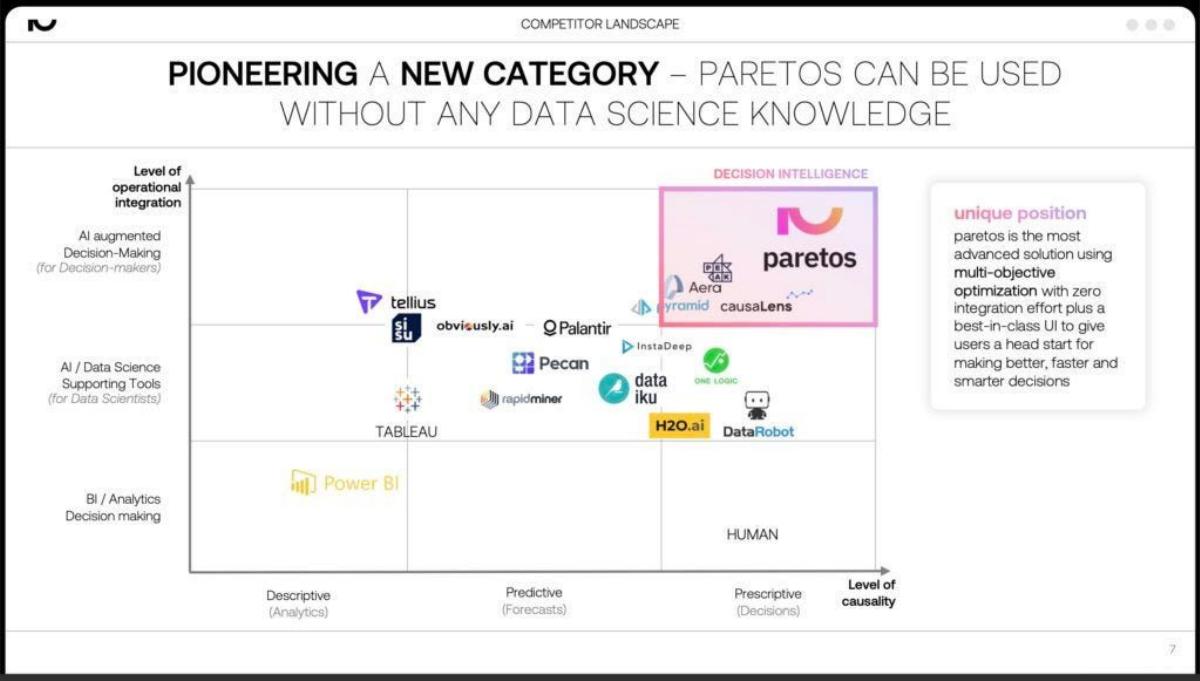
The most notable omission is a Competitor Slide . While they contrast themselves against 'Excel and PPT,' they do not mention other AI decision-support platforms or established players in the AutoML space. This leaves a gap in understanding how they defend their position against other tech-heavy startups.
There is also no Financial Forecast or Use of Funds slide in the provided images. While the publisher reports they raised $6.8M, the deck itself does not state the amount they are seeking or how they plan to allocate that capital (e.g., % to R&D vs. % to Sales). Finally, the Unit Economics (CAC, LTV) are absent, though the high NDR partially compensates for this by implying a very high LTV.
Lessons for Founders
Focus on Expansion: If your product has a 'land and expand' motion, highlight it. Paretos' 214% NDR is the strongest argument in their entire deck. · Use Third-Party Validation: Citing Gartner (Slide 6) helps move a startup from 'niche tool' to 'market leader in a growing category.' It reduces the perceived risk for investors. · Define the Workflow: Don't just say you use AI. Show the steps (Design, Predict, Execute, Track) so investors can visualize how a customer actually uses the software daily. · Humanize the Team: Including 'Fun Facts' (Slide 12) like being a songwriter or a national rugby player makes the founders memorable and approachable, which is vital in the relationship-driven Seed stage.
Frequently asked questions
- What is 'Decision Intelligence' according to Paretos?
- Paretos defines Decision Intelligence as the evolution of BI and Process Mining. While BI asks 'what can we learn,' Decision Intelligence asks 'how can I use my data for better decision making.' On Slide 4, they break this down into a workflow of designing models, predicting futures, executing trade-offs with one-click, and tracking past results for full transparency.
- How does Paretos demonstrate product-market fit in this deck?
- They use a combination of qualitative 'Client Stories' (Slide 8) and quantitative 'Traction' (Slide 10). The most significant proof point is their 214% Net Dollar Retention. This suggests that once a company starts using Paretos, they rapidly expand their usage, doubling their spend within five months and quadrupling it within ten.
- What specific business problems does the platform solve?
- Slide 2 highlights that current decision-making is 'broken' because it happens behind closed doors where the 'strongest personality wins' or is 'biased by intuition.' Paretos replaces this with 'AI-powered decisions with human in the loop.' Use cases mentioned on Slide 8 include dynamic pricing for margin optimization and parcel quantity forecasting for logistics.
- Is the team qualified to build an AI decision engine?
- Yes, Slide 12 presents a highly technical and experienced founding team. CEO Thorsten Heilig has a track record of scaling companies like moovel, while CTO Fabian Rang has four years of research in multi-objective optimization. The broader team includes leads from high-growth tech companies like Celonis, RapidMiner, and IBM.
- What is the projected market size for this technology?
- According to Slide 6, Paretos views the 'Decision Intelligence' market as being worth $10BN 'Now' (2022) and projected to grow to $36BN by 2030. They support this growth narrative with a Gartner quote stating that more than one-third of large organizations will have analysts practicing decision modeling by 2023.