Parfait's pitch deck outlines a business model centered on high-quality, healthy yogurt parfaits distributed through local farmers' markets and regional grocery chains. The company emphasizes a 'local' competitive advantage, citing specific Ottawa-based partners like Ewenity Dairy Co-operative and Cauldron Kitchen. Financially, the deck is transparent, detailing a $4.00 unit cost and a $2.00 profit margin on direct sales. However, the presentation is hampered by a lack of founder background information and the absence of a clear funding request. While the growth projections show a path to 232…
Key takeaways
- The company identifies a gap in the market for healthy grab-and-go snacks that are actually nutritious and flavorful (Slide 2).
- Target retail distributors are specifically named, including regional players like Market Organics, FarmBoy, and Rainbow Foods (Slide 3).
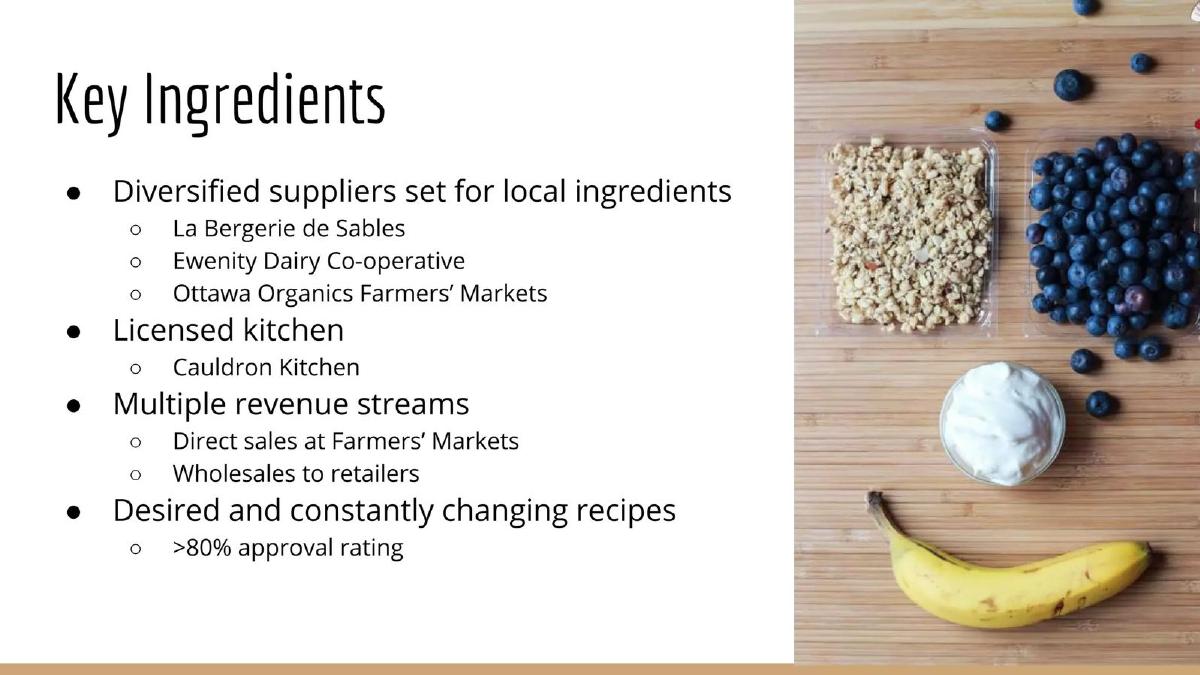
- Supply chain transparency is a core focus, listing La Bergerie de Sables and Ewenity Dairy Co-operative as key partners (Slide 4).
- Unit economics are clearly defined: a $4.00 cost per unit results in a $2.00 profit for direct sales and $0.95 for wholesale (Slide 7).
- The financial plan projects revenue to exceed $1,050,000 by Year 5, driven by a presence in 60 grocery stores (Slide 7).
- The team slide includes one identified founder but uses generic silhouettes for six other roles, including the Chef and Sales Director (Slide 8).
- Risk mitigation strategies include a 15-day payback for suppliers and swapping local fruit for imported options if costs become too high (Slide 9).
- The deck completely omits a 'The Ask' slide, leaving potential investors without a target funding amount or equity offer.
Slide-by-Slide Analysis
Slide 1: Title Slide
The title slide features the company name, 'Parfait,' and a stylized 'P' logo in a purple circle. The background imagery consists of two high-resolution photos of fruit and yogurt parfaits in glass jars. It is a standard, clean branding slide that clearly establishes the product category.
Slide 2: Problem Definition
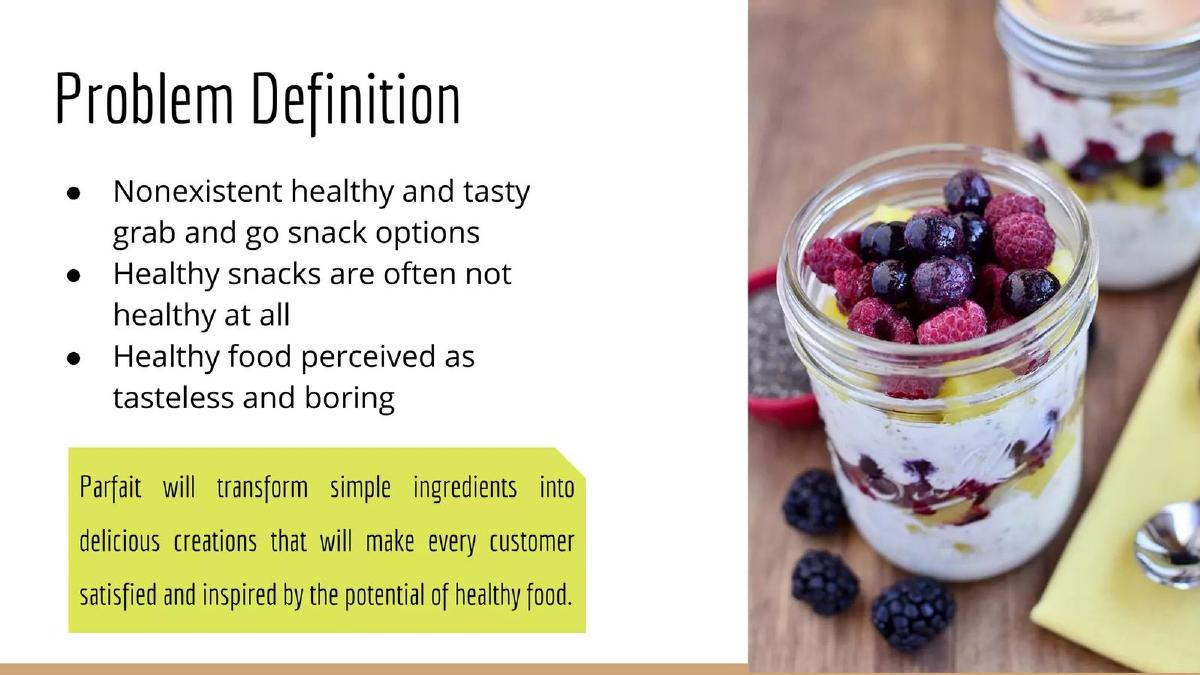
This slide identifies three pain points: the nonexistence of healthy grab-and-go options, the fact that 'healthy' snacks are often unhealthy, and the perception that healthy food is boring. A highlighted box at the bottom states the solution: Parfait will transform simple ingredients into delicious creations. While it identifies a consumer sentiment, it lacks data to support the 'nonexistent' claim, which is a strong statement in a crowded yogurt market.
Slide 3: Target Markets
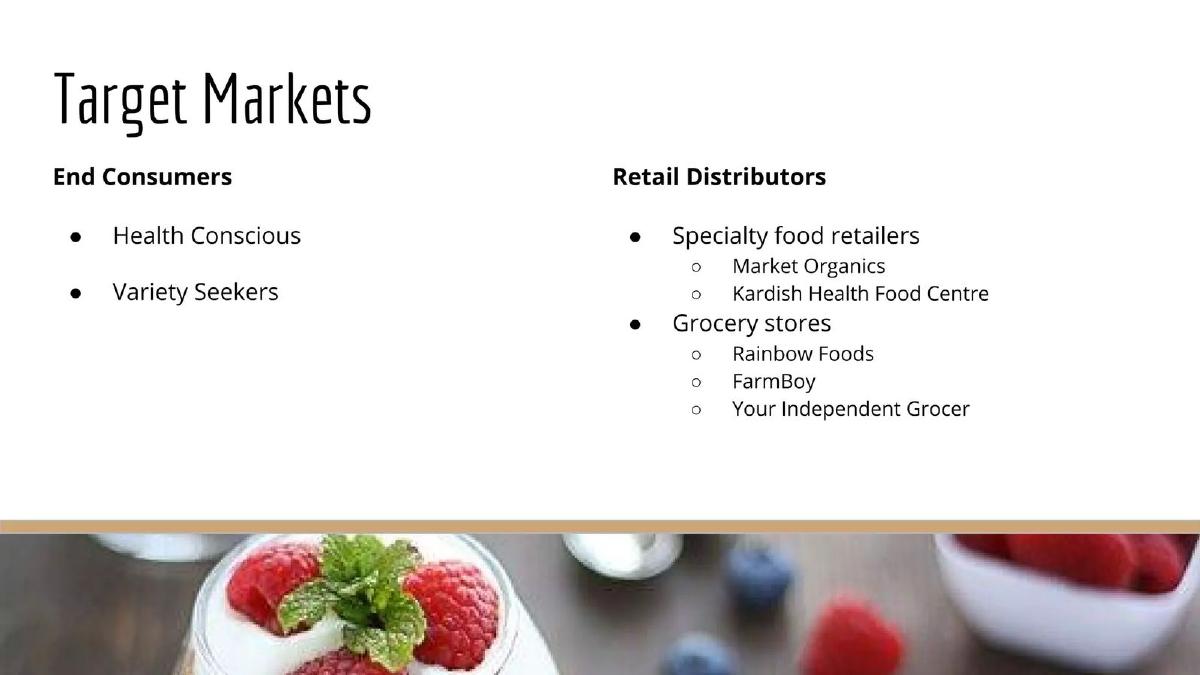
Parfait divides its market into End Consumers (Health Conscious and Variety Seekers) and Retail Distributors. The slide is notable for naming specific regional retailers: Market Organics, Kardish Health Food Centre, Rainbow Foods, FarmBoy, and Your Independent Grocer. This indicates a focused, regional launch strategy centered around Ottawa, Canada, given the specific retail names provided.
Slide 4: Key Ingredients and Operations
This slide focuses on the supply chain and operational model. It lists specific local suppliers like Ewenity Dairy Co-operative and mentions the use of a licensed kitchen, Cauldron Kitchen. It also notes a '>80% approval rating' for its recipes, though it does not specify the sample size or methodology of the testing. The slide establishes the company as a 'local-first' brand.
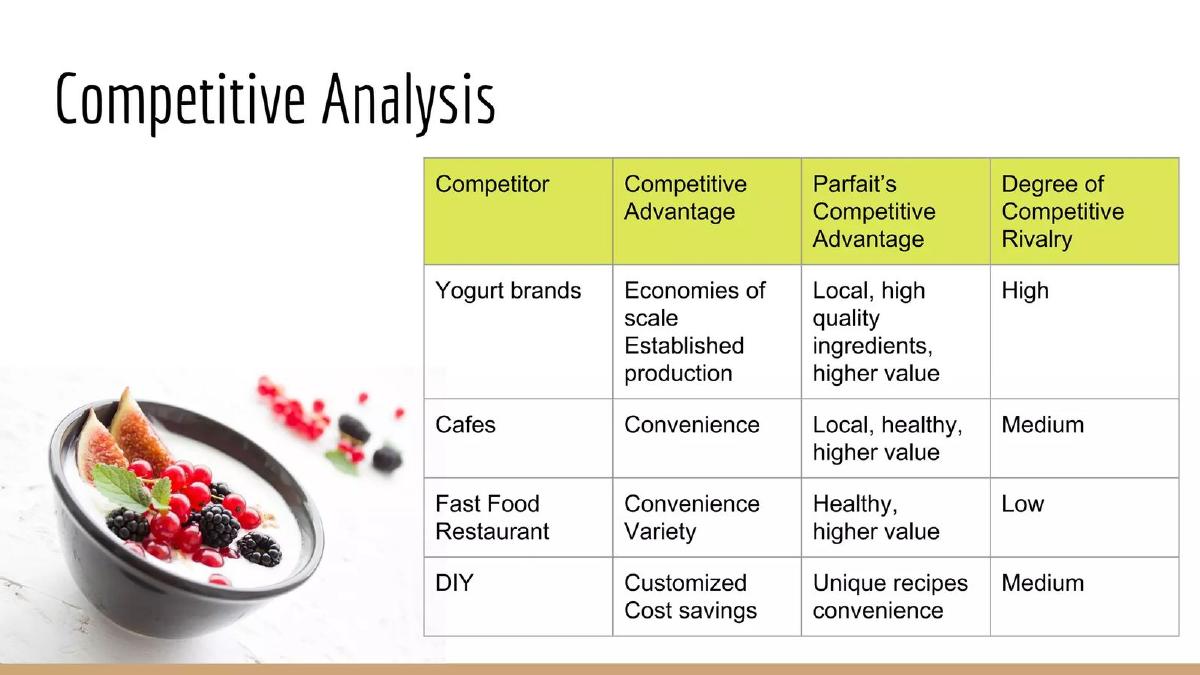
Slide 5: Competitive Analysis
The competitive landscape is presented in a table comparing Yogurt brands, Cafes, Fast Food Restaurants, and DIY options. Parfait claims a 'Local, high quality' advantage over mass-market yogurt brands, which have 'Economies of scale.' The degree of competitive rivalry is rated as 'High' for yogurt brands and 'Low' for fast food, which seems optimistic given the ubiquity of fast-food breakfast options.
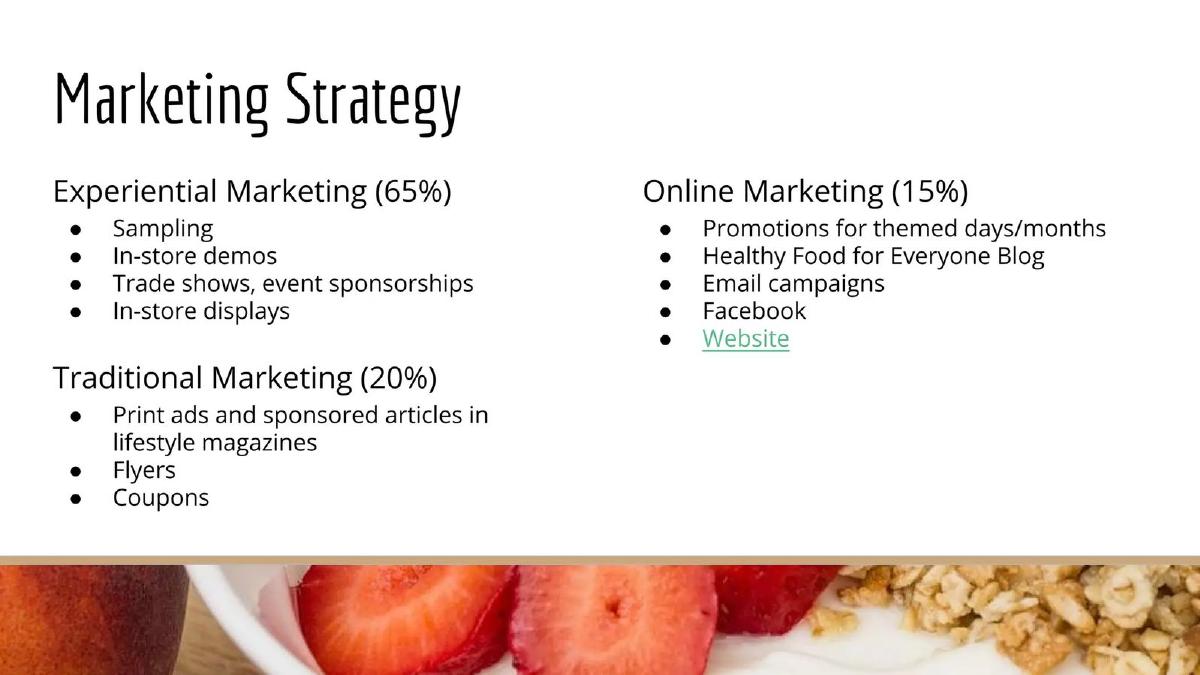
Slide 6: Marketing Strategy
The marketing mix is weighted heavily toward Experiential Marketing (65%), including sampling and in-store demos. Traditional Marketing (flyers, magazine ads) accounts for 20%, and Online Marketing (social media, blog) accounts for 15%. This is a logical allocation for a food product where taste-testing is the primary driver of initial conversion.
Slide 7: Financial Plan and Growth Projections
This is the most data-dense slide in the deck. It provides clear unit economics: a $6 direct price, a $4.95 wholesale price, and a $4 cost per unit. The 5-year projections show revenue climbing toward $1.4 million. The growth table tracks the number of grocery stores, specialty stores, and farmers' markets, providing a clear roadmap for how they intend to reach 232,416 units in annual sales by Year 5.
Slide 8: The Team
The team slide is a significant weakness. It features one photo of the founder but provides no name or background. The other six roles (Legal Advisor, Sales Director, Parfait Assembler, Supply Chain Advisor, Food Manufacturing Advisor, and Chef) are represented by generic icons. This suggests the company is currently a solo-founder operation looking to hire or that these are unfilled advisory roles.
Slide 9: Risk Considerations and Mitigation
The slide lists six risks, including cash flow, quality control, and seasonality. The mitigation strategies are practical: using a 15-day payback for suppliers to manage cash and swapping local fruit for imported fruit to mitigate high costs or seasonality. This shows a level of operational realism often missing in early-stage decks.
Slide 10: Conclusion
The final slide is a simple 'Thank you!' with a call for questions. It includes the same product imagery used throughout the deck but lacks contact information or a final 'Ask' summary.
What Parfait Does Well
Parfait excels at defining its unit economics and operational footprint. Unlike many early-stage decks that use vague 'market share' percentages, Slide 7 breaks down exactly how many stores they need to enter to hit their revenue targets. The specificity of their supply chain (Slide 4) and their target retail list (Slide 3) demonstrates that the founder has done significant local market research and likely has existing relationships with these entities. The focus on experiential marketing (Slide 6) is also a highly appropriate strategy for the CPG (Consumer Packaged Goods) space, where physical product interaction is key.
What is Missing from the Deck
The most glaring omission is a 'The Ask' slide. There is no mention of how much money the company is seeking, the valuation, or what the funds will be used for. Furthermore, the Team slide (Slide 8) is essentially empty of credentials. Investors invest in people, and without knowing the founder's track record in food service or retail, the 'Visionary' title carries little weight. The deck also lacks a TAM/SAM/SOM (Total Addressable Market) analysis; while they list local stores, they don't quantify the broader market opportunity for healthy grab-and-go snacks beyond their immediate region.
What a Founder Should Copy
Founders should emulate the transparency of the unit economics on Slide 7. Providing the exact cost per unit and the resulting margins for different sales channels (direct vs. wholesale) builds immediate credibility. Additionally, the naming of specific, real-world retail targets and suppliers (Slides 3 and 4) is a 'show, don't tell' technique that proves the business is grounded in reality rather than theoretical projections. The risk mitigation slide (Slide 9) is also a strong addition, as it demonstrates the founder has thought through the 'unhappy path' of the business, such as ingredient cost spikes and seasonal fluctuations.
Frequently asked questions
- What is Parfait's primary product and value proposition?
- Parfait produces healthy, grab-and-go snack cups using local, high-quality ingredients. According to Slide 2, the value proposition is transforming simple ingredients into 'delicious creations' to solve the problem of healthy snacks being perceived as 'tasteless and boring.' They differentiate themselves from mass-market yogurt brands by focusing on local sourcing and a higher perceived value for health-conscious consumers.
- How does the company plan to generate revenue?
- Parfait utilizes a dual-channel revenue model detailed on Slide 4. The first stream is direct sales at Farmers' Markets, which yields a $2.00 profit per unit. The second stream is wholesale to retailers, including specialty food stores and grocery chains, which yields a lower profit of $0.95 per unit but allows for greater scale.
- What are the specific growth targets for the next five years?
- Slide 7 outlines a growth trajectory starting from 7,450 units in Year 1 and reaching 232,416 units by Year 5. This growth is predicated on expanding retail presence from 2 grocery stores and 5 farmers' markets in Year 1 to 60 grocery stores and 23 farmers' markets by the end of the five-year period.
- Who are the key partners in Parfait's supply chain?
- The company relies on a localized supply chain listed on Slide 4. Key partners include La Bergerie de Sables, Ewenity Dairy Co-operative, and Ottawa Organics Farmers' Markets for ingredients. Production is handled through a licensed kitchen partnership with Cauldron Kitchen, indicating an asset-light approach to manufacturing in the early stages.
- What critical information is missing from this pitch deck?
- The deck lacks three major components: a specific funding ask, a Total Addressable Market (TAM) analysis, and founder credentials. Slide 8 shows only one photo for the 'Founder, Visionary, and Relationship-Builder' without a name or professional history, and the remaining team members are placeholders. There is also no mention of how much capital is being raised or how it will be spent.