Fitness and Sports Solution Slide: Pitch Deck Examples
How fitness and sports startups present the solution in a pitch deck: show how the product keeps people training past the point they used to quit.
Fitness and Sports Solution Slide: Real Pitch Deck Examples
Eight solution slides from fitness and sports startups, shown in full, compare whether each slide shows how the product is used in a workout, answers the reason people quit, and says what it costs.
TL;DR
A fitness solution slide has to show how the product keeps someone training past the point where they used to quit. The stronger slides walk through a workout. Fitmove shows five steps, "Find program", "Push workouts", "Perform exercises", "Analyze difficulties", "Improve progress", which answer the fear and lack of progress on its problem slide. MySwimPro shows the app on a phone and four watch brands with "Subscription Pricing: $119.99/year or $19.99/month", against the "$100" hourly coach on its problem slide. Mustard's "secret sauce" slide of algorithms and "game-changing" protocols, with no link to the cost problem it raised, is the weaker pattern.
Fitness and sports solution slides from real pitch decks
Each example shows the exact stored slide above its analysis and links to the full teardown. Claims are as shown on the slides; we have not verified them.
Fitmove solution slide — slide 4
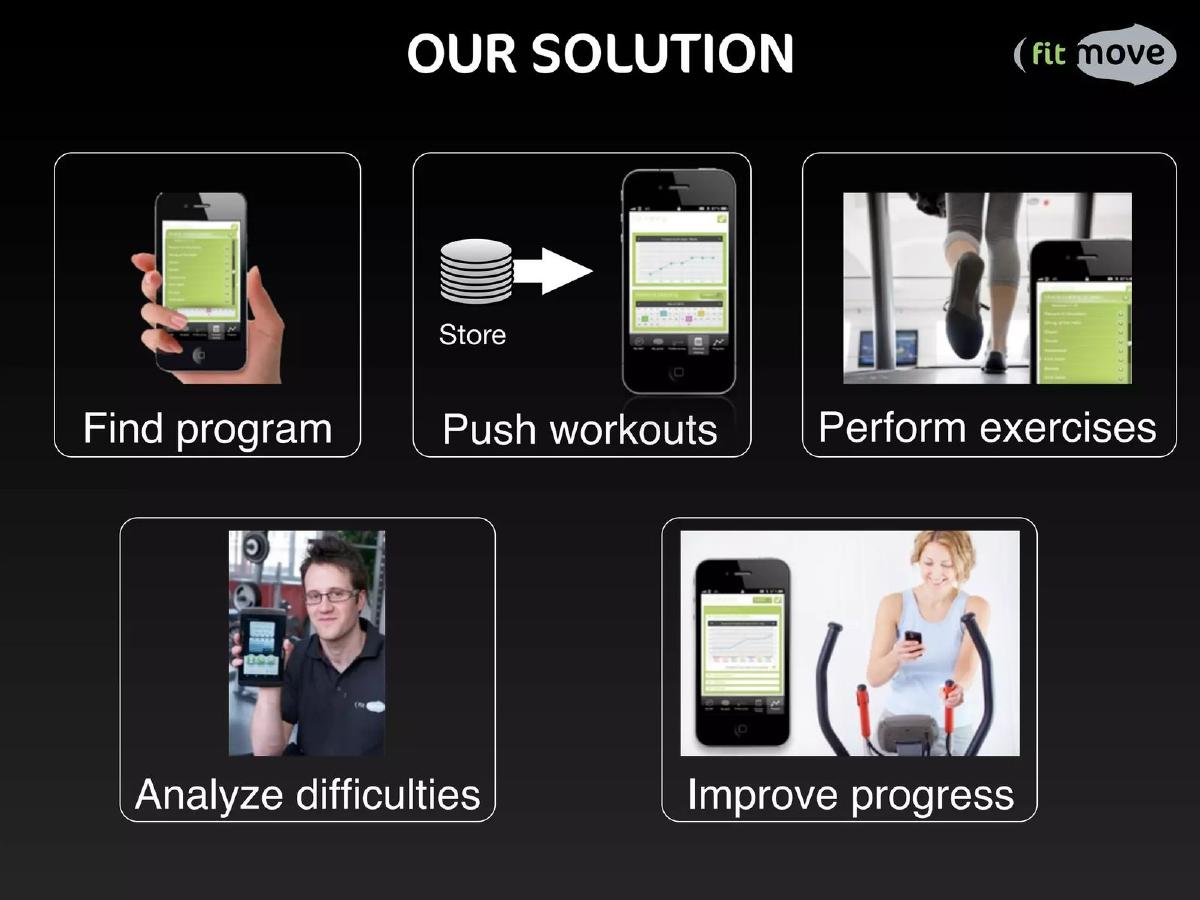
Guidance for gym members. Five photo boxes on black, each with a short caption.
Fitmove deck, slide 4. Exact stored slide matched to this analysis.
Our analysis: The strongest slide here: five steps that follow one member through the gym and answer the problem slide's fear, loneliness and missing progress.
Evidence and limitation: No figures.
What a founder can adapt: Show your product as the steps of one workout, ending with the progress the user sees.
Supporting analysis
What the deck claims: "Our solution." "Find program." "Store" → "Push workouts." "Perform exercises." "Analyze difficulties." "Improve progress."
Presentation choice: Each box is something a member does or sees, in order.
When it does not fit: "Analyze difficulties" shows a trainer at a desk; say whether a person or the app does it, and what it costs.
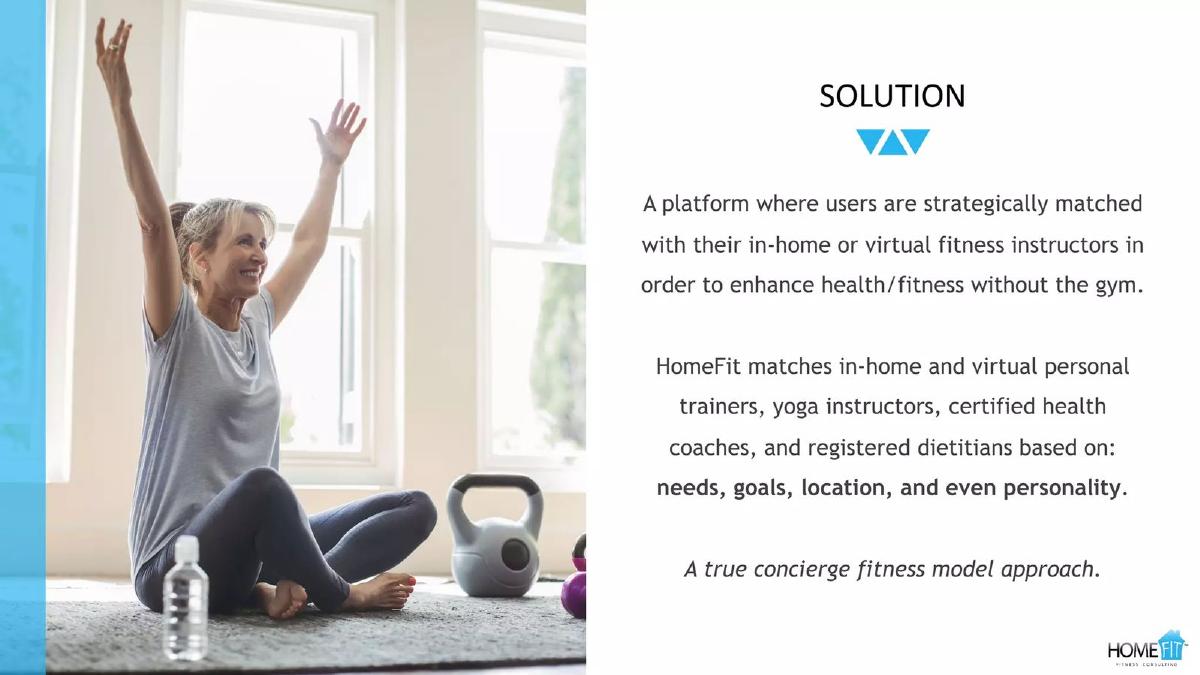
Personal trainers at home. A photo of a woman exercising at home and three short paragraphs.
HomeFit deck, slide 3. Exact stored slide matched to this analysis.
Our analysis: It answers the no-time problem (training at home) and says how matching works, in four criteria.
Evidence and limitation: No figures.
What a founder can adapt: Name what you match on and what the user gets in their first week.
Supporting analysis
What the deck claims: "A platform where users are strategically matched with their in-home or virtual fitness instructors in order to enhance health/fitness without the gym." "HomeFit matches in-home and virtual personal trainers, yoga instructors, certified health coaches, and registered dietitians based on: needs, goals, location, and even personality." "A true concierge fitness model approach."
Presentation choice: The photo finally matches the message: exercising at home, not in a gym.
When it does not fit: Add the price of a session and how fast a trainer arrives; "concierge" suggests expensive without saying so.
Premium bicycles for new riders. A heading and six bullet points.
iCycle deck, slide 3. Exact stored slide matched to this analysis.
Our analysis: It answers its problem slide point by point: expensive bikes (hire), no trial ride (weekend test rides), no support (supported rides).
Evidence and limitation: No figures.
What a founder can adapt: Put the same headings on your problem and solution slides so investors can match them.
Supporting analysis
What the deck claims: "iCycle solutions to newbie cyclists." "A chance to test-ride high-end, international quality bicycles on long rides (weekend rides)." "Bicycle hiring options to experience 'owning' a high-end bicycle (day-wise, weekly, long-term, etc...)." "Fully-supported bicycle rides for newbie cyclists (incl. Cycles, support vehicles, mechanic, Mentor cyclist, food & refreshments, etc...)." "Corporate sponsored events..." "Customized rides..." "Building awareness..."
Presentation choice: The one-to-one match with the problem slide is easy to check.
When it does not fit: Six offers is a lot for one company; give hire prices and pick the one that makes money.
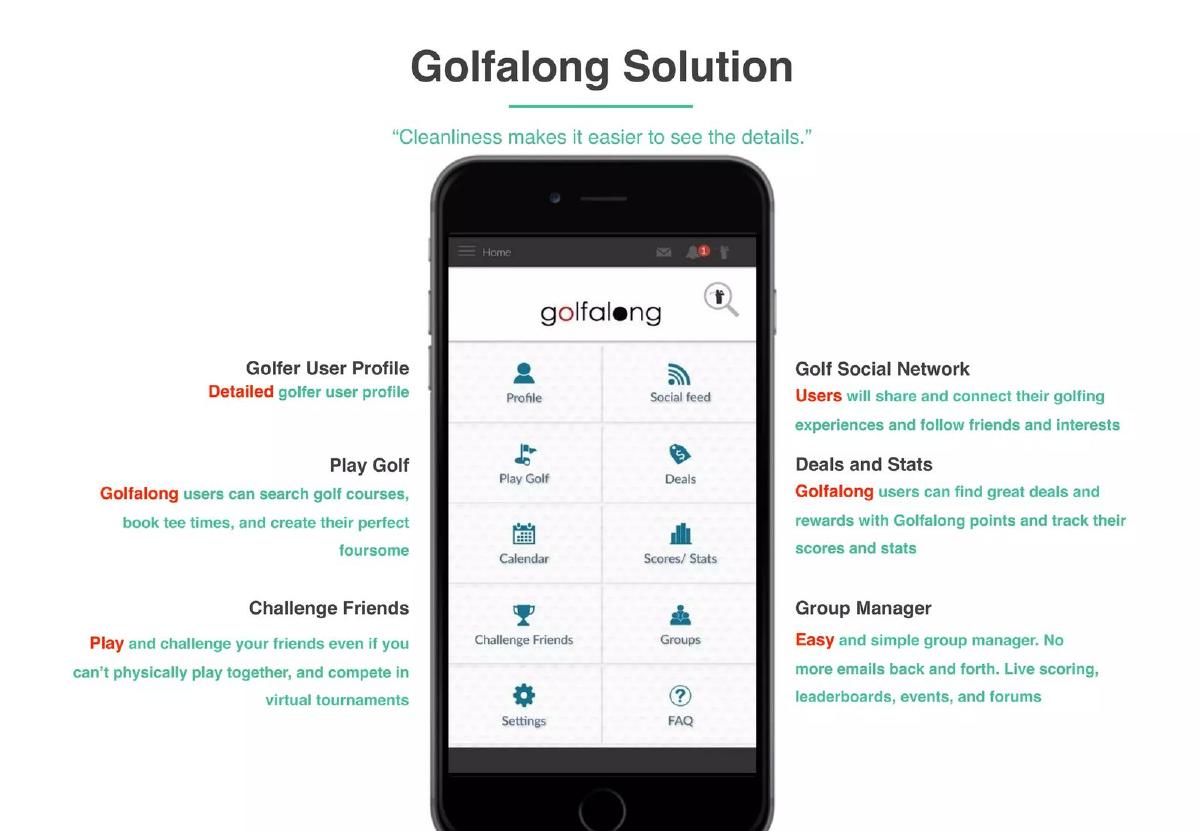
Golf platform. One phone screen with six features labelled on either side.
Golfalong deck, slide 5. Exact stored slide matched to this analysis.
Our analysis: Clear labels, but it covers only the golfer side; the golf courses from its problem slide don't appear.
Evidence and limitation: No figures.
What a founder can adapt: For a two-sided product, show what each side gets.
Supporting analysis
What the deck claims: "Golfalong Solution." "Golfer User Profile." "Play Golf: Golfalong users can search golf courses, book tee times, and create their perfect foursome." "Challenge Friends." "Golf Social Network." "Deals and Stats." "Group Manager: Easy and simple group manager. No more emails back and forth."
Presentation choice: "No more emails back and forth" names a real annoyance.
When it does not fit: Six features at equal size; lead with booking tee times, the one courses pay for.
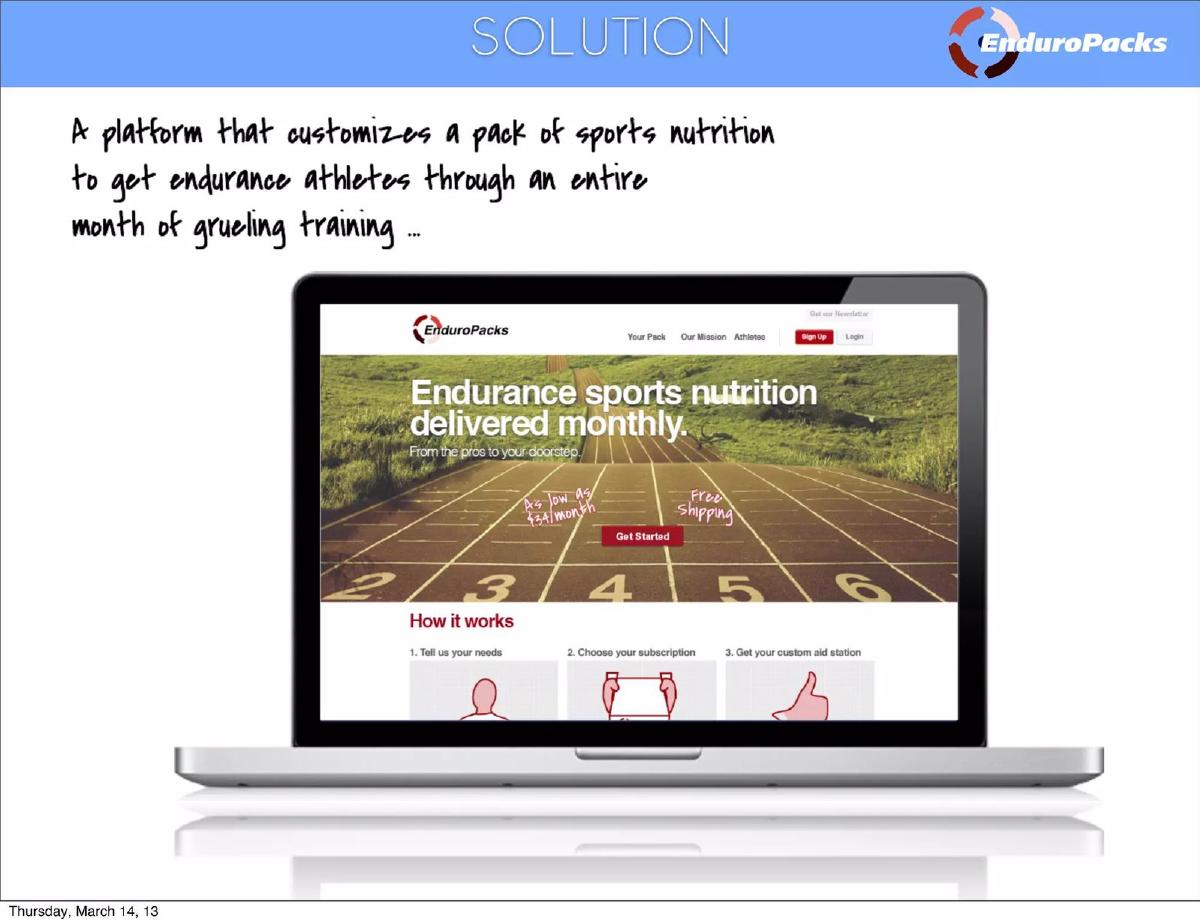
Monthly sports nutrition for endurance athletes. A handwritten line over a laptop screenshot of the website. Partial.
EnduroPacks deck, slide 5. Exact stored slide matched to this analysis.
Our analysis: The pieces are there (who, what, price, three steps), but they're inside a small website screenshot.
Evidence and limitation: A price, handwritten on the screenshot.
What a founder can adapt: Take the three steps and the price out of the screenshot and set them as slide text.
Supporting analysis
What the deck claims: "A platform that customizes a pack of sports nutrition to get endurance athletes through an entire month of grueling training..." Screenshot: "Endurance sports nutrition delivered monthly." "As low as $34/month." "Free shipping." "How it works: 1. Tell us your needs, 2. Choose your subscription, 3. Get your custom aid station."
Presentation choice: It shows how a screenshot hides what should be on the slide.
When it does not fit: Handwritten notes on a screenshot are hard to read on screen.
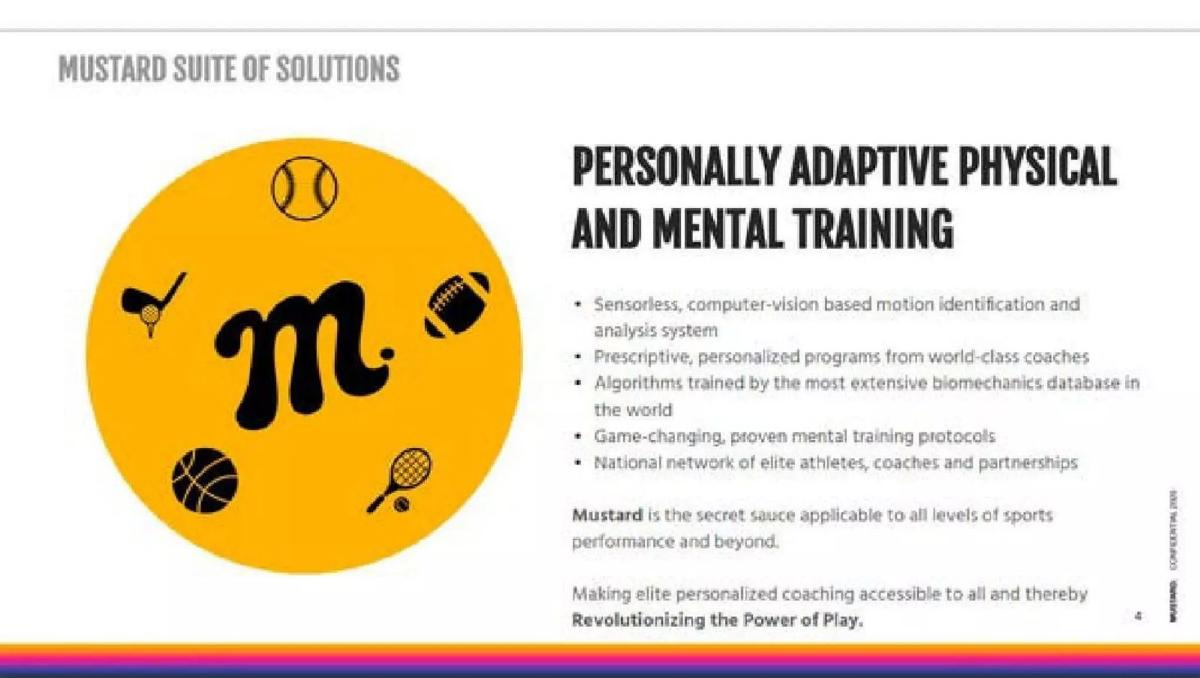
Coaching app for youth sports. A large logo circle with sports icons and five bullet points. Weak on purpose.
Mustard deck, slide 4. Exact stored slide matched to this analysis.
Our analysis: Its problem slide was one of the strongest in the library: families overpay for poorly trained coaches. This slide never says what a family pays or does, or how a child's training changes.
Evidence and limitation: No figures; "most extensive" and "proven" are unsupported.
What a founder can adapt: Show a young player filming a swing on a phone and getting a drill back, and give the monthly price against $6,000 a year.
Supporting analysis
What the deck claims: "Mustard suite of solutions." "Personally adaptive physical and mental training." "Sensorless, computer-vision based motion identification and analysis system." "Prescriptive, personalized programs from world-class coaches." "Algorithms trained by the most extensive biomechanics database in the world." "Game-changing, proven mental training protocols." "Mustard is the secret sauce applicable to all levels of sports performance and beyond."
Presentation choice: It shows what the stronger slides avoid: technology claims in place of the user's experience.
When it does not fit: "Secret sauce", "game-changing" and "world's most extensive" need proof or removal.
Whether each slide shows how the product is used, answers why people quit, and gives a price.
Example
How it's used
Answers why people quit
Price
Fitmove
Yes (five steps)
Yes (fear, no progress)
No
MySwimPro
Yes (phone and watches)
Yes (no coach)
Yes
HomeFit
Partly (matching)
Yes (no time)
No
iCycle
Partly (offers listed)
Yes (cost, no trial)
No
WeFitter
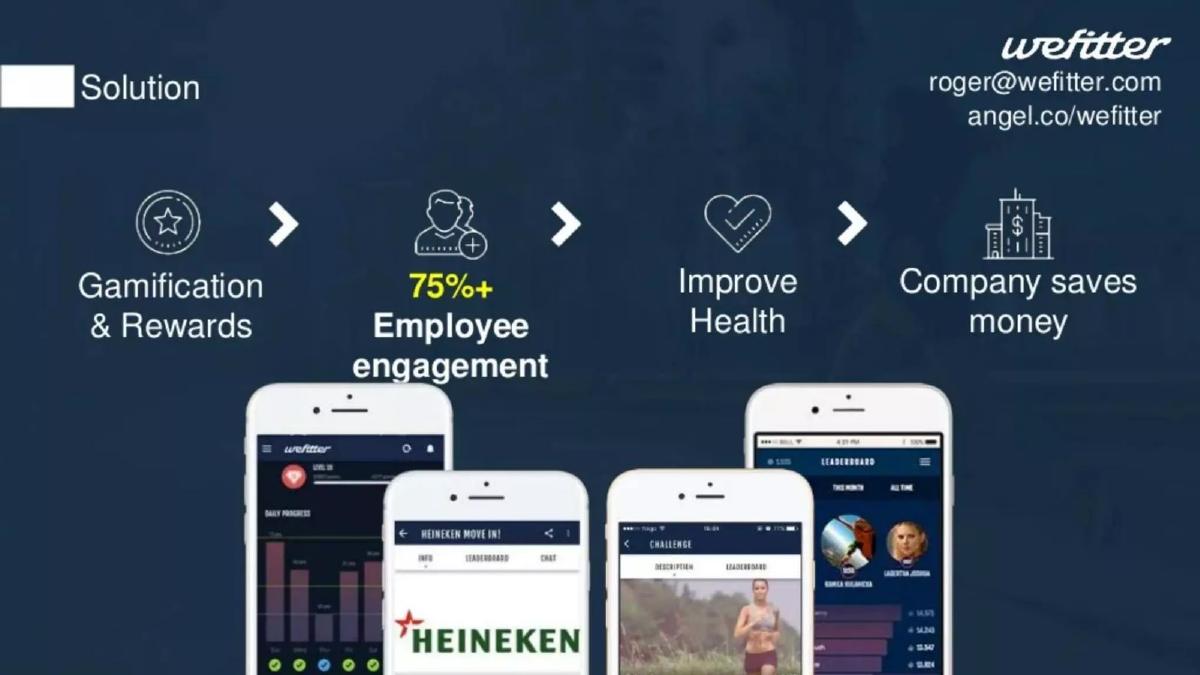
Partly (app screens)
Partly (engagement)
No
Golfalong
Yes (labelled app)
Partly (golfers only)
No
EnduroPacks
In a screenshot
Partly
Yes (in screenshot)
Mustard
No
No
No
Key Takeaways
Walk through one workout: what the user opens, does and sees afterwards.
Answer the reason people quit from your problem slide: fear, boredom, no progress, cost, no time.
Give the price next to the alternative: an app subscription against a personal coach.
Show the product in use, on the phone or watch people already train with.
"Secret sauce" and "game-changing" describe your pride, not the user's workout.
Build your fitness solution slide
One workout, the quitting point fixed, one price.
Workout. What does the user open, do and see in one session?
Quitting point. Which reason for quitting from your problem slide does this fix?
Price. What does it cost, and what does the current alternative cost?
Proof. One result: retention, sessions per week, or an award.
Copyable framework: [User] opens [product], [does what] and sees [result]. It fixes [reason people quit] for [price], against [alternative] at [cost].
Illustrative example 1 — written by us
Before: An AI-powered holistic platform revolutionizing fitness with personalized programs.
After: A new runner films one lap on their phone and gets three drills for the week; 64% of users are still running after three months. $12 a month, against $80 for one physio session.
What improved: Our illustrative rewrite; the figures are invented for the example. It shows the session, the quitting point fixed and the price comparison.
What this guide adds
This guide follows the fitness and sports problem guide: most of the decks here appear in both, so you can see whether each solution answers its own problem slide.
The slides range from workout apps (Fitmove, MySwimPro) and trainer matching (HomeFit) to bike hire (iCycle), sports nutrition (EnduroPacks), golf (Golfalong), workplace activity (WeFitter) and youth coaching (Mustard).
Three things a fitness solution slide proves
How it's used: Fitmove's five steps, MySwimPro's phone and watch screens, Golfalong's labelled app menu.
Which quitting reason it fixes: fear and no progress (Fitmove), no coach (MySwimPro), no time for the gym (HomeFit), no chance to try a bike (iCycle).
What it costs: "$119.99/year or $19.99/month" (MySwimPro), "As low as $34/month" (EnduroPacks, handwritten on the screenshot).
Common mistakes
Technology instead of the workout. Computer vision and algorithms matter only through what the user sees.
Not answering your own problem slide. If you said people quit at six weeks, show what keeps them going.
Hiding the price. Fitness buyers compare with a gym or coach; so will investors.
The key facts in a screenshot. Set steps and prices as slide text.
Unsupported superlatives. "Proven", "game-changing", "world's most extensive" need a source or removal.
Diagnostic checklist
It shows one session or workout.
It answers the quitting reason from the problem slide.
It gives a price next to the alternative.
It shows the product on the device people train with.
No claim is unsupported.
Frequently asked questions
How we chose these examples
Corpus: published pitch deck teardowns on StartupFundraising.com. Founder-uploaded private decks are excluded.
Selection (2026-09-25): we looked at slides 3–6 of the decks in the fitness and sports problem guide, then searched slides 3–6 for solution slides mentioning fitness, workouts, gyms, trainers, athletes, exercise or coaching. Twelve stored images were inspected. FutbolFitClub slide 6 was left out because it is a competition table; MySwimPro slide 3 is a market slide; Cardiolyse was left out because it sells heart analysis to device makers rather than fitness to users. EnduroPacks is marked partial; Mustard is kept as a weaker contrast.
Overlap check: none of these eight slides appears in another guide.
Review: all eight stored slide images were inspected on 2026-09-25 and matched to company, deck and slide number (editorial model review). No person has yet completed an editorial review of this page.
Claims are as shown on the slides; we have not verified them. We make no claim that any slide caused a fundraising outcome.