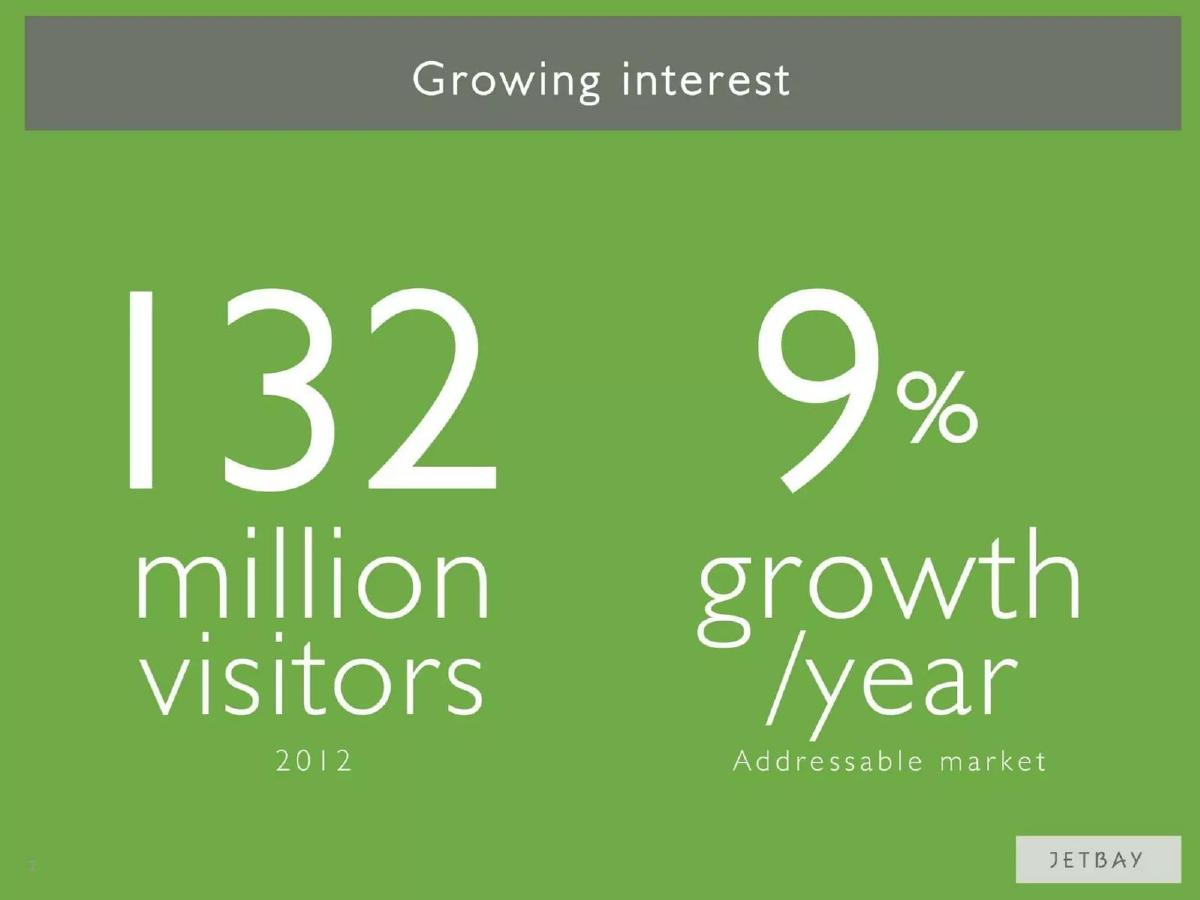
Jetbay raised $1.7 million in 2016 with a deck that prioritizes narrative over numbers. Operating in the inbound China travel sector, the company used a minimalist 11-slide presentation to highlight a massive market opportunity—132 million visitors in 2012 with 9% annual growth. The deck relies heavily on a 'problem' sequence that uses photography to show the overcrowding of traditional tourist sites, positioning Jetbay as the solution for 'unexplored' experiences. While it lacks a formal business model breakdown, revenue projections, or a specific funding ask, the 'Who we are' slide does the…
Key takeaways
- The deck identifies a massive addressable market of 132 million visitors as of 2012 on slide 2.
- Market growth is cited at a steady 9% per year on slide 2.
- A visual 'expectation vs. reality' narrative (slides 4-6) effectively communicates the pain point of over-tourism in China.
- The business model is presented purely through imagery on slide 8, omitting commission rates or fee structures.
- The team slide (slide 10) is the strongest asset, highlighting the founders' previous roles at 55tuan, a major Chinese group-buying site.
- The presentation completely omits a financial 'Ask' slide, leaving the $1.7M target to be negotiated outside the deck.
- There are no traction metrics, user numbers, or revenue figures included in the 11 slides.
- The deck uses a 16:9 visual format with minimal text, designed for a guided presentation rather than a standalone read.
The Visionary Minimalist: Analyzing Jetbay's $1.7M Seed Deck
Jetbay’s 2016 pitch deck is an anomaly in the world of data-heavy seed presentations. With only 11 slides and almost no technical jargon, the company managed to secure $1.7 million in funding. The deck focuses on a single, powerful narrative: China is a massive travel market, but the current experience for foreigners is broken. By using high-contrast imagery, the founders established an emotional connection with investors before closing the deal with their impressive professional pedigrees.
The Hook: Market Size and Audience
Slide 1: Title The deck opens with a high-resolution image of the Li River in Guilin, a classic symbol of Chinese natural beauty. The subtitle is clear and functional: "Travel research and booking for foreign travelers in China." It immediately defines the niche: inbound tourism.
Slide 2: Growing Interest Jetbay moves quickly to the TAM (Total Addressable Market). They cite "132 million visitors" in 2012 with a "9% growth/year." By using 2012 data for a 2016 raise, the founders are likely pointing to the most recent verified government statistics available at the time. The simplicity of this slide—just two numbers—prevents the audience from getting bogged down in demographic minutiae.
Slide 3: Target Segments Titled "Groups, school exchanges, backpackers...", this slide uses a candid photo of diverse travelers engaged in a cooking class. This suggests that Jetbay isn't just for luxury travelers, but for a broad spectrum of visitors looking for cultural immersion.
The Problem: Expectation vs. Reality
Slide 4: What you think you will get This slide shows a serene, empty section of the Great Wall of China. It represents the marketing dream sold by travel agencies.
Slide 5: What you really get The contrast is immediate. This slide shows a sea of people packed onto the Great Wall. It’s a visceral representation of the "pain point"—over-tourism and the difficulty of finding a quality experience in a country of 1.4 billion people.
Slide 6: What you really get (Part 2) To drive the point home, Jetbay shows a beach so crowded with umbrellas and people that the sand is invisible. This sequence (Slides 4-6) is the core of their pitch. It identifies the problem not as a lack of travel options, but as a lack of curated, high-quality options.
The Solution and Business Model
Slide 7: Many cities yet to be explored The solution is presented as an alternative to the crowded scenes previously shown. The image features western travelers walking along a river with mountains in the background, suggesting that Jetbay helps users find the "hidden gems" of China.
Slide 8: Business Model This is perhaps the most controversial slide in the deck from a traditional analyst's perspective. It contains zero text. Instead, it features a collage of five images: a man in a local market, a traveler in front of a high-speed train, a martial arts student, a Hertz car rental sign, and a group at the Terracotta Army. The implication is that Jetbay is a full-service booking platform covering transportation, activities, and rentals. However, it fails to explain the take rate, margins, or supply-side acquisition strategy.
Slide 9: Great partners Continuing the visual theme, this slide shows two pandas. While it likely refers to partnerships with local tourism bureaus or conservation sites (like the Chengdu Research Base of Giant Panda Breeding), the lack of logos or names makes it more of a "mood" slide than a traditional partnership slide.
The Closer: The Team
Slide 10: Who we are This is the most important slide in the deck. For a seed round, investors are betting on the team. Michael Pan (CEO) and James Tan (COO) are listed as Co-Founders of 55tuan, a major Chinese O2O (Online-to-Offline) company that went public on the NASDAQ. Their backgrounds include MIT, JPMorgan, and Tsinghua University. The presence of QuestVC as an existing investor is also noted at the bottom. This slide provides the credibility that the rest of the minimalist deck relies upon.
Slide 11: Contact The deck ends with a simple contact slide, repeating the mission statement and providing an email address and AngelList link.
What Works in the Jetbay Deck
1. Visual Storytelling: The "Expectation vs. Reality" sequence is a textbook example of how to communicate a problem without using a single bullet point. It makes the need for a better travel platform feel urgent and obvious.
2. Extreme Focus: The deck doesn't try to explain the technology, the algorithm, or the marketing plan. It focuses entirely on the Market Opportunity and the Team. In a Seed round, these are often the only two things that matter.
3. Credibility by Association: By prominently featuring the logos of MIT, JPMorgan, and 55tuan, the founders signal that they are "insiders" who understand both the Western investor mindset and the Chinese operational landscape.
What is Missing from the Jetbay Deck
1. Financial Projections: There is no mention of how the company intends to make money beyond the vague imagery on the business model slide. Investors usually want to see a 3-5 year revenue forecast, even if it's speculative.
2. Traction Metrics: The catalogue facts state the company was in beta. Usually, a beta-stage startup would show user sign-ups, waitlist size, or early booking data. Jetbay chose to omit these entirely.
3. Competitive Landscape: The deck ignores competitors like Ctrip, TripAdvisor, or local boutique agencies. Explaining why Jetbay is better than existing solutions is a major omission.
4. The Ask: A pitch deck usually ends with a slide detailing how much money is being raised and what it will be used for (e.g., "Raising $1.5M for engineering and marketing"). Jetbay leaves this out, which suggests this deck was used as a visual aid for a conversation rather than a standalone document.
What a Founder Should Copy
1. The 10-Slide Rule: Jetbay sticks closely to the Guy Kawasaki 10-slide rule (they have 11). It is concise and respects the investor's time.
2. High-Quality Imagery: If you are in a visual industry like travel, food, or real estate, your deck should look the part. Jetbay’s use of full-bleed, high-resolution photos makes the brand feel premium and professional.
3. The "Why Now" Logic: By showing the 9% growth rate and the overcrowding of traditional sites, they create a "Why Now" moment. The market is growing, but the infrastructure for a good experience is failing, creating a gap for a new player.
4. Leverage Your Past: If you have worked at a successful company or attended a prestigious university, make those logos large. Jetbay understood that their resumes were their strongest fundraising tool and gave them a dedicated, clean slide.
Final Analysis
Jetbay’s deck is a "Team and Dream" presentation. It sells a massive vision of a better way to see China, backed by a team that has already proven they can scale businesses in that specific geography. While it lacks the rigor of a Series A deck, its ability to communicate a complex market problem through simple imagery is a strategy many early-stage founders could learn from. It proves that if your team is strong enough and your market is big enough, you don't need 50 slides of data to get a check.
Frequently asked questions
- How much did Jetbay raise with this deck?
- According to the catalogue facts, Jetbay raised $1,700,000 in a Seed round in 2016. Interestingly, the deck itself does not mention the amount being raised or the valuation, which is common for Silicon Valley startups that prefer to discuss terms in person.
- What is Jetbay's primary value proposition?
- Based on slides 4 through 7, Jetbay positions itself as a way to avoid the 'reality' of Chinese tourism—which it depicts as massive crowds at the Great Wall and beaches—and instead find 'unexplored' cities and authentic experiences like school exchanges and backpacking.
- Who are the founders of Jetbay?
- The team consists of Michael Pan (CEO), James Tan (COO), and Ai Ziyi (BD Director). Slide 10 highlights their deep roots in the Chinese tech scene, specifically their leadership roles at 55tuan.com, along with academic and professional backgrounds at MIT, JPMorgan, and Tsinghua University.
- What is missing from the Jetbay pitch deck?
- The deck is missing several standard components: a detailed financial model, a competitive analysis, a roadmap, a specific use of funds, and any current traction or user growth metrics. It functions more as a high-level vision and team introduction.
- What is the 'Business Model' described in the deck?
- Slide 8, titled 'Business Model,' contains no text. Instead, it shows five photos representing different travel services: local food, high-speed rail, martial arts classes, car rentals (Hertz), and museum tours. This implies a marketplace model where Jetbay takes a cut of various travel bookings.