Jargon is a public speaking platform that aims to modernize the experience of communication training. The deck presents a business model that blends physical 'pop-up' meetings with a digital social network where users can submit videos for feedback and compete for monthly prizes. The founder, Nathan Sukonik, draws on his experience as a Toastmaster to identify gaps in the current market, specifically targeting 'upwardly mobile' and 'tech-savvy' professionals. The financial model relies heavily on subscriptions, with 60% of projected revenue coming from online memberships. While the deck clear…
Key takeaways
- The company is seeking a $700,000 investment in exchange for a 10% equity stake in Jargon LLC (Slide 8).
- Revenue is projected to come from four streams: online subscriptions (60%), pop-up meeting subscriptions (25%), entrance fees (10%), and mobile app submissions (5%) (Slide 6).
- The target market is defined as upwardly mobile, tech-savvy Americans, with a specific focus on Spanish Americans who make up 44% of that demographic (Slide 3).
- The product includes a mobile and web app where users submit videos, receive feedback, and can win a $1,000 monthly prize for the best elevator pitch (Slide 5).
- Founder Nathan Sukonik cites three years of PR and IT management experience and status as a Toastmaster as core team credentials (Slide 2).
- Toastmasters and Dale Carnegie are identified as the primary competitors, though the deck claims they offer 'little to none' of Jargon's planned features (Slide 7).
- The service model includes bimonthly in-person meetings at varying locations to maintain a 'fast-paced' and 'evolving' environment (Slide 4).
- The deck uses several celebrity and stock images, including Mark Zuckerberg and Steve Ballmer, to illustrate concepts rather than as actual endorsements or team members (Slides 4, 6).
Slide-by-Slide Analysis
Slide 1: The Hook
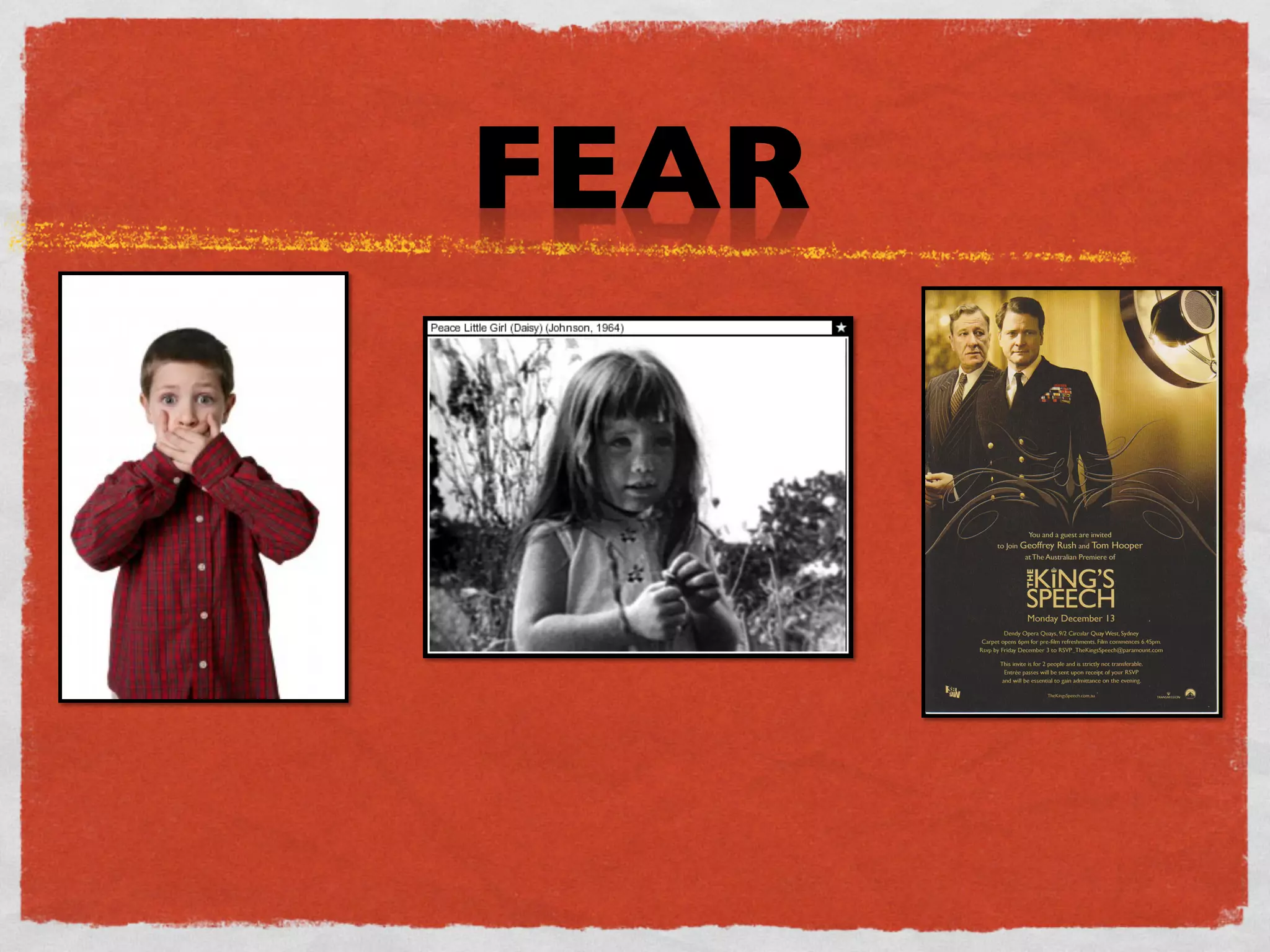
The deck opens with a single word: FEAR . This is accompanied by three images: a child covering their mouth, a vintage photo of a girl, and a poster for the film 'The King's Speech.' The slide establishes the emotional core of the business—addressing the universal anxiety associated with public speaking. It functions as a classic 'Problem' slide, though it relies entirely on visual metaphor rather than data or text-based problem statements.
Slide 2: The Founder
This slide introduces Nathan Sukonik . It lists his credentials, including three years as a manager of PR & IT, participation in the NY State Business Plan Competition, and winning the Hofstra University Capital One Challenge. Crucially for this specific sector, he is noted as a Toastmaster and founder of 'Surf Side Talkers.' The slide also claims he is 'skilled in all applicable presentation technology,' though it does not specify what that technology entails.
Slide 3: Target Market
Jargon defines its audience using demographic data. It states that 35% of Americans are 'Upwardly Mobile, Tech Savvy Individuals' who are interested in improving public speaking. The slide cites sources like P$YCLE, Nielsen, and NPD. A specific data point mentions that Spanish Americans make up 44% of this upwardly mobile group. The slide includes photos of Emily Miethner and a cartoon of Dennis Yu, though their specific roles or relationship to the company are not defined here.
Slide 4: The Value Proposition
Titled 'Jargon IS About You,' this slide outlines the service model. It promises an 'evolving and cool environment' featuring bimonthly meetings in person at differing locations to prevent member fatigue. It also mentions 1-to-1 personable professional coaching and an online social network. An image of Mark Zuckerberg is used, presumably to associate the brand with modern tech success, though he is not affiliated with the company.
Slide 5: Mobile & Web App
This slide details the digital product. The workflow is described as Submit Video -> Get Feedback -> Pitch Again . It highlights a gamification element: a $1,000 monthly prize for the most popular elevator pitch. The UI mockups show a video recording interface and a comment section integrated with Facebook. Logos for 'Quirky' and 'Threadless' appear at the top, likely as examples of the 'crowdsourced' or 'community-driven' models Jargon seeks to emulate.
Slide 6: Profit Model
The revenue breakdown is presented in a flowchart. The primary driver is the 60% Online Member Subscription . Other streams include a 25% Pop Up Meeting Subscription, a 10% Entrance Fee, and 5% from Mobile App Submissions. This suggests a 'freemium' or tiered membership structure where the bulk of the value is captured through the digital platform rather than the physical events. An image of Steve Ballmer is used in the corner.
Slide 7: Competition
The deck identifies Toastmasters International and Dale Carnegie as the primary competitors. It argues that these incumbents offer 'little to none' of what Jargon plans to provide, specifically the social network and mobile community aspects. The slide asserts that these competitors are 'not a major threat,' positioning Jargon as a modern alternative to legacy institutions.
Slide 8: The Ask
The final slide in this selection is the investment offer: 10% of Jargon LLC for a $700,000 investment . This puts the company's self-valuation at $7 million. The slide features a stock photo of a man in front of a chalkboard, but contains no information on how the funds will be allocated (e.g., hiring, marketing, or R&D).
What Jargon Does Well
The deck is highly focused on the psychology of the user . By starting with 'Fear' and emphasizing a 'cool' and 'positive' environment, the founders show they understand the emotional barriers to their product's adoption. The hybrid model—combining the accountability of in-person meetings with the scale of a digital app—is a logical evolution for the professional development space.
The revenue diversification shown on Slide 6 is also a strength. By not relying solely on event tickets, the company demonstrates an understanding that physical events are difficult to scale, whereas digital subscriptions provide the recurring revenue necessary for a $7 million valuation.
What is Missing from the Deck
The most significant omission is traction data . There is no mention of current user counts, pilot programs, or revenue generated to date. For a $700,000 ask, investors typically expect to see proof of concept beyond wireframes and demographic statistics.
Furthermore, the Team Slide is incomplete . While Nathan Sukonik's background is provided, a company seeking this level of funding usually requires a broader team, including technical leads for the app development and operations leads for the 'pop-up' meetings. The use of celebrity photos (Zuckerberg, Ballmer) and unaffiliated professionals (Miethner, Yu) without context can be confusing and may detract from the perceived professionalism of the venture.
Finally, there is no Use of Funds breakdown. An investor needs to know if the $700,000 is going toward building the app, renting spaces for meetings, or a massive marketing push to the identified Spanish American demographic.
Founder's Guide: What to Copy
Founders should look at Slide 5 for a clear way to visualize a user journey . The 'Submit, Feedback, Pitch Again' flow is simple and easy to digest. Additionally, the clear 'Ask' on Slide 8 is commendable for its directness; many founders hide their valuation or ask in vague terms, whereas Jargon is explicit about the equity-to-cash ratio.
The market segmentation on Slide 3 is also a good example of looking beyond broad categories. By identifying a specific sub-demographic (upwardly mobile Spanish Americans) that over-indexes on the required traits (tech-savvy and upwardly mobile), the company provides a clear starting point for a Go-To-Market strategy.
Conclusion
Jargon presents a modern take on a classic self-improvement niche. The deck successfully identifies a stagnant market (public speaking clubs) and proposes a tech-enabled solution. However, to secure the requested $700,000, the company would need to provide significant evidence of operational capability and early user validation to bridge the gap between a 'cool environment' concept and a scalable business entity.
Frequently asked questions
- What is the primary problem Jargon is trying to solve?
- Jargon addresses the 'fear' of public speaking, as highlighted on Slide 1. It aims to replace traditional, potentially stagnant speaking clubs with a 'cool' and 'evolving' environment. By offering bimonthly meetings in different locations and a digital feedback loop, it seeks to make the process of improving communication skills more engaging and less intimidating for modern professionals.
- How does the mobile application work according to the deck?
- As shown on Slide 5, the app follows a three-step process: Submit Video, Get Feedback, and Pitch Again. It features a social component where users can comment on videos (integrated with Facebook profiles). To drive engagement, the platform offers a $1,000 monthly prize for the most popular elevator pitch, mimicking a crowdsourced competition model.
- What is the valuation implied by the 'Ask' slide?
- Slide 8 explicitly states the ask is $700,000 for 10% of Jargon LLC. This implies a post-money valuation of $7 million. The deck does not provide historical revenue data or user growth metrics to justify this valuation, suggesting it is based on projected market capture and the perceived value of the hybrid platform.
- Who is the intended user for Jargon?
- Slide 3 identifies the target market as 'Upwardly Mobile, Tech Savvy Individuals.' It further segments this into professionals in business, spiritual, or educational fields. Interestingly, it highlights that Spanish Americans make up 44% of this upwardly mobile group, suggesting a specific demographic focus for their initial marketing or community building efforts.
- How does Jargon differentiate itself from Toastmasters?
- Slide 7 claims that while Toastmasters is the closest competitor, it lacks the social network and mobile community features Jargon plans to build. Jargon emphasizes 'adaptivity' and 'positivity' through changing meeting locations and 1-to-1 personable coaching, contrasting this with the more rigid, traditional structure of established speech services.