Jiffy.ai’s Series B deck is a study in enterprise credibility. Rather than focusing on abstract market sizes, the company leans into its 'HyperApp' concept and a robust list of global partners including Accenture, Deloitte, and KPMG (Slide 4). The deck is notable for its unusually large leadership team—citing 20 co-founders—and its deep commitment to showing, not just telling, through three consecutive slides of detailed case study data. By the time an investor reaches the end, the technical feasibility is proven through realized benefits like '90% less resources at peak' and '100% automation…
Key takeaways
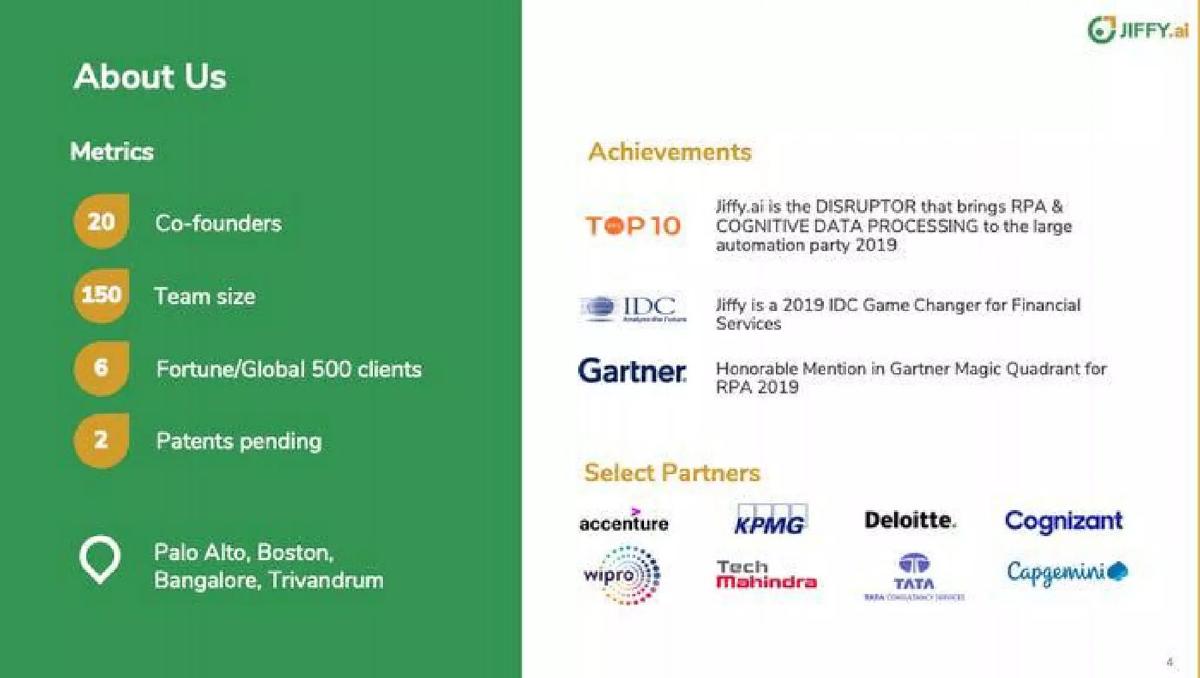
- The company claims a massive founding team of 20 co-founders and a total team size of 150 (Slide 4).
- Social proof is established early with logos from top-tier consulting partners like Deloitte, KPMG, and Capgemini (Slide 4).
- The deck highlights 6 Fortune/Global 500 clients across diverse sectors including Airline, Banking, and Retail (Slide 5).
- Technical differentiation is centered on 'HyperApps' which combine RPA, ML, and NLP into a low-code/no-code framework (Slide 6).
- The platform architecture is divided into three distinct layers: Designer Tools, Cognitive Layer, and Execution Layer (Slide 10).
- A comprehensive case study for a global automobile manufacturer details 11 specific F&A automation benefits (Slide 12).
- Specific outcomes include a 90% reduction in manual processing effort for internal audits (Slide 13).
- The deck achieves 75% 'Straight Through Processed' invoices in its registration use case (Slide 14).
Introduction: The Enterprise Credibility Play
Jiffy.ai’s pitch deck is a focused, professional document designed for a Series B audience that already understands the Robotic Process Automation (RPA) market. Founded in 2012 and having raised $71,000,000 according to catalogue facts, the company uses this 16-slide presentation to prove one thing: their technology works at scale for the world's largest companies. The deck avoids the typical 'Problem/Solution' tropes of early-stage pitches and instead focuses on architecture, partnerships, and granular case studies.
Slides 1-3: Origin and Vision
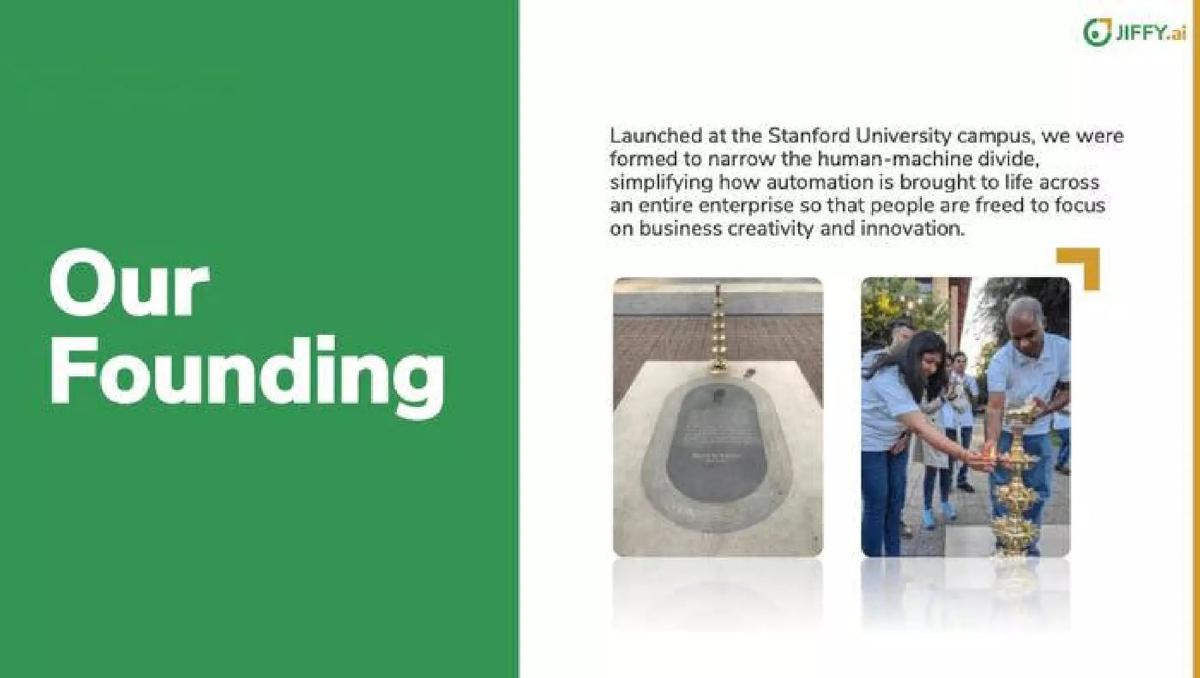
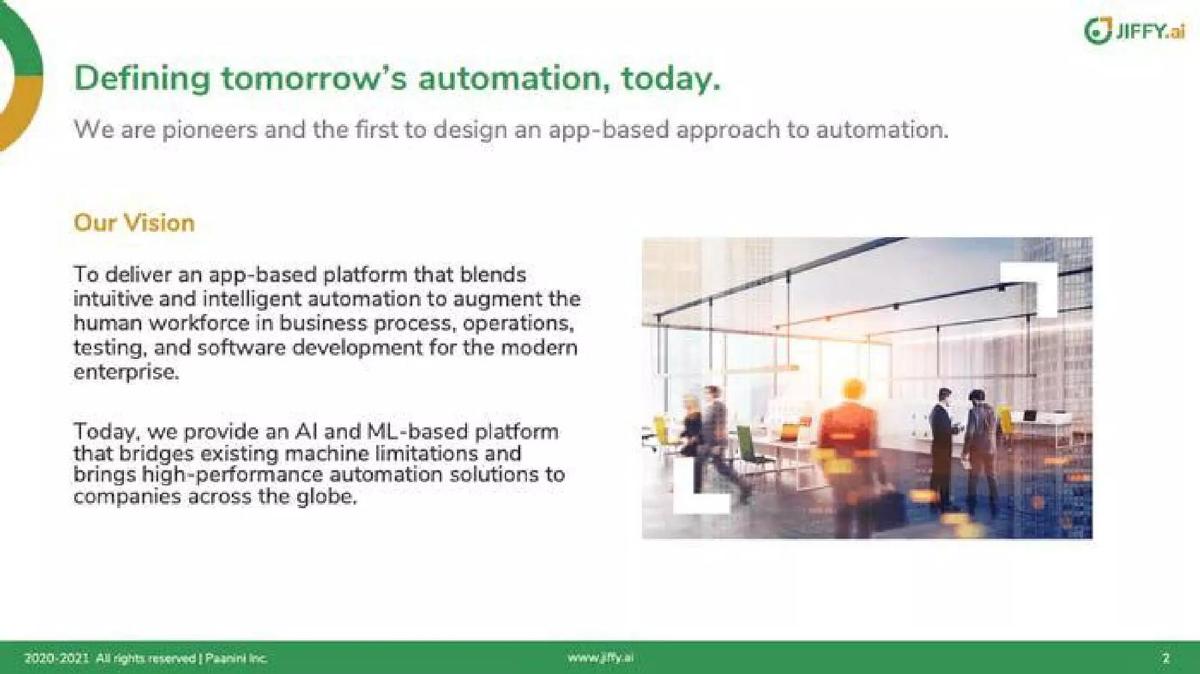
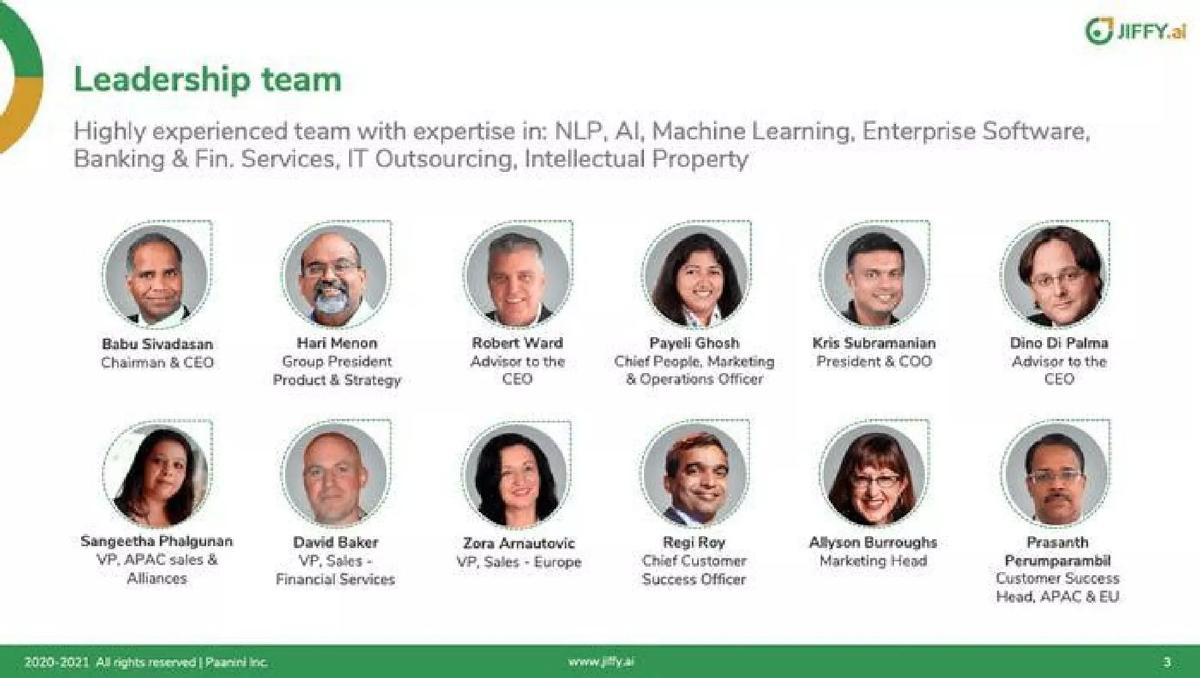
The deck opens with a standard title slide (Slide 0) featuring the tagline "Automation Accelerating Innovation." Slide 1, titled "Our Founding," emphasizes the company's academic roots, noting it was "Launched at the Stanford University campus." This is a common tactic to establish intellectual prestige. Slide 2 defines their vision as an "app-based approach to automation" that bridges existing machine limitations. The imagery here is corporate and aspirational, signaling a focus on the "modern enterprise." Slide 3 introduces a 12-person leadership team, led by CEO Babu Sivadasan. The slide highlights expertise in NLP, AI, and Banking, which aligns with the vertical focus seen later in the deck.
Slides 4-5: The Power of Social Proof
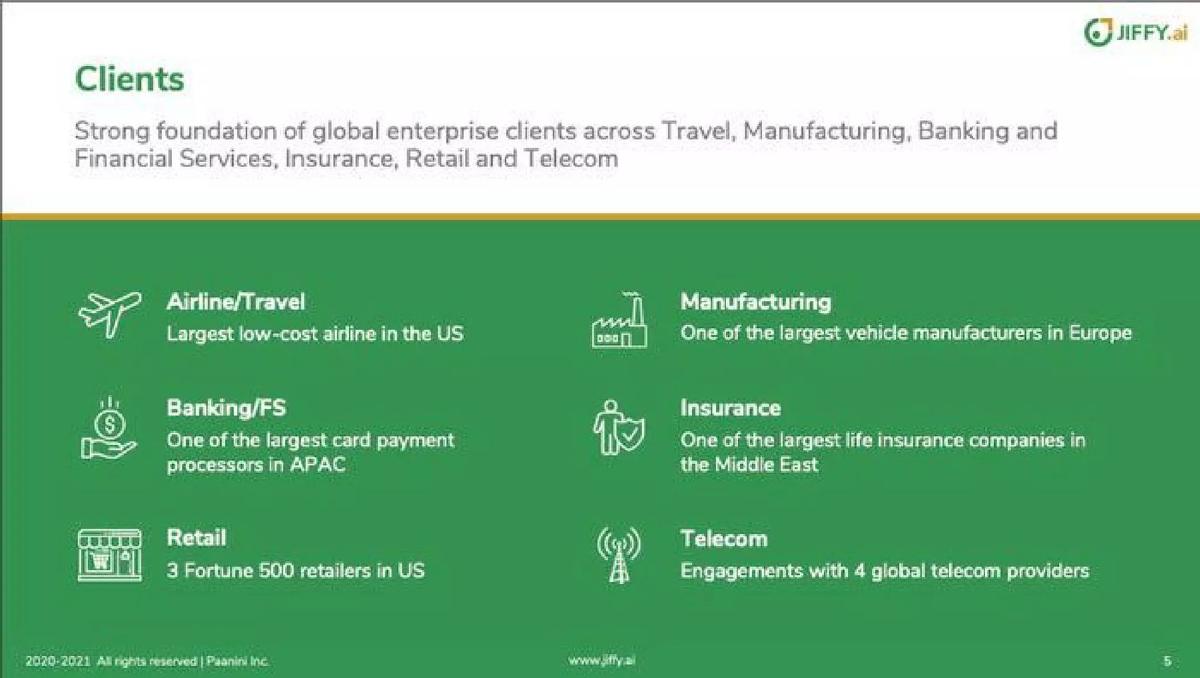
Slide 4 is perhaps the most important slide for establishing trust. It lists four key metrics: 20 Co-founders, 150 Team members, 6 Fortune/Global 500 clients, and 2 Patents pending. The mention of 20 co-founders is a staggering number that suggests a highly collaborative, expert-heavy origin. This slide also includes 'Achievements' from IDC and Gartner, alongside a 'Select Partners' section featuring heavyweights like Accenture, Deloitte, KPMG, and Wipro. For a Series B investor, these logos represent a pre-validated sales channel. Slide 5 doubles down on this by categorizing their clients into sectors like Airline/Travel, Manufacturing, and Retail, noting they work with the "largest low-cost airline in the US" and "4 global telecom providers."
Slides 6-10: Product Architecture and the 'HyperApp'
Slide 6 introduces the core differentiator: "HyperApps." The company claims to differentiate from traditional RPA by combining AI, ML, and NLP into a low-code/no-code platform. Slide 7 breaks the offering into three pillars: JIFFY.ai AUTOMATE (daily workflows), JIFFY.ai ASSURE (test automation), and JIFFY.ai INNOVATE (software development from spoken word). Slide 8 and 9 provide a deeper dive into the 'Automate' platform, showing actual UI screenshots of the ML Workspace and Human-Bot Workflows. Slide 10 provides a clean visualization of the 'Platform Stack,' organized into Designer, Cognitive, and Execution layers. This technical transparency is vital for enterprise software due diligence.
Slides 11-14: Deep-Dive Case Studies
The final third of the deck is dedicated to a single, massive case study of a global automobile manufacturer. Slide 12 is a data-dense grid showing "F&A Automation Benefits Realized." It quotes specific figures: "90% Less Resources at Peak," "85% Reduction in Overdue Invoices," and "100% Automation of JV processing." Slide 13 focuses on Compliance and Internal Audit, claiming a "90% Reduction in manual processing effort." Slide 14 covers Invoice Registration, highlighting "75% Straight Through Processed Invoices." These slides are the 'proof of work' that justifies a Series B valuation, showing that the product isn't just a pilot, but a core operational component for a multinational corporation.
Slide 15: The Conclusion
The deck ends abruptly on Slide 15 with a simple "Thank You." There is no contact information, no summary of the round, and no call to action. This suggests the deck was likely part of a larger presentation or a data room where the context of the deal was already established.
What Works in This Deck
Granular Metrics: The use of specific percentages (e.g., "98% of customers auto copied" on Slide 12) makes the claims feel grounded in reality rather than marketing fluff. Partner Ecosystem: By listing major consulting firms as partners, Jiffy.ai proves they have a scalable 'go-to-market' strategy that doesn't rely solely on their internal sales team. Visual Hierarchy: The deck uses a consistent green and gold color palette and clear headers, making it easy to skim for key information.
What is Missing from This Deck
The Financial Ask: There is no slide detailing how much capital is being raised or the intended use of funds. Market Size (TAM): While they mention Fortune 500 clients, they don't quantify the total addressable market for 'HyperApps.' Competition: There is no mention of UiPath, Automation Anywhere, or Blue Prism. A Series B deck usually needs to explain why they are winning against these incumbents. Business Model: The deck doesn't explain if they charge per bot, per user, or via a consumption-based AI model.
What a Founder Should Copy
The 'Benefits Realized' Grid: Slide 12 is a masterpiece of enterprise reporting. If you have one big client, break down every single department they use you in and the specific ROI for each. Layered Architecture: Slide 10 is an excellent way to explain a complex technical stack to non-technical investors without losing the nuance of what the 'Cognitive' vs 'Execution' layers actually do. Vertical Proof: Instead of saying "we work in many industries," Slide 5 proves it by giving a specific 'anchor' description for each sector.
Final Summary
Jiffy.ai’s deck is a high-signal, low-noise presentation. It assumes the reader knows that RPA is a valuable market and spends its time proving that Jiffy.ai is the most sophisticated player in that market. While it lacks the narrative arc of a seed deck, its reliance on hard data and blue-chip logos makes it a compelling document for late-stage institutional investors.
Frequently asked questions
- How does Jiffy.ai define its competitive advantage in the RPA space?
- Jiffy.ai differentiates itself by moving beyond traditional rule-based RPA. According to Slide 6, the platform uses an AI-driven low-code/no-code approach called 'HyperApps.' This integrates Robotic Process Automation with Machine Learning, NLP, and Document Processing, allowing enterprises to build new applications via natural conversation and deploy them in real-time.
- What is the significance of the '20 Co-founders' metric on Slide 4?
- Reporting 20 co-founders is highly unusual for a startup. In an enterprise software context, this typically signals a 'founding syndicate' of senior industry experts who brought existing intellectual property or deep vertical networks to the company. It suggests a horizontal breadth of expertise rather than a traditional two-person garage startup model.
- Who are Jiffy.ai's primary target customers based on the deck?
- The deck targets large-scale global enterprises. Slide 5 explicitly mentions the 'largest low-cost airline in the US,' 'one of the largest vehicle manufacturers in Europe,' and '3 Fortune 500 retailers in US.' The focus is clearly on high-volume, complex environments like Banking, Telecom, and Manufacturing.
- What technical layers make up the Jiffy.ai platform stack?
- Slide 10 outlines a three-tier architecture. The 'Designer Tools' layer includes studios for bots, apps, and workflows. The 'Cognitive Layer' handles intelligent document processing, OCR, and NLP. Finally, the 'Execution Layer' manages bot orchestration, APIs, and the web UI for end-user interaction.
- Is this a complete fundraising deck?
- Technically, no. While it provides excellent product and traction data, it lacks the 'Business' half of a standard pitch. There are no slides covering the competitive landscape, the business model (pricing), the financial projections, or the specific 'Ask' (how much money they want and what they will do with it).