AI Startup Team Slides: 6 Real Pitch Deck Examples
How AI and data startups show investors who actually builds the models: research credentials, prior AI roles and named technical leads.
AI Startup Team Slides: Real Pitch Deck Examples
Six team slides from AI and data startups that answer one investor question: who on this team can build the models? The strongest name the technical founders and tie them to research or prior AI work. The weakest show a full executive or sales team but leave it unclear who builds the technology.
TL;DR
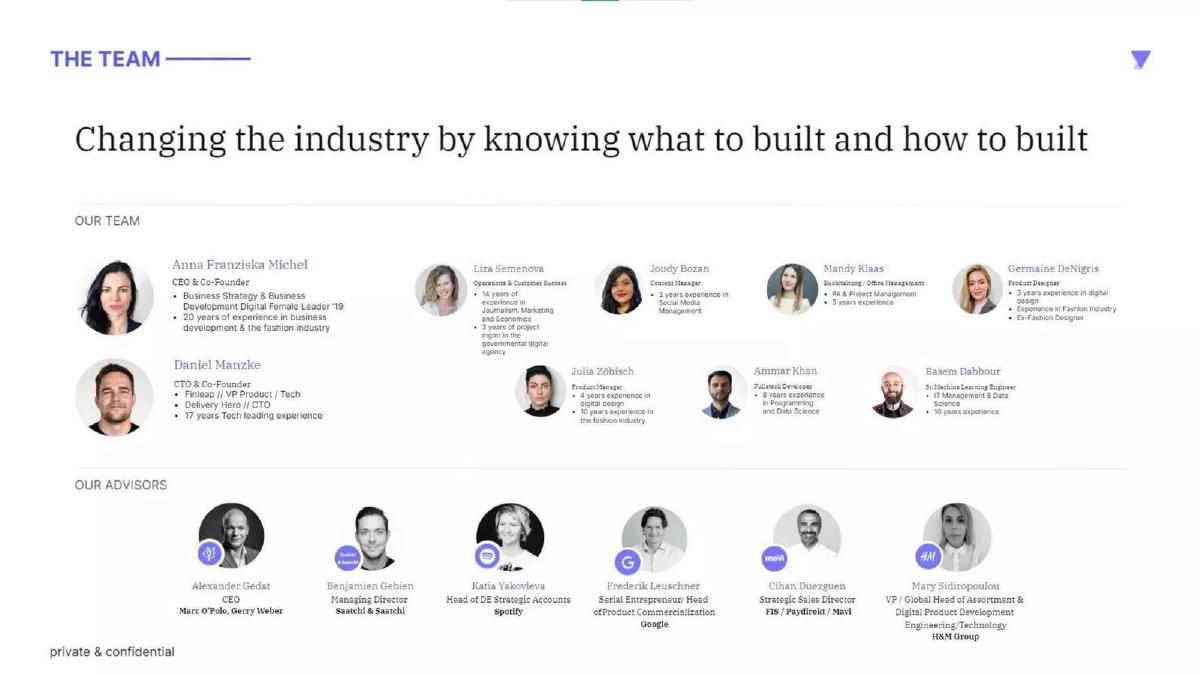
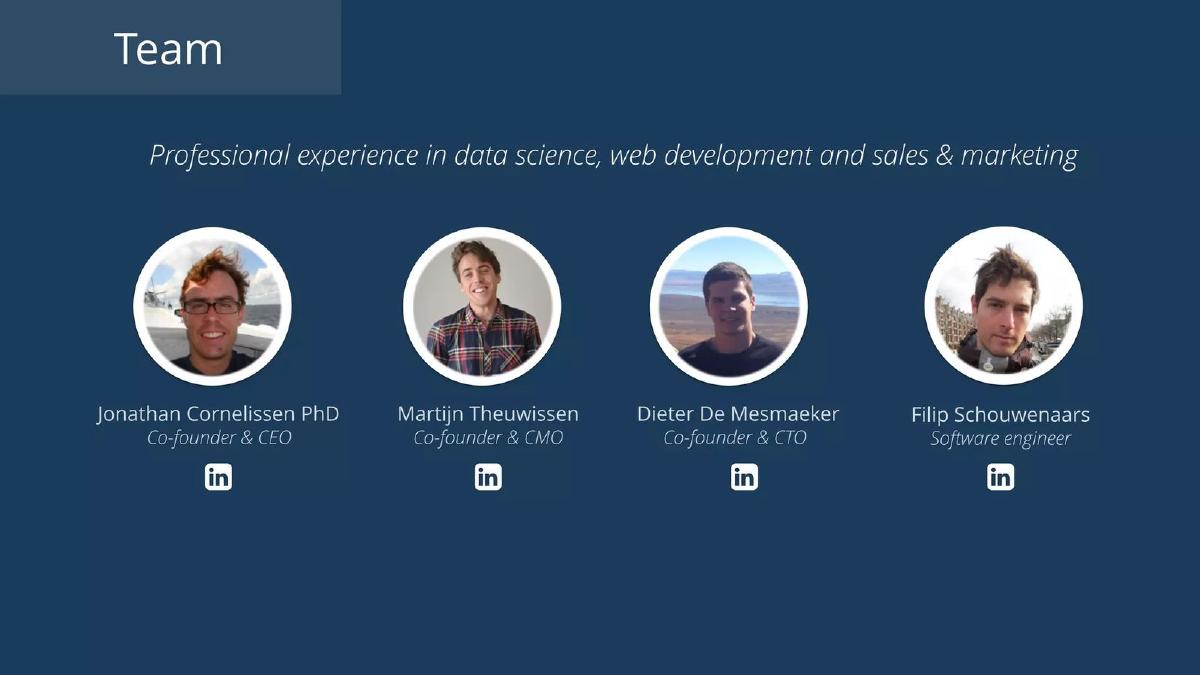
An AI team slide should make it obvious who builds the technology and why they can. Pecan does this best: both co-founders are listed with "PhD in AI", and the wider team includes a former AI success director at DataRobot and an R&D lead formerly at Google. Everpix gives a whole slide to one technical founder: "2 MS in Applied Mathematics and Computer Vision", "10+ years of experience in imaging maths and tech" and work on graphics in the first iPhone and iPad. Jiffy.ai shows twelve people under one line of expertise that includes "NLP, AI, Machine Learning", but no individual is tied to that expertise. authID, Yoona and DataCamp are weaker for different reasons: only executive and sales titles, text too small to read with advisors taking half the slide, and four photos with one general line.
AI startup team slides
Each example shows the exact stored slide above its analysis and links to the full teardown. Stronger examples first. Claims are as shown on the slides; we have not verified them.
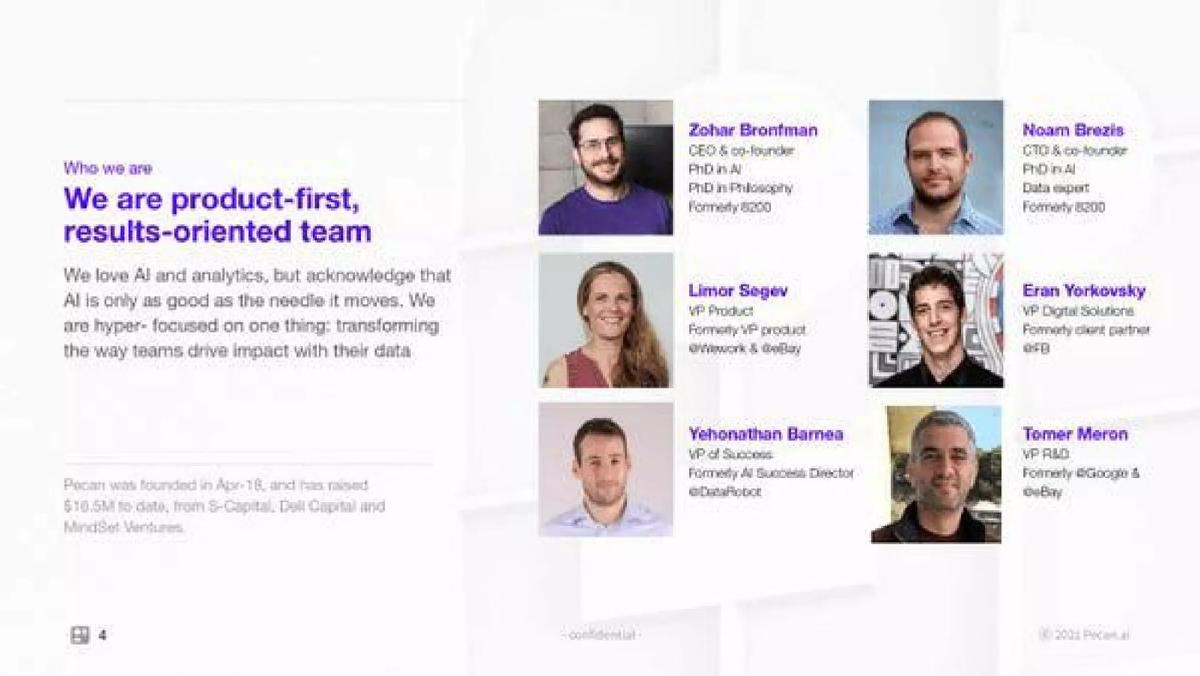
Pecan team slide — slide 4
Predictive analytics for business teams. Six leaders with photos and prior roles, plus a positioning line.
Pecan deck, slide 4. Exact stored slide matched to this analysis.
Our analysis: Answers both halves of the question: the founders can build the models, and the team knows how to make customers succeed with them.
Evidence and limitation: Both founders hold AI doctorates, and the rest of the team brings prior AI and product roles at named companies.
What a founder can adapt: Put technical credentials on the founders' lines, then show one or two hires who turn the model into customer results.
Supporting analysis
What the deck claims: "Who we are. We are product-first, results-oriented team." "We love AI and analytics, but acknowledge that AI is only as good as the needle it moves." Zohar Bronfman, "CEO & co-founder" ("PhD in AI", "PhD in Philosophy", "Formerly 8200"). Noam Brezis, "CTO & co-founder" ("PhD in AI", "Data expert", "Formerly 8200"). Also a VP Product formerly at WeWork and eBay, a VP of Success formerly "AI Success Director @DataRobot" and a VP R&D formerly at Google and eBay. Footnote: founded April 2018, $16.5M raised.
Presentation choice: Research credentials on the founders plus a named AI customer-success hire reassure investors the product can be built and sold.
When it does not fit: The small grey text is hard to read; give the credentials more contrast.
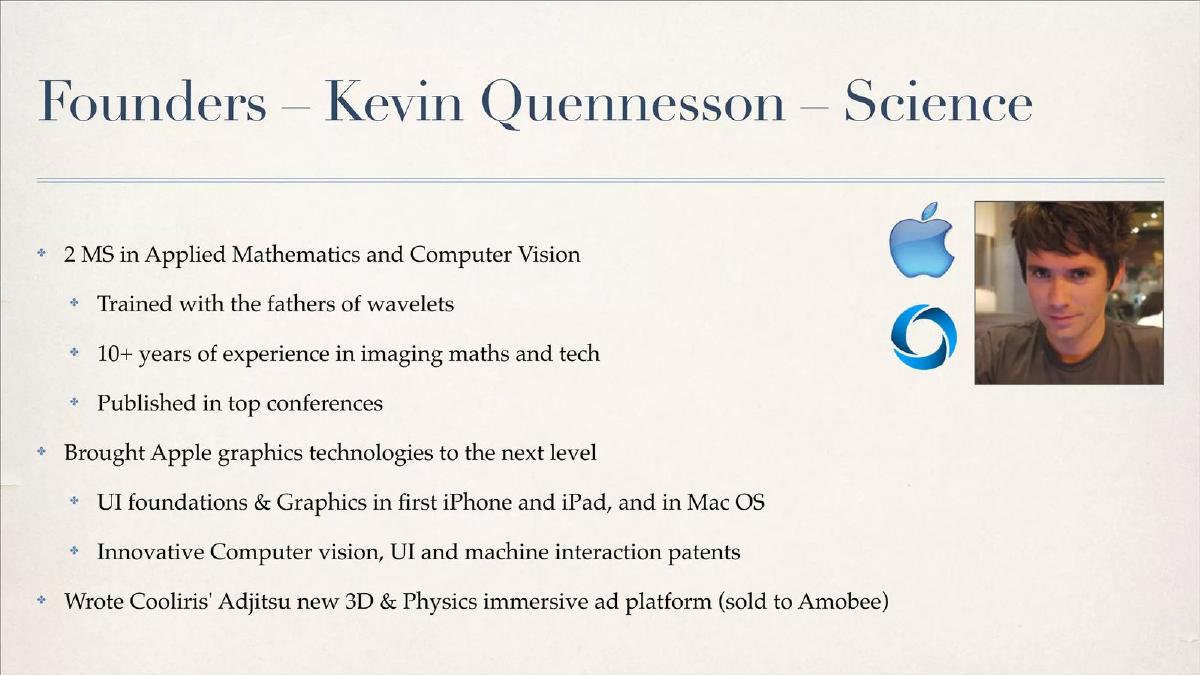
Photo organisation software built on computer vision. One slide per founder; this is the science founder.
Everpix deck, slide 4. Exact stored slide matched to this analysis.
Our analysis: Leaves no doubt who builds the technology and why they can.
Evidence and limitation: Degrees, research training, publications, patents and shipped products at Apple, all for one person.
What a founder can adapt: If your edge is research, give your technical lead enough space to show degrees, publications and shipped work.
Supporting analysis
What the deck claims: "Founders — Kevin Quennesson — Science." "2 MS in Applied Mathematics and Computer Vision", "Trained with the fathers of wavelets", "10+ years of experience in imaging maths and tech", "Published in top conferences", "UI foundations & Graphics in first iPhone and iPad, and in Mac OS", "Innovative Computer vision, UI and machine interaction patents".
Presentation choice: When the product depends on hard research, a dedicated slide for the technical founder carries more weight than one line on a group slide.
When it does not fit: Say how this background applies to the product being pitched; the slide lists credentials but not the link.
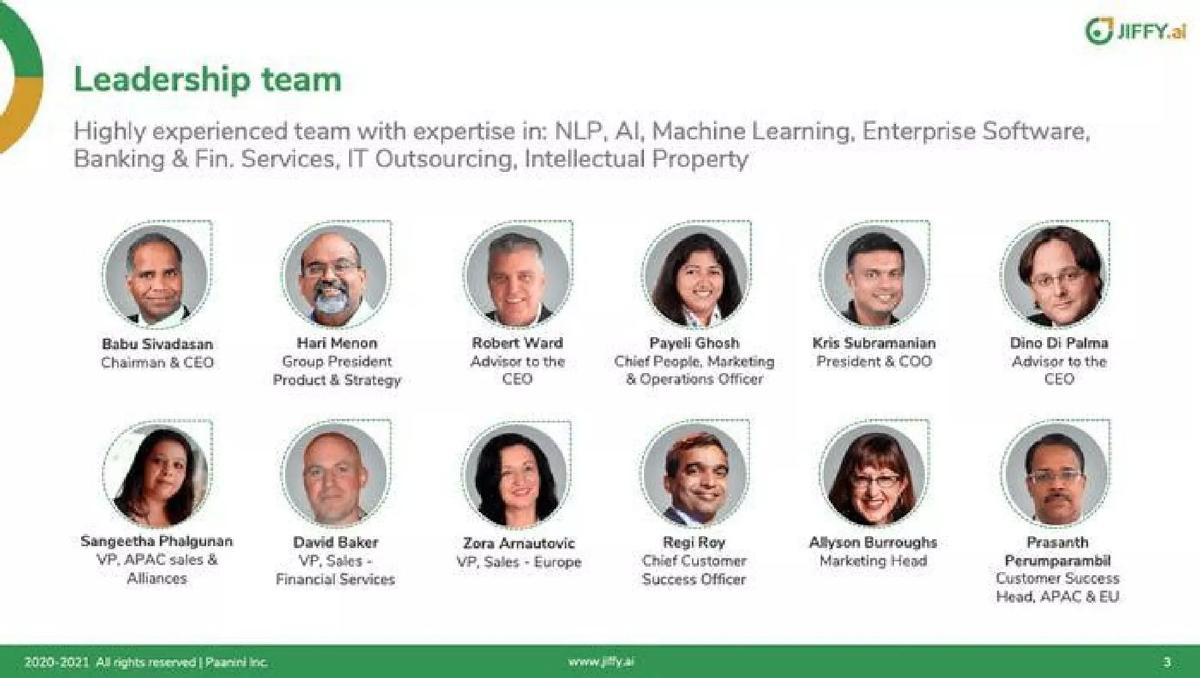
Enterprise automation software. Twelve people with photos and titles under one expertise line.
Jiffy.ai deck, slide 4. Exact stored slide matched to this analysis.
Our analysis: Claims AI expertise for the group without showing which person has it.
Evidence and limitation: A broad expertise line and a full leadership team, but no per-person background.
What a founder can adapt: Keep the expertise line, but attach each skill to a named person.
Supporting analysis
What the deck claims: "Leadership team. Highly experienced team with expertise in: NLP, AI, Machine Learning, Enterprise Software, Banking & Fin. Services, IT Outsourcing, Intellectual Property." Titles include "Chairman & CEO", "President & COO", "Chief Customer Success Officer", "Marketing Head" and several sales VPs and advisors.
Presentation choice: An investor reading this slide still has to ask who leads the machine learning work.
When it does not fit: Twelve faces with titles only; no chief technology or data science role is visible.
Design software for the fashion industry. Two founders, nine team members and six advisors on one slide.
Yoona deck, slide 3. Exact stored slide matched to this analysis.
Our analysis: The relevant information is there but buried among seventeen people.
Evidence and limitation: A machine learning engineer is on the team, but the text is too small to read at normal slide size.
What a founder can adapt: Move your machine learning lead next to the founders and put advisors on a separate slide.
Supporting analysis
What the deck claims: "The Team. Changing the industry by knowing what to built and how to built." Anna Franziska Michel, "CEO & Co-Founder" ("20 years of experience in business development & the fashion industry"). Daniel Manzke, "CTO & Co-Founder" ("17 years Tech leading experience"). Team members include a "Sr Machine Learning Engineer" with "10 years experience" and a full-stack developer with data science experience. Advisors from Marc O'Polo, Spotify, Google, H&M Group and others.
Presentation choice: An investor skimming the slide will not find the machine learning engineer.
When it does not fit: Don't fit seventeen bios on one slide.
Online data science education. Four people with photos, names and titles.
DataCamp deck, slide 5. Exact stored slide matched to this analysis.
Our analysis: Clean and readable, but an investor can't tell who brings the data science experience.
Evidence and limitation: One summary line and titles; no per-person background beyond a PhD after one name.
What a founder can adapt: Add one line per person saying where their data science or engineering experience comes from.
Supporting analysis
What the deck claims: "Team. Professional experience in data science, web development and sales & marketing." Jonathan Cornelissen PhD, "Co-founder & CEO". Martijn Theuwissen, "Co-founder & CMO". Dieter De Mesmaeker, "Co-founder & CTO". Filip Schouwenaars, "Software engineer".
Presentation choice: The summary line makes a claim the rest of the slide doesn't support.
When it does not fit: Don't rely on a single summary line for technical depth.
Whether an investor can see who builds the technology and what backs up their expertise.
Example
Business
People shown
Technical lead named
Evidence of AI or research depth
Pecan
Predictive analytics
6
Yes (both founders)
Yes (PhDs in AI; DataRobot, Google)
Everpix
Computer vision photos
1
Yes
Yes (degrees, publications, patents)
Jiffy.ai
Enterprise automation
12
No
Group line only
authID
Biometric identity
11
CTO title only
No
Yoona
Fashion design software
17
Yes (small text)
One ML engineer, hard to read
DataCamp
Data science education
4
CTO title only
Group line only
Key Takeaways
Name who builds the models.
Tie each technical claim to a person.
Show research or prior AI roles.
Keep sales and advisors secondary.
Make the text readable at slide size.
Build your AI team slide
Show who builds the models, what backs up their expertise, and who turns the technology into customer results.
Builders. Who designs and trains your models, by name and role.
Proof. Each builder's strongest evidence: degree, publication, patent or prior AI role.
Delivery. Who makes the technology work for customers (product, success or deployment lead).
Everyone else. Which commercial roles and advisors can move to a second slide.
Copyable framework: [Name], [CTO/ML lead]: [degree or prior AI role at company]. [Name], [CEO]: [relevant background]. [Name], [product/success lead]: [prior role]. Advisors: separate slide.
Illustrative example 1 — written by us
Before: Team. Professional experience in data science, web development and sales & marketing. Jonathan Cornelissen PhD, Co-founder & CEO. Dieter De Mesmaeker, Co-founder & CTO.
After: Jonathan Cornelissen, CEO: PhD in [field]; [data science role]. Dieter De Mesmaeker, CTO: built [platform or system] at [company]. Martijn Theuwissen, CMO: [growth role].
What improved: Our illustrative rewrite; not DataCamp's wording. It replaces the group claim with one piece of evidence per person.
What this guide adds
The library has a general team slide guide and team guides for healthcare, deep tech, consumer, SaaS and fintech. This page covers the question AI investors add: is the technology built by this team, and do they have the research or engineering background to keep improving it?
The six decks cover predictive analytics (Pecan), photo software built on computer vision (Everpix), enterprise automation (Jiffy.ai), identity verification (authID), fashion design software (Yoona) and data science education (DataCamp). None of these decks appears in another guide.
Three things investors check on an AI team slide
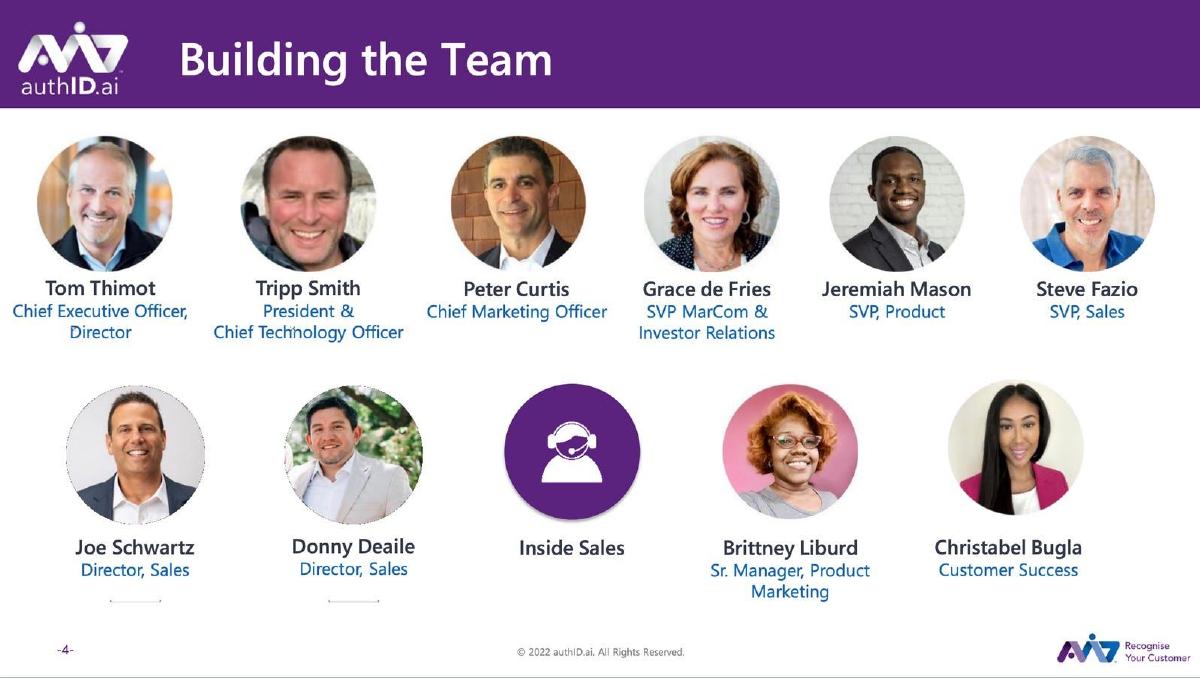
Builders: who designs and trains the models? Pecan and Everpix name them; authID does not show anyone in a research or machine learning role.
Proof of depth: degrees, publications, patents or prior AI jobs. Everpix lists degrees, conferences and patents; Pecan lists PhDs and prior employers.
Balance: an AI company still needs to sell. The best slides show technical leads first and commercial roles second.
Common mistakes
No visible builder. If no one is shown in a technical role, investors will ask who builds the product.
Group expertise claims. "Expertise in AI" for the whole team means less than one named person with an AI background.
Sales-heavy slide. A slide full of sales titles suggests the technology is bought or outsourced.
Unreadable text. Credentials no one can read don't count.
Advisors crowding out the team. Put advisors on their own slide.
Diagnostic checklist
Technical lead named first.
One piece of evidence per builder.
A delivery or customer-success owner.
Text readable at slide size.
Advisors on a separate slide.
Frequently asked questions
How we chose these examples
Corpus: published pitch deck teardowns on StartupFundraising.com. Founder-uploaded private decks are excluded.
Selection (2026-09-25): we searched stored slide text for slides headed Team, Founders or Leadership that also mention AI, machine learning, NLP, computer vision or data science, and searched deck names containing AI. We kept only slides with a stored image and excluded decks already used in another guide (AI Rudder and Fakespot were left out for this reason). authID, Yoona and DataCamp are included as weaker examples for contrast.
Company descriptions come from the slides themselves.
Review: stored slide text and images were checked on 2026-09-25 and matched to company, deck and slide number (editorial model review). No person has yet completed an editorial review of this page.
Claims are as shown on the slides; we have not verified them. We make no claim that any slide caused a fundraising outcome.