yoona.ai’s 20-slide deck is a masterclass in aligning a B2B SaaS product with global ESG (Environmental, Social, and Governance) trends. By focusing on the staggering waste in the fashion industry—citing that 30% of goods go unsold—the company positions its AI design tool not just as a productivity booster, but as a sustainability necessity. The deck relies heavily on social proof, featuring logos from Techstars, Microsoft, and Porsche on the cover, and an advisory board with veterans from H&M and Google. While the financial projections are aggressive (scaling from €160k to €61m ARR in four y…
Key takeaways
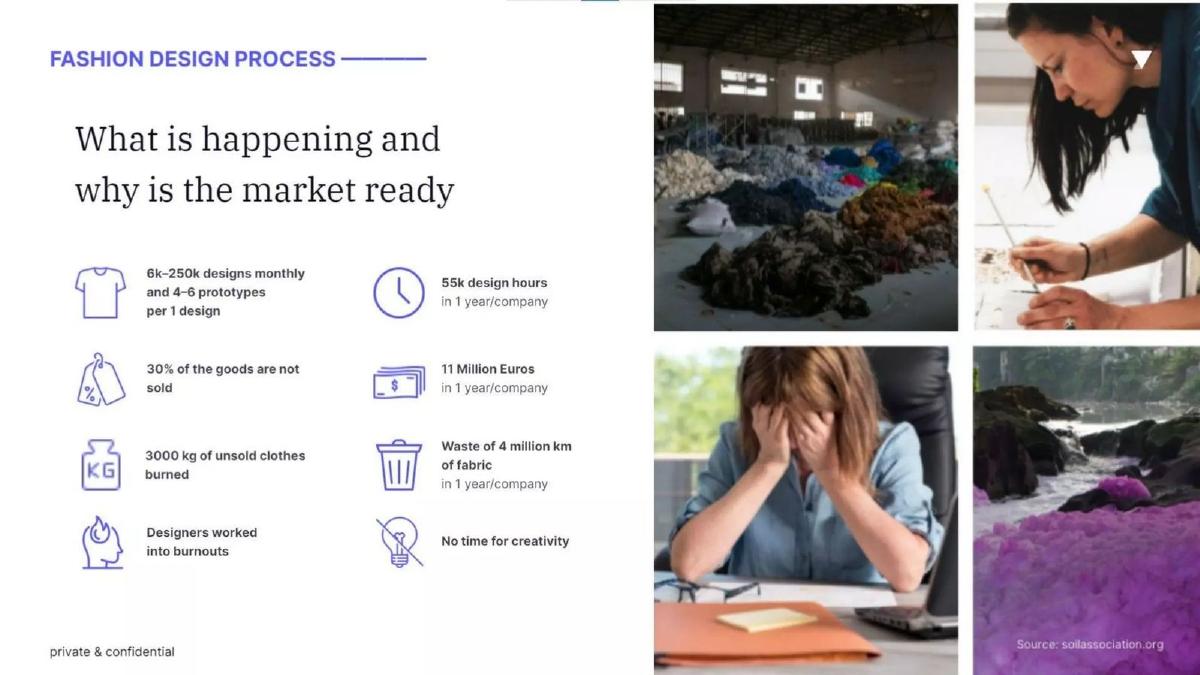
- The deck identifies a massive efficiency gap, noting that companies spend 55k design hours and 11 million Euros annually on manual processes (Slide 4).
- Sustainability is a core value proposition, claiming the fashion industry is responsible for 8-10% of global CO2 emissions (Slide 7).
- The product claims to reduce daily design work by 4 hours and achieve 99.8% energy savings compared to traditional prototyping (Slides 10, 11).
- Market sizing is ambitious, projecting a European TAM of €115 billion by 2024 with advanced features (Slide 8).
- The business model is a subscription-based B2B SaaS, with pricing tiered by the number of designs and specific 'assistants' like 3D or AR (Slide 14).
- Traction is demonstrated through a pipeline of 10 customers in 2022 and a list of high-profile POC planning partners including Adidas and H&M (Slide 15).
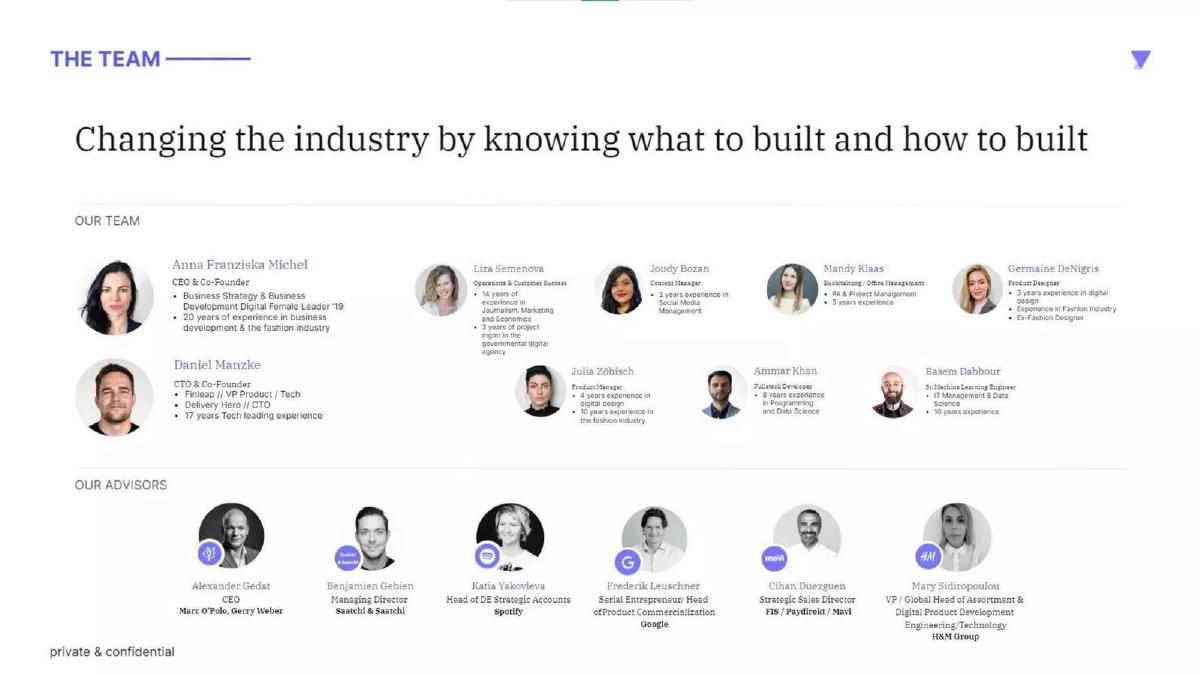
- The team slide highlights deep industry expertise, including a CEO with 20 years of business development experience and a CTO with 17 years in tech leadership (Slide 3).
- The 'Ask' slide presents three different funding scenarios—Most Likely, Minimum, and Hyper Growth—rather than a single fixed number (Slide 18).
Introduction: The Intersection of Generative AI and ESG
The yoona.ai pitch deck, produced in 2020, arrived at a pivotal moment for both the fashion industry and the venture capital landscape. Fashion was facing a reckoning over its environmental footprint, and 'Generative AI'—though not yet the household term it is today—was beginning to show promise in B2B applications. This 20-slide deck successfully secured $1.1 million in pre-seed funding by framing a software solution as a direct answer to industrial waste and inefficiency.
Slide 1: The Cover and Social Proof
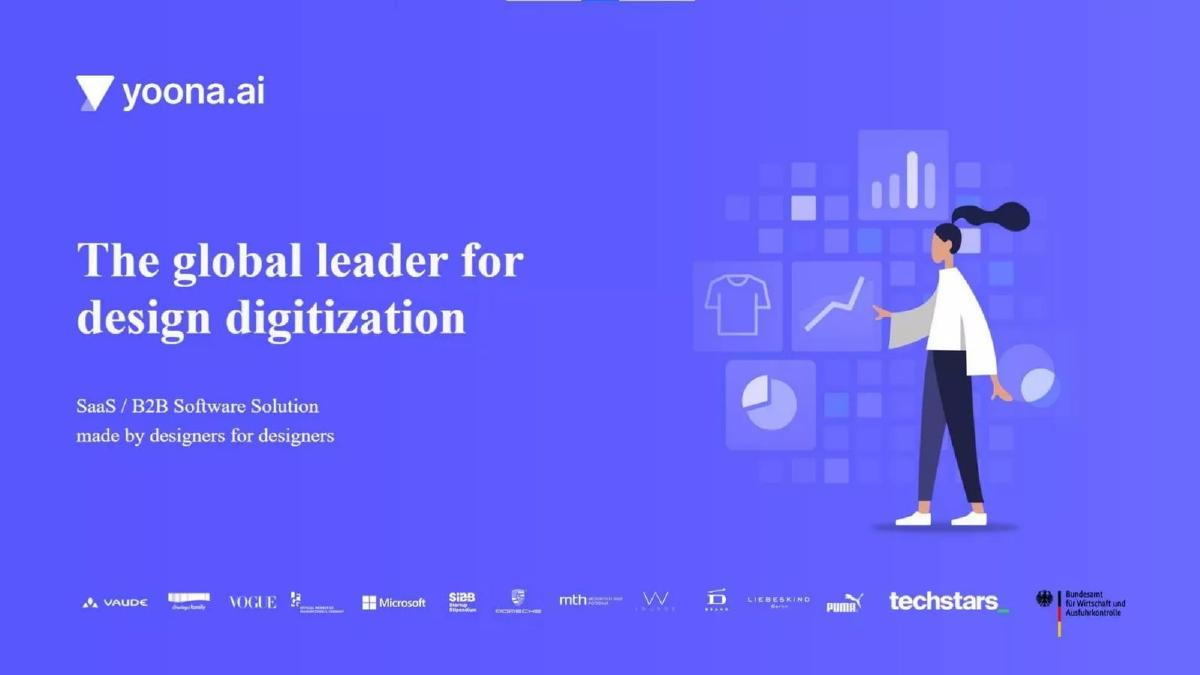
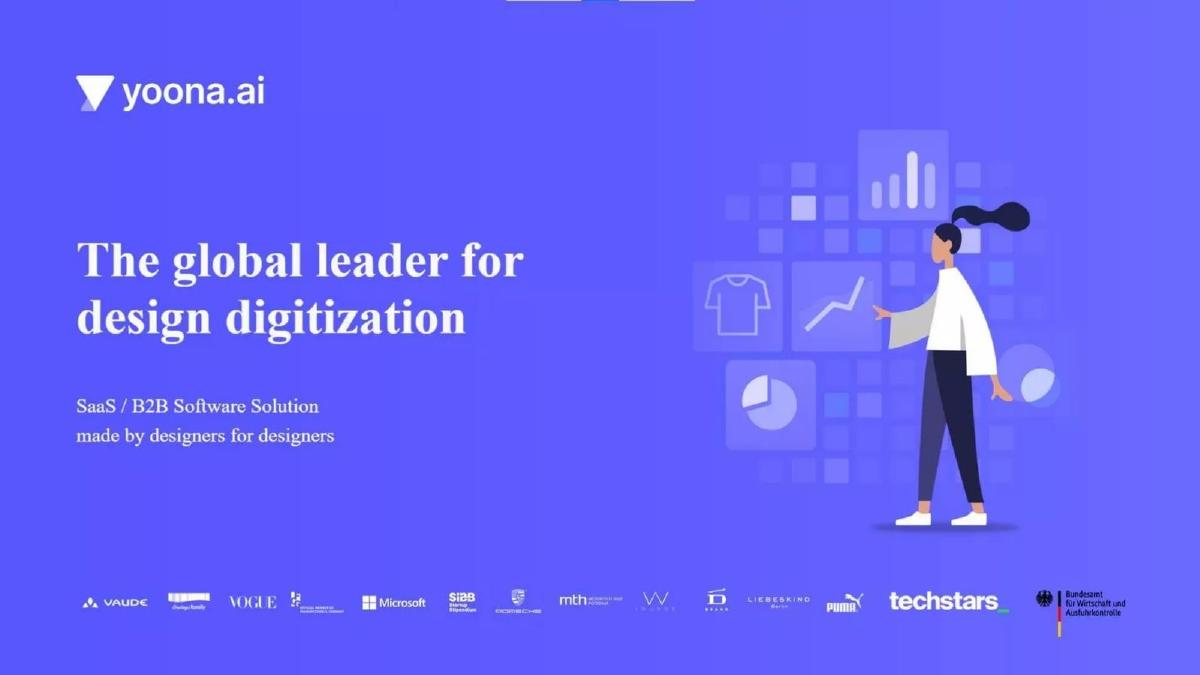
The cover slide establishes yoona.ai as "The global leader for design digitization." It immediately utilizes a 'logo wall' at the bottom, featuring heavyweights like Microsoft, Porsche, Techstars, and Vogue. This is a strategic move for a pre-seed company; by associating with established accelerators and brands early, they mitigate the perceived risk of a nascent technology. The subtitle "made by designers for designers" addresses the potential friction of AI adoption in creative fields.
Slides 2-3: The Hook and The Team
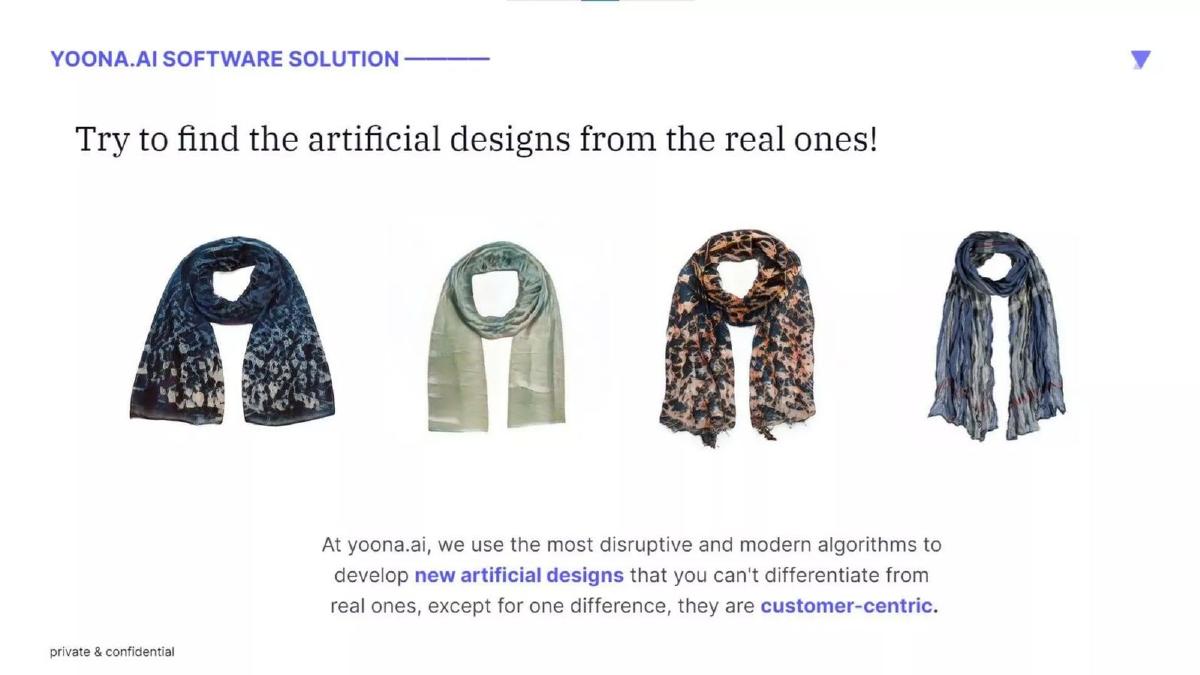
Slide 2 presents a visual challenge: "Try to find the artificial designs from the real ones!" This is a classic 'Turing Test' for product quality, asserting that their AI-generated scarves are indistinguishable from physical products. It introduces the concept of "customer-centric" design, suggesting the AI isn't just creative, but commercially optimized.
Slide 3 introduces the team and advisors. The founder pedigree is strong, with CEO Anna Franziska Michel cited as a "Digital Female Leader '19" and CTO Daniel Manzke bringing 17 years of tech experience from companies like Delivery Hero. The advisory board is particularly impressive for a pre-seed round, featuring executives from H&M Group, Google, and Spotify. This suggests the company has the industry 'ins' required to sell into complex fashion supply chains.
Slides 4-7: Defining the Problem and Sustainability
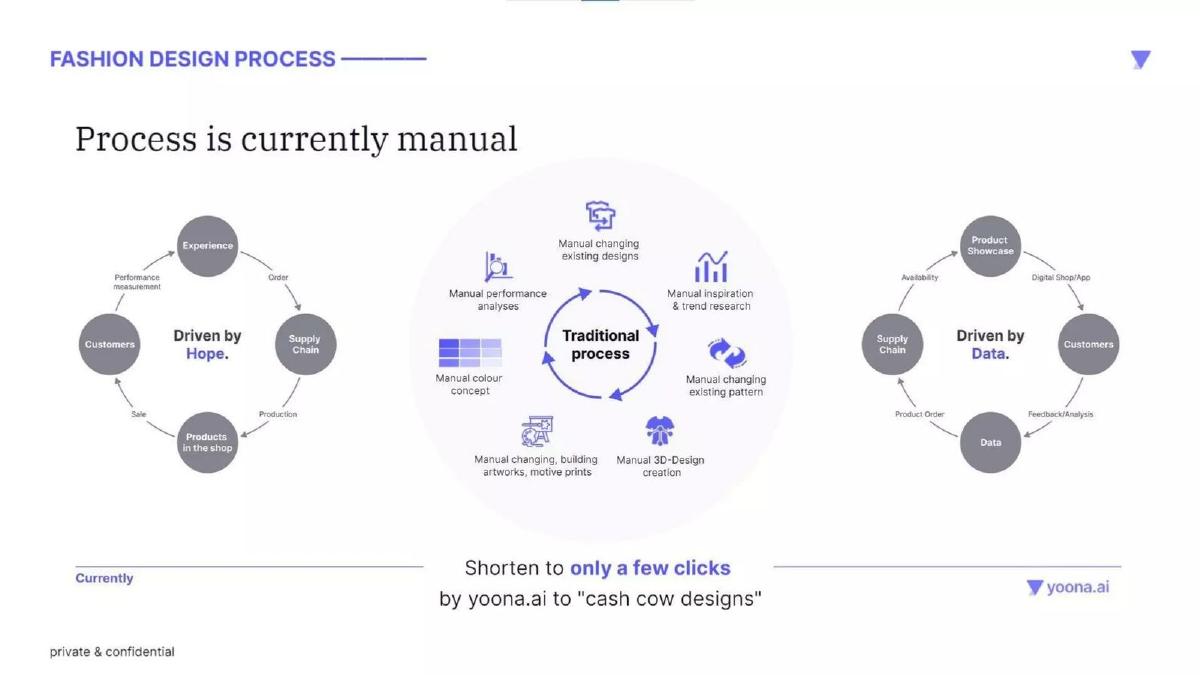
Slide 4 breaks down the "Fashion Design Process" with grim statistics: 30% of goods are unsold, 3000 kg of clothes are burned, and designers are facing burnout. It quantifies the pain point at 11 million Euros lost per year per company due to manual processes. Slide 5 contrasts the "Traditional process" (Driven by Hope) with the "yoona.ai process" (Driven by Data), promising to shorten the workflow to "only a few clicks."
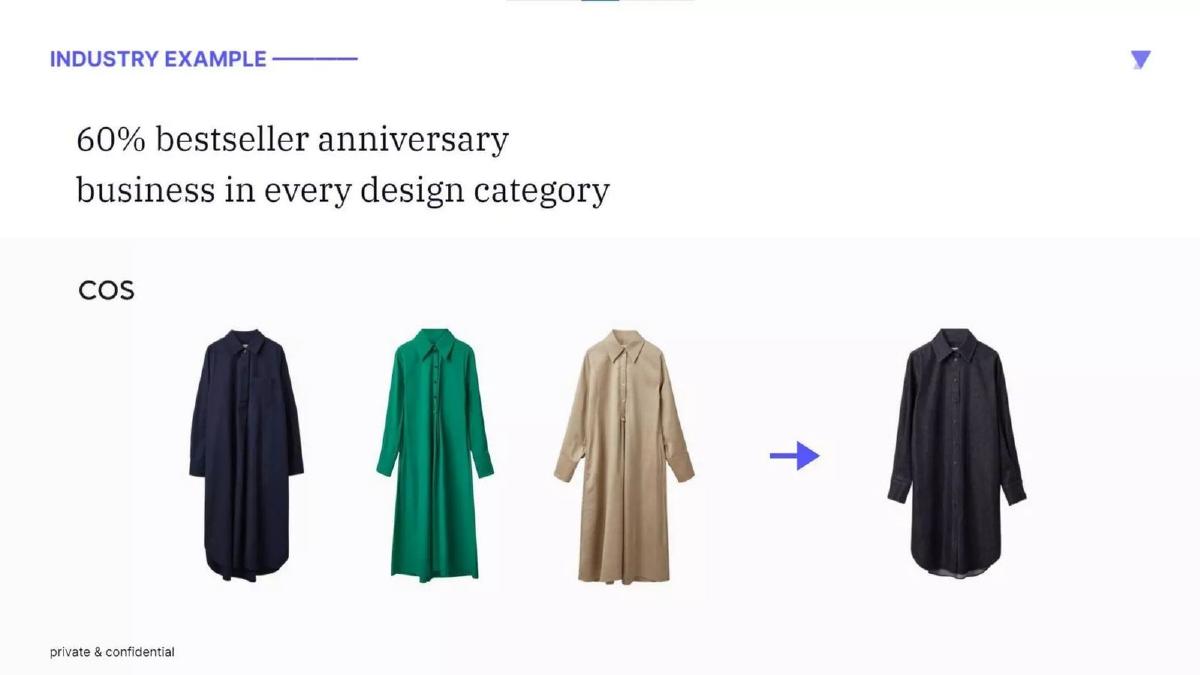
Slide 6 uses the brand COS as an industry example, noting that 60% of business comes from "bestseller anniversary" items. This justifies why an AI tool focusing on iterative design is so valuable—it automates the most profitable, repeatable parts of the business. Slide 7 leans heavily into the 'Fight for Sustainability,' noting that the industry is responsible for 8-10% of world CO2 emissions and highlighting upcoming CO2 taxes in 2021. This aligns the startup with regulatory tailwinds.
Slides 8-11: Market Size and Technical Benefits
Slide 8 estimates the TAM. It claims fashion companies spend 2-3% of retail volume on design processes. They project a European TAM of €6.7 billion in 2022, growing to €115 billion by 2024 as they add features. The slide notes there are 160,000 fashion and production companies in Europe alone.
Slide 9 shows a product mockup on a laptop, claiming the platform is 80% faster and 90% more efficient. Slide 10 provides a direct comparison: traditional creation takes 55k design hours and costs 11M Euros, while the yoona.ai platform takes 1 design hour for a whole collection and costs 700k Euros. Slide 11 is a data-heavy energy savings slide, claiming a 99.8% reduction in CO2 and energy by replacing physical prototypes with digital generation.
Slides 12-15: Product Examples and Business Model
Slides 12 and 13 provide visual evidence of the AI's output, ranging from sneakers and sweaters to 3D designs and Augmented Reality (AR) applications. Slide 13 specifically mentions Gerry Weber and Taifun, showing a clear pipeline from "Data of any kind" to an "AR" end product. Slide 14 defines the B2B SaaS model. Revenue is driven by subscriptions that scale based on the number of designs and the specific 'assistants' (3D, AR, shirt, or silhouette) the client uses.
Slide 15 is the traction and roadmap slide. It lists 10 customers for 2022 with €160k ARR, scaling to 1,650 customers and €61m ARR by 2026. It also lists a prestigious 'POC planning' list including H&M, Adidas, and Desigual. This is the 'meat' of the deck for investors—showing that major players are already at the table.
Slides 16-20: Recognition, Expansion, and The Ask
Slide 16 is a secondary logo wall for awards and programs, reinforcing the social proof from the cover. Slide 17 discusses the "Global Design Database," suggesting the technology is scalable beyond fashion into the Automotive, Advertising, Furniture, and FMCG industries, which represent trillions in market turnover.
Slide 18 details "What we are looking for." Unusually, it doesn't state a single dollar amount but presents three cases: Most Likely, Minimum, and Hyper Growth. It notes that $1.3m is "Already committed." The pyramid graphic shows that the bulk of the focus is on 'Product,' followed by Sales and Marketing. Slide 19 provides an Executive Summary, and Slide 20 is the contact page.
What Works in this Deck
Quantified Pain Points: The deck doesn't just say the industry is wasteful; it cites 11 million Euros in losses per company and 55k wasted design hours (Slide 4). · Sustainability as a Feature: By calculating the exact CO2 savings (Slide 11), the company appeals to the growing number of ESG-focused venture funds. · Strong Social Proof: The inclusion of high-level advisors from H&M and Google (Slide 3) provides immediate credibility in a niche market. · Clear 'Before and After': The contrast between "Driven by Hope" and "Driven by Data" (Slide 5) is a simple, effective narrative device.
What is Missing
Unit Economics: While the deck mentions a €3500/month subscription (Slide 8), it lacks detail on Customer Acquisition Cost (CAC) or Lifetime Value (LTV) projections. · Competitive Landscape: There is no slide comparing yoona.ai to other digital design tools or emerging AI competitors. It assumes a vacuum. · Technical Depth: For an AI-based solution, there is very little explanation of the underlying architecture or how the "Global Design Database" is actually built and protected (IP). · Clear Funding Amount: Slide 18 is vague about the actual 'Ask' for the current round, focusing instead on hiring plans for different scenarios.
What a Founder Should Copy
The 'Turing Test' Slide: If you are building generative tech, show—don't just tell—that the output is high quality (Slide 2). · The Advisory Board Strategy: If you are a young team, surround yourself with industry veterans and put their logos front and center (Slide 3). · Regulatory Alignment: Mentioning upcoming taxes or laws (like the Circular Economy Act on Slide 7) makes your solution feel like an inevitable necessity rather than a 'nice-to-have.' · Tiered Growth Cases: Presenting a 'Minimum' vs. 'Hyper Growth' case (Slide 18) shows investors you have thought through different capital efficiency scenarios.
Frequently asked questions
- How does yoona.ai differentiate its AI from standard design tools?
- According to Slide 2 and Slide 5, yoona.ai moves the industry from a process 'Driven by Hope' to one 'Driven by Data.' It uses algorithms to generate 'customer-centric' designs that are ready for production, rather than just providing a canvas for manual creation. It specifically targets 'cash cow' designs—bestsellers that make up 60% of anniversary business—to ensure commercial viability.
- What are the specific sustainability claims made in the deck?
- The deck is very specific about environmental impact. Slide 11 calculates that traditional prototyping for 24,000 shirts emits 132,800kg of CO2, whereas yoona.ai’s digital generation process emits only 8.87kg. This represents a claimed 99.8% reduction in both energy consumption and CO2 emissions for the design phase.
- What is the company's projected growth trajectory?
- Slide 15 outlines a five-year roadmap. It projects starting with 10 customers and €160k ARR in 2022, scaling rapidly to 200 customers and €5.2m ARR in 2024, and reaching 1,650 customers with €61m ARR by 2026. This represents an extremely aggressive growth curve typical of venture-scale software expectations.
- Who are the key people behind the company?
- The team is led by Anna Franziska Michel (CEO) and Daniel Manzke (CTO). As shown on Slide 3, the team includes specialists in machine learning, 3D design, and fashion. They are supported by an advisory board with representatives from major brands and tech firms, including the former CEO of Marc O'Polo and the VP of Assortment at H&M Group.
- What is the intended use of the funds raised?
- Slide 18 indicates the funds are primarily for team expansion. Depending on the 'case' (Minimum vs. Hyper Growth), they intend to hire Account Managers, Mobile Engineers, Senior Software Engineers (Frontend and Backend), and Machine Learning Engineers. The goal is to release full 3D support by 2022.