Yingo Yango’s 2014 pitch deck positions the company as a central hub for the fragmented health and wellness ecosystem. By framing the problem around the failure of wellness programs to engage employees, the deck argues for an 'integrative approach' that connects doctors, medications, and fitness data into a single interface. While the deck is visually clean and professionally structured, it is notably light on operational data, revenue models, and user growth metrics. Instead, it relies on the credibility of a heavy-hitting advisory board—including the former CEO of Priceline and a CNN journa…
Key takeaways
- The company defines itself as a patient engagement platform that integrates healthcare teams and wellness resources (Slide 3).
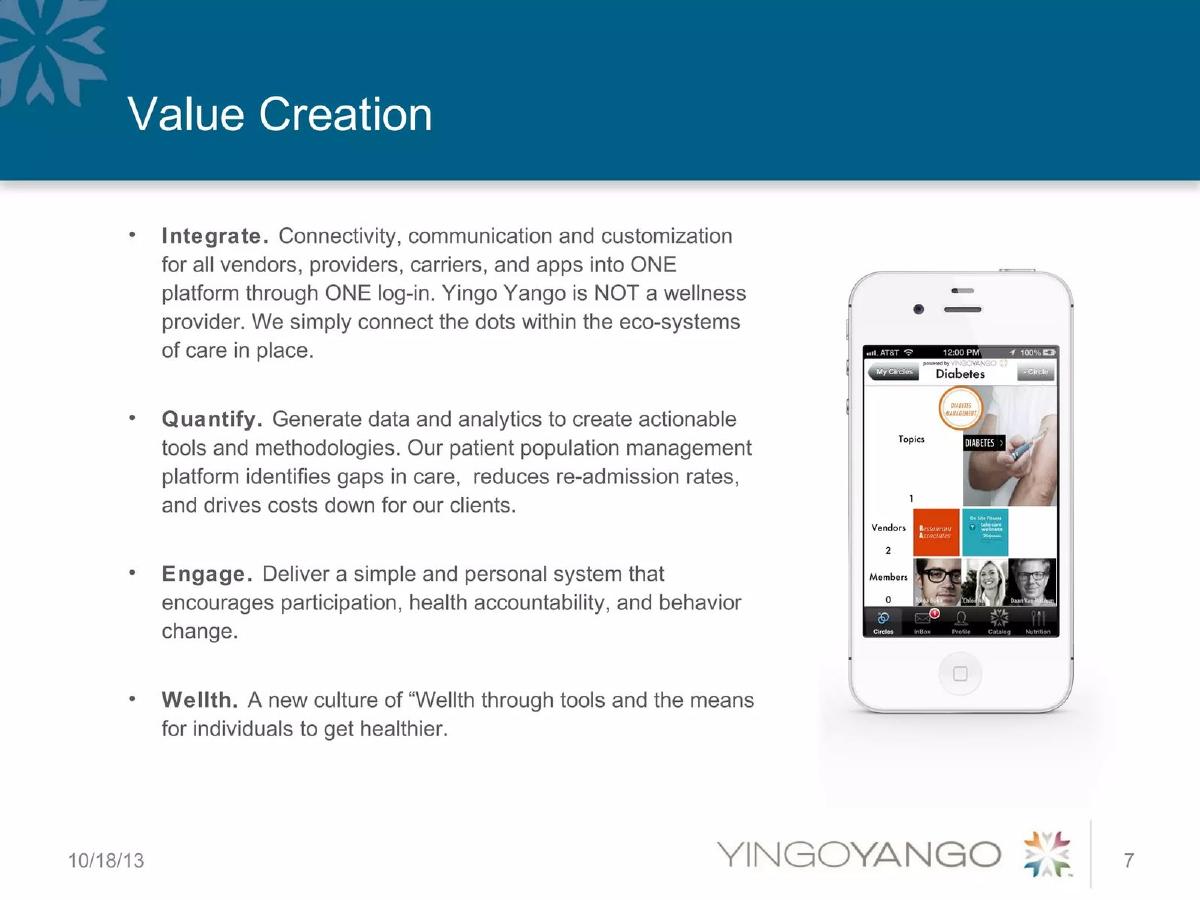
- The core value proposition is built on four pillars: Integrate, Quantify, Engage, and 'Wellth' (Slide 7).
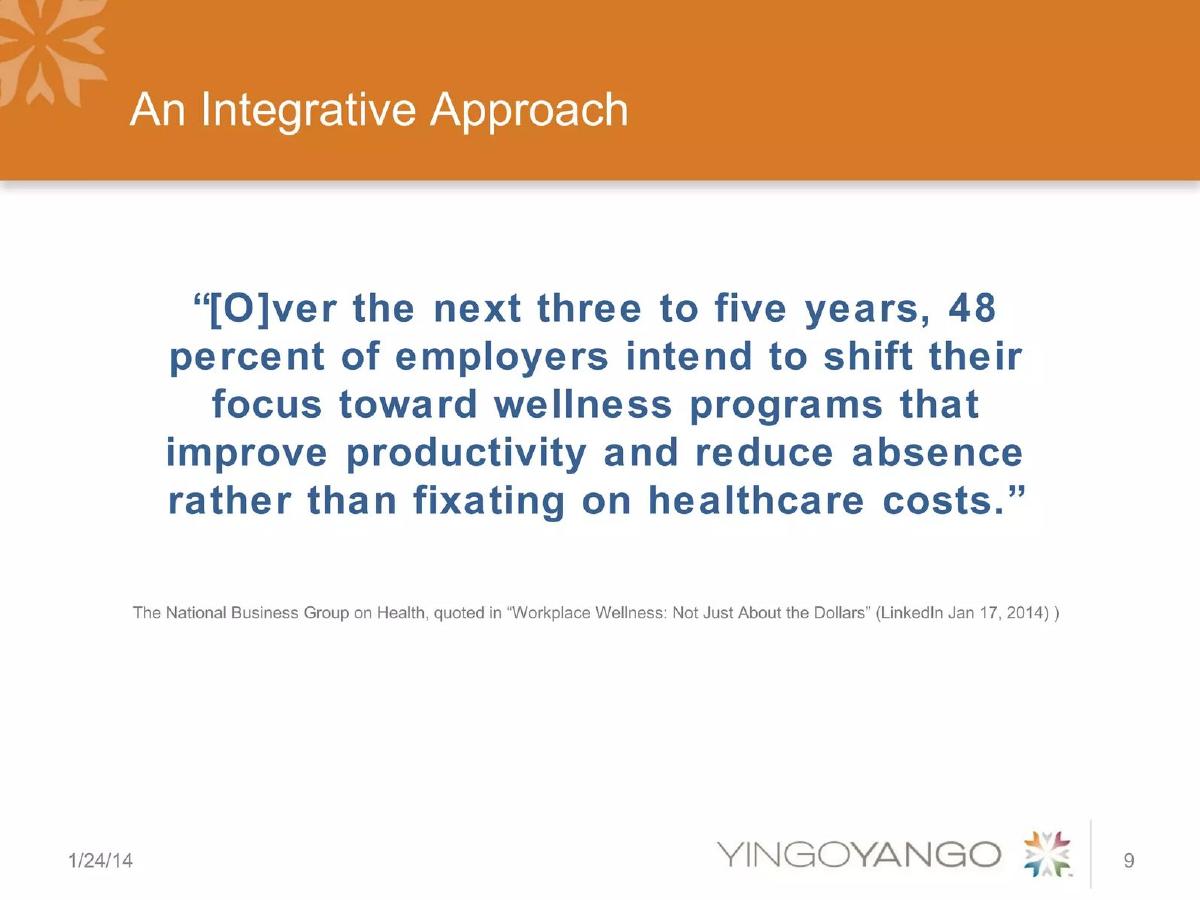
- A significant market shift is cited, with 48 percent of employers intending to focus on wellness programs to improve productivity over the next three to five years (Slide 9).
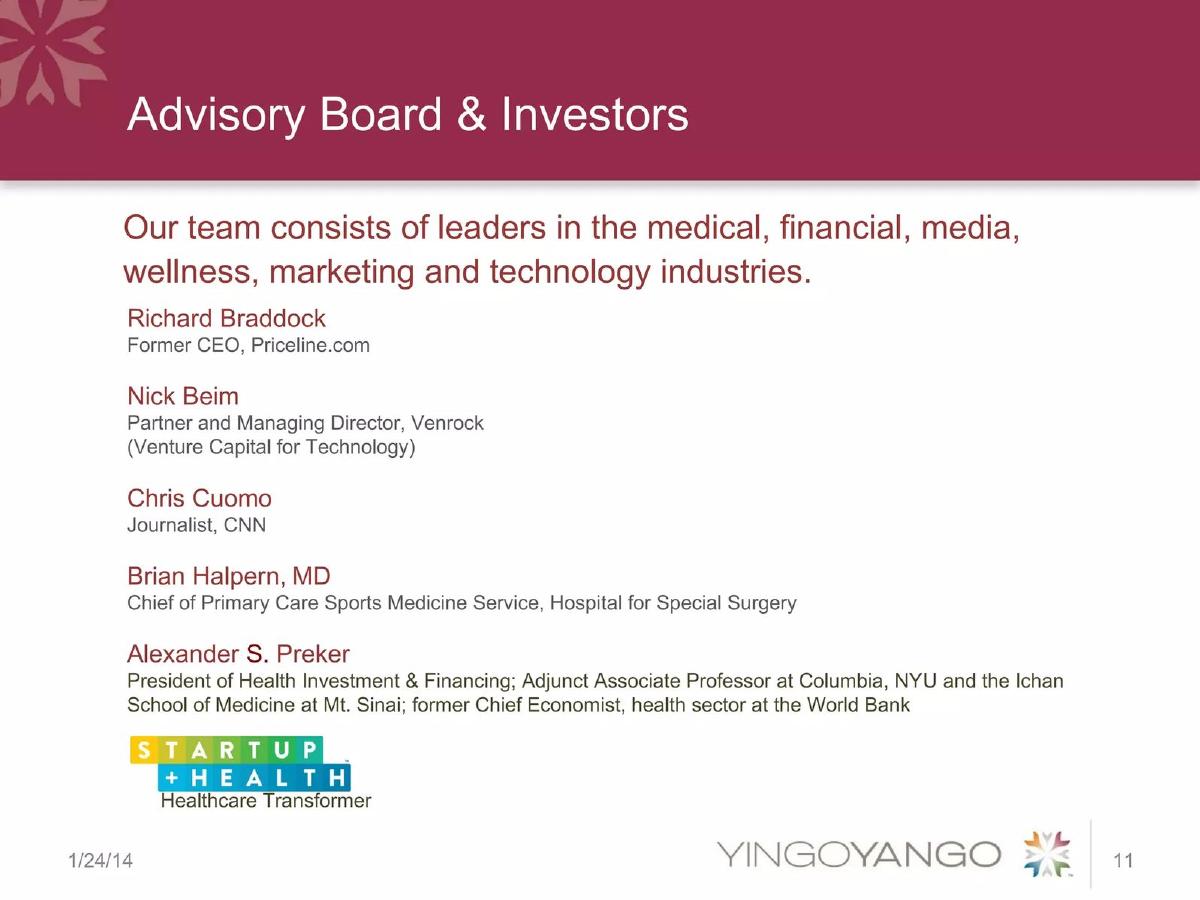
- The deck leverages a high-profile advisory board featuring Richard Braddock (Former CEO, Priceline.com) and Chris Cuomo (Journalist, CNN) (Slide 11).
- Startup Health is a key partner, with the company participating in the Healthcare Transformers Academy in Spring 2013 (Slide 13).
- The total addressable market is identified as a ~$1 Trillion industry, broken down into Fitness ($412B), Healthy Lifestyle ($282B), and Consumer Health ($479B) (Slide 17).
- The deck omits a specific financial 'Ask,' detailed unit economics, and a competitive landscape analysis.
- Product functionality is demonstrated through mockups showing 'Circles' for specific conditions like Diabetes Management (Slide 7).
Introduction: The Integration Play in Digital Health
The Yingo Yango pitch deck, dated January 2014, represents a specific era of digital health where 'integration' was the primary buzzword. At this time, the market was flooded with disparate fitness trackers, wellness apps, and patient portals. Yingo Yango’s pitch was not to be another app in the pile, but the 'glue' that held them together. This teardown analyzes how the company attempted to sell this middleware vision to investors.
Slide 1: Title Slide
The deck opens with a clear, descriptive subtitle: "Mobile Health and Wellness Integration & Patient Engagement Platform." It identifies the presenters as Marty Jaramillo and Andy Quinn. Notably, the slide features the Startup Health logo, immediately signaling that the company has been vetted by a known industry accelerator. The date is listed as 01/30/14.
Slide 3: What We Do
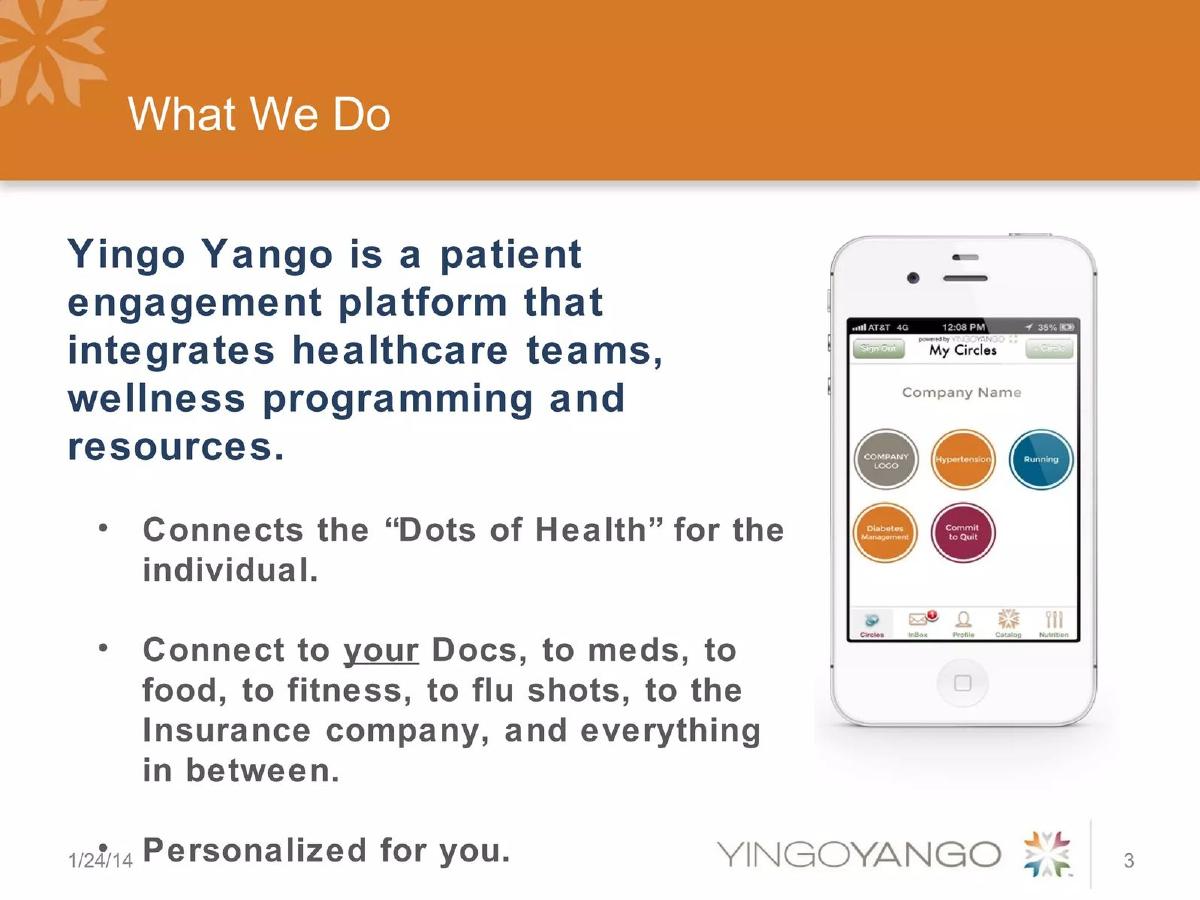
This slide serves as the executive summary. It defines Yingo Yango as a platform that "integrates healthcare teams, wellness programming and resources." The slide uses the phrase "Connects the 'Dots of Health' for the individual." A mobile mockup is included, showing a 'My Circles' interface with icons for Hypertension, Running, Diabetes Management, and 'Commit to Quit.' This visual suggests a modular approach to health management where users can join specific health interest or condition groups.
Slide 5: The Challenge
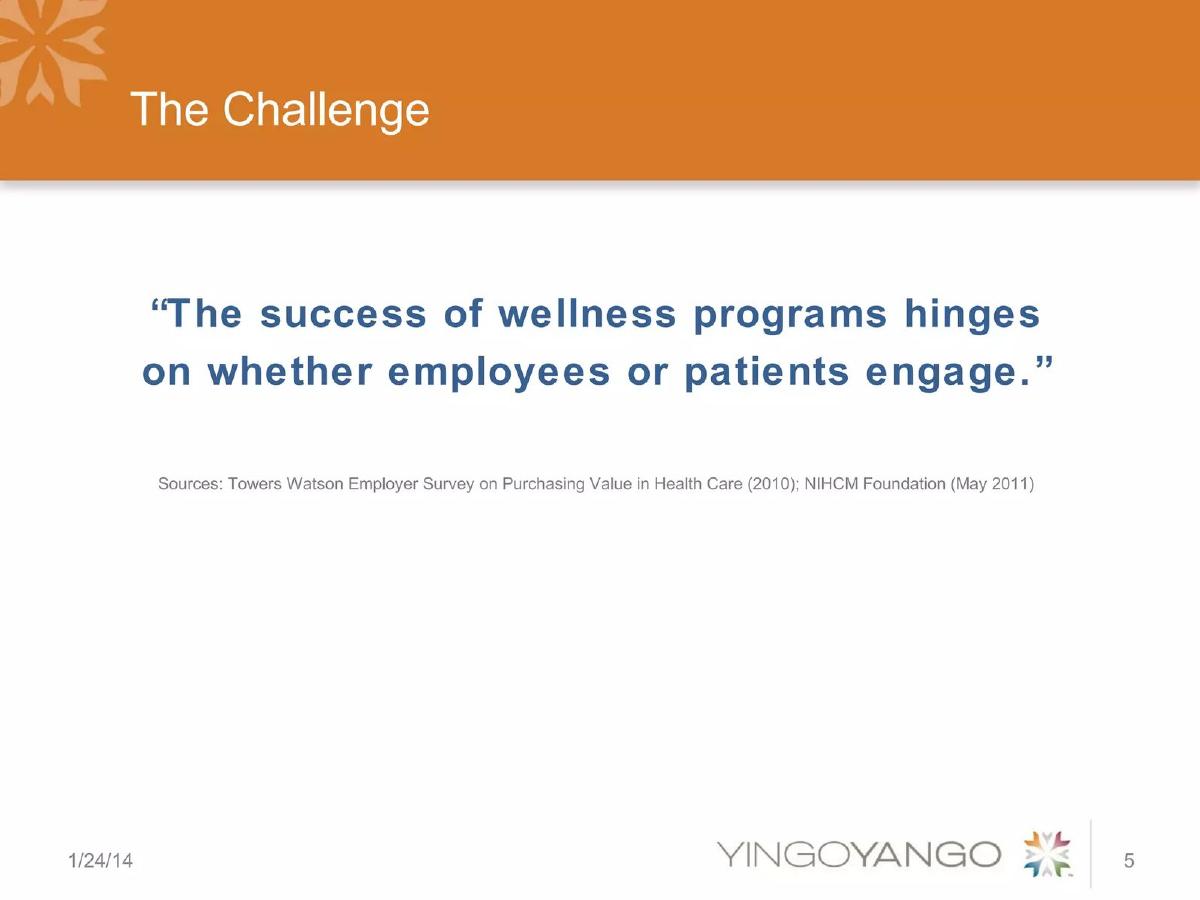
Yingo Yango frames the problem through a single, powerful quote: "The success of wellness programs hinges on whether employees or patients engage." The slide cites sources from Towers Watson and the NIHCM Foundation (2010-2011). By focusing on engagement rather than clinical outcomes or cost, the company identifies the 'last mile' problem in healthcare: if the patient doesn't use the tool, the tool has no value.
Slide 7: Value Creation
This slide breaks down the platform's utility into four verbs: Integrate, Quantify, Engage, and Wellth.
Integrate: The slide clarifies that Yingo Yango is "NOT a wellness provider" but a connectivity layer for all vendors and providers through a single log-in. · Quantify: It claims to generate analytics to identify gaps in care and reduce re-admission rates. · Engage: It promises a personal system to encourage behavior change. · Wellth: A branded term for a new culture of health.
The accompanying mockup shows a 'Diabetes' circle with sections for 'Vendors' (e.g., Restaurant Associates, Walgreens) and 'Members,' suggesting a community-based social health model.
Slide 9: An Integrative Approach
To validate the market timing, Slide 9 cites the National Business Group on Health, stating that "48 percent of employers intend to shift their focus toward wellness programs that improve productivity and reduce absence" over the next three to five years. This is a strategic inclusion, as it moves the conversation away from just 'saving on insurance premiums' to the broader corporate benefit of 'employee productivity.'
Slide 11: Advisory Board & Investors
This is arguably the strongest slide in the deck for an early-stage company. It lists high-profile names that provide significant social proof:
Richard Braddock: Former CEO of Priceline.com. · Nick Beim: Partner at Venrock. · Chris Cuomo: Journalist at CNN. · Brian Halpern, MD: Chief of Primary Care Sports Medicine at the Hospital for Special Surgery. · Alexander S. Preker: Former Chief Economist for the health sector at the World Bank.
The inclusion of a prominent venture capitalist (Beim) and a major media figure (Cuomo) suggests the company had deep ties into the New York and Silicon Valley ecosystems.
Slide 13: Milestones (cont’d)
This slide lists 'Event participation' as a proxy for traction. It mentions the SXSW Accelerator Competition (Jan 2014) and the JP Morgan Healthcare Conference (Jan 2014) . It also highlights their participation in the Startup Health Academy (Spring 2013) , chaired by former TimeWarner CEO Jerry Levin. While these are 'soft' milestones (events rather than revenue or users), they demonstrate that the company was active in the highest levels of the healthcare innovation circuit.
Slide 15: Thank You
A standard closing slide with the company URL. It maintains the clean, minimalist aesthetic found throughout the deck.
Slide 17: Market Size
The final slide provides a macro view of the industry, citing North Castle Partners. It values the Health, Wellness, and Active Living industry at ~$1 Trillion. It breaks this down into three segments:
Fitness, Sports & Recreation ($412B) · Healthy Lifestyle ($282B) · Consumer Health, Beauty & Personal Care ($479B)
This slide is likely intended to show the massive ceiling for a platform that can successfully integrate these disparate categories.
What Yingo Yango Does Well
The deck is visually professional and avoids the cluttered, text-heavy pitfalls of many 2014-era healthcare presentations. By explicitly stating what they are not (a wellness provider), they clear up potential confusion about their business model. The heavy reliance on an Advisory Board (Slide 11) is a classic 'pre-revenue' tactic that works well here because the names listed are genuinely top-tier. The use of 'Circles' in the UI mockups (Slide 3 and 7) provides a concrete mental model for how the app actually functions.
What is Missing from the Deck
The most glaring omission is hard data. There are no slides showing user growth, pilot program results, or engagement metrics, despite 'engagement' being the core problem they claim to solve. Furthermore, the Business Model is vague. While they mention 'clients' and 'vendors,' there is no explanation of how they make money—is it a Per Member Per Month (PMPM) fee, a licensing fee for vendors, or a data play? Finally, the Ask is missing from these slides. A pitch deck usually concludes with the amount of capital being raised and how it will be deployed.
Founder's Guide: What to Copy
Founders should emulate Yingo Yango’s problem framing. Slide 5 uses a single, authoritative quote to define the 'Challenge,' which is much more effective than a list of ten minor grievances. The Value Creation slide (Slide 7) is also a great template for explaining a complex platform; it uses simple verbs to categorize features. Lastly, if you have a strong advisory board, Slide 11 shows how to present it: names, titles, and logos that immediately communicate authority without requiring the reader to do extra research.
Final Analysis
Yingo Yango’s deck is a 'vision and validation' play. It sells the vision of a unified health ecosystem and uses the validation of Startup Health and a prestigious advisory board to make that vision credible. While it lacks the operational rigor (unit economics, churn rates, sales pipeline) required for a Series A, it is a strong example of a seed-stage deck designed to open doors at major conferences and with institutional investors.
Frequently asked questions
- What problem does Yingo Yango aim to solve?
- According to Slide 5, the primary challenge is that the success of wellness programs depends entirely on employee or patient engagement. The deck suggests that existing programs fail because they are fragmented. Yingo Yango aims to solve this by 'connecting the dots of health' for the individual, integrating doctors, medications, insurance, and fitness data into one platform (Slide 3).
- Who are the key people involved with Yingo Yango?
- The deck lists Marty Jaramillo and Andy Quinn as the presenters (Slide 1). However, it places significant emphasis on its Advisory Board (Slide 11), which includes Richard Braddock (former Priceline CEO), Nick Beim (Venrock), Chris Cuomo (CNN), and medical/economic experts like Dr. Brian Halpern and Alexander S. Preker.
- What is the company's business model?
- The business model is not explicitly detailed in the provided slides. Slide 7 mentions 'driving costs down for our clients' and identifies 'vendors' and 'members' within the app interface, suggesting a B2B or B2B2C model targeting employers or insurance carriers, but specific pricing or revenue streams are omitted.
- How does Yingo Yango differentiate itself from a standard wellness provider?
- Slide 7 explicitly states, 'Yingo Yango is NOT a wellness provider.' Instead, it positions itself as an integration layer that connects existing vendors, providers, and carriers into a single log-in platform. The focus is on connectivity and data aggregation rather than content creation.
- What milestones had the company achieved by early 2014?
- As shown on Slide 13, the company participated in the Startup Health Healthcare Transformers Academy (2013) and several major industry events, including the SXSW Accelerator Competition (2014), JP Morgan Healthcare Conference (2014), and the mHealth Summit (2012, 2013).