How crypto and web3 startups frame the problem: a cost, a delay or a risk a specific user faces today, not a claim that blockchain is the future.
Web3 Problem Slide: Name the User's Cost, Delay or Risk
Investors have heard many crypto pitches that start from the technology and look for a problem afterwards. They read a web3 problem slide for a specific user, what that user loses today, and why the current way fails. This guide compares seven real problem slides from decks tagged web3 in our library, from a blockchain platform that prices a proof of concept at six figures to a slide with one sentence about community.
TL;DR
Name who has the problem and what it costs them, with a number where you can. SIMBA Chain says blockchain proofs of concept "can cost six figures" and gas fees make applications "costly, unsustainable and impractical to move". Air Payments puts card fees at "2-5%" and cites "400,000,000 Stolen Cards in US". GTX names three groups stuck after FTX, and Superfund writes the problem as questions from fund managers and depositors. Best Rate reduces the problem to "10 Days", Seam.so to "Ad-driven social sucks", and Glow Labs to one sentence with no user or cost.
Web3 problem slides from real pitch decks
Each example shows the exact stored slide above its analysis and links to the full teardown. The clearest slides come first; weaker ones follow for contrast. Claims are as shown on the slides; comments are ours.
SIMBA Chain problem slide — slide 2
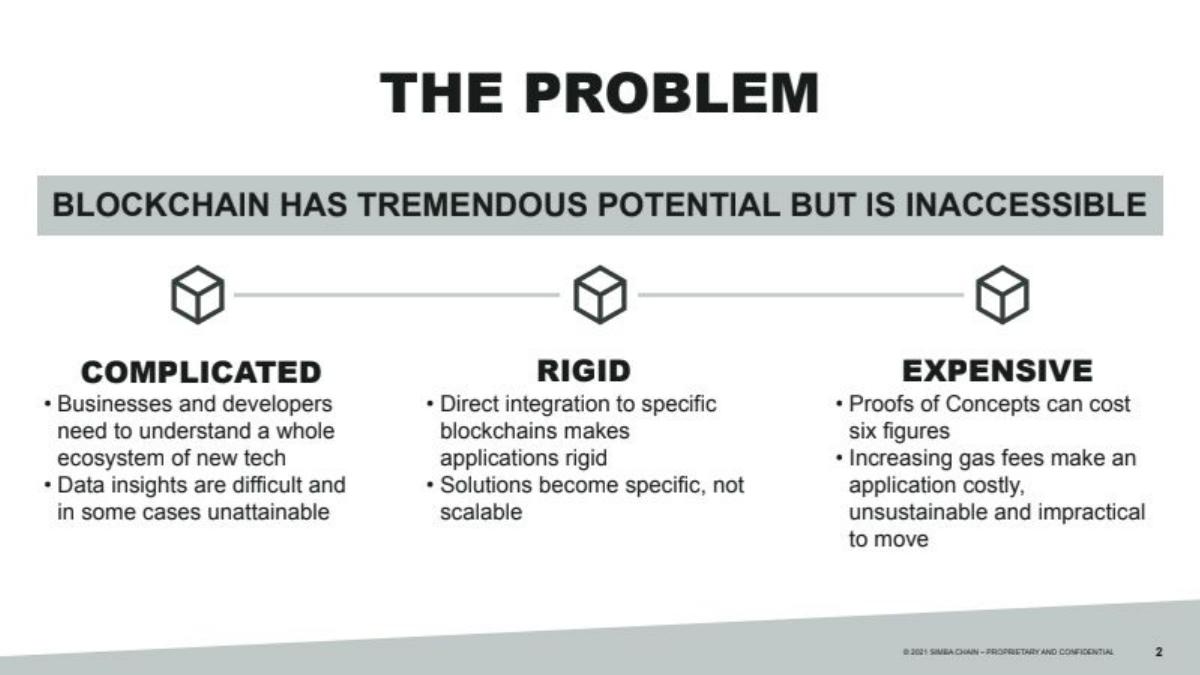
Platform for building blockchain applications. Slide titled "The Problem" with the headline "Blockchain has tremendous potential but is inaccessible".
SIMBA Chain deck, slide 2. Exact stored slide matched to this analysis.
Our analysis: The slide is about the buyer's problem with blockchain, not blockchain's promise. "Six figures" gives the cost an order of magnitude, though it has no source.
Evidence and limitation: A named user (businesses and developers), three barriers and one cost figure.
What a founder can adapt: Add a source or a customer example for the six-figure figure.
Supporting analysis
What the deck claims: Three columns. "Complicated": "Businesses and developers need to understand a whole ecosystem of new tech"; "Data insights are difficult and in some cases unattainable". "Rigid": "Direct integration to specific blockchains makes applications rigid"; "Solutions become specific, not scalable". "Expensive": "Proofs of Concepts can cost six figures"; "Increasing gas fees make an application costly, unsustainable and impractical to move".
Presentation choice: For a developer platform, the problem is the time and money it takes to build on the technology.
When it does not fit: A headline about potential; lead with the cost instead.
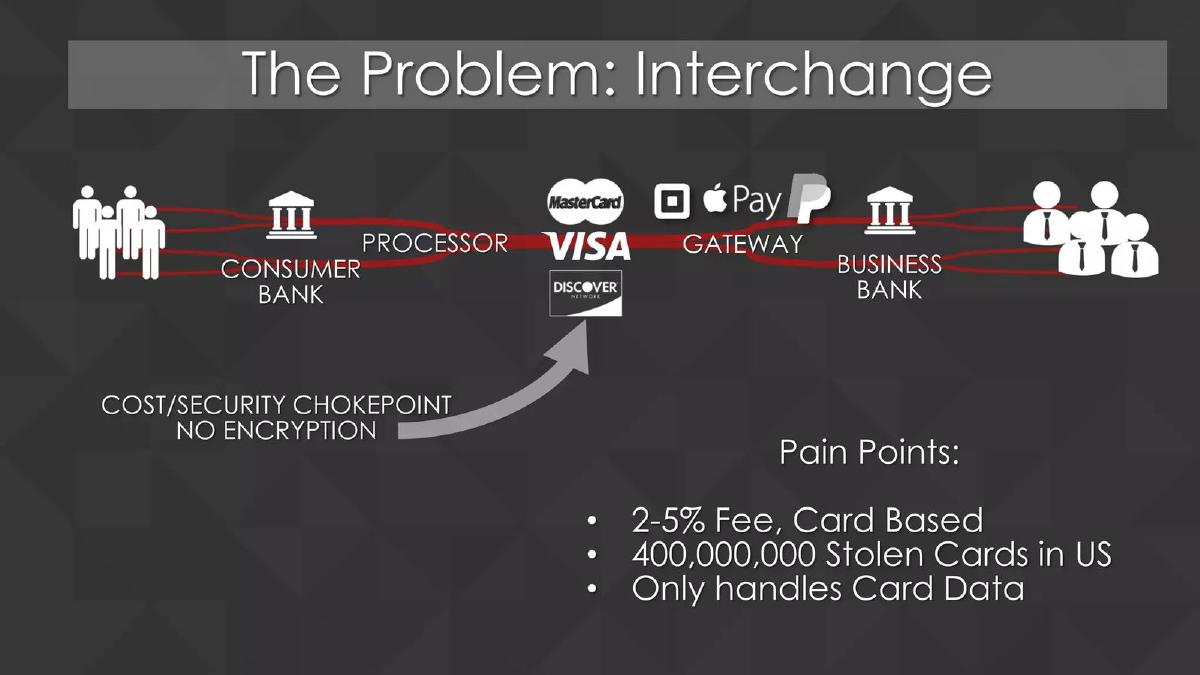
Payments network. Slide titled "The Problem: Interchange".
Air Payments deck, slide 3. Exact stored slide matched to this analysis.
Our analysis: The diagram shows every party a payment passes through, and the pain points put numbers on cost and security. The slide doesn't say who pays the fee or source the stolen-card figure.
Evidence and limitation: A fee range, a fraud figure and a diagram of where both arise.
What a founder can adapt: Say who bears the 2-5% fee and source the fraud figure.
Supporting analysis
What the deck claims: A diagram from consumer through "Consumer Bank", "Processor", card networks (Visa, Mastercard, Discover), "Gateway" (Apple Pay and others) to "Business Bank", with "Cost/Security Chokepoint, No Encryption" marked at the card network. "Pain Points: 2-5% Fee, Card Based; 400,000,000 Stolen Cards in US; Only handles Card Data".
Presentation choice: Payments investors want to see where money leaks today and who loses it.
When it does not fit: A number with no source on a fraud claim.
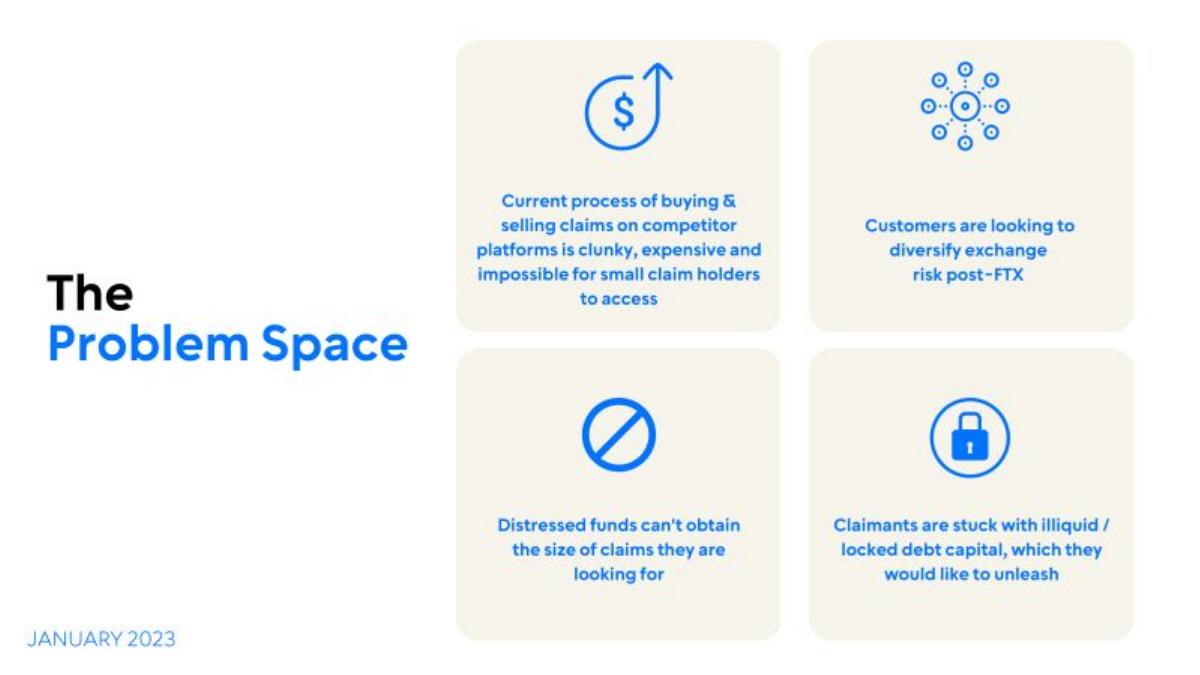
Crypto exchange and bankruptcy-claims trading, dated January 2023. Slide titled "The Problem Space".
GTX deck, slide 5. Exact stored slide matched to this analysis.
Our analysis: The slide ties the problem to a specific moment, the FTX collapse, and names both buyers and sellers of claims. It gives no size: how many claimants, or how much capital is locked.
Evidence and limitation: Three named groups (small claim holders, distressed funds, claimants) and a dated event.
What a founder can adapt: Add the value of claims outstanding or the number of claimants.
Supporting analysis
What the deck claims: Four boxes: "Current process of buying & selling claims on competitor platforms is clunky, expensive and impossible for small claim holders to access"; "Customers are looking to diversify exchange risk post-FTX"; "Distressed funds can't obtain the size of claims they are looking for"; "Claimants are stuck with illiquid / locked debt capital, which they would like to unleash".
Presentation choice: A problem created by a recent event explains why now; a figure would show how big it is.
When it does not fit: "Clunky, expensive" with no fee or time.
DeFi fund platform. Slide titled "Problem Statement" with the subtitle "Crypto Fund Managers | Depositors".
Superfund deck, slide 3. Exact stored slide matched to this analysis.
Our analysis: Writing the problem in each user's voice makes both sides of the platform clear. There are no numbers, so the size and cost of the problem are left open.
Evidence and limitation: Two named users, each with a goal and specific questions.
What a founder can adapt: Add one number per side, such as yields depositors get today.
Supporting analysis
What the deck claims: "For CFM's: I want to create an income stream using my knowledge of DeFi, but: How do I get investors to trust me with their capital? How do I safely and efficiently manage multiple pools of capital from different users? How do I easily access the best yield opportunities across different chains?" "For Depositors: I want to earn above average yields on my USD without excessive risk, but: Who can I trust with my capital? Where will I earn the best returns relative to risk?"
Presentation choice: A two-sided product needs a problem for each side.
When it does not fit: Questions alone; pair them with a fact.
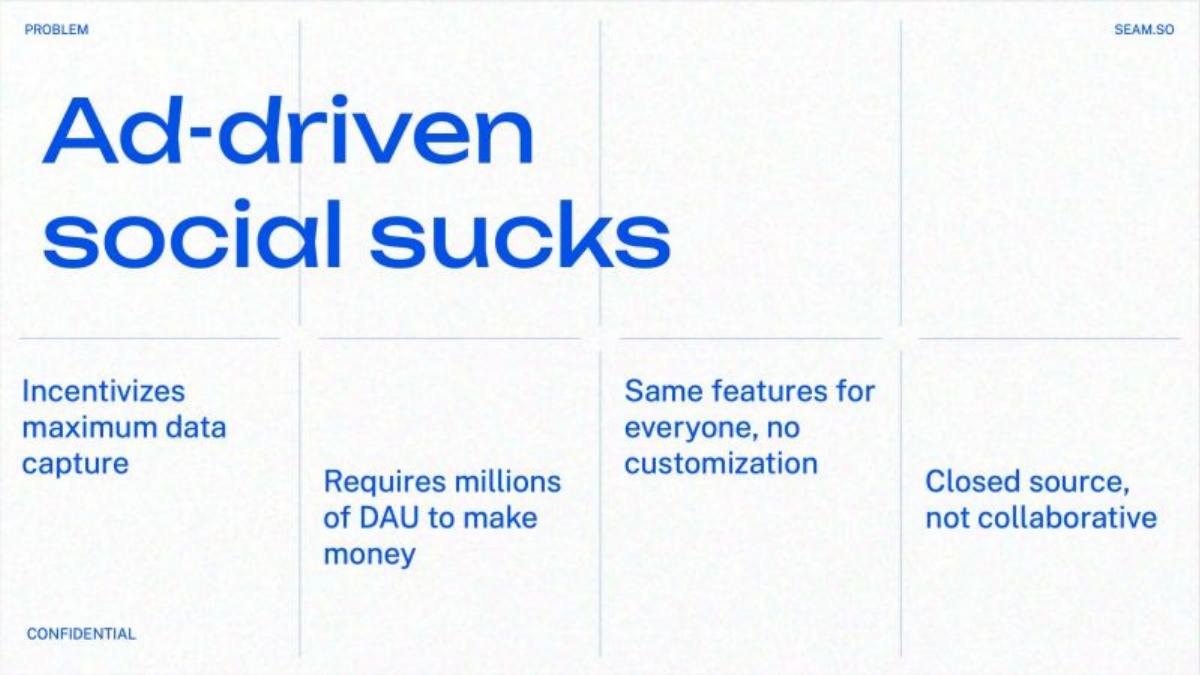
Web3 social network. Slide titled "Problem" with the headline "Ad-driven social sucks".
Seam.so deck, slide 2. Exact stored slide matched to this analysis.
Our analysis: A memorable headline and clear criticisms of existing platforms. The slide doesn't say who is hurt: users, creators or developers.
Evidence and limitation: Four claims about ad-funded social networks, with no user or figures.
What a founder can adapt: Name the user and give one number, such as how few apps reach millions of daily users.
Supporting analysis
What the deck claims: Four points: "Incentivizes maximum data capture"; "Requires millions of DAU to make money"; "Same features for everyone, no customization"; "Closed source, not collaborative".
Presentation choice: Investors need to know which user will switch, and why.
When it does not fit: A slogan in place of a user.
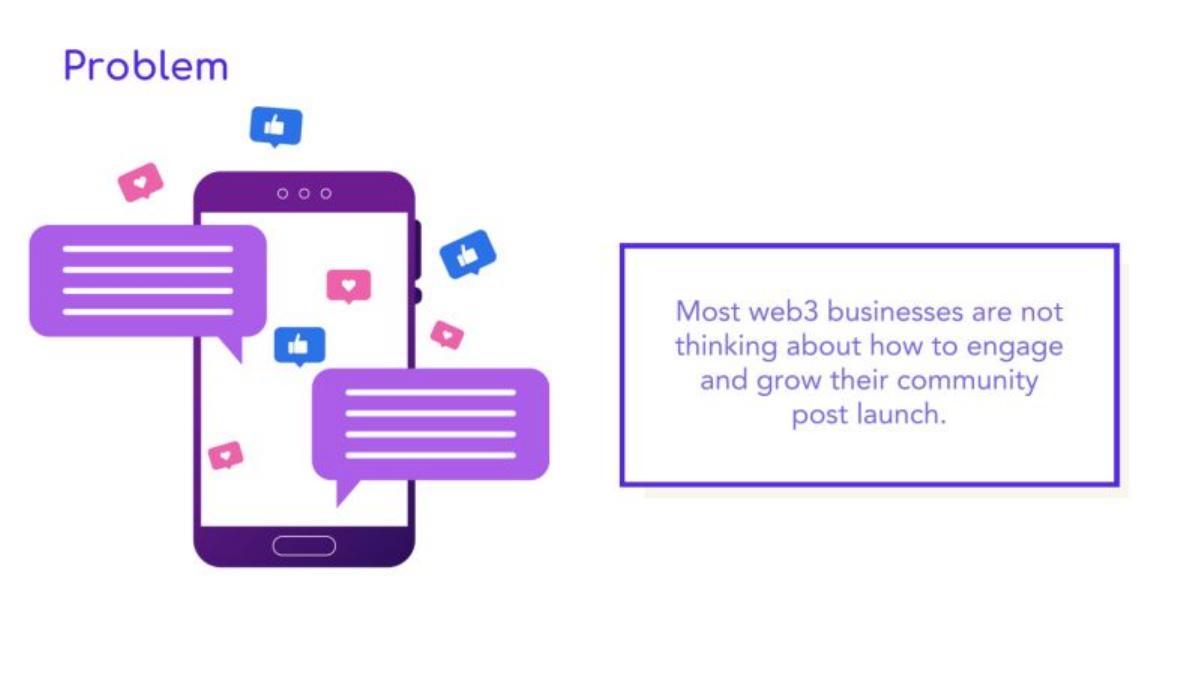
Web3 community and loyalty product. Slide titled "Problem".
Glow Labs deck, slide 3. Exact stored slide matched to this analysis.
Our analysis: The user (web3 businesses) is named, but the slide gives no cost of the problem, such as how many holders leave after launch.
Evidence and limitation: One claim with no figure or example.
What a founder can adapt: Add what happens after launch: holders lost, trading volume or community activity.
Supporting analysis
What the deck claims: One sentence in a box: "Most web3 businesses are not thinking about how to engage and grow their community post launch." A phone illustration.
Presentation choice: "Not thinking about" is an opinion; investors look for a loss they can measure.
When it does not fit: One sentence and an illustration.
Whether an investor can see who has the problem, what it costs and why today's option fails.
Example
Business
Who has it
Cost or number
Why today fails
SIMBA Chain
Blockchain platform
Businesses, developers
Six-figure proofs of concept
Complex, rigid, gas fees
Air Payments
Payments
Consumers, businesses
2-5% fee; 400M stolen cards
Card networks, no encryption
GTX
Claims trading
Claimants, funds
Not stated
Clunky, expensive platforms
Superfund
DeFi funds
Fund managers, depositors
Not stated
Trust, managing capital
Best Rate
Crypto exchange rates
Not stated
10 days (unexplained)
Manual comparison
Seam.so
Web3 social
Not stated
Not stated
Ad-driven model
Glow Labs
Web3 community
Web3 businesses
Not stated
Not stated
Key Takeaways
Start with the user and what they lose today, not with blockchain.
Give a number: a fee, a delay, a cost or a loss.
Say why today's option fails, including existing crypto options.
If there are two sides, write the problem for each.
Keep slogans as headlines; back them with a fact.
Build your web3 problem slide
Describe a problem that exists without blockchain, for a specific user, with a number.
User. Who has this problem today, in one phrase?
Cost. What does it cost them in money, time or risk, as a number?
Today. How do they deal with it now, and why does that fail, including crypto options?
Sides. If your product has two sides, what is the problem for each?
Source. Where does each figure come from?
Copyable framework: Headline: [user] loses [amount or time] to [cause]. Today they [current option], which fails because [reason]. [Figure] ([source]).
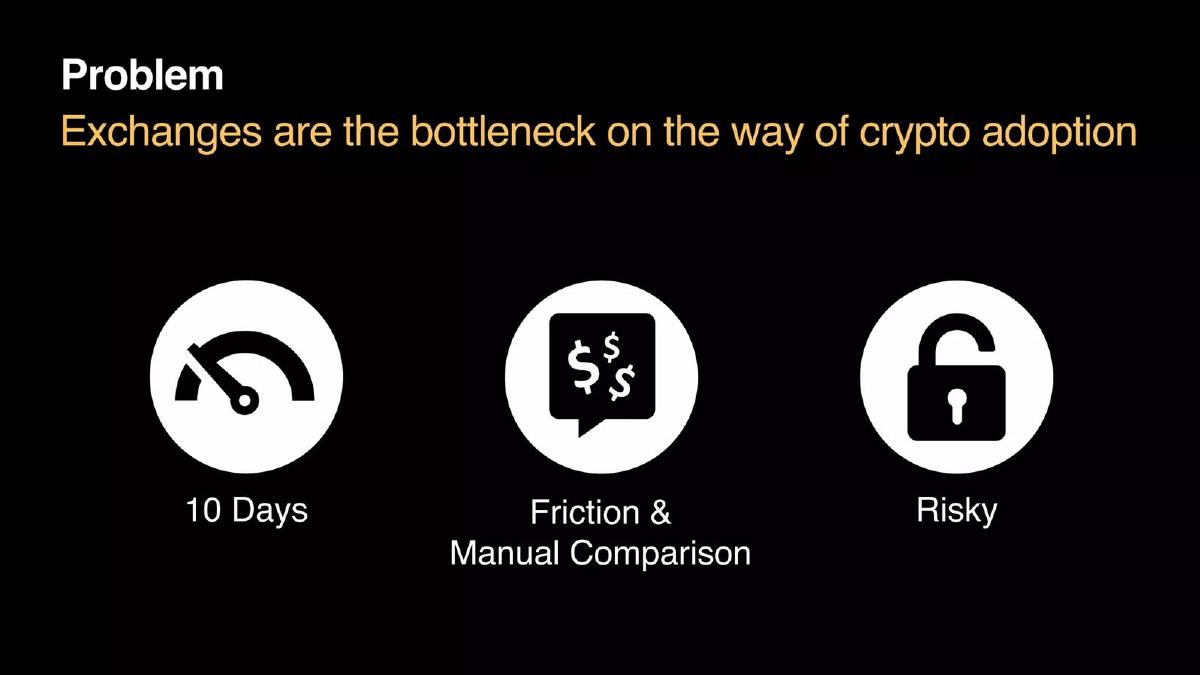
After: Buying crypto takes [user] up to 10 days: [step] and [step]. Comparing rates across [number] exchanges is manual.
What improved: Our illustrative rewrite; the bracketed details are placeholders, not Best Rate's facts. It says what the ten days measure and for whom.
What this guide adds
The general problem slide guide covers any company. Web3 adds a common trap: describing what blockchain can do instead of what a user can't. Investors look for a problem that exists without the technology.
Our library's web3 tag covers crypto exchanges, payments, DeFi funds, blockchain developer platforms and web3 social apps. We note each company's business in the examples.
How we read each slide
We quote the text on the stored slide images. We have not checked any fee, cost, statistic or market claim.
Common mistakes
Starting from the technology. Describe the user's loss, not blockchain's potential.
No user. Say who has the problem.
Unexplained numbers. Say what each figure measures.
Slogans without facts. Back a headline with a cost or example.
Unsourced statistics. Give a source for fee and fraud figures.
Diagnostic checklist
A named user.
A cost, delay or risk with a number.
Why today's option fails.
A problem for each side of a two-sided product.
Sources for figures.
Frequently asked questions
What should a web3 problem slide show?
A specific user's cost, delay or risk today. SIMBA Chain says proofs of concept can cost six figures and gas fees make applications impractical.
Should the problem mention blockchain?
Only if the user's problem is with blockchain itself, as for a developer platform. Otherwise describe a problem that exists without it, like Air Payments' card fees.
Is a strong headline enough?
No. Seam.so's "Ad-driven social sucks" is memorable, but the slide doesn't say who is hurt or by how much.
How we chose these examples
Corpus: published pitch deck teardowns on StartupFundraising.com. Founder-uploaded private decks are excluded.
Selection (2026-09-27): we searched extracted slide text in decks tagged web3 for slides that begin with "problem". 21 slides matched; we reviewed those with stored images and not used elsewhere.
Kept seven. Left out: Carbon Block p3 (already used in the general problem slide guide), Twilight Coin p3 (deck already used in the web3 product guide), Kandola, Calaxy and Genotik (similar lists without a cost figure), and slides from decks tagged web3 whose problem isn't about crypto or blockchain (Bitdharma, Blockit, PaperStreet, Seedefy, SATT Atayen, the betting app deck, Icaro AI) or that contain template placeholder text (the Bitcoin Company deck). No uploads were requested.
Review: stored slide text and images were checked on 2026-09-27 and matched to company, deck and slide number (editorial model review). No person has yet completed an editorial review of this page.
Claims are as shown on the slides; we have not verified them. We make no claim that any slide caused a fundraising outcome.