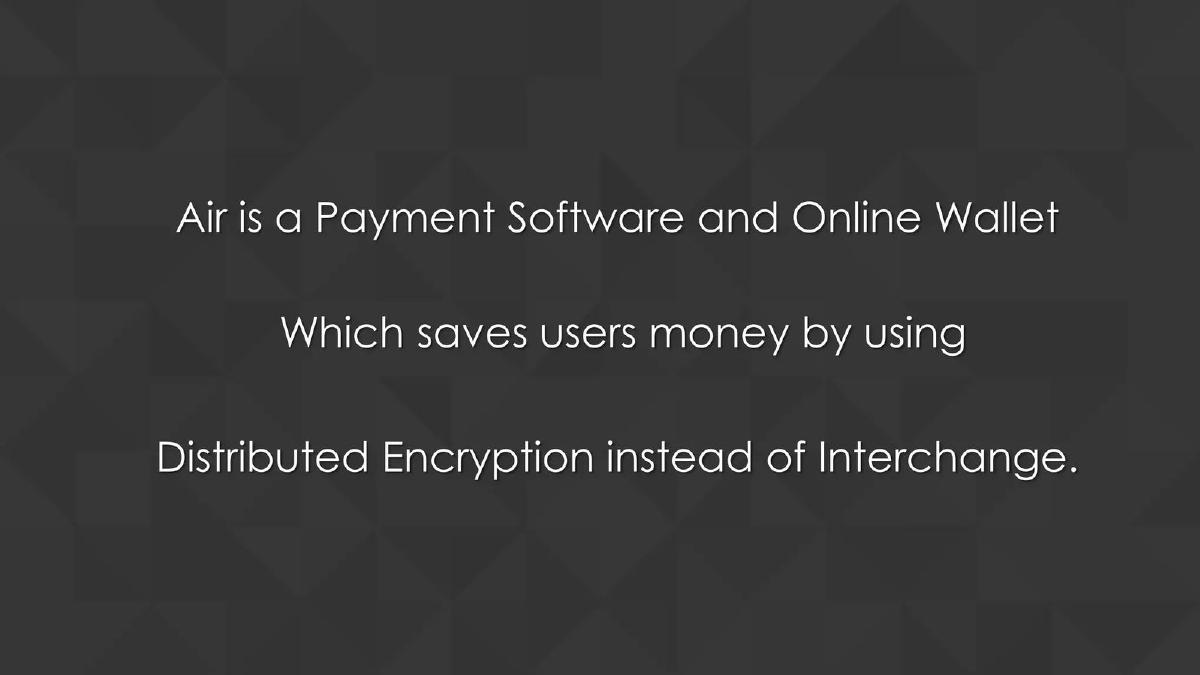
Air Payments (referred to as 'Air' in the slides) positions itself as a disruptive force in the fintech sector, specifically targeting the 'interchange' problem. The deck argues that current payment systems are burdened by 2-5% fees and security vulnerabilities, citing 400 million stolen cards in the US on slide 2. Air proposes a blockchain-based universal wallet that claims to offer 10x higher rewards than traditional banks (slide 4) and operates below the 'interchange limit' with 1% instant transactions (slide 5). While the deck provides specific growth projections for potential partners li…
Key takeaways
- The core problem identified is the 'Interchange' system, which Air claims creates a cost/security chokepoint with no encryption (Slide 2).
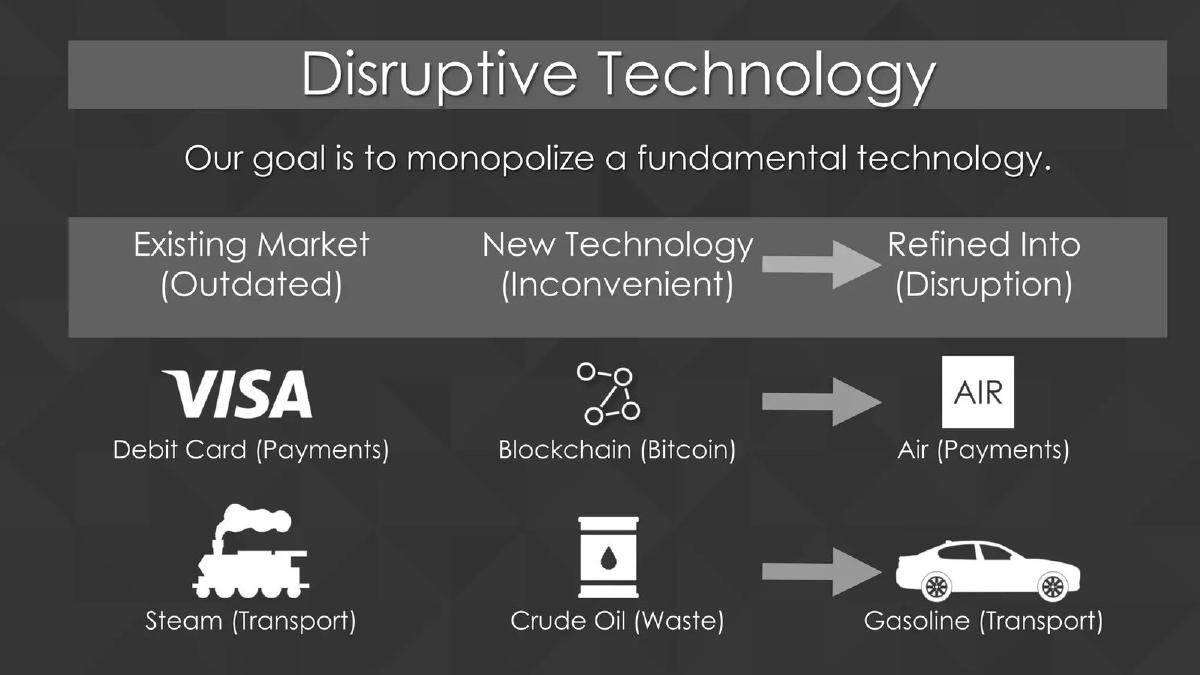
- Air aims to 'monopolize a fundamental technology' by refining blockchain into a consumer-ready payment disruption (Slide 3).
- The product is described as a 'universal wallet' that replaces online shopping carts and stores receipts on the cloud (Slide 4).
- Air positions itself as the only payment system below the 'interchange limit,' offering 1% instant transactions compared to 2.9% for Stripe or Square (Slide 5).
- The deck identifies Venmo, Square, and Apple Pay as potential partners rather than just competitors (Slide 5).
- Financial projections suggest Air could increase net profit for businesses by an average of 35% (Slide 6).
- The development roadmap shows a progression from a $25,000 prototype phase with 2 employees to a $33,000/month MVP phase with 9 staff members (Slide 7).
- The deck omits a team slide, specific founder backgrounds, and a clear investment 'ask' or valuation (Slides 1-8).
Slide-by-Slide Analysis
Slide 1: Title Slide
The title slide is minimalist, featuring the word 'AIR' in a clean, sans-serif font overlaid on a grayscale image of the Chicago skyline. There is no subtitle, date, or presenter information. While visually professional, it fails to immediately communicate the sector or the specific value proposition of the company.
Slide 2: The Problem: Interchange
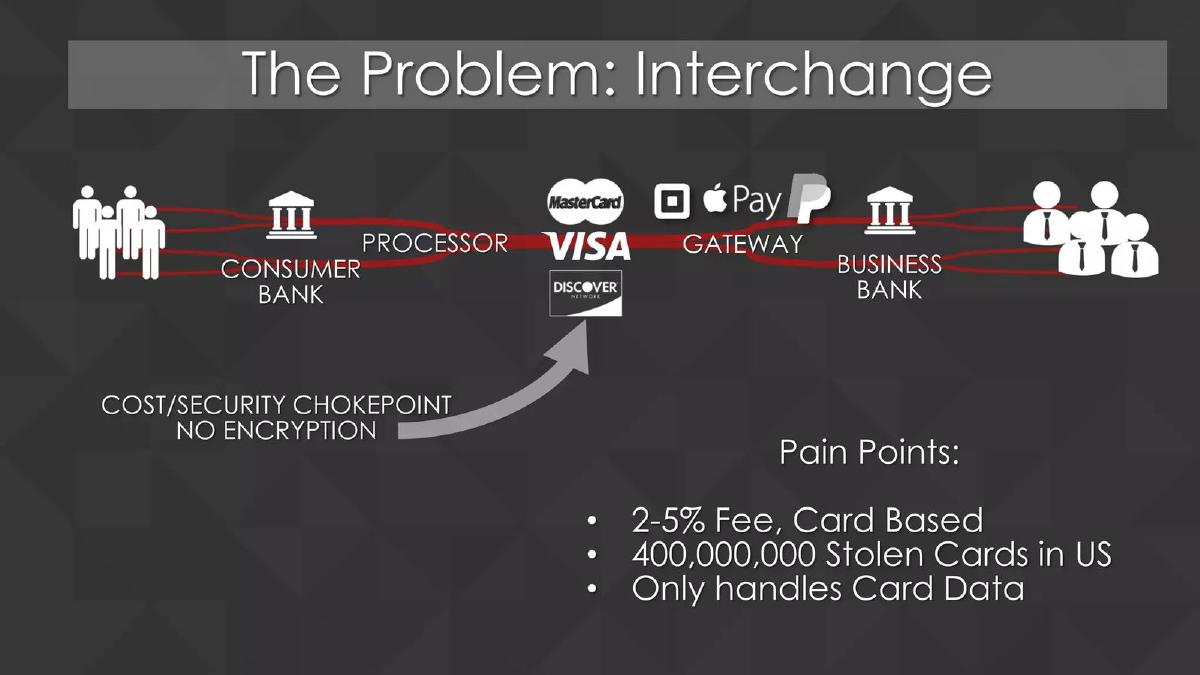
This slide identifies the 'Interchange' system as the primary friction point in global commerce. It uses a flow diagram showing the path from consumer to business, passing through consumer banks, processors (Visa, Mastercard, Discover), gateways (Square, Apple Pay, PayPal), and business banks. The slide claims this process is a 'cost/security chokepoint' with 'no encryption.' It lists three specific pain points: 2-5% fees, 400,000,000 stolen cards in the US, and the limitation that the system 'only handles card data.'
Slide 3: Disruptive Technology
Air explicitly states its goal: 'to monopolize a fundamental technology.' The slide uses a comparative framework to explain its role in the market. It compares the transition from Steam to Gasoline in transport to the transition from Debit Cards to Air in payments. It categorizes Blockchain (Bitcoin) as 'Inconvenient' new technology and positions Air as the 'Refined' version that will cause 'Disruption.' This is a high-level conceptual slide that lacks technical depth but clearly communicates the company's ambition to be the 'gasoline' of the blockchain era.
Slide 4: For Their Customers: Online Wallet
This slide focuses on the user experience. It claims Air replaces traditional online shopping carts with '1 universal wallet.' Key features listed include average rewards ~10x higher than a bank, full encryption, cross-device compatibility, and cloud-stored receipts. The slide includes UI mockups showing a 'Network Contribution' dashboard, a search function for the 'AIR Network' (featuring Papa John's as an example), and a transaction history. The balance shown in the mockup is $5634.25.
Slide 5: Positioning
This is a standard 2x2 matrix, though formatted as a quadrant curve. The Y-axis measures 'Net Cost / Transaction Time' (ranging from 1% Instant to 4% >3 Days) and the X-axis measures 'Convenience/Features.' Air is positioned in the top-right corner, described as the 'only payment system below the interchange limit.' The slide plots competitors like Stripe, PayPal, and Visa above the 2% cost line. Interestingly, it marks Venmo, Square, and Apple Pay with yellow circles, indicating they are 'Potential Partnerships' rather than direct threats.
Slide 6: Growth Potential
This slide provides specific financial projections for four hypothetical or target partners. It claims an average net profit increase of +35% for businesses using Air. The table breaks down 'Annual Savings,' 'Expected Adopt Rate,' and 'Total Air Revenue' over three years for Ticketsnow, Raise, Grubhub, and Groupon. For example, it projects that by Year 3, Groupon could see $13,248,000 in annual savings with a 23.31% adoption rate, generating $63,798,000 in revenue for Air. The slide notes that projections include all subsidies and incentives.
Slide 7: Development Progress and Budget
This roadmap slide splits the company's timeline into 'Past Stages' and 'Future Stages.' Past stages include a blockchain-based Proof of Concept and a Prototype/Alpha phase that cost $25,000 with 2 employees. The future stages are detailed with monthly burn rates: Private Beta ($10,000/mo, 3 employees), Public Beta ($20,000/mo, 4 employees + 2 interns), and a Revenue-Ready MVP ($33,000/mo, 5 employees + 4 interns). This is the most granular slide in the deck regarding operations, though it still lacks a specific 'Ask' for a total investment round.
Slide 8: Closing Slide
The deck concludes with a repeat of the title slide. There is no contact information, no 'thank you' note, and no call to action. This is a significant omission for a fundraising document, as it leaves the investor without a clear next step or a way to reach the founders.
What Works Well
Clear Problem Identification: Slide 2 does an excellent job of visualizing the complexity of the current payment ecosystem. By labeling the traditional processors as a 'chokepoint,' the founders create a clear enemy for their solution to defeat. The inclusion of the '400,000,000 stolen cards' statistic adds a sense of urgency and a tangible security justification for their blockchain approach.
Ambitious Positioning: Slide 5 is a strong competitive analysis. Instead of just saying they are better than everyone, they define a specific boundary—the 'Interchange Limit'—and show that they are the only ones operating beneath it. Categorizing major players like Square and Apple Pay as potential partners rather than competitors is a savvy way to mitigate the perceived risk of being crushed by incumbents.
Granular Operational Roadmap: Slide 7 provides a refreshing level of detail regarding how the company plans to spend money. By breaking down the headcount and monthly costs for each stage (Private Beta, Public Beta, MVP), they demonstrate a disciplined approach to scaling and a clear understanding of their short-term capital requirements.
What is Missing
The Team Slide: This is the most glaring omission. In early-stage startup investing, the team is often more important than the idea. There is no mention of who the founders are, their technical expertise in blockchain, or their experience in the highly regulated payments industry. Without this, investors cannot assess the 'execution risk.'
The Ask: While Slide 7 mentions monthly burn rates, the deck never explicitly states how much money they are looking to raise, what the valuation is, or what the specific milestones for the funding round will be. A pitch deck is a sales tool; failing to ask for the 'sale' is a fundamental error.
Regulatory and Compliance Strategy: Payments is one of the most heavily regulated industries in the world. The deck mentions 'monopolizing a fundamental technology' and bypassing banks, but it does not address how they will handle KYC (Know Your Customer), AML (Anti-Money Laundering), or money transmitter licensing. For a fintech deck, this is a critical missing piece of the puzzle.
Technical Depth: The deck relies heavily on analogies (Slide 3). While analogies are good for high-level understanding, a blockchain company needs to provide at least a high-level overview of its consensus mechanism, scalability, or how it achieves 'Full Encryption' while maintaining 'Instant' transactions. The 'Prototype' screenshot on Slide 7 is too small to provide meaningful technical insight.
What a Founder Should Copy
The 'Interchange Limit' Concept: Founders in crowded markets should look for a 'hard line' in their industry—a cost, a speed, or a technical limitation that no one else has crossed—and position themselves as the sole occupant of the space beyond that line. It creates a very simple, binary value proposition for investors.
Partner Projections: Slide 6 is a great example of how to make a product feel real. By naming specific, well-known companies (Grubhub, Groupon) and modeling exactly how much money those companies would save, the founders move the conversation from 'what if' to 'how much.' This makes the 'Growth Potential' feel tangible rather than theoretical.
Visualizing the Ecosystem: The flow chart on Slide 2 is a masterclass in explaining a complex industry quickly. Founders tackling 'middleman' industries should use similar diagrams to show exactly where they are cutting out the fat. It makes the 'disruption' claim much more believable when you can see the specific nodes being bypassed.
Frequently asked questions
- What is the primary value proposition for merchants?
- According to slide 6, the primary value proposition is a significant increase in net profit, averaging +35%. Air achieves this by bypassing the traditional interchange fee structure, which they claim costs merchants 2-5% per transaction. By offering a 1% instant transaction fee, Air projects that a company like Groupon could see over $63 million in total Air-related revenue by Year 3 of adoption.
- How does Air differentiate its technology from Bitcoin?
- Slide 3 uses a 'Crude Oil to Gasoline' analogy. It classifies Bitcoin and general blockchain technology as 'New Technology' that is currently 'Inconvenient.' Air positions its own platform as the 'Refined' version of this technology, intended to turn a raw, difficult-to-use tool into a seamless 'Disruption' for the payments market, much like gasoline refined the utility of crude oil for transport.
- What are the specific security claims made in the deck?
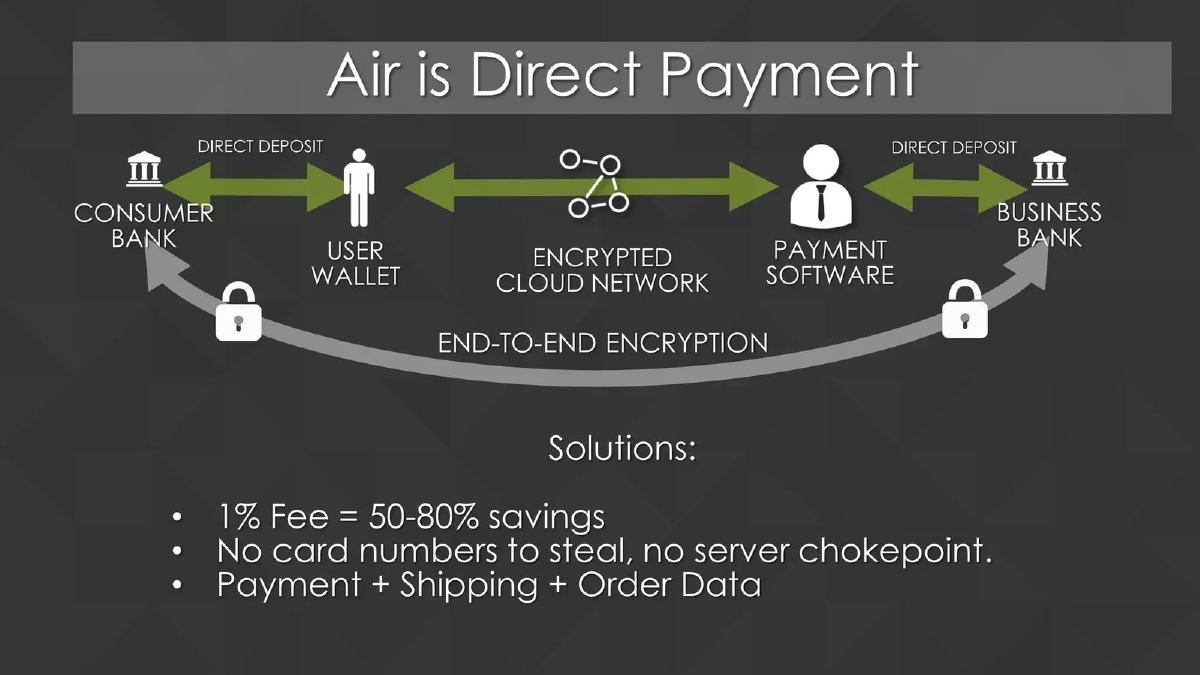
- Slide 2 highlights that the current system has 'No Encryption' at the interchange chokepoint and notes there are 400,000,000 stolen cards in the US. In contrast, slide 4 claims that the Air Online Wallet offers 'Full Encryption' and stores all receipts on the cloud, implying a superior security architecture based on its blockchain foundation.
- What does the development roadmap reveal about the company's stage?
- Slide 7 indicates the company is in the transition between 'Past Stages' and 'Future Stages.' It shows they have completed a prototype and Alpha 1/2 phases with a $25,000 budget. The roadmap looks forward to a Private Beta ($10k/mo), Public Beta ($20k/mo), and a 'Revenue-Ready' MVP requiring $33,000 per month and a team of 5 employees plus 4 interns.
- Who are the target partners for Air Payments?
- Slide 6 specifically names and provides projections for four major digital platforms: Ticketsnow, Raise, Grubhub, and Groupon. Additionally, slide 5 identifies Venmo, Square, and Apple Pay as 'Potential Partnerships,' suggesting that Air intends to act as a backend rails provider for existing consumer-facing payment apps rather than purely competing for the front-end user interface.