Aurora is a Singapore-based edtech startup targeting the $5 billion global K-12 assessment market. Their core product is an AI-powered authoring tool that generates educational questions from text content in seconds, aiming to reduce the traditional 3-month content creation timeline. The deck highlights a clear B2B focus, targeting publishers and tutoring chains with an enterprise subscription model priced at $2,000-$5,000 per subject per month. While the technology currently addresses lower-tier cognitive levels (Remember, Understand, Apply), their roadmap outlines a transition toward higher…
Key takeaways
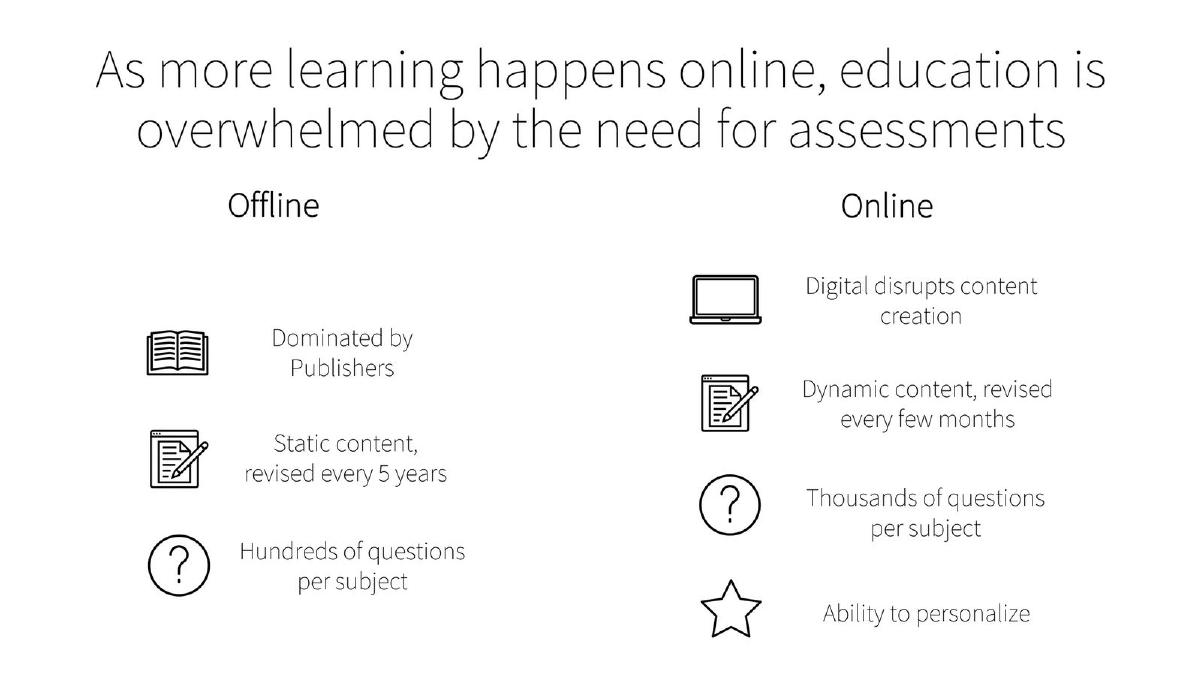
- The company identifies a massive bottleneck in digital education where content is revised every few months but assessment creation takes 3+ months (Slide 2, 4).
- Aurora's tool generates questions in 10 seconds, compared to the 20 minutes to 2 hours required for manual human creation (Slide 14).
- Traction includes one paid pilot with a digital textbook platform and advanced discussions with three of the top 10 global publishers (Slide 8).
- The market size for global K-12 assessments is estimated at $5 billion, within a broader $9 billion content creation market (Slide 11).
- Pricing is tiered, with Enterprise plans ranging from $2,000 to $5,000 per subject per month, featuring custom-trained algorithms (Slide 13).
- The product currently generates Tier 1-3 questions on Bloom's Taxonomy, with a roadmap to include higher-order analysis and evaluation (Slide 7, 9).
- The founders have relevant domain expertise, including a CEO with a Harvard Masters in Education and a CTO with 7 years of AI product experience (Slide 15).
- The $1 million SGD ask is primarily allocated to building the core tech team (70%) to reach 10-15 enterprise customers (Slide 16, 17).
Executive Summary and Value Proposition
Slides 1-2: The Problem of Scale in Digital Learning
Aurora introduces itself on Slide 1 as an AI-powered authoring tool for K-12 quality assessments. The core thesis, presented on Slide 2 , is that the shift from offline to online learning has created a content bottleneck. While offline content is static and revised every five years, online education requires dynamic content revised every few months. This creates a need for thousands of questions per subject and the ability to personalize learning, which current manual methods cannot sustain.
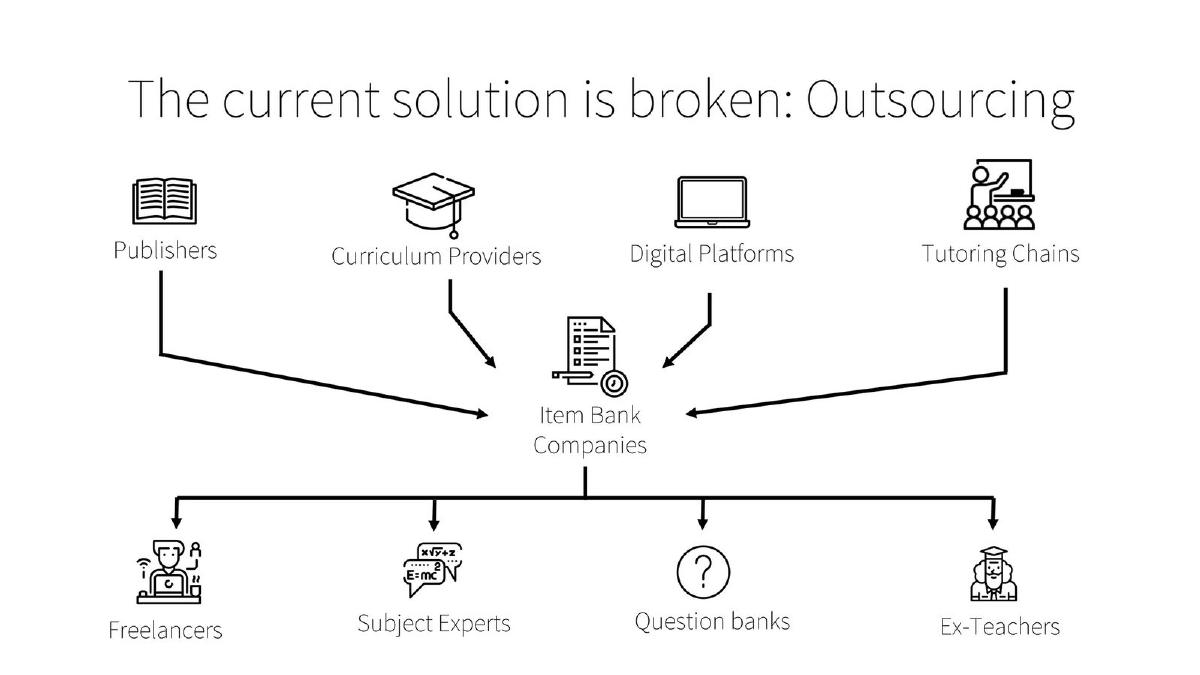
Slides 3-4: The Broken Outsourcing Model
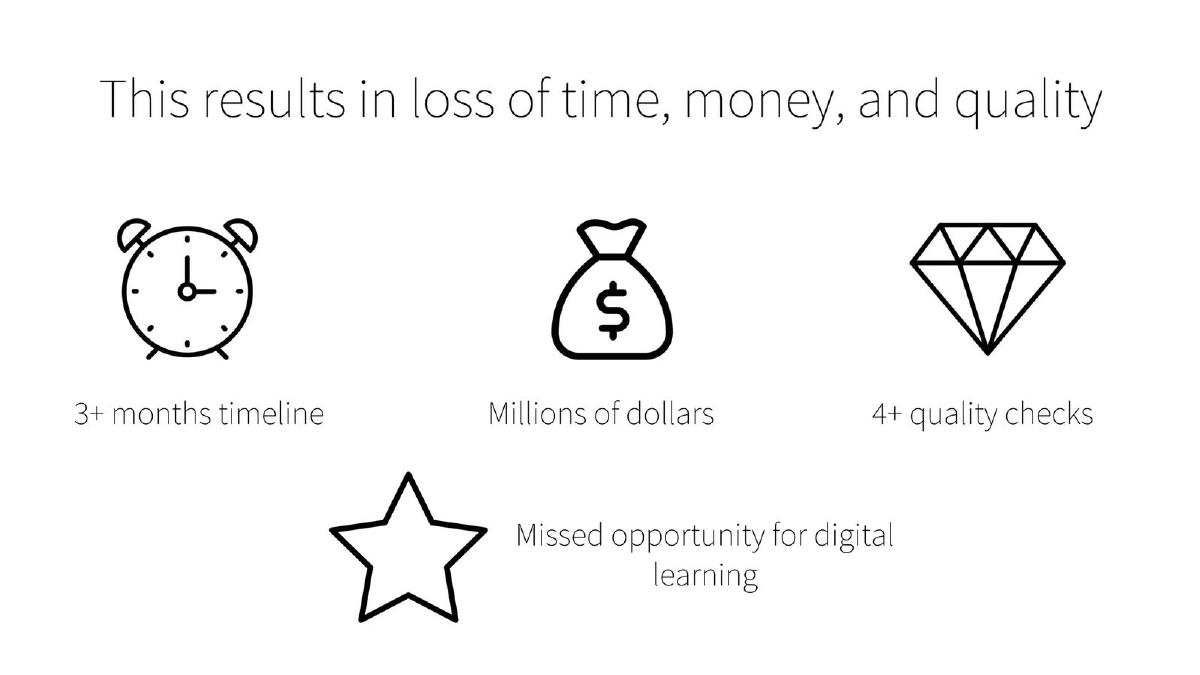
Slide 3 maps out the current ecosystem, showing how publishers, curriculum providers, and tutoring chains rely on 'Item Bank Companies.' These companies, in turn, manage a fragmented workforce of freelancers, subject experts, and ex-teachers. Slide 4 quantifies the pain points of this model: a timeline of over three months, costs in the millions of dollars, and the requirement for four or more quality checks. The slide characterizes this as a 'missed opportunity for digital learning.'
The Aurora Solution
Slides 5-6: AI-Driven Authoring
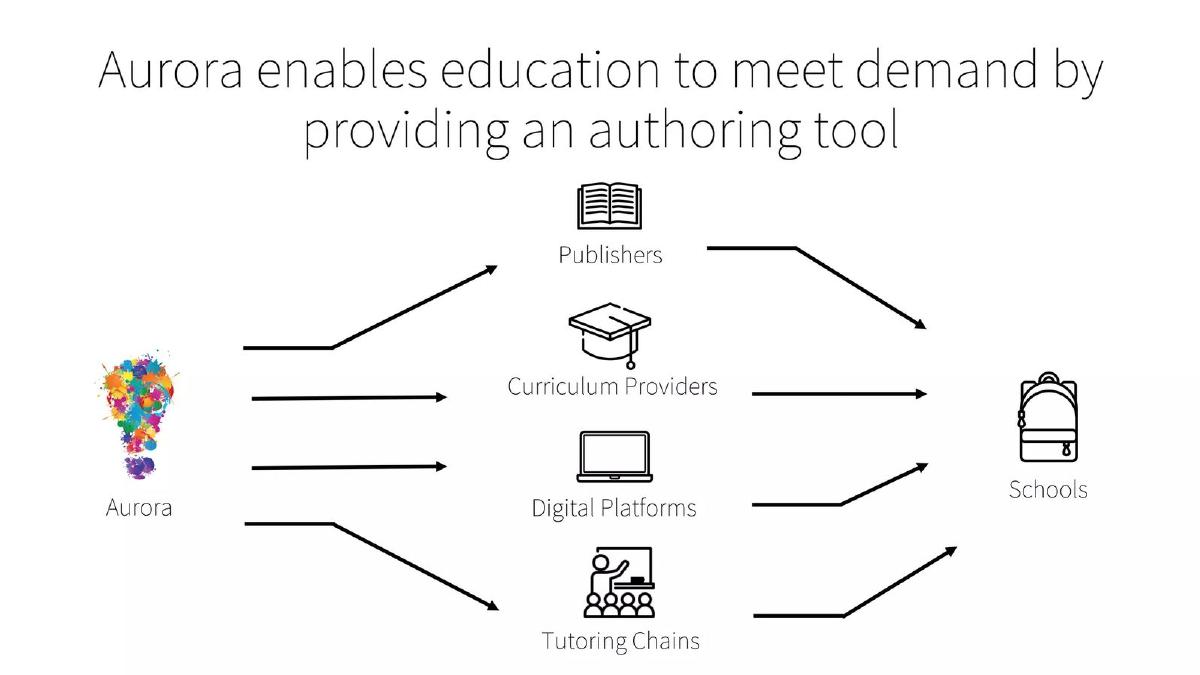
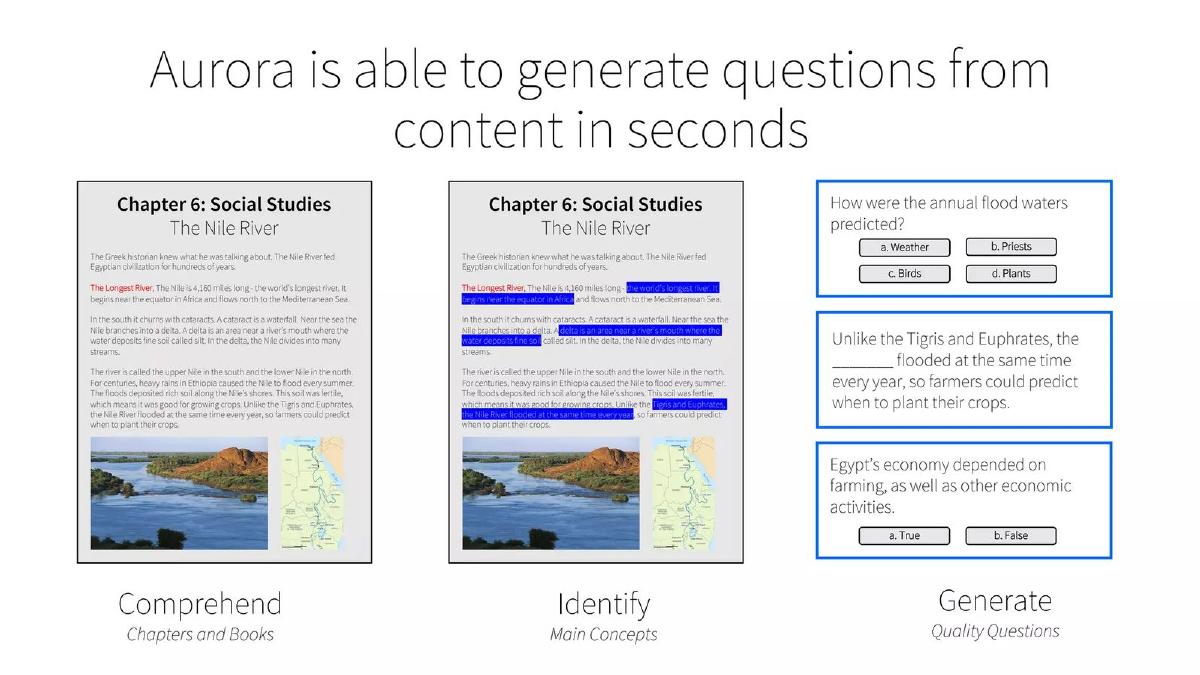
Slide 5 illustrates Aurora's position as a direct authoring tool that feeds content to publishers and tutoring chains, who then deliver it to schools. Slide 6 provides a product demonstration, showing how the AI 'Comprehends' a chapter (using a Nile River social studies example), 'Identifies' main concepts, and 'Generates' quality questions including multiple-choice and fill-in-the-blank formats in seconds.
Slide 7: Alignment with Educational Standards
To address quality concerns, Slide 7 references Bloom's Taxonomy. The deck admits that the tool is currently 'Able to generate tier 1-3 questions today,' which covers the 'Remember,' 'Understand,' and 'Apply' levels of cognitive complexity. This honesty is a strength, as it sets realistic expectations for the current state of the AI while acknowledging the higher tiers (Analyse, Evaluate, Create) as the ultimate goal.
Traction and Market Opportunity
Slide 8: Current Traction
The company demonstrates early market validation on Slide 8 . They cite one paid pilot with a digital textbook platform (Opiq), usage by 100 teachers at a 'Global Middle School' (referencing Singapore American School and Frankfurt International School), and advanced discussions with three of the top 10 global publishers, specifically showing the logos of Oxford University Press and McGraw Hill Education.
Slides 9-10: The Two-Year Roadmap
Slide 9 details the product roadmap from 2019 to 2021, highlighting milestones like English Language Learning worksheets, image-based questions, and grading subjective answers. Slide 10 focuses on customer milestones, aiming to secure three of the top 10 global publishers and grow to 10 enterprise customers by 2021. The pipeline is stated to include over 90 education enterprises.
Slides 11-12: Market Size and Breakdown
Slide 11 defines the Total Addressable Market (TAM). The global K-12 assessment market is valued at $5 billion , within a larger $9 billion market for grading and content creation. Slide 12 provides a granular breakdown of the spend: Top Publishers ($400M), Digital Publishers ($750M), Content Providers ($3B), and Tutoring Chains ($3B). The slide notes that individual top publishers spend roughly $20 million annually on assessment creation.
Business Model and Competition
Slide 13: Subscription Pricing
Aurora utilizes a tiered SaaS model. The 'Enterprise' tier is the primary focus, priced at ~$2-5K per subject per month , featuring custom-trained algorithms on customer data. A 'Pro' tier for individuals is priced at $10 per month for unlimited questions, while a 'Freemium' tier offers limited questions to drive user acquisition.
Slide 14: Competitive Differentiation
Slide 14 compares Aurora against traditional human creation, tech-enhanced tools (Kahoot!, Learnosity), and other AI-assisted tools (Quillionz, Cerebry). Aurora claims the same volume as other AI tools (8,000 questions per day) but distinguishes itself through 'Higher Order Thinking questions' and a strict B2B focus, whereas competitors are noted as B2C.
Team and Fundraising Ask
Slide 15: The Founders
The team slide features two founders. Karishma Galani (CEO) holds a Masters in Education from Harvard and has authored two education books. Ramsri Golla (CTO) holds a Masters from Arizona State University and has seven years of experience building AI products in Silicon Valley, including patented machine learning algorithms. The mix of pedagogical expertise and technical AI experience is a strong signal for this specific product.
Slides 16-18: The $1M SGD Ask
Slide 16 states the fundraising goal: $1 million SGD . The allocation is 70% for the core tech team, 20% for enterprise sales, and 10% for marketing. Slide 17 sets the 18-month target: 10-15 enterprises, $50-60K/month in revenue , and a team of 10. The final slide provides contact information and notes backing from Entrepreneur First and SGInnovate, with an HQ address in Singapore.
What Works and What is Missing
What Works
Clear Problem Definition: The deck successfully argues that manual content creation is the primary bottleneck for digital education scaling. · Pedagogical Grounding: Using Bloom's Taxonomy (Slide 7) speaks the language of their target B2B customers (publishers and schools). · Granular Market Data: Slide 12 breaks down the market by customer type and individual spend, showing a deep understanding of the industry's wallet. · Founder-Market Fit: The combination of a Harvard M.Ed and a Silicon Valley AI engineer is highly credible for an AI-Edtech play.
What is Missing
Unit Economics: While pricing is shown, there is no mention of Customer Acquisition Cost (CAC) or Lifetime Value (LTV), which are critical for SaaS investors. · Churn/Retention Data: The deck mentions a pilot with 100 teachers but does not provide data on how often they use the tool or the quality of the generated questions from their perspective. · Technical Moat: Beyond 'custom trained algorithms,' the deck does not explain how their AI is fundamentally different or better than the competitors listed on Slide 14 who also generate 8k questions a day. · Language Support: The deck focuses on English; there is no mention of whether the AI supports other languages, which is a significant factor in the 'Global' market they claim to target.
Founder Takeaways
Be honest about product limitations: Aurora's admission that they only handle the first three tiers of Bloom's Taxonomy builds trust. Don't claim your AI can do everything if it's still in development. · Map the ecosystem: The flowchart on Slide 3 is an excellent way to show investors you understand the complex web of vendors and buyers in your industry. · Quantify the 'Old Way': By stating that humans take 20 minutes to 2 hours per question while the AI takes 10 seconds, the value proposition becomes undeniable.
Frequently asked questions
- What specific problem is Aurora solving in the edtech space?
- Aurora addresses the 'broken' outsourcing model of assessment creation. Currently, publishers and tutoring chains rely on a slow network of freelancers and subject experts to build question banks. This process is expensive, takes over three months, and requires at least four quality checks. Aurora replaces this manual workflow with an AI authoring tool that generates questions from digital content almost instantly.
- How does Aurora's technology compare to existing AI competitors?
- According to slide 14, Aurora differentiates itself by focusing on 'Higher Order Thinking' questions and a B2B model. While competitors like Quillionz and Cerebry generate 8,000 questions per day at 10 seconds per question, Aurora claims their method produces higher-quality questions that align better with educational standards, specifically targeting the B2B sector rather than B2C.
- What is the current state of Aurora's product development?
- As of the deck's publication, the tool is capable of generating questions for the first three tiers of Bloom's Taxonomy: Remember, Understand, and Apply. The product roadmap indicates that they began testing with 100 teachers in Q3 2019 and planned to expand into science and social studies, as well as subjective answer grading, throughout 2020 and 2021.
- What are the financial goals for the 18 months following the seed round?
- Aurora aims to reach a monthly revenue run rate of $50,000 to $60,000. To achieve this, they plan to secure 10 to 15 enterprise customers. The team is projected to grow to 10 members, with a heavy emphasis on engineering (6 tech roles) supported by sales and product management.
- Who are the key investors and partners supporting Aurora?
- The deck notes that Aurora is backed by Entrepreneur First and SGInnovate. They are also members of the AWS EdStart program, an educational technology startup accelerator. These partnerships provide the company with institutional credibility and technical infrastructure support as they scale their AI offerings.