Edgar is a creative marketplace and toolset designed to help Small and Medium Businesses (SMBs) move away from traditional static advertising toward narrative-driven content. The deck identifies a massive inefficiency in the $107,000 average yearly advertising spend per SMB, claiming that 99% of this is wasted due to market noise. Edgar operates a 'StoryMarket' where it takes a 30% commission on transactions, supplemented by storytelling tools. At the time of the deck's creation in late 2014, the company reported 21 clients and a 62% monthly user growth rate. While the deck excels at establis…
Key takeaways
- The company uses a bold 'Uber for X' hook, specifically calling themselves 'Uber for brand stories' on slide 1.
- Edgar targets a market of 48 million SMBs in the US and EU, citing an average annual ad spend of $107,000 per business on slide 2.
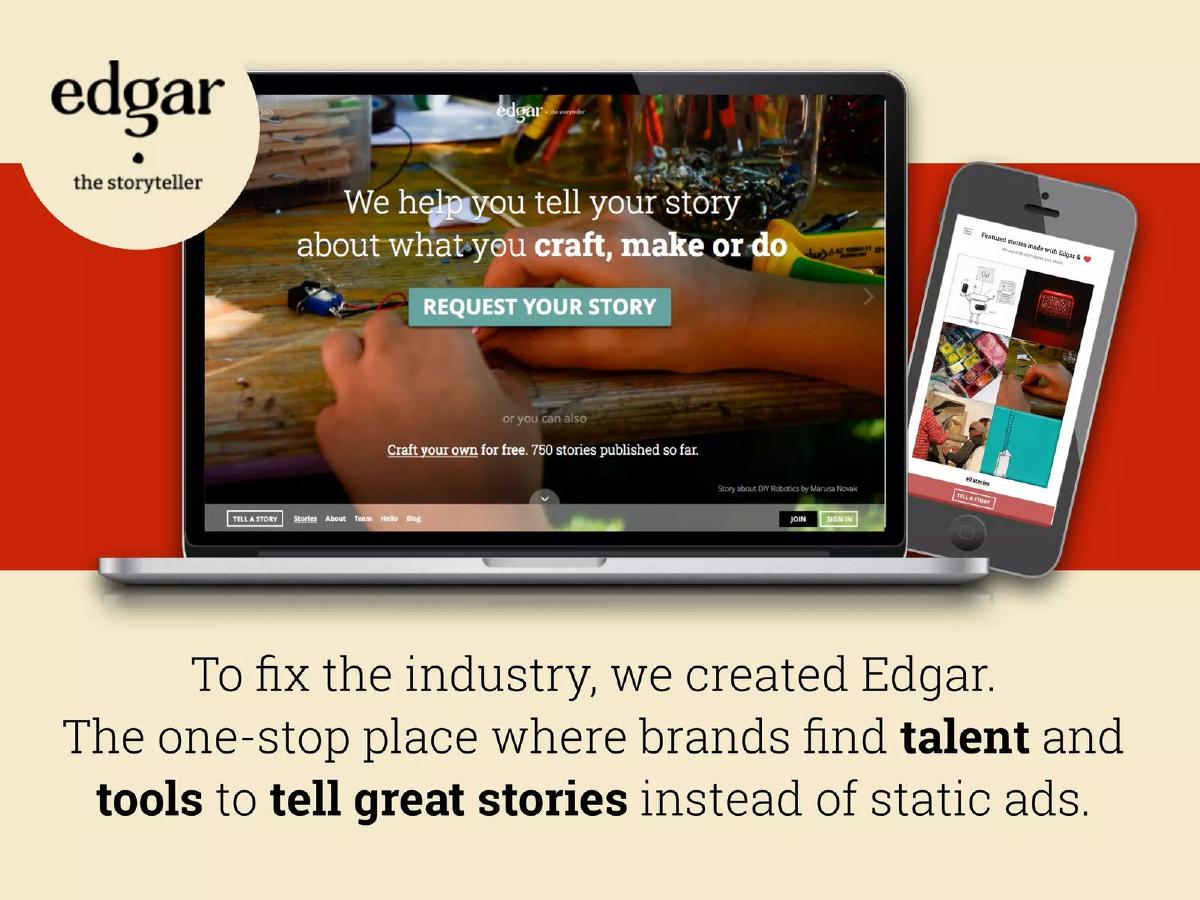
- The platform has already published 750 stories as of the product reveal on slide 5.
- The business model relies on a 30% commission on 'StoryMarket' transactions plus revenue from storytelling tools, as shown on slide 9.
- Early traction metrics include 21 clients since June 2014 and an average revenue of $3,500 per month since May 2014 (slide 9).
- The deck claims a 62% monthly user growth rate on slide 9, though it does not define what constitutes a 'user' in this context.
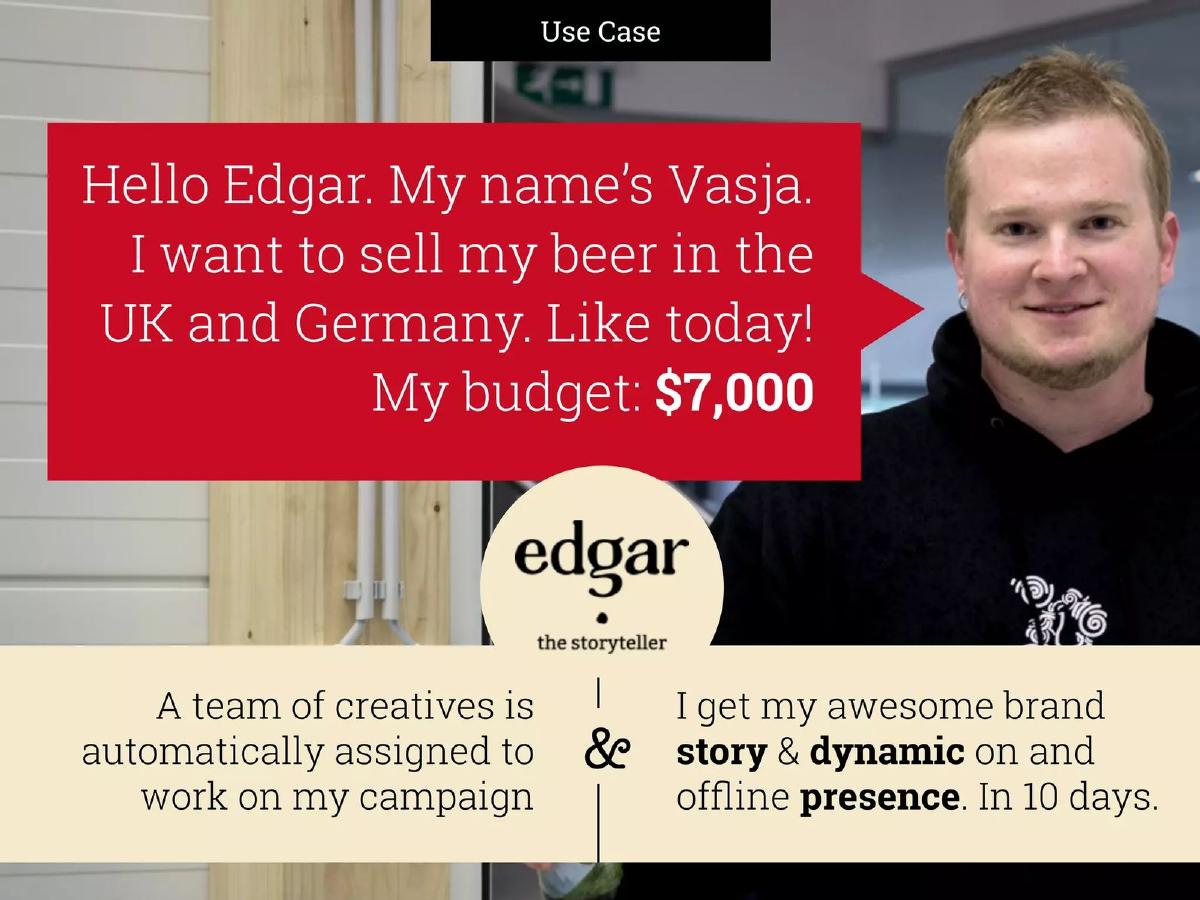
- A specific use case on slide 6 demonstrates a $7,000 budget campaign that was executed in 10 days.
- The seed round was scheduled to begin in September 2014, according to slide 10, though the target raise amount is omitted.
The Hook and the Industry Problem
Slide 1: Title and High-Level Concept
The deck opens with a minimalist aesthetic, featuring the brand name "Edgar" and the URL "edgartells.me." The central hook is a classic 'X for Y' construction: "We are Uber for brand stories." This immediately signals a marketplace model where supply (creatives) is matched with demand (brands) via an automated or semi-automated platform. The character illustration in the bottom right suggests a whimsical, approachable brand personality.
Slide 2: The Broken Industry
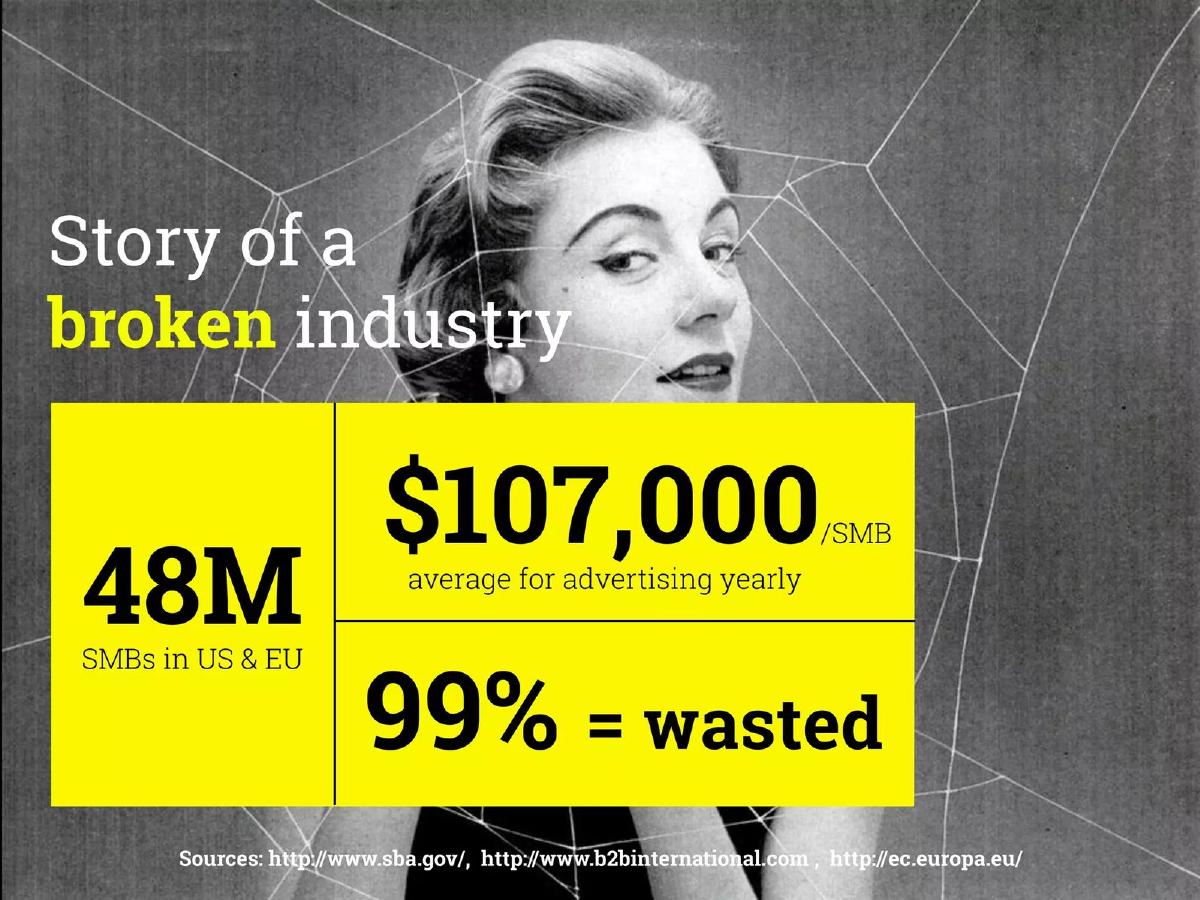
Slide 2 establishes the scale of the problem. It cites 48 million SMBs in the US and EU, with an average yearly advertising spend of $107,000 per SMB. The most striking figure is the claim that "99% = wasted." By citing sources like the SBA and the European Commission, the founders attempt to ground this massive inefficiency in external data, framing the current advertising landscape as fundamentally "broken."
Slide 3: Market Noise
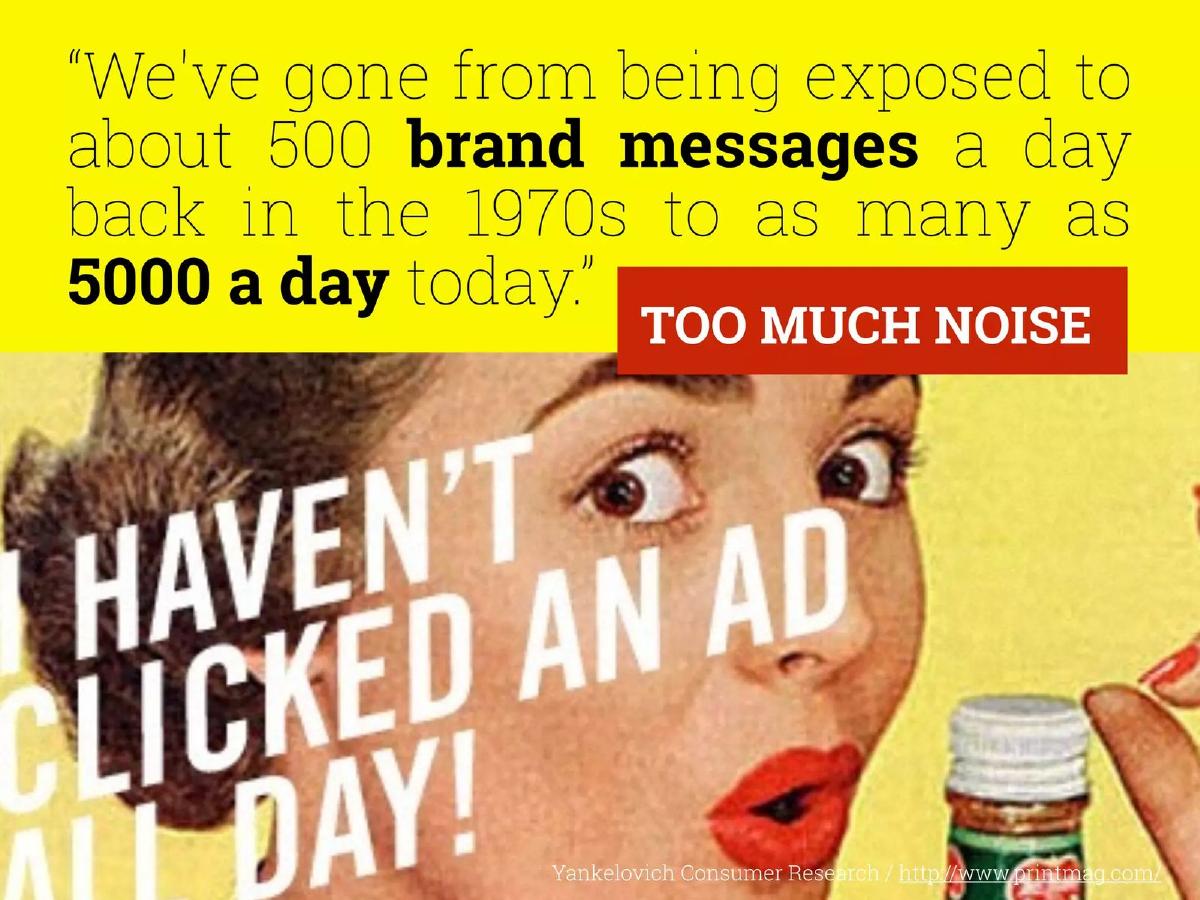
This slide provides the psychological justification for why advertising is failing. It quotes Yankelovich Consumer Research, stating that brand message exposure has grown from 500 per day in the 1970s to 5,000 per day today. The red banner "TOO MUCH NOISE" and the overlay "I HAVEN'T CLICKED AN AD ALL DAY!" emphasize consumer fatigue and the declining efficacy of traditional digital advertising.
Slide 4: The Opportunity
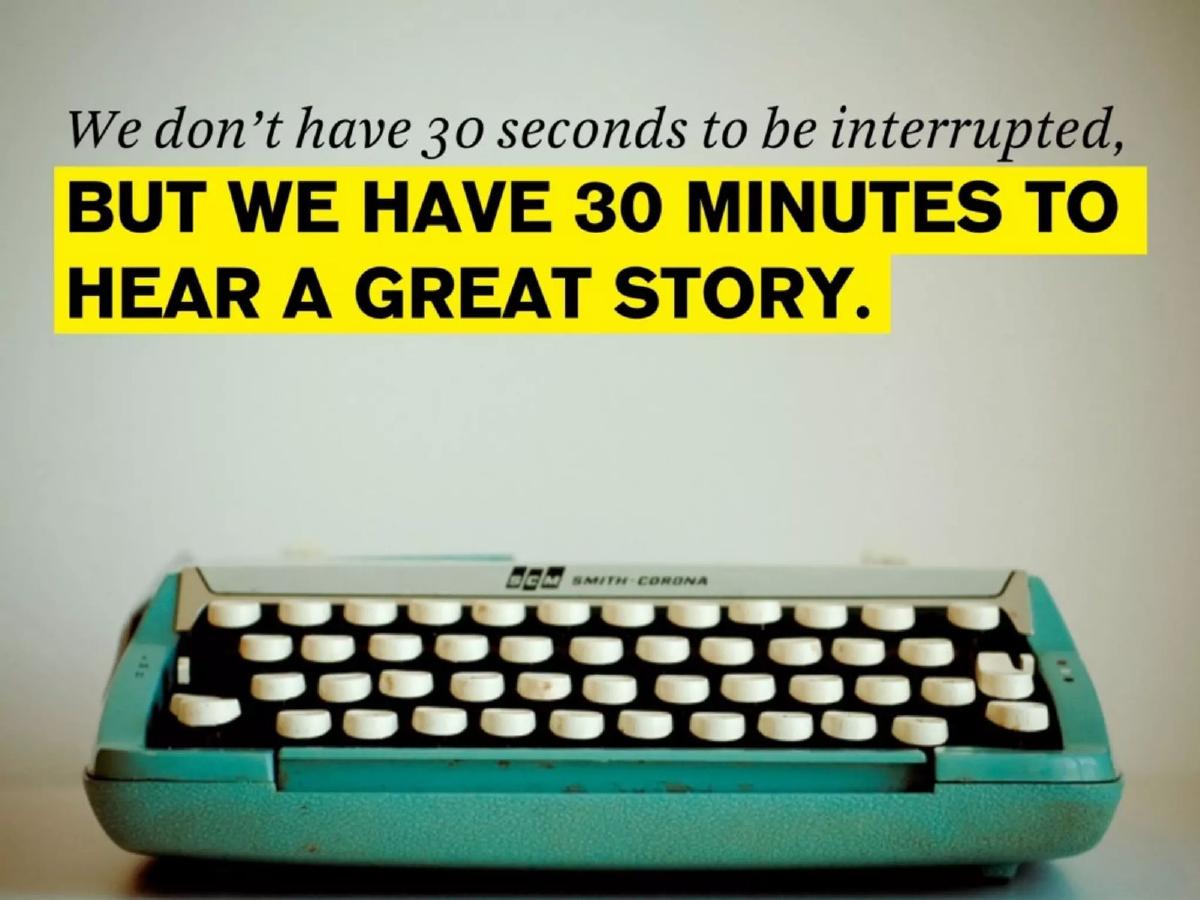
Slide 4 presents the pivot from ads to stories. It contrasts time spans: "We don't have 30 seconds to be interrupted, BUT WE HAVE 30 MINUTES TO HEAR A GREAT STORY." This sets the stage for Edgar's solution, suggesting that narrative content can bypass the filters consumers have built against traditional advertising.
The Solution and Product
Slide 5: Introducing Edgar
The solution slide shows the product interface on both a laptop and a smartphone. The tagline describes Edgar as a "one-stop place where brands find talent and tools to tell great stories instead of static ads." A key metric is tucked into the subtext: "750 stories published so far." This indicates the platform is live and has achieved initial volume before the seed round.
Slide 6: Use Case - The Beer Campaign
To make the marketplace concept concrete, slide 6 introduces a specific persona: Vasja, an Austrian brewer with a $7,000 budget who wants to sell beer in the UK and Germany. The slide explains the workflow: a team of creatives is "automatically assigned" to the campaign, delivering a brand story and presence in 10 days. This slide is crucial for explaining the "Uber for brand stories" claim, showing the speed and automation of the service.
Slide 7: Results and Performance
Following the use case, slide 7 displays the results of the aforementioned campaign. It claims a "98% higher conversion rate" and a "12x higher share rate." While the baseline for these comparisons isn't explicitly stated (presumably compared to traditional ads), the magnitude of the numbers is intended to prove the ROI of the storytelling approach.
Slide 8: Social Proof and Testimonials
Slide 8 features three testimonials. Vasja Golar (the brewer from the use case) praises the ease of communication. Marko Brumen (a festival producer) mentions that Edgar provided "5 writers and a designer for 2 weeks." Dr. Kristjan Kosic (CEO of Adora) notes that Edgar helped design a "slick slide deck." These testimonials confirm that Edgar's output ranges from social media content to professional presentations.
Business Model and Team
Slide 9: The Business Model and Traction
This is the most data-dense slide in the deck. It outlines two revenue streams: a 30% commission on StoryMarket transactions and fees for "powerful tools for brand storytelling." The bottom of the slide lists three traction metrics: 21 clients since June '14, $3,500 average monthly revenue since May '14, and a 62% monthly user growth rate. This shows a company in its very early stages, having been active for only a few months at the time of the pitch.
Slide 10: Founders and The Ask
The final slide introduces the three founders: Damjan Obal, PhD (Product & UX), Maruša Novak (Design & Creative), and Marko Zabreznik (Code & Logic). The roles suggest a balanced team of design, product, and engineering. The "Ask" is stated as "raising our seed round starting September '14." Below the call to action are logos for Google+, the UAE government, Mayo Clinic, and CNN. Without context, it is unclear if these are former employers, clients, or simply brands the founders have worked with in a different capacity.
What Works Well
Clear Problem/Solution Narrative: The deck follows a logical progression from the macro problem (industry waste) to the micro solution (a specific beer campaign). By the time the viewer reaches the business model, the "why" behind the company is well-established.
Specific Use Case: Using "Vasja the brewer" as a recurring character makes the abstract concept of a "storytelling marketplace" tangible. It explains the budget, the timeline (10 days), and the specific output, which is often missing in marketplace pitches.
Consistent Aesthetic: The deck uses a consistent color palette and typography that reflects the company's focus on "creative" and "design." This builds subconscious trust in their ability to deliver the creative services they are selling.
What Is Missing
The Specific Ask: While the deck mentions a seed round, it does not state how much capital is being sought. Investors need to know if the company is looking for $500k or $2M to determine if it fits their mandate.
Competitive Landscape: The deck ignores the existence of other creative marketplaces (like 99designs or Upwork) and content marketing platforms. A slide explaining why Edgar's "automated team assignment" is superior to existing bidding models would be beneficial.
Unit Economics: While the 30% commission is clear, there is no information on the Cost of Customer Acquisition (CAC) or the Lifetime Value (LTV) of these clients. With only 21 clients, these numbers might be early, but a projection would help validate the scalability of the $3,500/month revenue.
Founder Takeaways
Use 'Uber for X' Sparingly: While it works here to describe a marketplace, founders should ensure the rest of the deck proves the automation and supply-side liquidity that the comparison implies. Edgar does this well by showing the "automatically assigned" team in the use case.
Quantify the Waste: If you are disrupting an incumbent industry, quantify the inefficiency. Edgar's claim that 99% of SMB ad spend is wasted is a provocative and effective way to grab attention, provided you have the data (which they cite) to back it up.
Show, Don't Just Tell: Instead of just saying they have a platform, Edgar shows the UI on multiple devices and provides a specific example of a finished product (the beer campaign). This reduces the perceived risk for an investor by proving the product is functional and the output is high-quality.
Frequently asked questions
- What is Edgar's primary value proposition for SMBs?
- Edgar aims to solve the problem of 'ad noise' by replacing static ads with brand stories. According to slide 2, SMBs waste 99% of their $107,000 annual ad spend. Edgar provides a marketplace where brands can find creative talent and tools to produce narrative content that consumers are more likely to engage with, claiming a 98% higher conversion rate in their featured case study on slide 7.
- How does the Edgar marketplace actually work?
- Based on slide 6, the process is automated. A client provides a budget (e.g., $7,000) and a goal. Edgar then automatically assigns a team of creatives to the campaign. The platform promises a 10-day turnaround for a 'dynamic on and offline presence.' Slide 9 clarifies that Edgar takes a 30% commission on these transactions, which occur within their 'StoryMarket.'
- What traction did Edgar have at the time of this pitch?
- Slide 9 lists several key metrics: 21 clients acquired since June 2014, an average of $3,500 in monthly revenue since May 2014, and a 62% monthly user growth rate. Additionally, slide 5 mentions that 750 stories had been published on the platform by the time the deck was finalized.
- Who are the founders and what is their background?
- The team on slide 10 includes Damjan Obal, PhD (Product & UX), Maruša Novak (Design & Creative), and Marko Zabreznik (Code & Logic). While the slide includes logos for Google+, CNN, and Mayo Clinic at the bottom, it does not explicitly state if these are former employers, partners, or clients, which is a common ambiguity in early-stage decks.
- What is missing from the Edgar pitch deck?
- The deck is missing a clear 'Ask'—it mentions raising a seed round in September 2014 but does not specify the dollar amount or the valuation. It also lacks a slide on the competitive landscape, a detailed go-to-market strategy beyond the 'StoryMarket,' and long-term financial projections. The definition of 'users' for the 62% growth metric is also left unexplained.