Fulfilio (now Fulfil.io) presents a compelling case for a centralized 'source of truth' in the fragmented e-commerce operations space. The deck, used for their 2015 seed round, focuses heavily on the pain points of scaling retailers who outgrow basic tools but aren't ready for enterprise-grade ERPs. The narrative is built on the transition from 'organic growth' to a 'deliberate approach,' supported by a staggering 137% net dollar retention rate. While the deck leans heavily on culture and vision in its early slides, the core strength lies in its market segmentation and the clear identificatio…
Key takeaways
- The company reports a 137% net dollar retention rate, indicating significant expansion within existing accounts (Slide 7).
- Fulfilio identifies a 5.5 billion dollar ARR potential within 'strong fit' use cases, specifically targeting logistics and supply chain departments (Slide 9).
- The deck highlights that 54% of current users joined in 2019, showcasing a recent and rapid acceleration in adoption (Slide 7).
- Product stickiness is demonstrated by the fact that 55% of customers use the platform and 18% directly leverage the API (Slide 12).
- The market map places 'Recruiting' and 'Insurance Brokers' as high-workflow, high-email reliance segments (Slide 6).
- The deck omits a traditional team slide, focusing instead on company culture and employee satisfaction metrics like a 94 eNPS (Slide 3).
- Operational efficiency is a core value proposition, aiming to eliminate 'duplicated work' caused by siloed inboxes (Slide 4).
- The platform supports 52 integrations with third parties, positioning it as a central hub for e-commerce operations (Slide 12).
Introduction: The ERP for the Modern Retailer
Fulfilio entered the market at a time when e-commerce was shifting from simple storefronts to complex, multi-channel operations. Their 2015 seed deck, while branded with the 'Front' interface logo in these slides, focuses on the systemic collapse that occurs when a small team grows into a medium-sized enterprise. The narrative is not about selling a feature; it is about selling a 'single point of truth' for businesses that are currently held together by 'human duct-tape.'
Slide 1-3: Culture and Motivation
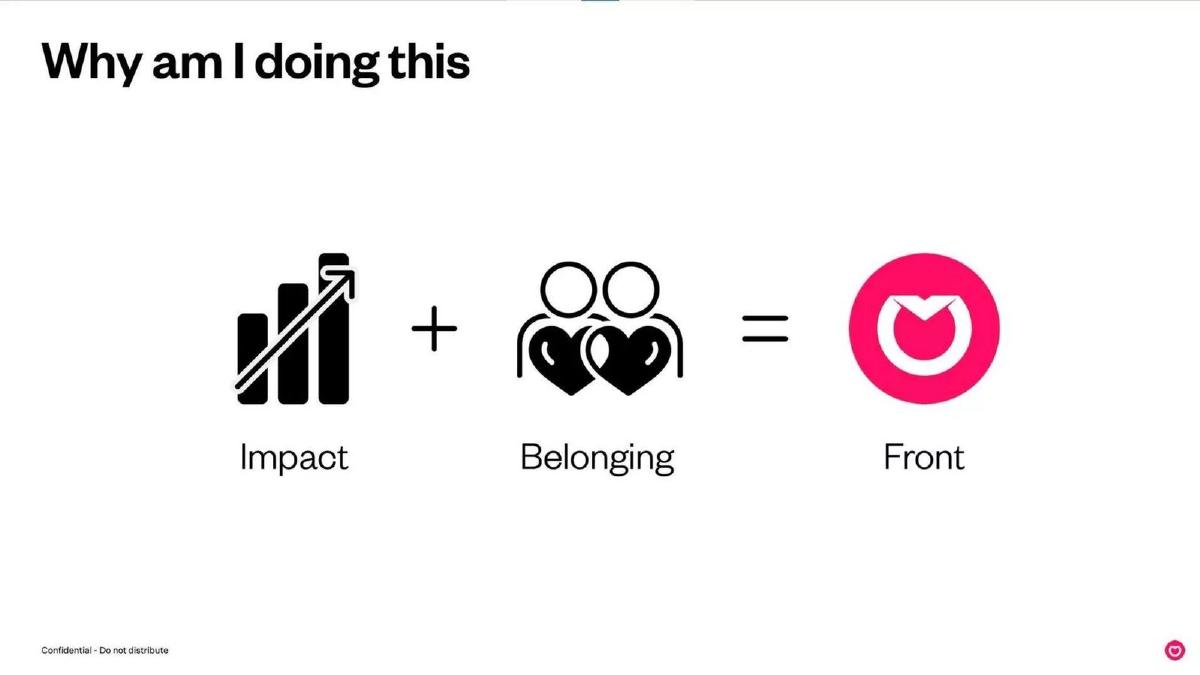
The deck opens with a non-traditional approach. Slide 1 is a minimalist title slide for a Series C round, though the catalogue data indicates this was part of their earlier Seed evolution. Slide 2 introduces a simple equation: Impact + Belonging = Front. This sets a tone that the company is mission-driven rather than purely mercenary.
Slide 3 doubles down on this by showcasing internal health metrics. Instead of starting with revenue, they highlight being a '2019 Best Place to Work' on Glassdoor with a 5.0 rating, a #1 ranking from 'Great Place to Work,' and an exceptionally high eNPS of 94 . For an investor, this suggests a stable, highly motivated team capable of executing a complex technical roadmap without the churn issues that plague many startups.
Slide 4-6: The Problem and The Pivot
Slide 4 defines the 'biggest bottleneck for productivity.' It illustrates a linear chain of siloed inboxes where '1 inbox only ever accessible to 1 user' leads to no visibility and duplicated work. The visual of four separate users with red 'X' marks between them effectively communicates the friction of traditional email in a collaborative environment.
Slide 5 presents the solution: 'Front flips the email model upside down.' By moving from a linear model to a hub-and-spoke model where inboxes are accessible to many users, the company promises information access, efficiency, and focus. Slide 6 provides a sophisticated market map. It plots various job functions along two axes: 'Communication can take any form' vs. 'Relies on email to get work done,' and 'Doesn't need workflows' vs. 'Needs complex workflows.' This slide is crucial because it identifies their 'sweet spot'—roles like Recruiting, Insurance Brokers, and Professional Services that are high in both email reliance and workflow complexity.
Slide 7-9: Traction and Market Opportunity
Slide 7 is the 'money slide.' It displays three charts: ARR growth, Quarterly revenue cohorts, and User cohorts. The standout figure here is the 137% net $ retention . In SaaS, anything over 120% is considered world-class, suggesting that once a customer starts using Fulfilio, they not only stay but significantly increase their spend over time. The slide also notes that 5,500+ customers are already on board and that 54% of current users joined in the most recent year (2019), indicating an accelerating growth curve.
Slide 8 transitions from 'organic' to 'deliberate' growth. It identifies four key buyer personas: VP Operations at 3PL/4PL, Head of Client Services at accounting firms, Head of Customer Success at high ASP SaaS, and Director of Ops at corporate travel agencies. This shows investors that the company has moved past 'founder-led sales' and has a repeatable sales playbook.
Slide 9 quantifies the Total Addressable Market (TAM). They claim a 5.5B ARR potential just on 'strong fit' use cases. The breakdown is granular, listing specific sectors like Supply Chain departments ($1.2B) and Accounting ($900M). While the LTV/CAC chart is present, the actual dollar amounts for cash efficiency are redacted as '$XXm,' though a footnote clarifies that 'Actual values for cash spent and ARR reached were equal,' implying a 1:1 ratio which is highly efficient for this stage.
Slide 10-13: Product Depth and Social Proof
Slide 10 shows the product's evolution. A bar chart illustrates the 'Share of users per type of usage,' showing a steady increase in 'Mixed usage' and 'Shared inbox' usage from Q1 17 to Q3 19. This proves that users are actually adopting the collaborative features rather than just using it as a standard email client. Slide 11 provides qualitative validation through customer quotes, with one user calling the platform 'genuinely life changing.'
Slide 12 focuses on the platform's extensibility. With 52 integrations and 18% of customers using the API, Fulfilio positions itself as a 'sticky' infrastructure play. The mockup of the interface shows integrations with tools like Salesforce and Shopify, reinforcing its role as the central hub for e-commerce. Finally, Slide 13 concludes with a simple 'Thank you' on a blue background, maintaining the deck's clean, minimalist aesthetic.
What Works in This Deck
The most successful element of this deck is the Net Dollar Retention metric (137%) on Slide 7. For a Seed or Series A investor, this is the ultimate proof of product-market fit. It tells a story of a product that becomes indispensable once integrated into a company's workflow. The market segmentation on Slide 6 is also excellent; it moves beyond vague 'everyone uses email' claims to identify exactly which professions suffer the most from the current limitations of the medium. The transition from organic to deliberate growth on Slide 8 shows a level of maturity in sales strategy that is often missing in early-stage decks.
What Is Missing
The most glaring omission is a Team Slide . While the culture slides (Slide 2 and 3) hint at a strong organization, investors need to see the specific pedigree of the founders—especially in a complex space like ERP and logistics where domain expertise is non-negotiable. Additionally, there is no Competitor Analysis . The deck assumes the only competition is 'traditional email,' but in the e-commerce space, they would be competing against NetSuite, Brightpearl, or Linnworks. Finally, the lack of a clear Financial Ask or a 'Use of Funds' slide makes the deck feel more like a general company update than a focused fundraising tool.
What a Founder Should Copy
Founders should emulate the Cohort Analysis shown on Slide 7. Showing revenue and user growth by 'join date' is the most honest way to display traction because it prevents old, stagnant data from masking recent performance. The Market Mapping on Slide 6 is another 'must-copy.' Instead of a standard Venn diagram or a 2x2 matrix with the company in the top-right corner, this axis-based approach explains why certain customers are a better fit than others. Finally, the use of specific buyer personas (Slide 8) is a great way to demonstrate that you understand your Go-To-Market (GTM) strategy and aren't just 'spraying and praying' across the entire internet.
Frequently asked questions
- What is the primary problem Fulfilio solves?
- Fulfilio addresses the 'bottleneck for productivity' caused by siloed communication. As retailers grow, they often use disparate tools where information is trapped in individual inboxes. This leads to no visibility, duplicated work, and email overload. Fulfilio 'flips the email model' by making inboxes accessible to multiple users, creating a central source of truth for orders, inventory, and shipments.
- How does Fulfilio demonstrate market demand?
- The deck uses a combination of quantitative growth metrics and qualitative customer feedback. Slide 7 shows consistent ARR growth from 2014 to 2019, while Slide 11 features a customer quote stating that Front (the product interface) is the 'intersection of all information' and 'life changing.' The 137% net dollar retention is the strongest evidence of product-market fit.
- What are the specific target markets identified in the deck?
- Slide 9 breaks down the 5.5 billion dollar ARR potential into specific niches. The largest opportunities are identified in Supply Chain departments ($1.2B), Accounting ($900M), Property Management ($760M), and Mortgage Brokerages ($760M). They also target smaller but high-fit segments like 3PL/4PL logistics and boutique hotels.
- What is missing from this pitch deck?
- The provided slides lack a traditional 'Team' slide detailing the founders' backgrounds. There is also no explicit 'Ask' slide detailing the amount of capital being raised or the planned use of funds. Furthermore, while LTV/CAC trends are graphed on Slide 9, the actual dollar values for cash spent and ARR reached are redacted as '$XXm'.
- How does the product integrate with existing workflows?
- Fulfilio emphasizes its role as a platform rather than just a standalone tool. Slide 12 notes that they have 52 third-party integrations and that 18% of their customers use their API to build custom workflows. This allows the software to sit at the center of a retailer's existing tech stack, connecting sales, purchasing, and accounting.