Fuelfinance, a Ukraine-based startup, raised a $1M Seed round in 2023 using a 10-slide deck that prioritizes transparency and efficiency. The deck successfully positions the company as a middle-ground solution between the 'mess' of manual spreadsheets and the $100k+ cost of enterprise ERPs like NetSuite. Key highlights include a 22% EBITDA margin in 2021, an exceptionally high Net Promoter Score (NPS) of 86.7, and a 7:1 LTV/CAC ratio. While the deck omits a specific 'Ask' slide and detailed roadmap, it compensates with strong social proof from customers like Petcube and Reface, and a clear co…
Key takeaways
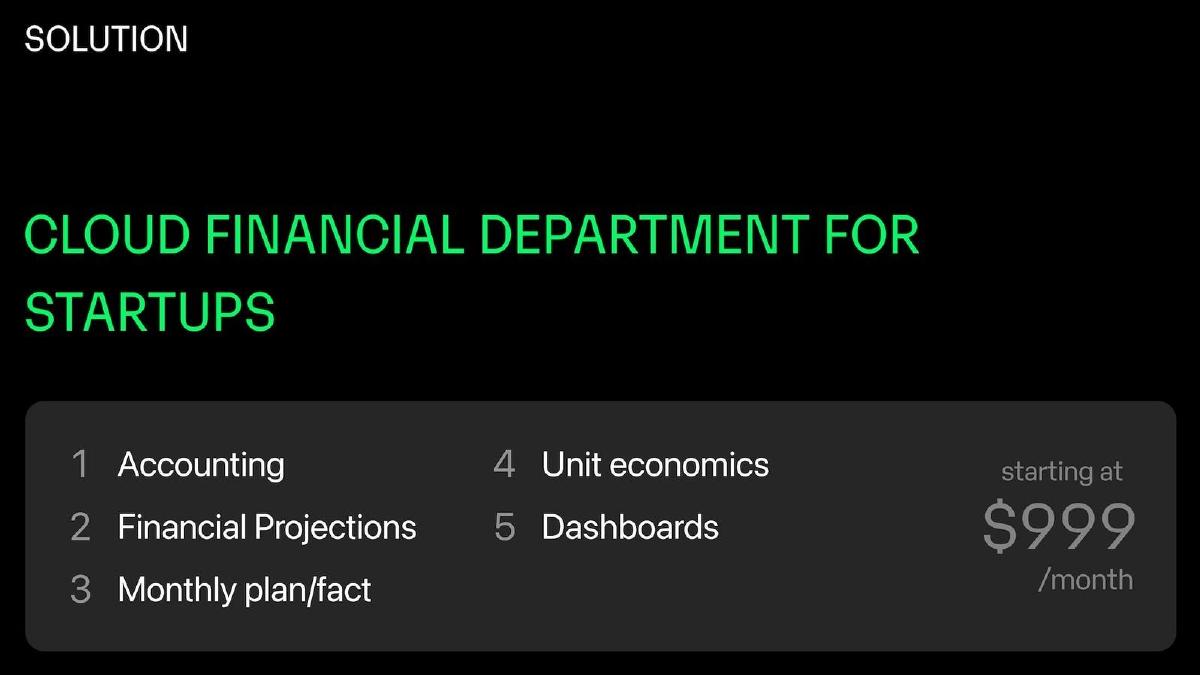
- The company positions its solution as a 'Cloud Financial Department' starting at $999/month (Slide 3).
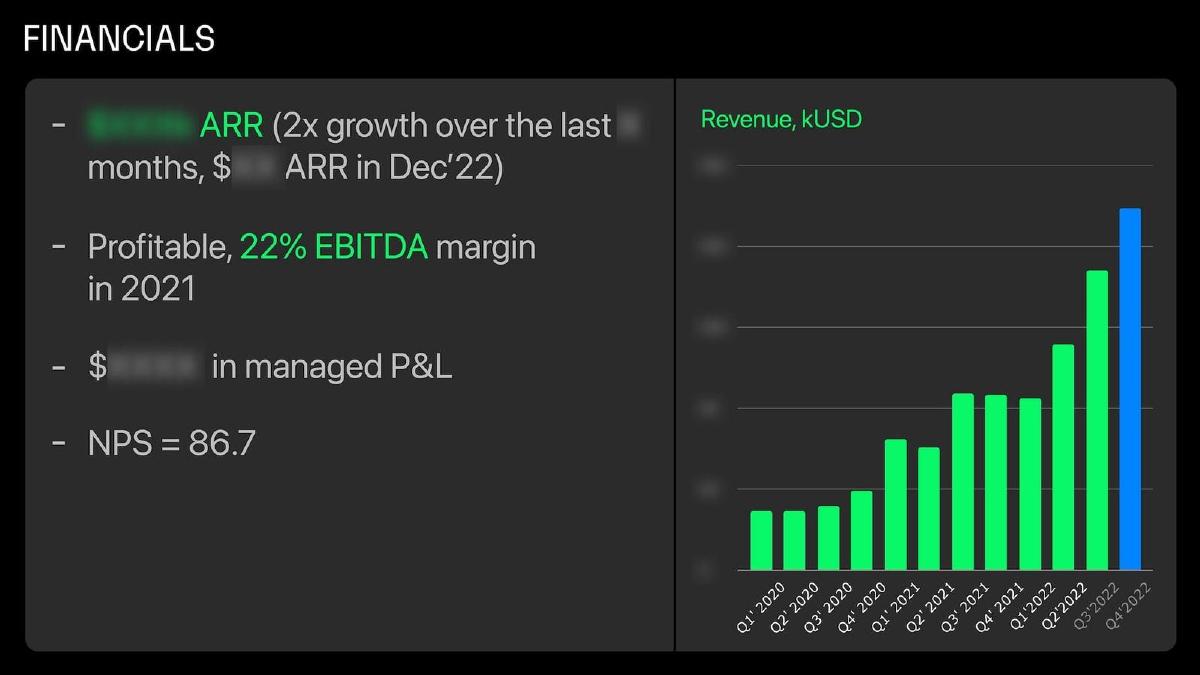
- Fuelfinance achieved a 22% EBITDA margin in 2021, demonstrating early profitability (Slide 5).
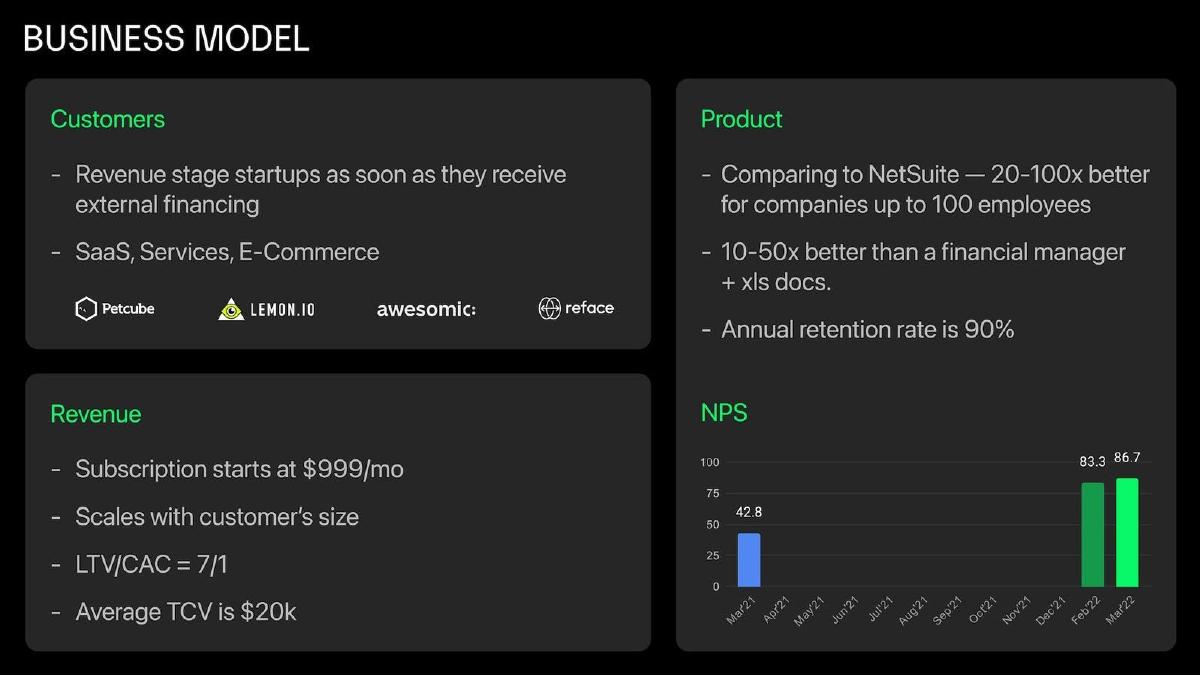
- Customer satisfaction is a core metric, with an NPS of 86.7 reported for March 2022 (Slide 6).
- The business model relies on a 7:1 LTV/CAC ratio and a 90% annual retention rate (Slide 6).
- Competitive positioning targets Pilot, claiming a lower cost of $1,999/month versus Pilot's $7,250/month for comparable services (Slide 7).
- The Total Addressable Market (TAM) is calculated at $30B based on 300k early-stage startups spending $100k/year on finance (Slide 8).
- The team includes a PwC veteran and a Y Combinator alumnus (Slide 9).
- The deck lacks a formal 'Ask' slide detailing the specific dollar amount or valuation sought (Slide 10).
Fuelfinance: The Lean Path to a $1M Seed
Fuelfinance’s 10-slide deck is a masterclass in efficiency, reflecting the very service they provide to startups. By focusing on high-margin operations and customer satisfaction, the Ukraine-based team secured $1M in 2023 (as reported by Business Insider). The deck avoids the trap of over-explaining technology, instead focusing on the economic pain points of their target audience: early-stage founders who are 'not financially savvy.'
Slide 1: Title and Tagline
The opening slide is minimalist, featuring the 'FUEL' logo in a bold, blocky font. The sub-headline, 'CLOUD FINANCIAL DEPARTMENT FOR STARTUPS,' immediately identifies the target market and the product category. There is no clutter here; it sets a professional, enterprise-focused tone from the outset.
Slide 2: The Problem of 'Messy' Financials
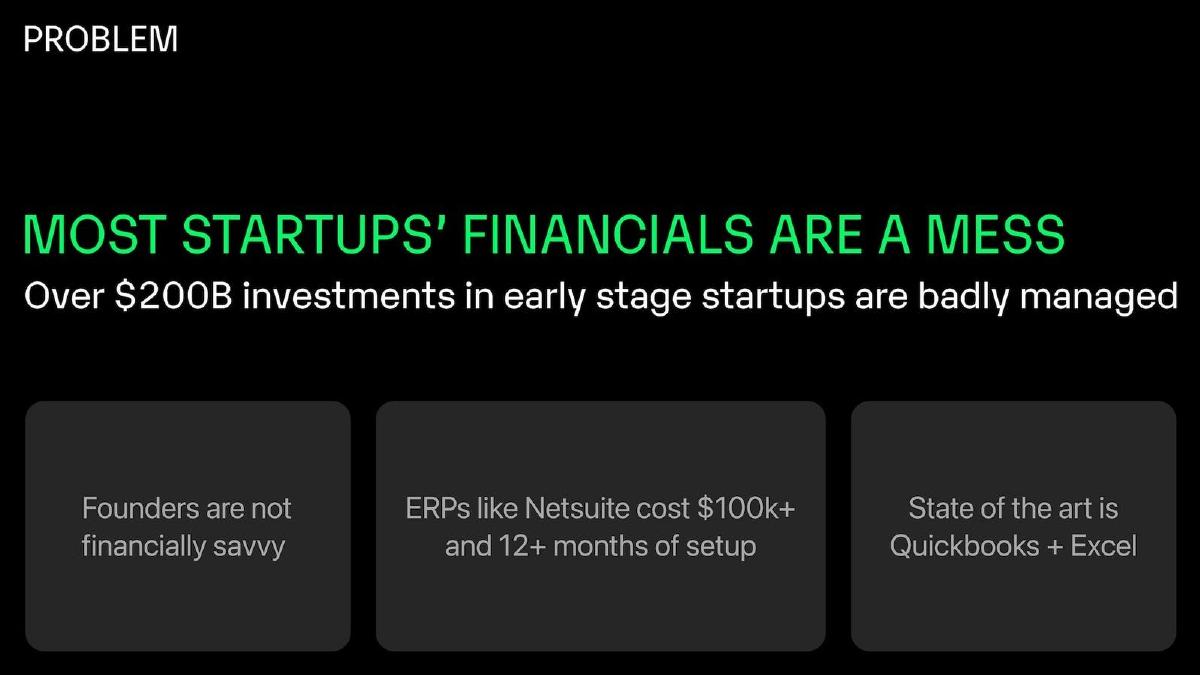
Slide 2 identifies the pain point: 'MOST STARTUPS' FINANCIALS ARE A MESS.' The slide quantifies the scale of the problem by stating that over $200B in early-stage investments are badly managed. It breaks down the current alternatives into three buckets: founders who lack financial expertise, ERPs like NetSuite that cost $100k+ and take 12+ months to set up, and the 'state of the art' which is a combination of QuickBooks and Excel. This framing positions the current market as either too expensive or too disorganized.
Slide 3: The Solution and Entry Pricing
The solution slide reiterates the 'Cloud Financial Department' branding and lists five core pillars: Accounting, Financial Projections, Monthly plan/fact, Unit economics, and Dashboards. Crucially, it includes a 'starting at $999/month' price tag. Including pricing this early in a deck is a bold move that qualifies the investor and the customer simultaneously, signaling that this is a high-value service, not a cheap utility tool.
Slide 4: Product Visualization
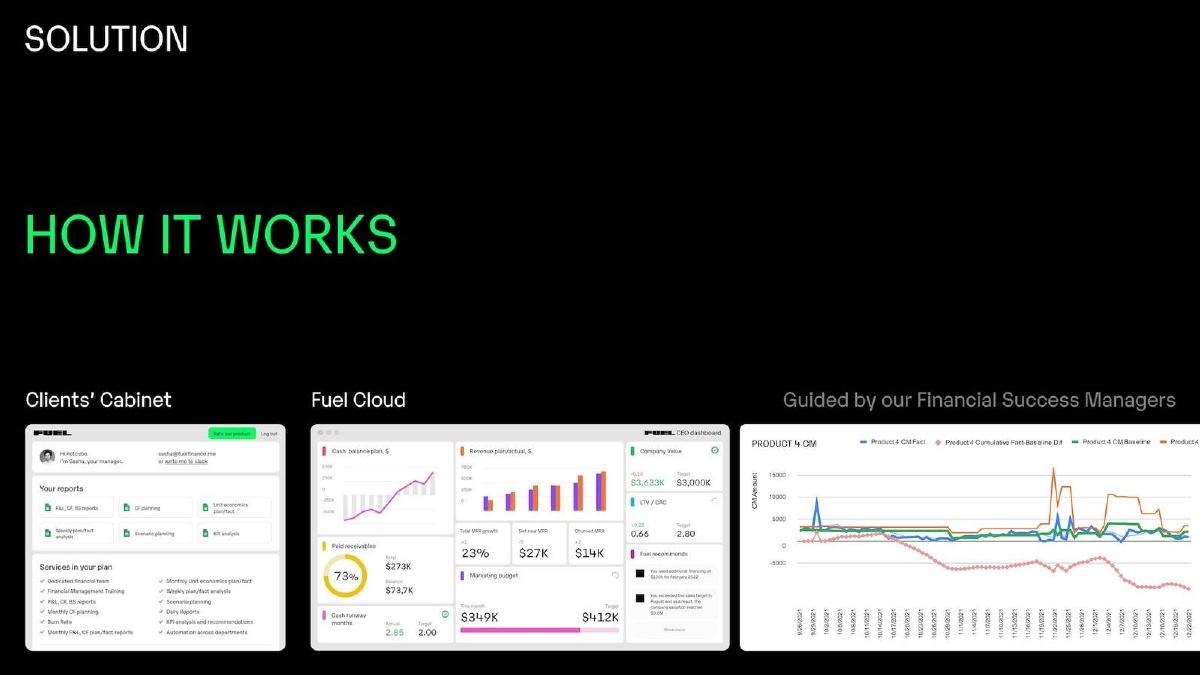
Slide 4, titled 'HOW IT WORKS,' uses three screenshots to show the user interface. It divides the experience into the 'Clients' Cabinet,' the 'Fuel Cloud' dashboard, and the human element: 'Guided by our Financial Success Managers.' The dashboards shown are data-dense, featuring metrics like Cash Runway, LTV/CAC, and Burn Rate. This slide proves the product is real and functional, moving beyond conceptual promises.
Slide 5: Financial Performance and Profitability
This is the 'traction' slide. While the specific ARR figures are redacted in the public version, the slide makes several strong claims: 2x growth over the last few months, a 22% EBITDA margin in 2021, and an NPS of 86.7. The bar chart on the right shows consistent quarterly revenue growth from 2020 to 2022. The mention of being 'Profitable' is a significant differentiator for a Seed-stage company, especially in the 2023 fundraising environment.
Slide 6: Business Model and Unit Economics
Slide 6 provides a deep dive into the company's health. It lists an LTV/CAC ratio of 7:1 and an average Total Contract Value (TCV) of $20k. The 'Product' section claims their solution is 20-100x better than NetSuite for companies under 100 employees. The slide also highlights a 90% annual retention rate and shows the growth of their NPS from 42.8 in March 2021 to 86.7 in March 2022. This data suggests a product that customers not only need but actively enjoy using.
Slide 7: The Competitive Landscape
The competition slide is a direct comparison table against 'Excel + founders' and 'Pilot.' Fuelfinance claims to offer a broader feature set (including Unit Economics and KPI Dashboards) for $1,999/month. In contrast, they list Pilot at $7,250/month and manual management at $14,000+/month. By positioning themselves as the most feature-rich yet cost-effective option, they create a 'no-brainer' argument for their target demographic.
Slide 8: TAM and Go-To-Market
Slide 8 addresses the market size. They estimate a $30B TAM based on 300k early-stage startups spending an average of $100k/year on financial management. The Go-To-Market strategy is two-pronged: content marketing (online workshops) and partnerships with VCs, which they claim generate 15 leads per month. The slide also features a screenshot of the CEO on the 'Masters of Scale' podcast, providing significant social proof.
Slide 9: The Team
The team slide features CEO Alyona Mysko and Co-founder Yaroslav Azhnyuk. Mysko’s background at PwC and 8 years of CFO experience provide the necessary domain expertise. Azhnyuk adds 'serial entrepreneur' credibility as a Y Combinator alumnus (Petcube, W16). The slide notes a total team size of 21 people, reinforcing the 'lean' narrative mentioned in the publisher's summary.
Slide 10: The Ask (or lack thereof)
The final slide, 'JOIN US AS A SHAREHOLDER,' lists the pedigree of their existing angel investors, including individuals from Google, Facebook, Uber, and Salesforce, as well as the CEOs of Bolt and Sendbird. However, the slide is notably missing a specific 'Ask.' There is no mention of the round size, valuation, or how the funds will be deployed. While the publisher reports a $1M raise, the deck itself leaves the door open for negotiation.
What Works in the Fuelfinance Deck
1. Radical Transparency on Unit Economics: Most Seed decks hide their margins. Fuelfinance leads with a 22% EBITDA margin and a 7:1 LTV/CAC. This signals to investors that the founders understand the 'business' of their business, not just the product.
2. High-Signal Social Proof: Mentioning an NPS of 86.7 and showing a 'Masters of Scale' appearance provides immediate credibility. In a crowded fintech space, these third-party validations are essential.
3. Clear Competitive Moat: By targeting the gap between 'free but messy' (Excel) and 'powerful but overpriced' (NetSuite), Fuelfinance carves out a specific, defensible niche.
What is Missing from the Fuelfinance Deck
1. The 'Ask' Slide: The deck ends on a high note regarding investors but fails to state what they are looking for. A standard pitch deck should clearly outline the capital required to reach the next milestone.
2. Technology Deep-Dive: The deck mentions being 'built on Google Spreadsheets' (Slide 4), but it doesn't explain how they maintain data integrity or automate the 'Cloud' aspect. Investors might worry about the scalability of a spreadsheet-based backend.
3. Future Roadmap: The deck is very focused on the 'now.' There is little information on where the product goes next—does it move into tax, payroll, or lending? A vision for the next 3-5 years is absent.
Founder Takeaways
Lead with Margins: If you are profitable or have high margins, make it a centerpiece of your deck. It differentiates you from the 'growth at all costs' crowd. · Quantify the Competition: Don't just list competitors; list their costs and feature gaps. Fuelfinance’s Slide 7 is a perfect example of how to make a competitor look expensive and inadequate. · Use NPS as a Weapon: If your customers love you, prove it with a Net Promoter Score. An 80+ NPS is a powerful indicator of product-market fit that speaks louder than a dozen testimonials.
Frequently asked questions
- What is the core value proposition of Fuelfinance?
- Fuelfinance positions itself as a 'Cloud Financial Department for Startups.' It aims to replace the manual 'mess' of Excel and QuickBooks and the high cost of ERPs like NetSuite ($100k+). They offer a suite of services including accounting, financial projections, unit economics, and dashboards, starting at a price point of $999 per month.
- How does Fuelfinance compare to its competitors?
- On Slide 7, Fuelfinance directly compares itself to Pilot and manual founder-led accounting. They claim to offer more features (like Unit Economics and KPI Dashboards) for $1,999/month, whereas they list Pilot's cost at $7,250/month and manual management at over $14,000/month in labor costs.
- What are the key financial metrics mentioned in the deck?
- The deck highlights a 22% EBITDA margin in 2021, a 7:1 LTV/CAC ratio, and a 90% annual retention rate. They also emphasize an NPS of 86.7. While the specific ARR on Slide 5 is redacted, the chart shows consistent quarterly revenue growth from Q1 2020 through Q4 2022.
- Who is behind the company?
- The leadership consists of Co-founder/CEO Alyona Mysko, a PwC alumna with 8 years of CFO experience, and Co-founder Yaroslav Azhnyuk, a serial entrepreneur and CEO of Petcube (YC W16). The company operates with a lean team of 21 people.
- What is missing from the Fuelfinance pitch deck?
- The deck is missing a clear 'Ask' slide specifying the amount of capital being raised and the intended use of funds. It also lacks a detailed product roadmap or a deep dive into the underlying technology, other than stating it is 'Fuel Cloud' guided by managers.