Front’s Series C deck, used to raise part of their $203.6M total funding, is a sophisticated example of late-stage storytelling. It moves quickly past the 'what' of the product to focus on the 'who' and 'how much.' The deck highlights a transition from organic, product-led growth (2014-2018) to a deliberate, persona-driven sales motion in 2019. With a net dollar retention of 137% and a clearly defined $5.5B ARR potential across specific 'strong fit' verticals like Logistics and Accounting, Front demonstrates the rare ability to maintain high efficiency while scaling. The deck is notable for i…
Key takeaways
- Front reports a net dollar retention of 137%, a top-tier metric for SaaS companies at this stage (Slide 7).
- The company identifies a $5.5B ARR potential specifically within 'strong fit' use cases like Supply Chain and Accounting (Slide 9).
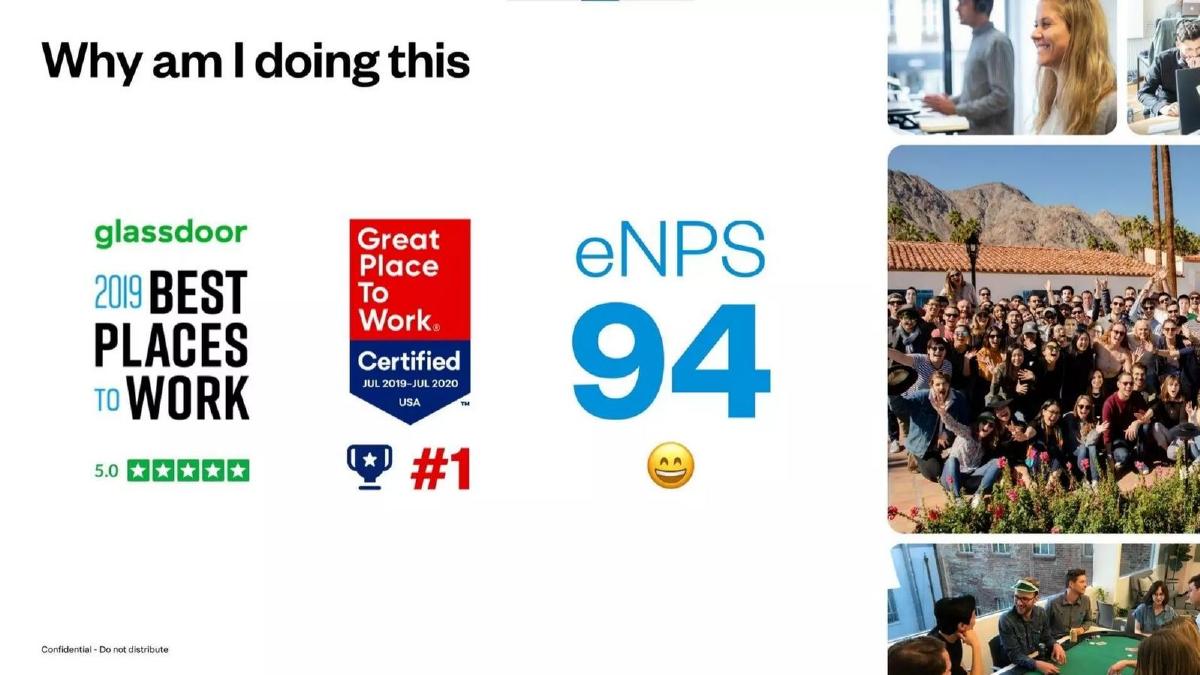
- Execution risk is mitigated by showing an eNPS of 94 and a #1 ranking on Glassdoor's Best Places to Work (Slide 3).
- The deck highlights a shift in user behavior, with 'Mixed usage' (shared and individual) becoming the dominant pattern by Q3 2019 (Slide 10).
- Front demonstrates platform maturity with 52 third-party integrations and 18% of customers leveraging their API (Slide 12).
- The 'deliberate approach to growth' in 2019 targeted specific personas like VP Operations at 3PL/4PL firms (Slide 8).
- Cash efficiency is emphasized by showing that cash spent to reach ARR was equal, though specific dollar amounts are redacted (Slide 9).
- The product narrative centers on flipping the '1 inbox per 1 user' model to a collaborative multi-user model (Slide 5).
The Evolution of a Communication Giant
Front’s Series C pitch deck is a masterclass in late-stage narrative. By the time a company reaches Series C, the product-market fit is no longer a question; the focus shifts to the scale of the opportunity and the efficiency of the machine. Front, founded in 2013, uses this deck to prove that they have transitioned from a simple shared inbox tool into a foundational communication hub for the enterprise.
Section 1: Mission and Culture (Slides 1-3)
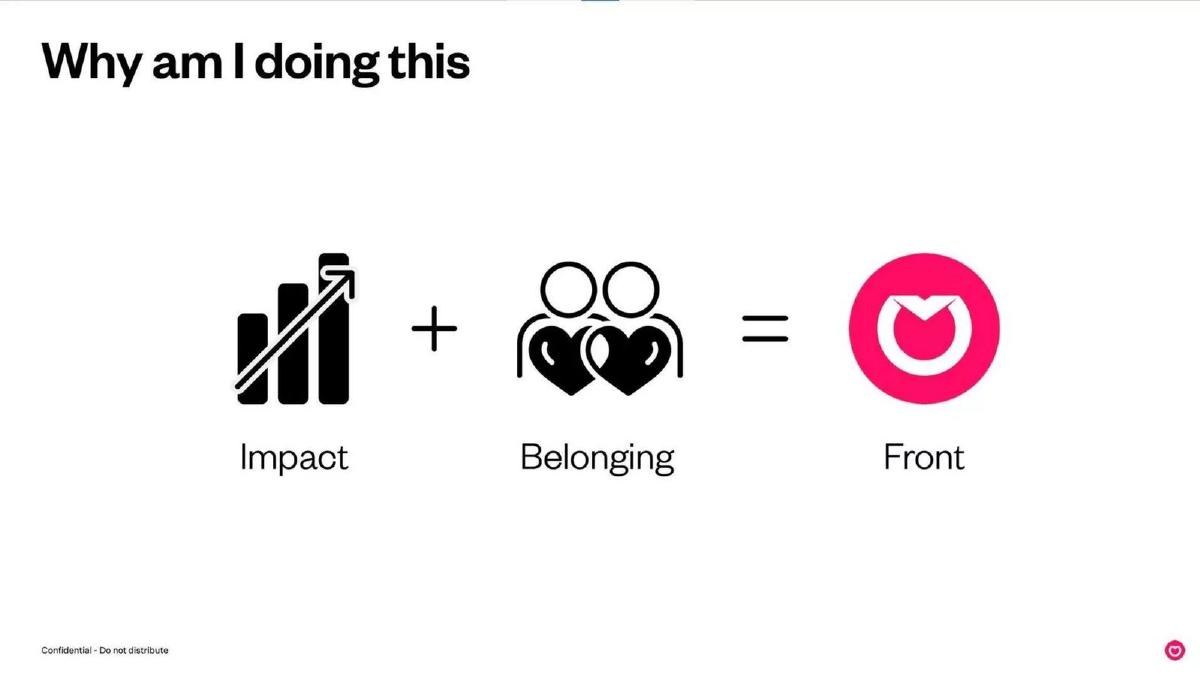
The deck opens with a bold, minimalist cover (Slide 1) featuring the tagline "Work happier." This sets the tone for the first few slides, which focus heavily on the 'Why.' Slide 2 uses a simple equation: Impact + Belonging = Front . This is a sophisticated move for a Series C deck; it suggests that the company’s success is built on a sustainable internal culture, not just a clever feature set.
Slide 3 doubles down on this by showcasing external validation of their culture. They cite being a Glassdoor 2019 Best Place to Work with a 5.0 rating, a Great Place to Work #1 certification, and a staggering eNPS of 94 . For investors, a high eNPS is a leading indicator of low turnover and high productivity, which are critical when scaling from 100 to 500+ employees.
Section 2: The Problem and the Flip (Slides 4-5)
Front identifies the "biggest bottleneck for productivity" on Slide 4. They visualize the traditional email model: isolated inboxes with red 'X' marks between them, leading to "No visibility," "Duplicated work," and "Email overload." This is a relatable pain point for any enterprise buyer.
Slide 5 presents the solution: "Front flips the email model upside down." The visual changes from isolated silos to a circular, collaborative hub where "Inboxes become accessible to many users." They promise three outcomes: Information access, Efficiency and speed, and Focus. This section is brief because, at Series C, most investors already understand the core product; the deck simply reinforces the fundamental shift Front is driving in the market.
Section 3: Market Mapping and Segmentation (Slide 6)
Slide 6 is one of the most important slides for understanding Front’s strategy. It maps various job titles along two axes: "Communication can take any form" vs. "Relies on email to get work done" and "Doesn't need workflows" vs. "Needs complex workflows."
They identify high-value targets in the top-right quadrant: Recruiting, Insurance brokers, and Professional services. Conversely, they acknowledge that roles like Software Engineers or Marketing Managers may not be their primary 'workflow' users. This level of segmentation shows investors that Front isn't just 'email for everyone'—it is a specialized tool for email-heavy, workflow-intensive industries.
Section 4: The Growth Engine (Slides 7-9)
Slide 7 provides the 'meat' of the deck with three powerful charts. They report 5,500+ customers and a 137% net $ retention . The fact that 54% of current users joined in 2019 (the year of the deck) is a clear signal of accelerating momentum. The quarterly revenue cohorts show a classic 'layer cake' of expanding spend from older customers, which justifies the high valuation typical of a Series C.
Slide 8 explains how they are achieving this growth: a "deliberate approach." They list specific buyer personas they have mastered, such as VP Operations @ 3PL & 4PL (Third-party logistics) and Head of Customer Success @ high ASP SaaS. This moves the narrative from 'people find us' to 'we know exactly who to sell to.'
Slide 9 addresses the Total Addressable Market (TAM). Instead of a generic $100B number, they list $5.5B ARR potential just on "strong fit" use cases. They break this down by industry: Supply Chain departments ($1.2B), Accounting ($900M), and Logistics ($360M). They also include a chart for LTV / CAC and a note on Cash efficiency , stating that the actual values for cash spent and ARR reached were equal (though the specific $XXm figures are redacted). This suggests a 1:1 magic number, which is exceptionally efficient for a high-growth SaaS company.
Section 5: Product Depth and Platform Play (Slides 10-12)
Slide 10 shows the evolution of product usage. In Q1 2017, the majority of usage was 'Shared inbox.' By Q3 2019, 'Mixed usage' (a combination of shared and individual inboxes) became the dominant category. This proves that Front is becoming the primary email client for its users, not just a side tool for support aliases.
Slide 11 uses customer testimonials to highlight the 'stickiness' of the product. One quote stands out: "Front is where everybody meets... it's the place where everyone ends up residing to solve a given problem." This supports the 'hub' narrative.
Finally, Slide 12 demonstrates that Front is a platform, not just an app. They cite 52 integrations with 3rd parties , 55% of customers using the platform (likely referring to integrations), and 18% directly leveraging their API. This platform play is essential for Series C companies to defend their moat against incumbents like Microsoft or Google.
What Works in This Deck
Granular TAM: By breaking down the $5.5B potential into specific industries like 'Boutique Hotels' and 'Mortgage Brokerages,' Front makes a massive number feel achievable and researched. · Retention as a North Star: The 137% net dollar retention is the strongest data point in the deck. It proves that once a company starts using Front, they almost never leave and consistently add more seats or features. · Culture as a Competitive Advantage: In a crowded SaaS market, showing a 94 eNPS tells investors that the company can win the 'war for talent,' which is often the primary bottleneck for Series C companies. · The 'Mixed Usage' Chart: This is a subtle but brilliant way to show that Front is successfully replacing the traditional email client (Outlook/Gmail) for its users.
What Is Missing
The Team: In this 13-slide subset, there is no mention of the founders or the leadership team. While likely present in the full 25-slide version, its absence here is notable. · The Competition: There is no slide addressing how Front wins against Zendesk, Intercom, or the native shared inbox features of G Suite and Office 365. · The Financial Ask: The deck does not state how much capital is being raised or how it will be deployed (e.g., '50% to sales expansion, 30% to R&D'). · Unit Economics: While LTV/CAC is mentioned, the specific CAC, payback period, and gross margins are omitted or redacted.
What a Founder Should Copy
The 'Axes of Usage' Slide: If you are building a tool that could be used by many people, use Slide 6’s format to show investors exactly which niches you are targeting first and why. · Cohort Visualizations: The 'layer cake' revenue cohort chart on Slide 7 is the gold standard for proving SaaS health. If your retention is good, show it exactly like this. · Persona-Based Growth: Don't just say you have a sales team. Show the specific titles and company types you have identified as 'high-intent' buyers, as seen on Slide 8. · Platform Metrics: If you have an API, track and show what percentage of your customer base uses it. It is the best way to prove your product is 'sticky' and integrated into the customer's workflow.
Frequently asked questions
- What is Front's core value proposition according to the deck?
- Front positions itself as a 'communication hub' that solves the productivity bottleneck of traditional email. By moving from a model where one inbox is accessible to only one user to a collaborative model, Front enables information access, efficiency, and focus. The deck argues that traditional email leads to no visibility, duplicated work, and email overload, which Front's collaborative interface eliminates.
- How does Front define its Total Addressable Market (TAM)?
- Rather than using broad, vague industry figures, Front defines its market by 'strong fit' use cases. They identify a $5.5B ARR potential across ten specific verticals. The largest opportunities cited are Supply Chain departments ($1.2B), Accounting ($900M), Property Management ($760M), and Mortgage Brokerages ($760M). This granular approach demonstrates a deep understanding of where their product provides the most value.
- What are the key growth metrics shared in the Series C deck?
- Front showcases exceptional health for a later-stage company. Key figures include 5,500+ customers, a 137% net dollar retention rate, and the fact that 54% of their current users joined in 2019 alone. This indicates that while they have a long history (founded in 2013), their growth was accelerating significantly at the time of the Series C raise.
- How does Front address the 'Why Now' or 'Execution' risk?
- Front uses its internal culture as a primary indicator of execution strength. By highlighting a 94 eNPS and being ranked the #1 Best Place to Work by Glassdoor, they signal to investors that they have the talent and morale required to win a competitive market. They also show a shift from 'mostly organic' growth to a 'deliberate' sales strategy, proving they have found a repeatable go-to-market motion.
- What is missing from this version of the Front pitch deck?
- In the 13 slides provided, there is no traditional team slide, no competitive landscape analysis, and no explicit 'Ask' slide detailing the amount being raised or the valuation. While these may have been in the full 25-slide version, their absence here suggests that for a Series C, the metrics and market expansion strategy are the primary drivers of the investment thesis.