The FTX Series B pitch deck is a masterclass in 'traction as the primary narrative.' With only 11 slides, the company secured $1B by highlighting its position as the fastest-growing crypto exchange in the world. The deck leans heavily on high-level financial outcomes, reporting an $800M estimated profit and a $1.2B annualized run rate for 2021. It positions the exchange not just as a trading platform, but as the 'infrastructure layer' of the entire crypto industry. While the deck is light on technical architecture or detailed roadmap, it uses aggressive competitive comparisons—specifically a…
Key takeaways
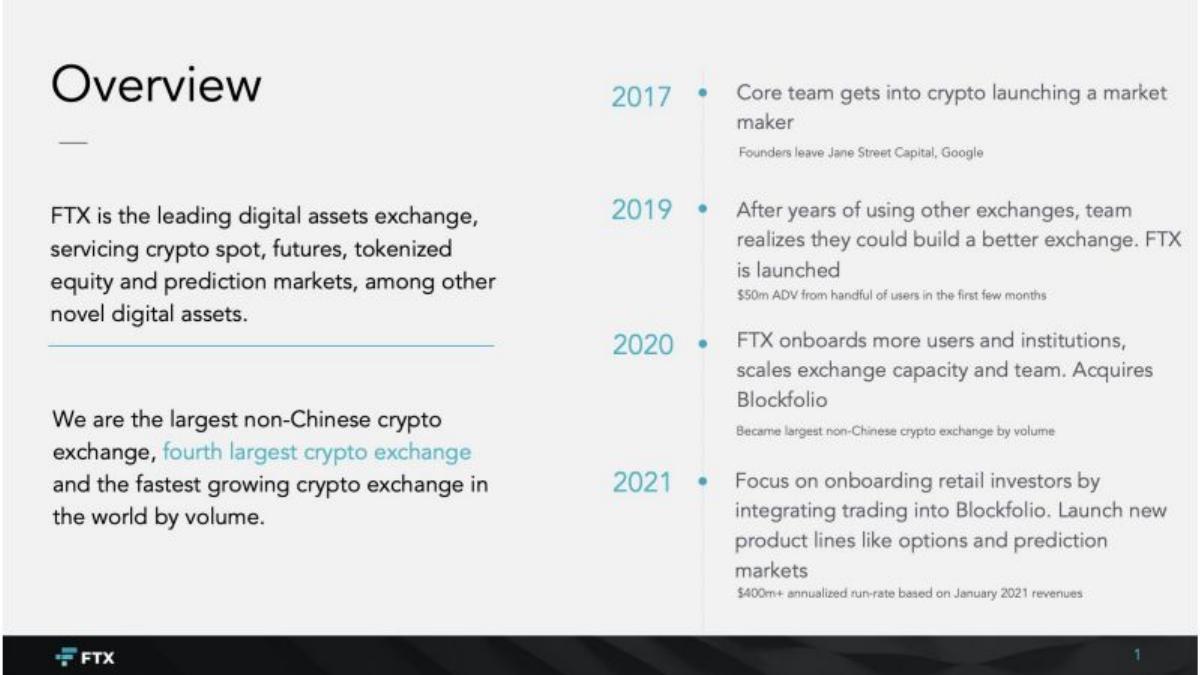
- FTX claimed to be the fourth largest crypto exchange and the fastest growing by volume globally on slide 1.
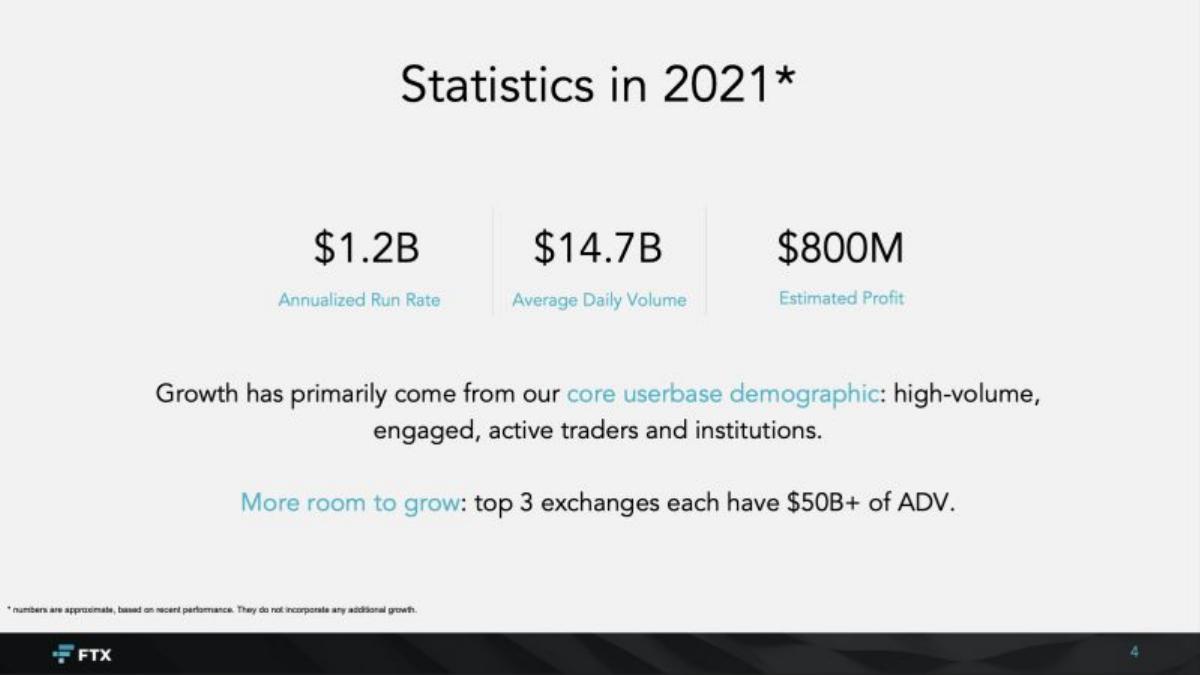
- The company reported an estimated profit of $800M and an annualized run rate of $1.2B for 2021 on slide 4.
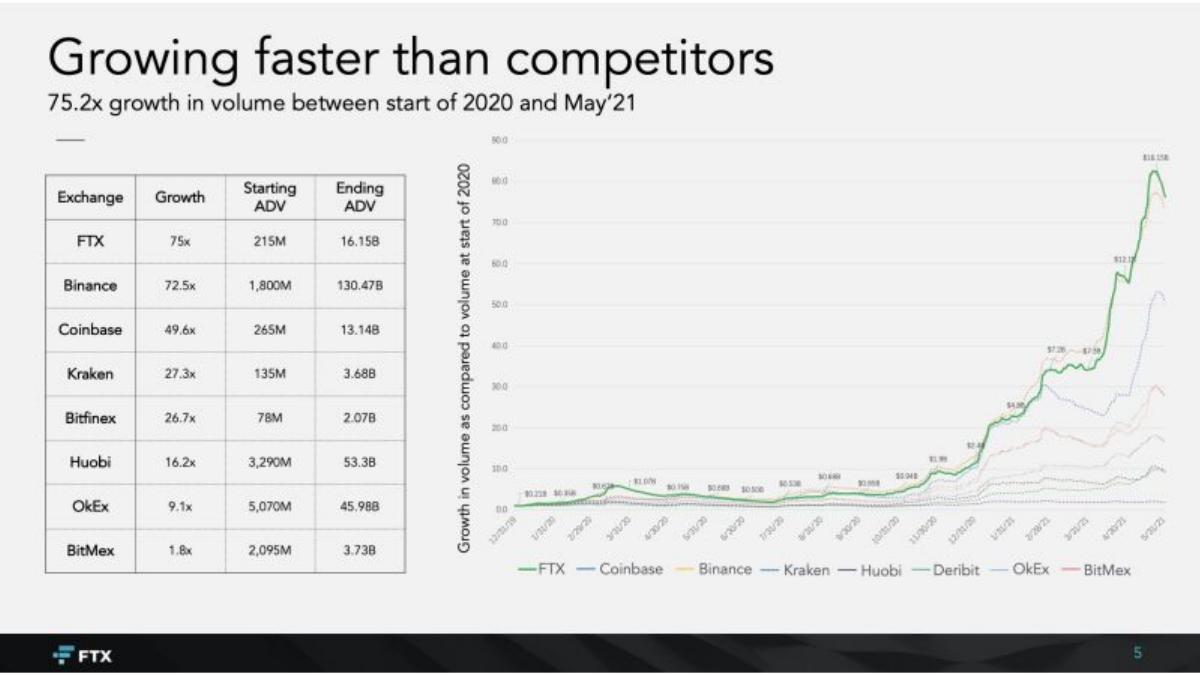
- FTX demonstrated a 75.2x growth in volume between the start of 2020 and May 2021 on slide 5.
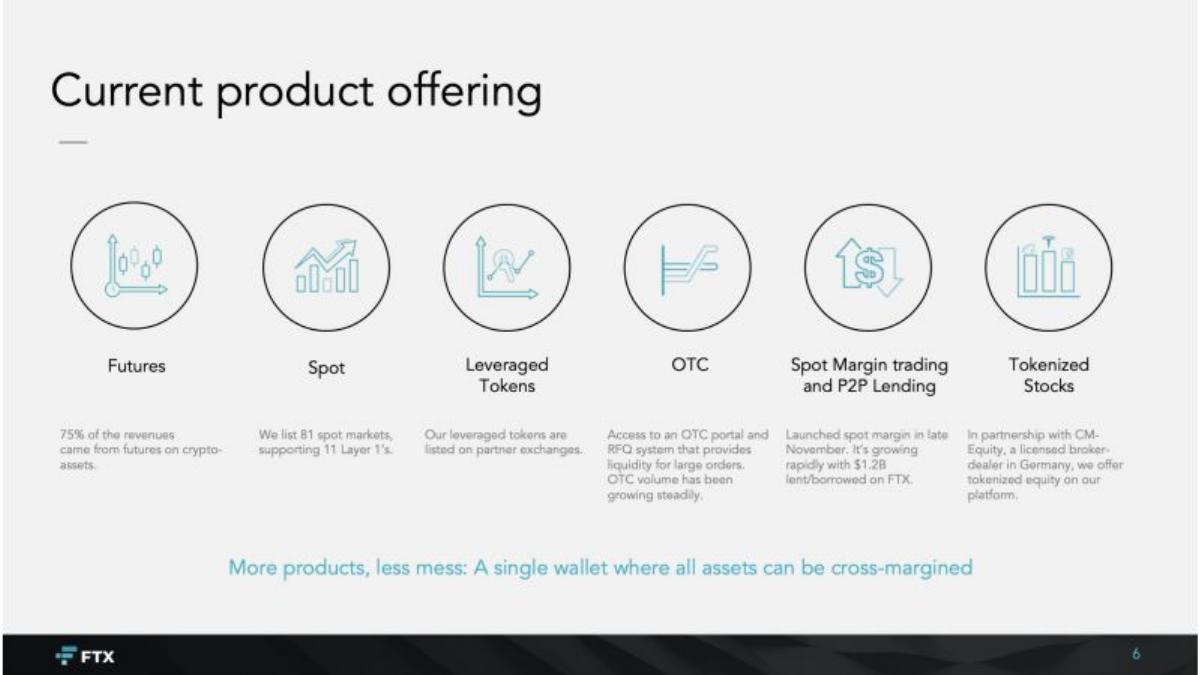
- The deck highlights that 75% of revenues were derived from futures on crypto-assets on slide 6.
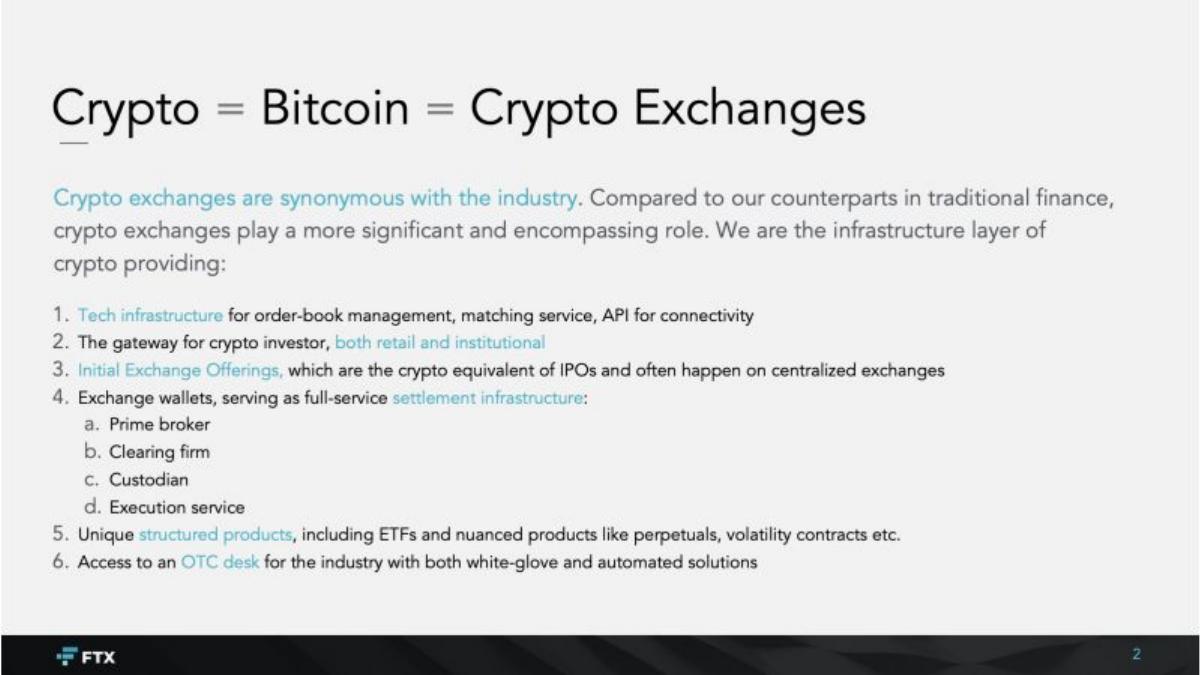
- FTX positioned itself as the 'infrastructure layer' of crypto, performing roles of prime broker, clearing firm, and custodian on slide 2.
- The acquisition of Blockfolio was used to signal a shift toward onboarding retail investors on slide 7.
- The compliance framework slide mentions partnerships with CM-Equity and a US broker-dealer license via West Realm on slide 8.
- The team slide emphasizes pedigrees from Jane Street, Google, and Facebook, alongside MIT and Berkeley degrees on slide 9.
The Anatomy of a $1B Series B Pitch
The FTX Series B pitch deck is a rare example of a multi-billion dollar fundraise conducted with minimal aesthetic flourish. At just 11 slides, the deck relies almost entirely on the sheer magnitude of its numbers. In 2021, the crypto market was at a fever pitch, and FTX positioned itself as the most efficient engine in that ecosystem. The deck doesn't spend time explaining what a blockchain is; instead, it assumes investor competence and dives straight into market share and profitability.
Slide 1: Overview and Timeline
The deck opens with a bold claim: FTX is the "fastest growing crypto exchange in the world by volume." It establishes a timeline starting in 2017 with the core team leaving Jane Street and Google to launch a market maker (Alameda Research, though not named here). By 2019, the exchange launched, achieving $50M Average Daily Volume (ADV) within months. The slide notes that by 2021, the company reached a $400M+ annualized run-rate based on January revenues alone. This slide sets the pace for the rest of the presentation: speed is the primary value proposition.
Slide 2: The Infrastructure Play
On slide 2, FTX attempts to redefine the role of a crypto exchange. They argue that crypto exchanges are "synonymous with the industry" and act as the infrastructure layer. They list six critical functions they provide, including tech infrastructure, a gateway for retail and institutional investors, and acting as a full-service settlement infrastructure (Prime broker, Clearing firm, Custodian, and Execution service). This is a strategic positioning move—by claiming to be the entire financial stack, they justify a much higher valuation than a simple trading platform would command.
Slide 4: The Big Numbers
Slide 4 is the 'money slide.' It presents three massive figures for 2021: a $1.2B Annualized Run Rate , $14.7B Average Daily Volume , and an Estimated Profit of $800M . A footnote clarifies these are approximate numbers based on recent performance. By leading with an $800M profit figure, FTX separates itself from the typical 'growth at all costs' startup. They are telling investors that they are already a highly profitable machine with "more room to grow," noting that the top three exchanges each have $50B+ in ADV.
Slide 5: Competitive Growth Benchmarking
This slide features a table and a line graph comparing FTX's growth to its peers. FTX claims 75.2x growth in volume between the start of 2020 and May 2021. The table includes competitors like Binance, Coinbase, Kraken, and BitMex. Interestingly, it shows that while Binance is significantly larger in absolute volume ($130.47B Ending ADV vs. FTX's $16.15B), FTX is outpacing them in relative growth (75x vs 72.5x). This is a classic venture capital narrative: betting on the fastest-moving player in a massive market.
Slide 6: Product Diversification
Slide 6 breaks down the current product offering: Futures, Spot, Leveraged Tokens, OTC, Spot Margin/P2P Lending, and Tokenized Stocks. The most critical data point here is tucked in the subtext: "75% of the revenues came from futures on crypto-assets." This confirms that despite the wide array of products, FTX was primarily a derivatives house. They also highlight their "single wallet" feature where all assets can be cross-margined, which they describe as "More products, less mess."
Slide 7: Retail Expansion via Blockfolio
Recognizing that their core user base was "high-volume, engaged, active traders" (as stated on slide 4), slide 7 focuses on the retail pivot. They highlight the integration of trading into the Blockfolio app and showcase high app store ratings. A graph of Daily Active Users shows a massive spike on "Election Night," where they traded almost $300M in contracts on prediction markets. This slide is intended to prove that FTX can successfully move from the 'pro' niche into the mass retail market.
Slide 8: The Compliance Narrative
In hindsight, slide 8 is the most scrutinized. It outlines a "Compliance Framework," claiming the company works closely with policymakers and uses third-party identity verification like Jumio and Chainalysis. It mentions a partnership with CM-Equity in Germany and a US-regulated entity (West Realm) that holds MSB and MTL licenses. For a Series B investor, this slide was meant to de-risk the regulatory uncertainty inherent in the crypto sector at the time.
Slide 9: The Team
The team slide focuses on five key individuals. Sam Bankman-Fried (CEO) is highlighted for his background at Jane Street Capital. Gary Wang (CTO) is noted as a former Google software engineer. Nishad Singh (Head of Engineering) is credited with leaving Facebook’s Applied Machine Learning team. Dan Friedberg (General Counsel) and Ramnik Arora (Head of Product) round out the leadership. The emphasis is heavily on elite institutional backgrounds (Jane Street, Google, Facebook, Goldman Sachs) and top-tier academic credentials (MIT, Berkeley, Stanford).
Slide 10: The 'Effective Altruism' Mission
The final content slide departs from financial metrics to discuss the company's "highest goal": leaving the world a better place. It states that 1% of all net revenues are donated to "the world's most effective charities." This was a core part of the FTX brand identity—the idea of 'earning to give'—which helped differentiate them from other exchanges and appealed to a specific subset of Silicon Valley investors.
What FTX Did Well
Traction-First Approach: The deck doesn't waste time on 'the problem.' In a hot market, the problem is self-evident. Instead, it focuses entirely on the fact that FTX is winning the race. · Profitability as a Moat: Showing an $800M estimated profit in a Series B deck is incredibly rare. It signals that the business model is not just viable but exceptionally lucrative. · Clear Competitive Positioning: The growth chart on slide 5 is the strongest visual in the deck. It clearly shows FTX's trajectory relative to the industry giants, making the investment feel like a 'last chance' to get into a future market leader.
What Was Missing
The Ask: There is no slide detailing how much money they are raising or what the valuation expectations are. While common in high-profile rounds where terms are negotiated privately, it leaves the 'why now' for the capital unanswered. · Risk Factors: For a business operating in a highly volatile and legally grey area, there is very little discussion of market risks or the specific hurdles of international regulation beyond a high-level compliance slide. · Detailed Financials: The deck provides 'estimated' and 'annualized' figures but lacks a deep dive into historical P&L or balance sheet health.
Lessons for Founders
Let the numbers talk: If your growth is truly exponential, you don't need 40 slides. FTX used 11 slides to raise $1B because the numbers on those slides were undeniable. · Position as Infrastructure: If you are a platform, try to position yourself as the 'infrastructure layer.' This shifts the perception of your company from a single tool to a foundational necessity for an entire industry. · Pedigree Matters in Complex Markets: In sectors like Fintech or Crypto, where trust and technical execution are paramount, highlighting 'boring' institutional backgrounds (Jane Street, Google) can be more effective than highlighting 'scrappy' startup experience.
Frequently asked questions
- How much did FTX raise with this deck?
- According to the catalogue facts, FTX raised $1B in a Series B round in 2021. The deck itself focuses on the company's performance and growth metrics to justify this massive capital injection, though it does not explicitly state the 'ask' amount on any of the 11 slides.
- Who were the lead investors in the FTX Series B?
- The round was led by Sequoia Capital. Other notable participants included Softbank Vision Fund, Tiger Global, Thoma Bravo, Lightspeed Venture Partners, and Temasek (though Temasek is not listed in the provided catalogue, it was a known participant in this specific 2021 round).
- What was the primary revenue driver for FTX according to the deck?
- Slide 6 explicitly states that 75% of FTX's revenues came from futures on crypto-assets. This highlights the company's roots as a derivatives-focused exchange before its expansion into spot markets and retail-facing products.
- How did FTX compare itself to competitors like Binance and Coinbase?
- On slide 5, FTX used a 'Growth in volume' chart to show it was growing faster than all major competitors. While Binance had a higher 'Ending ADV' (Average Daily Volume) of $130.47B compared to FTX's $16.15B, FTX highlighted its 75x growth rate compared to Binance's 72.5x and Coinbase's 49.6x.
- What was FTX's strategy for retail growth?
- As shown on slide 7, FTX's retail strategy centered on the integration of trading within the Blockfolio app. They also expanded into 'novel' product lines like prediction markets and sportsbooks to attract a broader user base beyond professional traders.