Funderful’s seed deck is a masterclass in narrative-driven pitching for a niche B2B market. The company identifies a specific, high-value pain point: the $4.9 billion spent by universities on outdated fundraising methods. The deck utilizes a 'then vs. now' comparison to highlight the obsolescence of phone-based outreach, supported by a powerful anecdote about Stanford University ending fundraising calls. With a lean 13 slides, the founders demonstrate significant traction, including $217K in ARR and 65% quarter-over-quarter growth. While the deck lacks a formal 'Ask' slide or detailed unit ec…
Key takeaways
- The deck identifies a $4.9 billion expenditure by universities on fundraising as the primary market opportunity on slide 4.
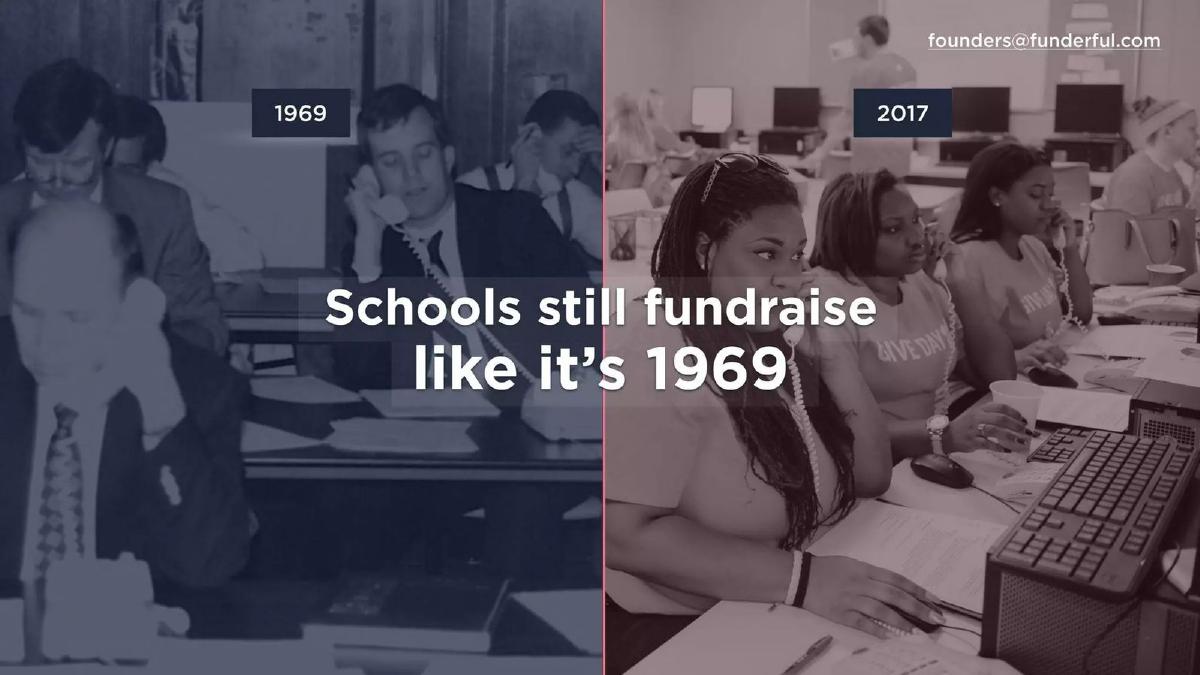
- Funderful uses a 'then vs. now' visual on slide 2 to argue that schools are still fundraising using 1969 methodologies.
- Traction is demonstrated on slide 8 with a reported 65% quarter-over-quarter growth, reaching $217K ARR in Q1 2017.
- The platform claims to deliver a 4X better ROI compared to traditional methods on slide 9.
- A specific case study for The Rhodes Scholarships shows donations increasing from $117,923 in 2015 to $424,051 in 2016 on slide 10.
- The customer list on slide 7 features high-prestige institutions including Berkeley, American University, Oxford, and Cambridge.
- The team slide (slide 12) uses a non-traditional headline, claiming the team 'beat Stanford in per capita donations.'
- The deck omits a specific funding request, valuation, or breakdown of how capital will be deployed.
The Narrative: Modernizing a Stagnant Billion-Dollar Industry
Funderful’s pitch deck is a focused, 13-slide presentation that targets a very specific pain point in the higher education market: the inefficiency of traditional alumni fundraising. The deck relies heavily on the contrast between the high costs of legacy systems and the efficiency of modern, gamified digital platforms. By using high-prestige logos and clear growth metrics, the founders attempt to prove that their solution is not just a 'nice to have' but a necessary evolution for university advancement teams.
Slides 1-3: The Hook and the Problem
Slide 1 is a standard title slide featuring the company logo over an image of a classical university building. It establishes the brand immediately but offers no tagline. The contact email, founders@funderful.com, is present at the bottom.
Slide 2 is the 'Problem' slide, and it is visually effective. It uses a split-screen comparison titled 'Schools still fundraise like it’s 1969.' On the left, a black-and-white photo from 1969 shows men on rotary phones; on the right, a 2017 photo shows a modern call center that looks remarkably similar in function. This slide successfully argues that while technology has advanced, the methodology of university fundraising has remained stagnant.
Slide 3 repeats the title slide but adds the tagline: 'Alumni fundraising done right.' This serves as a transition from the problem to the Funderful solution.
Slides 4-5: Market Size and Validation
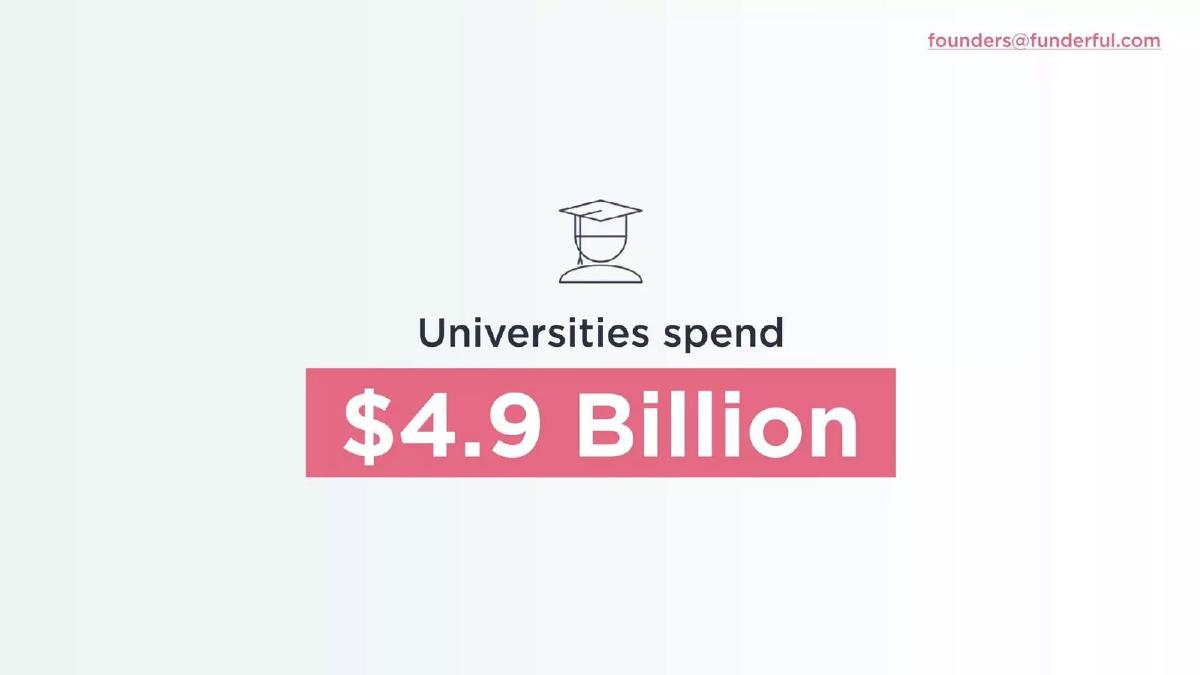
Slide 4 provides the primary market anchor. It states that 'Universities spend $4.9 Billion' on fundraising. While it doesn't break this down into TAM (Total Addressable Market) or SAM (Serviceable Addressable Market), it establishes that the 'cost of doing business' in this sector is massive, implying a significant opportunity for a more efficient software-based solution.
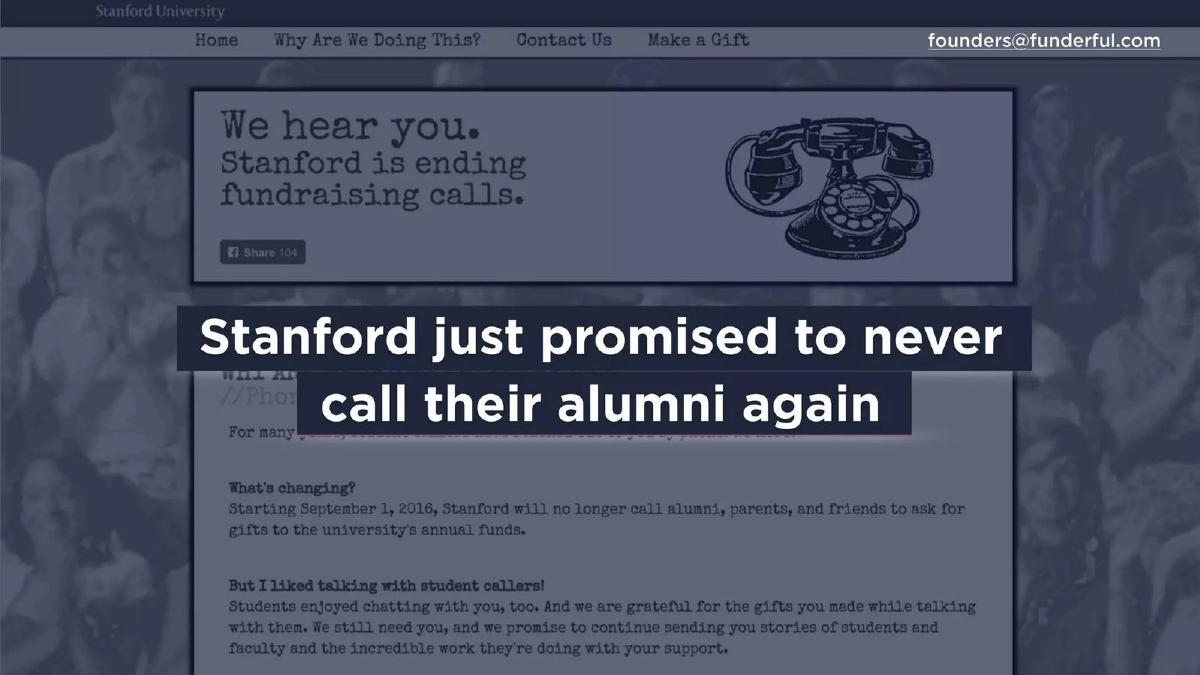
Slide 5 offers external validation of the problem. It features a screenshot of a Stanford University announcement stating, 'Stanford just promised to never call their alumni again.' This is a powerful piece of social proof. By showing that a top-tier institution is actively abandoning the old way (phone calls), Funderful positions itself as the logical successor to that abandoned strategy.
Slides 6-7: The Solution and Customer Base
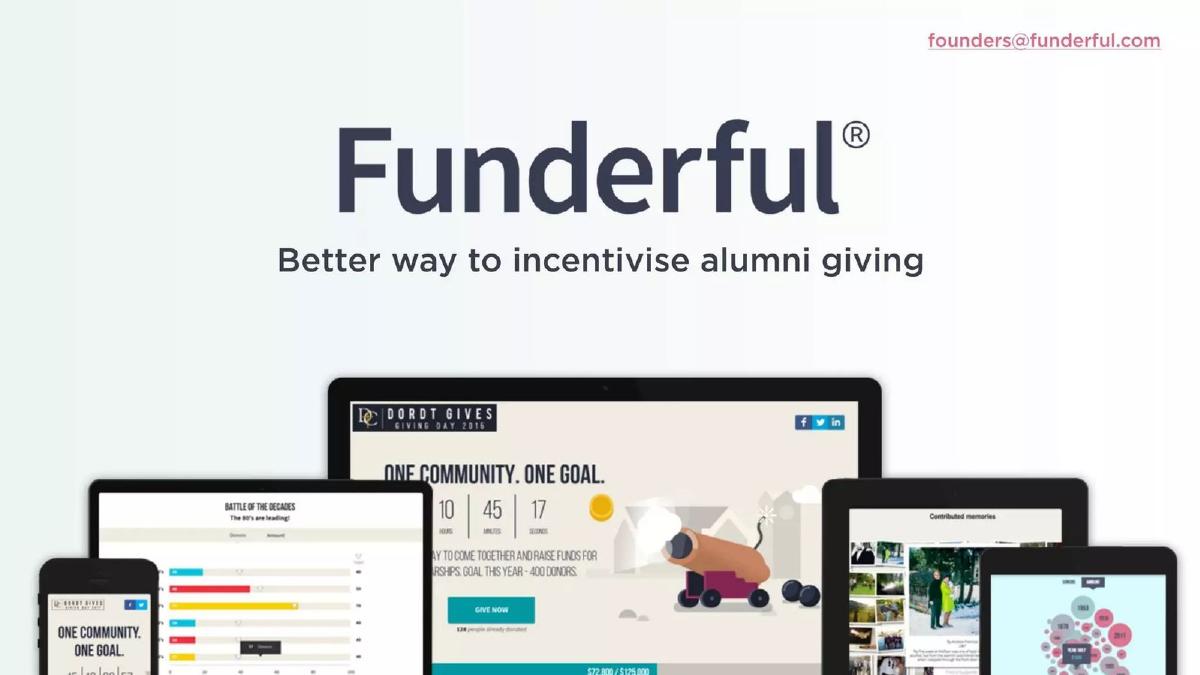
Slide 6 introduces the product interface. The headline is 'Better way to incentivise alumni giving.' The slide shows the platform across various devices (laptop, tablet, smartphone). The screenshots reveal features like a 'Battle of the Decades' leaderboard and a 'Giving Day' countdown clock. This is the first hint at the 'gamification' aspect of the product.
Slide 7 is a 'Logo Slide' that carries significant weight. It lists Berkeley, American University, University of Oxford, and University of Cambridge as customers. For a seed-stage company, having two of the world’s most famous universities (Oxford and Cambridge) as clients provides immense credibility and suggests that the product can scale internationally.
Slides 8-10: Traction and ROI
Slide 8 focuses on growth. It features a bar chart showing ARR (Annual Recurring Revenue) increasing from $135K in Q4 '16 to $217K in Q1 '17 . The headline explicitly states, 'We are growing 65% QoQ.' This is the 'meat' of the deck for investors, showing clear financial momentum.
Slide 9 is a simple, bold claim: '4X Better ROI.' While the slide lacks the data to back up how this ROI is calculated, it sets the stage for the specific case study that follows.
Slide 10 provides that case study using The Rhodes Scholarships . It shows a bar chart where donations grew from $117,923 in 2015 to $424,051 in 2016 'With Funderful platform.' The slide claims this is '3X more donations.' This is perhaps the most important slide in the deck, as it moves from 'we have customers' to 'our customers get massive results.'
Slides 11-13: The 'How' and The Team
Slide 11 asks, 'How we do it?' and answers with 'We gamify giving.' The background image shows a university mascot high-fiving students, reinforcing the idea of community and excitement rather than the 'chore' of traditional donating.
Slide 12 introduces the team: Raimonds Kulbergs (CEO), Dmitry Dedelis (CTO), Walter Rivera (Sales US), and Dave Celone (Advisor, Ivy League Fundraiser). The headline is unique: 'Our team beat Stanford In per capita donations.' This suggests the founders have a background in actual fundraising, rather than just being pure software developers. However, the slide lacks specific career histories or previous company exits for the founders.
Slide 13 is a closing slide with the logo and contact information over an aerial view of a university campus.
What Works in the Funderful Deck
The Stanford Anecdote: Using a specific news item about a market leader (Stanford) abandoning the old way of doing things is a brilliant way to create urgency. · High-Signal Logos: For a B2B startup, the quality of the first few customers matters more than the quantity. Oxford and Cambridge are world-class signals. · Clear Growth Metrics: Stating 65% QoQ growth and providing specific ARR figures ($217K) gives investors a clear picture of the company's trajectory. · The Rhodes Case Study: Moving from $117K to $424K in donations is a tangible, impressive result that justifies the product's existence.
What is Missing from the Funderful Deck
The Ask: There is no slide stating how much money Funderful is raising, the valuation, or what the milestones for the next 18 months look like. · Competition: The deck ignores other digital giving platforms or CRM-integrated tools like Blackbaud or Salesforce for Nonprofits. Investors would want to know how Funderful defends its niche. · Unit Economics: While the deck mentions ARR and ROI, it does not mention Customer Acquisition Cost (CAC) or Lifetime Value (LTV). In a market like Higher Ed, where sales cycles can be long, these metrics are vital. · Product Depth: The deck mentions 'chatbots' in the catalogue description, but the slides themselves focus mostly on web-based gamification. The technical 'how' of the chatbot integration is not explained.
What a Founder Should Copy
The 'Then vs. Now' Visual: Slide 2 is a perfect example of how to show a market is 'ripe for disruption' without using a single bullet point. · The Headline-First Approach: Every slide has a clear, declarative headline that tells the story (e.g., 'We are growing 65% QoQ'). A reader could understand the entire pitch just by reading the headlines. · Focusing on a Niche: Funderful doesn't try to be a general fundraising tool. It is specifically for university alumni. This focus allows them to use industry-specific language and social proof that resonates deeply with their target investors.
Frequently asked questions
- What is Funderful's core product?
- Based on the deck and catalogue listing, Funderful is a digital platform that gamifies alumni giving for higher education. It uses messaging and chatbots to replace traditional email and phone outreach. Slide 6 shows the interface across mobile and desktop, featuring leaderboards like a 'Battle of the Decades' to incentivize competition among different alumni year groups.
- How much revenue was Funderful generating at the time of this deck?
- According to slide 8, Funderful reached $217,000 in Annual Recurring Revenue (ARR) by the first quarter of 2017. This represented a 65% increase from the $135,000 ARR reported in the fourth quarter of 2016. This rapid growth serves as the primary evidence of product-market fit within the higher education sector.
- Who are Funderful's main customers?
- The company targets elite higher education institutions. Slide 7 explicitly lists the University of California Berkeley, American University, the University of Oxford, and the University of Cambridge as customers. The catalogue listing also mentions partnerships with Pomona College, Georgetown, and West Point, indicating a focus on high-end academic brands.
- What evidence of success does the deck provide?
- The strongest evidence is found on slide 10, which features a case study of The Rhodes Scholarships. After implementing the Funderful platform, donations rose from $117,923 in 2015 to $424,051 in 2016. Additionally, slide 9 claims the platform provides a 4X better ROI than traditional fundraising methods, though it does not detail the specific cost-per-dollar raised.
- What information is missing from the Funderful pitch deck?
- The deck is missing several standard fundraising components. There is no 'Ask' slide detailing how much money is being raised or the terms of the round. It also lacks a detailed market size (TAM/SAM/SOM) analysis beyond the $4.9B spend figure, a competitor matrix, a roadmap for future product development, and specific unit economics like CAC or LTV.