Mollie’s 2020 'Strategy Discussion Document' is a high-level overview used during a period of massive scaling. The deck is remarkably brief at only seven slides, omitting traditional elements like a team slide, detailed financials, or a specific 'ask.' Instead, it leans heavily on massive traction metrics—specifically processing over €10b in volume and achieving 1,000% YoY growth in Germany. The narrative centers on a 'commercial turn-around' and a shift toward the medium-sized merchant segment (€1-50m TPV). By positioning themselves as the 'most loved' alternative to legacy incumbents, Molli…
Key takeaways
- The company reported processing over €10b in volume in 2020, representing a doubling of year-over-year growth (Slide 2).
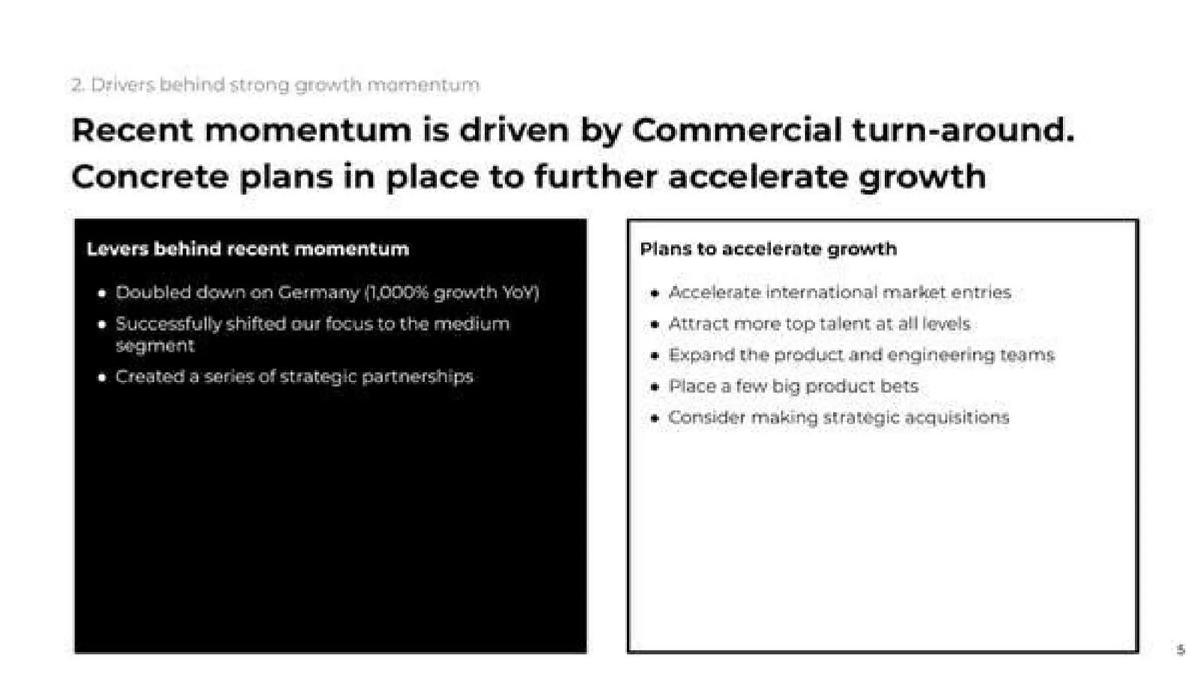
- Mollie achieved a significant 1,000% year-over-year growth rate in the German market (Slide 5).
- The strategy explicitly targets capturing churn from incumbents by focusing on the SME and medium-sized merchant segments with €1-50m TPV (Slide 7).
- The deck highlights a workforce of approximately 300 employees across the Netherlands, Belgium, Germany, and France (Slide 2).
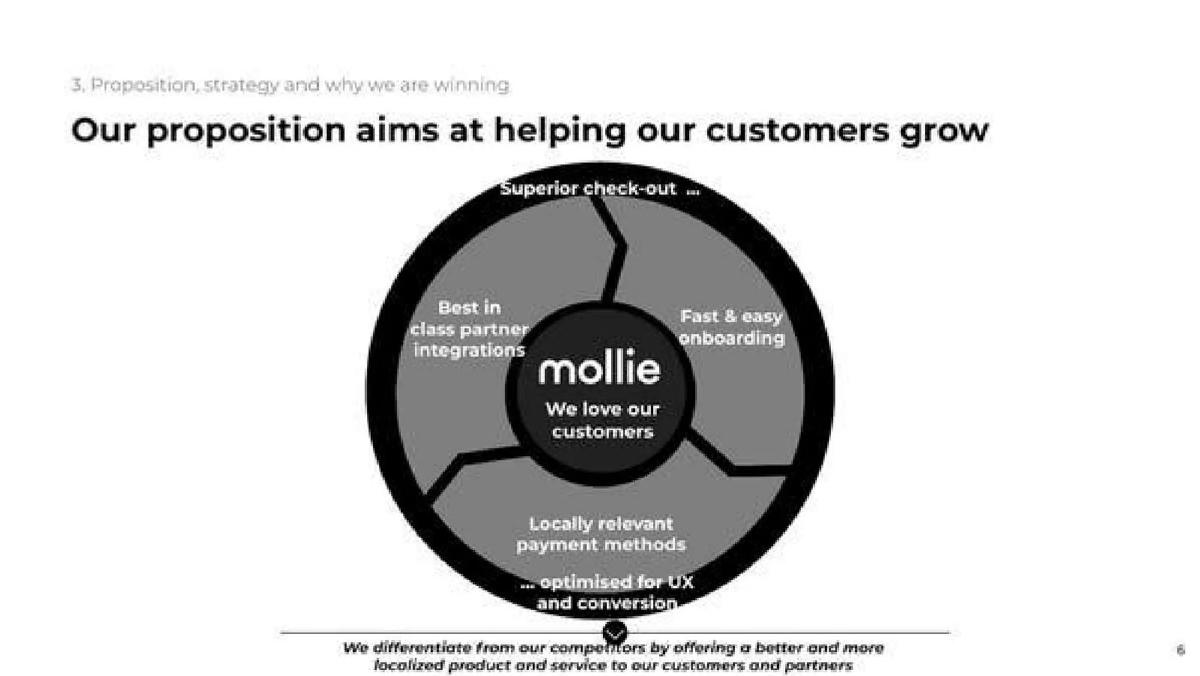
- Mollie identifies its core differentiation as offering a 'better and more localized product' compared to competitors (Slide 6).
- The company serves nearly 100,000 businesses across Europe as of the August 2020 document date (Slide 2).
- Future growth plans include considering strategic acquisitions and placing 'big product bets' (Slide 5).
- The deck lacks a formal team slide, detailed unit economics, or a specific funding request, functioning more as a strategy alignment tool (General Observation).
The 7-Slide Strategy: Mollie’s Path to €10B+
Mollie’s 2020 strategy document is a fascinating artifact from a company that was founded in 2004 but found a second gear of hyper-growth nearly two decades later. This deck, titled "Founders of Growth," was produced in August 2020. It does not follow the traditional 12-15 slide venture capital pitch deck format. Instead, it serves as a high-level strategic alignment tool, likely used for internal stakeholders or existing investors during their massive Series B and C rounds. The deck is characterized by extreme brevity, high-contrast design, and a focus on massive scale indicators.
Slide 1: Title Slide
The cover slide is minimalist, featuring the Mollie logo in the top right and the title "Founders of Growth: Mollie Strategy Discussion Document" in the center-left. The date, August 2020, is crucial context. This was a period when e-commerce was accelerating globally due to pandemic tailwinds, and Mollie was positioning itself to capture that surge. The subtitle "Strategy Discussion Document" signals that this is not a pitch for a first-time meeting, but a deeper dive into how the company intends to scale its existing momentum.
Slide 2: Mollie Overview
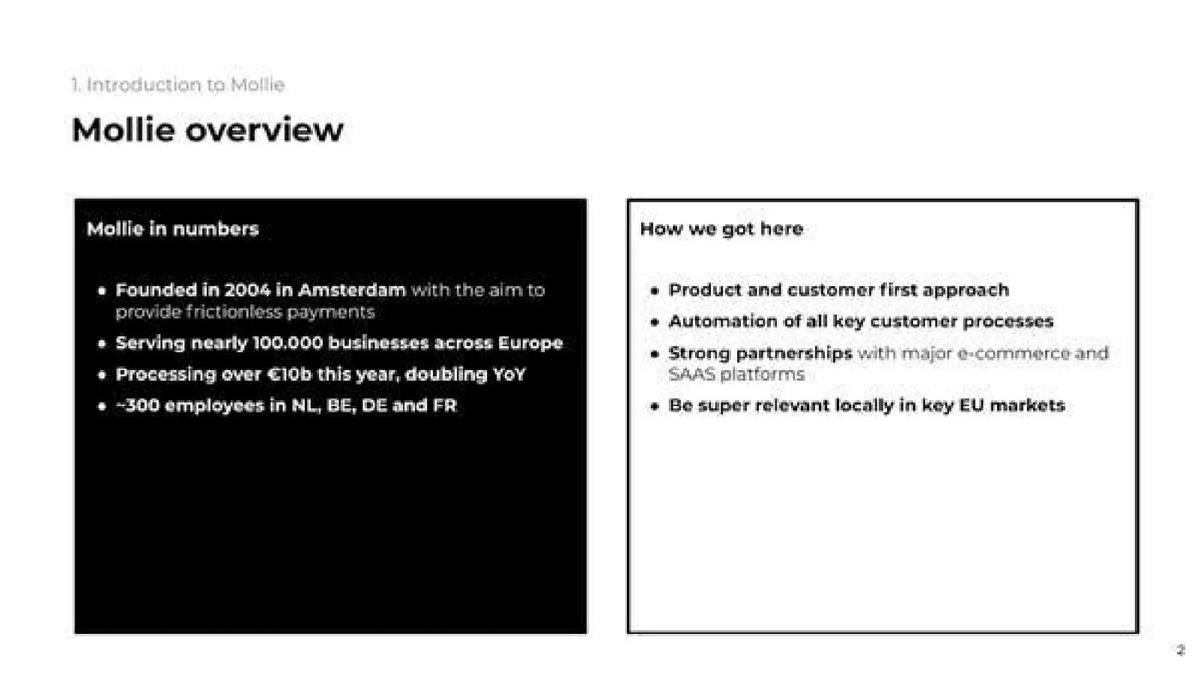
Slide 2 provides the 'meat' of the company’s current status. It is divided into two sections: "Mollie in numbers" and "How we got here." The figures are staggering for a European fintech. The company claims to be serving nearly 100,000 businesses across Europe and processing over €10b in volume for the year, which they note is "doubling YoY." It also lists a headcount of approximately 300 employees across the Netherlands (NL), Belgium (BE), Germany (DE), and France (FR). The "How we got here" section emphasizes a "product and customer first approach" and the automation of key customer processes, suggesting that their efficiency is a result of technical superiority rather than just brute-force sales.
Slide 3: What Drives Us
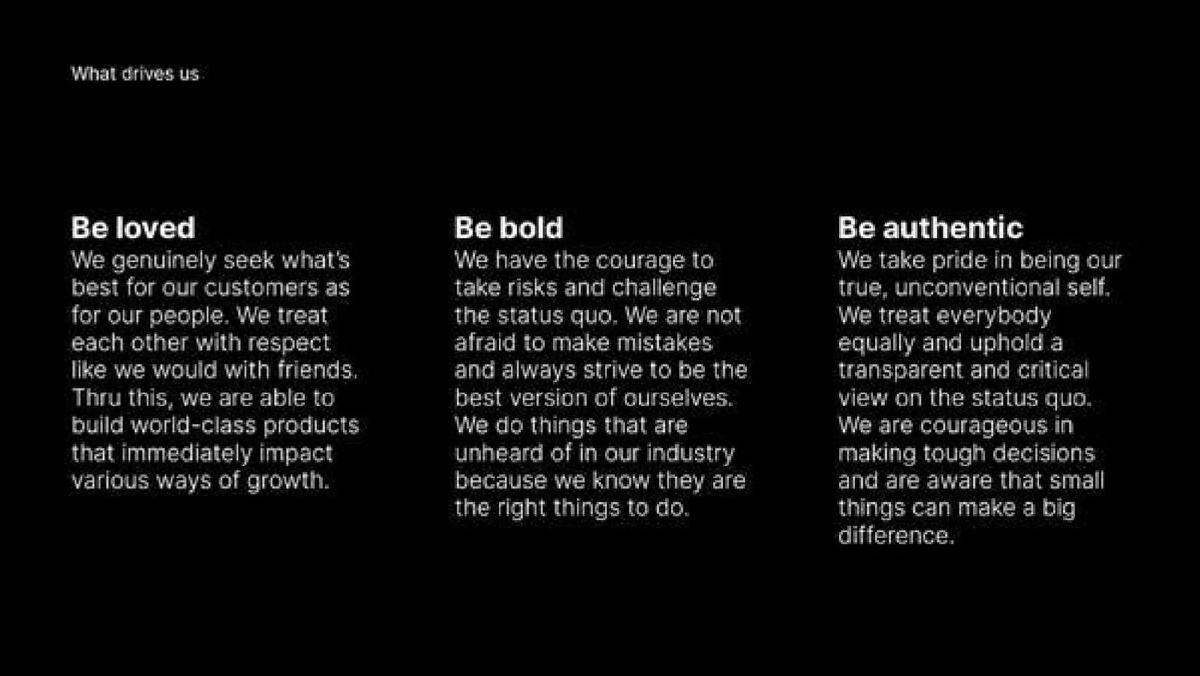
This is a culture and values slide. It outlines three pillars: "Be loved," "Be bold," and "Be authentic." While many decks include values as filler, Mollie connects these to their business outcomes. Under "Be loved," they mention building products that "immediately impact various ways of growth." Under "Be bold," they talk about challenging the status quo and doing things "unheard of in our industry." This slide sets the stage for their competitive strategy: they aren't just a utility; they are a brand that merchants actually like, a rarity in the world of payment processing.
Slide 4: Product Visual
Slide 4 is a wordless visual of a mobile device showing a checkout screen. It features an Apple Pay integration and a clean, minimalist UI. This slide serves as a proof of their "superior design" claim mentioned later in the deck. In the payments industry, the checkout experience is the moment of truth; by showing a sleek, frictionless mobile interface, Mollie reinforces their value proposition of "frictionless payments" mentioned on Slide 2.
Slide 5: Drivers Behind Strong Growth Momentum
This slide addresses the "why now" and "what's next." It attributes recent momentum to a "Commercial turn-around." Specifically, it highlights a 1,000% YoY growth rate in Germany, a shift in focus to the "medium segment," and the creation of strategic partnerships. The right side of the slide, "Plans to accelerate growth," lists five levers: international market entries, attracting talent, expanding product/engineering teams, placing "big product bets," and considering strategic acquisitions. This is the most forward-looking slide in the deck, indicating that the company is moving from a regional leader to a potential consolidator in the space.
Slide 6: The Proposition and Why We Are Winning
Using a circular diagram, Slide 6 illustrates the Mollie flywheel. At the center is "mollie: We love our customers." Surrounding this are three core components: "Best in class partner integrations," "Fast & easy onboarding," and "Locally relevant payment methods... optimised for UX and conversion." The footer of the slide explicitly states their competitive advantage: "We differentiate from our competitors by offering a better and more localized product and service to our customers and partners." This is a direct shot at global incumbents like Stripe or Adyen, suggesting that Mollie’s edge is its deep understanding of local European payment nuances.
Slide 7: The Strategy to Capture Churn
The final slide is the most aggressive. It states the goal clearly: "Our strategy is to create and capture churn from incumbents." It breaks this down into the "Proposition" (superior design, easy integration, no lock-in) and the "Target segment." Notably, it defines its target as the "SME segment adding medium sized merchants (€1-50m TPV)." The slide concludes with a bold vision statement: "Aiming to become the most loved financial service provider for SMB's in Europe." This slide defines their market position not as a generalist, but as a specialist for the underserved mid-market that is tired of legacy banking infrastructure.
What Works in the Mollie Deck
The most effective element of this deck is its unapologetic focus on momentum . By leading with the €10b processing figure and the 1,000% growth in Germany, Mollie makes it difficult for any investor to ignore the business. The deck also does an excellent job of defining a clear enemy : the "incumbents." By framing their growth as "capturing churn," they present themselves as an inevitable force that is eating the market share of older, slower banks. Furthermore, the visual simplicity of the deck reflects their product philosophy. If a company claims to value "superior design" and "frictionless" experiences, their pitch deck must embody those qualities. Mollie’s high-contrast, low-text slides do exactly that.
What is Missing from the Mollie Deck
For a standard fundraising teardown, the omissions here are significant. First, there is no Team slide . While the founders and leadership of a company processing €10b are likely well-known, a strategy document usually benefits from highlighting the key personnel driving the "commercial turn-around." Second, there is no detailed financial breakdown . We see the top-line volume (TPV), but we don't see take rates, net revenue, or EBITDA margins. Third, the competitive landscape is vague . While they mention "incumbents," they do not name them, nor do they provide a feature-by-feature comparison against other modern fintechs like Stripe or Checkout.com. Finally, there is no specific 'Ask' . The deck ends on a vision statement rather than a request for capital, which confirms its role as a discussion document rather than a formal solicitation.
What a Founder Should Copy
Founders should emulate Mollie’s use of specific, high-impact metrics . Instead of listing twenty different KPIs, Mollie picks the two that prove their scale and their ability to win new markets (TPV and German growth). Another takeaway is the clear segmentation . Mollie doesn't just say they want to be a payment provider; they specify the "medium sized merchants (€1-50m TPV)" segment. This level of specificity tells investors that the company knows exactly who their most profitable customers are and how to find them. Lastly, the flywheel visualization on Slide 6 is a great way to show how disparate parts of a business (onboarding, integrations, local methods) work together to create a single, unified value proposition.
Final Analysis
Mollie’s deck is a product of its stage. In 2020, they weren't a startup looking for validation; they were a scale-up looking for market dominance. The deck succeeds because it doesn't waste time on the basics. It assumes the reader knows that payments is a massive market and instead focuses on why Mollie is the specific winner in the European theater. It is a masterclass in how to use a few slides to communicate massive ambition and even larger results.
Frequently asked questions
- Why is the Mollie deck so short at only seven slides?
- This document is labeled as a 'Strategy Discussion Document' from August 2020, rather than a cold-outreach seed deck. At this stage, Mollie was already a well-established player processing €10b annually. Late-stage decks often focus on high-level strategic pivots—like their shift to the medium-market segment—rather than explaining the basics of the business model, which investors at that level already understand.
- What is the most impressive metric included in the deck?
- The standout figure is the 1,000% YoY growth in Germany mentioned on Slide 5. For a company founded in 2004, achieving four-digit growth in a major European market sixteen years later is exceptional. This metric validates their 'locally relevant' strategy and proves that their model is highly exportable beyond their home market in the Netherlands.
- How does Mollie plan to compete with larger payment incumbents?
- According to Slide 7, their strategy is to 'create and capture churn from incumbents.' They aim to do this by offering superior design, easy integration, and no lock-in contracts. They specifically target the 'underserved' SME and medium-sized merchant segments (€1-50m TPV) who may find legacy bank solutions too complex or poorly designed.
- What key fundraising elements are missing from this deck?
- The deck omits several standard components: a Team slide (founders/executives), a Competition slide (naming specific rivals), a detailed Financial slide (P&L or margins), and a specific 'Ask' (how much they are raising). Because it is a strategy document, it assumes the audience is already familiar with the core team and the cap table.
- What does Mollie mean by 'locally relevant payment methods'?
- Slide 6 and the company description emphasize that European payments are fragmented. Unlike the US, where credit cards dominate, Europe relies on local methods like iDEAL (NL), Bancontact (BE), and Giropay (DE). Mollie’s value proposition is providing a single API that integrates all these specific local methods, which they claim is a key driver of their 'superior check-out' experience.