MoneyMan’s pitch deck is a masterclass in operational transparency for a fintech startup. By the end of 2015, the company had issued over 258,000 loans and established a presence in Russia, Kazakhstan, Georgia, Spain, and Poland. The core of their argument rests on a proprietary scoring model that reduced Non-Performing Loans (NPL) to sub-10% even during economic volatility in Russia. Financially, they demonstrate a clear path to profitability with a Client Lifetime Value (CLV) of $112 against a new loan amount of $85. While the deck lacks a specific 'Ask' slide or a forward-looking roadmap b…
Key takeaways
- MoneyMan achieved over 258,000 total loans issued across five countries by the end of 2015 (Slide 2).
- The company maintains an NPL level of under 10% through a proprietary scoring model analyzing hundreds of data points (Slide 2).
- Operational efficiency is highlighted by monthly admin costs of under $200,000 for three fully operational countries (Slide 3).
- The platform demonstrates high loyalty, with $6.40 of repeat loans issued for every $1.00 of new loans (Slide 4).
- Unit economics show a Gross Revenue of $284 and a resulting CLV of $112 per client (Slide 4).
- Collection efficiency is high, with over 70% of cash flow collected in-house to minimize costs (Slide 5).
- Client acquisition costs (CAC) have been reduced to sub-5% of issuance levels through a multi-channel strategy (Slide 6).
- The management team features deep institutional experience from Deutsche Bank, RBS, and Experian (Slide 8).
MoneyMan Pitch Deck Teardown
MoneyMan is an international alternative finance provider that focuses on the microloan sector. This deck, likely used for a Series B or growth stage discussion around late 2015, provides a granular look at how a fintech company manages risk in emerging and volatile markets. The presentation is heavy on data, charts, and operational metrics, which is exactly what sophisticated fintech investors look for.
Slide 1: Title and Social Proof
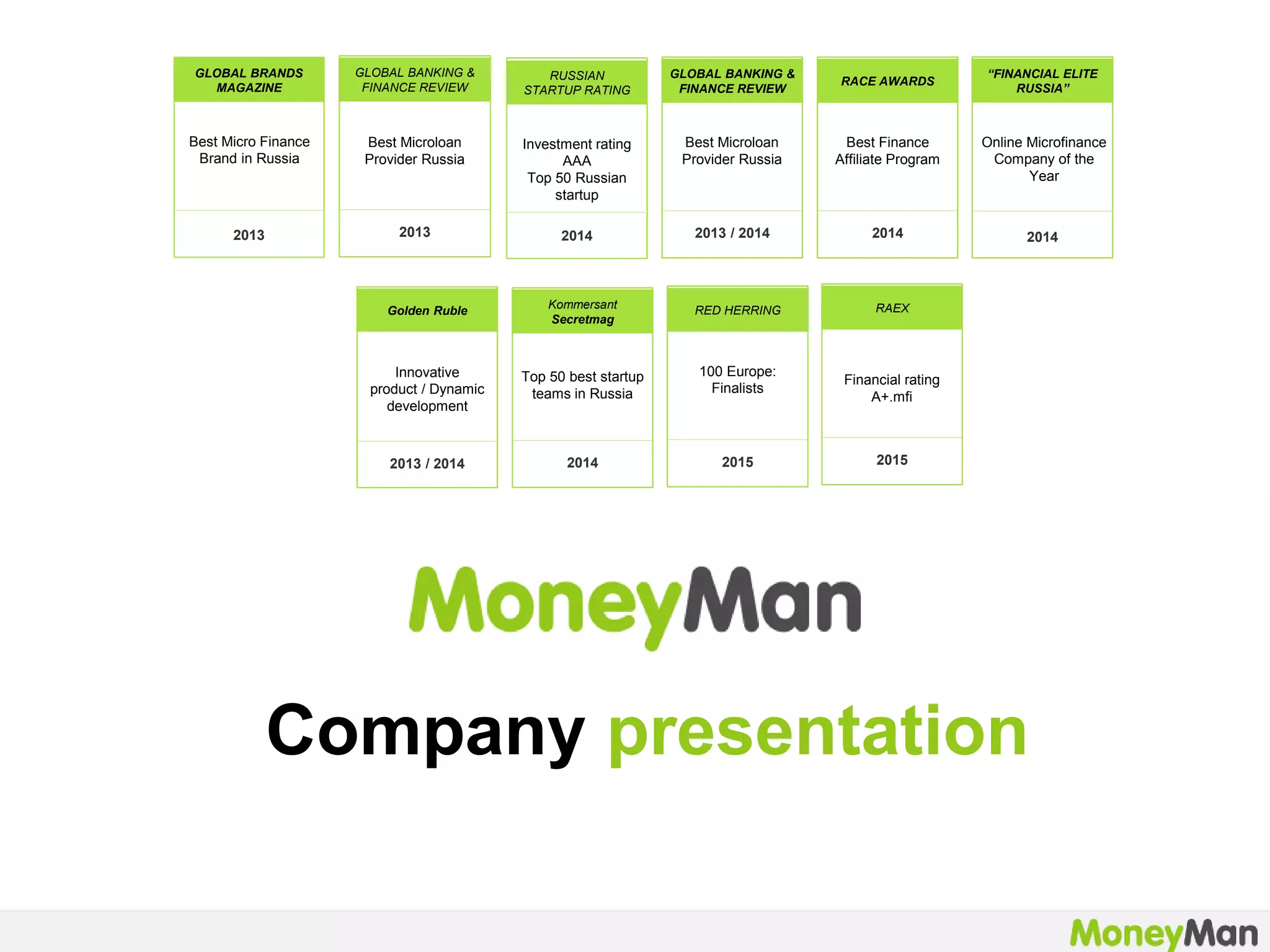
The cover slide is unconventional because it leads with a massive wall of awards and ratings. MoneyMan lists ten distinct accolades from 2013 to 2015, including "Best Microfinance Brand in Russia" and a "AAA" investment rating from the Russian Startup Rating. By placing these at the very front, the company establishes immediate credibility in a sector (microfinance) that is often viewed with skepticism regarding stability and ethics.
Slide 2: Introduction and Key Facts
Slide 2 serves as the executive summary. It establishes the company's scale: 258,000 loans issued across five countries by the end of 2015. The most critical metric here is the NPL (Non-Performing Loan) level of under 10%. In the lending world, NPL is the ultimate indicator of health. The slide also mentions that the company is profitable in Russia, Kazakhstan, and Georgia. A map shows their footprint extending into Spain, Poland, and Brazil, signaling global ambitions. The chart at the bottom right is particularly effective, showing that as loan volume increased, the NPL rate decreased—a sign that their scoring models were learning and improving.
Slide 3: MoneyMan at a Glance
This slide focuses on the user experience and operational efficiency. It highlights a "low cost model" with under $200,000 in monthly admin costs for three countries. For investors, this demonstrates high operating leverage. The "MoneyMan client profile" section uses a persona (29-year-old male, higher education, working in sales) to humanize the data. It also notes that their technology allows them to launch in a new country within three months, emphasizing the scalability of their Minsk-based IT development team.
Slide 4: Key Figures of MoneyMan.ru
Slide 4 dives deep into the Russian market, their largest at the time. The "Client Lifetime Value Analysis" is the standout feature here. It shows a clear progression from a small initial loan ($85) to significant repeat business ($543). The math is transparent: Gross Revenue ($284) minus NPL ($82) and OPEX ($90) equals a CLV of $112. Providing this level of detail on unit economics is rare in pitch decks and highly effective for building trust. The bar charts show explosive growth, with a 6x increase in loan volume followed by a 3x increase in the subsequent period.
Slide 5: Risk Technology and Collection
Lending is easy; getting paid back is hard. Slide 5 addresses the "getting paid back" part. It details a fully automated collection process using autodialers, SMS, and email. The slide breaks down their collection buckets from 1 day to 365+ days. The chart showing the "unprecedented reduction of NPL rate" from over 50% in 2012 to 8% in June 2015 is the strongest evidence in the deck that their "proprietary scoring model" actually works.
Slide 6: Client Acquisition Costs (CAC)
This slide addresses the marketing side of the business. It shows that CAC has been reduced to sub-5% of the issuance level. The bar chart tracks gross vs. net loan costs in Rubles from 2012 to 2015. It highlights a multi-channel strategy including SEO, direct marketing, and CPA (Cost Per Action) leads. The mention of "traffic recycling" to partially cover marketing costs suggests a sophisticated understanding of digital arbitrage and lead management.
Slide 7: Risk Technology in Origination
Slide 7 provides a technical breakdown of their data sources. It separates "Global" data (web analytics, device identity) from "Local" data (social networks, government services, local credit bureaus). By listing specific partners like Equifax, Experian, and Facebook, MoneyMan proves they are integrated into the modern data ecosystem. This slide is intended to satisfy the technical due diligence requirements of a lead investor.
Slide 8: Management Team
The team slide is strong, featuring four key executives with relevant institutional backgrounds. CEO Boris Batin and COO Alexander Dunaev both bring pedigree from Deutsche Bank and London-based finance firms. The inclusion of a Chief Risk Officer (Ekaterina Kazak) with experience at Experian is a strategic move, as it reinforces the company's focus on risk management as its core competency. Each bio includes years of experience and specific educational credentials (PhD, CFA, Masters from Cambridge and Imperial College).
Slide 9: Disclaimer
The final slide is a standard legal disclaimer regarding forward-looking statements and confidentiality. While necessary for a formal presentation, it offers no additional insight into the business itself.
What Works in This Deck
Transparency of Unit Economics: The breakdown of CLV, CAC, and NPL is exceptionally detailed. Most founders hide these numbers or use vague percentages; MoneyMan uses hard dollar figures.
Focus on Risk Mitigation: In the microfinance sector, investors fear defaults. MoneyMan spends three full slides (2, 5, and 7) explaining how they prevent and manage defaults, which directly addresses the biggest investor objection.
Proof of Scalability: By showing successful operations in five diverse countries (from Russia to Spain), they prove that their model isn't just a local anomaly but a scalable global platform.
What is Missing
The Ask: The deck never explicitly states how much money they are looking to raise or what the specific use of funds will be. While this might be in a separate document, a pitch deck usually benefits from a clear "Ask" slide.
Competitive Landscape: There is no slide comparing MoneyMan to other microfinance players or traditional banks. While they claim to be #1 in several markets, a visual comparison of features or interest rates would have been helpful.
Future Roadmap: The data stops at late 2015/early 2016. There is no vision for where the company goes in 2018 or 2020. Are they moving into credit cards? Mortgages? Small business loans? The deck is very focused on the "now" but lacks a "future" narrative.
What a Founder Should Copy
The NPL vs. Volume Chart: If you are in a lending or subscription business, show that your churn or default rate stays stable or improves as you scale. This is the ultimate proof of a healthy engine.
The "At a Glance" Persona: Slide 3’s use of a customer persona alongside hard operational metrics makes the business model easy to visualize for an outsider.
Data Source Listing: If your startup relies on "proprietary algorithms," don't just say it—show the data inputs. Slide 7’s list of global and local data sources makes the "black box" of their algorithm feel tangible and real.
Frequently asked questions
- What is MoneyMan's primary competitive advantage according to the deck?
- MoneyMan identifies its proprietary scoring model as its primary advantage. As stated on Slide 2, this model analyzes hundreds of data points per client to maintain an NPL (Non-Performing Loan) level under 10%. This technical edge allowed them to adjust scoring quickly during the Russian economic downturn, ensuring the business remained sustainable while competitors faced rising defaults.
- How does the company manage its international operations so efficiently?
- The deck highlights a low-cost business model where monthly administrative costs for three countries are kept under $200,000. Slide 3 credits this to efficient IT development based in Minsk and a scalable technology stack that allows the company to launch in a new country within just three months. This centralized technical core supports decentralized local operations.
- What do the unit economics look like for a typical MoneyMan customer?
- Slide 4 provides a detailed Client Lifetime Value (CLV) analysis. A new loan typically averages $85, but repeat loans grow to $543. After accounting for NPL ($82) and OPEX ($90), which includes marketing and collection, the company realizes a CLV of $112. This indicates a highly profitable relationship with the customer over time.
- What is the company's strategy for handling overdue loans?
- MoneyMan uses a five-bucket collection strategy detailed on Slide 5. It starts with in-house client managers for loans 1-15 days overdue and moves through soft in-house collection, then external agencies for loans 120-365 days overdue. Finally, loans over 365 days are handled via legal collection or portfolio sales. Over 70% of cash is collected in-house.
- Who are the key members of the leadership team?
- The team is led by CEO Boris Batin, PhD, who has 13 years of experience at Deutsche Bank and RBS, and COO Alexander Dunaev, CFA, who also has a background at Deutsche Bank. The technical side is managed by CTO Pavel Shareyko, while risk is overseen by Ekaterina Kazak, formerly the Head of Russia & CIS for Experian Analytics (Slide 8).