Five Flute’s 18-slide pre-seed deck is a masterclass in domain-specific problem solving. By focusing on the 'nightmare' of hardware collaboration, the founders—who boast 29 combined years of experience—positioned their software as the 'Frame.io for hardware.' The deck successfully argues that general-purpose tools like Jira or Slack fail because they are disconnected from the actual engineering assets (CAD models). With a clear beachhead strategy targeting SolidWorks’ 3.25 million active users and a product-led growth model, the startup secured $1.2M from Baukunst and others in 2022. While th…
Key takeaways
- The founders possess significant domain expertise, with 29 combined years of product and software development experience (Slide 2).
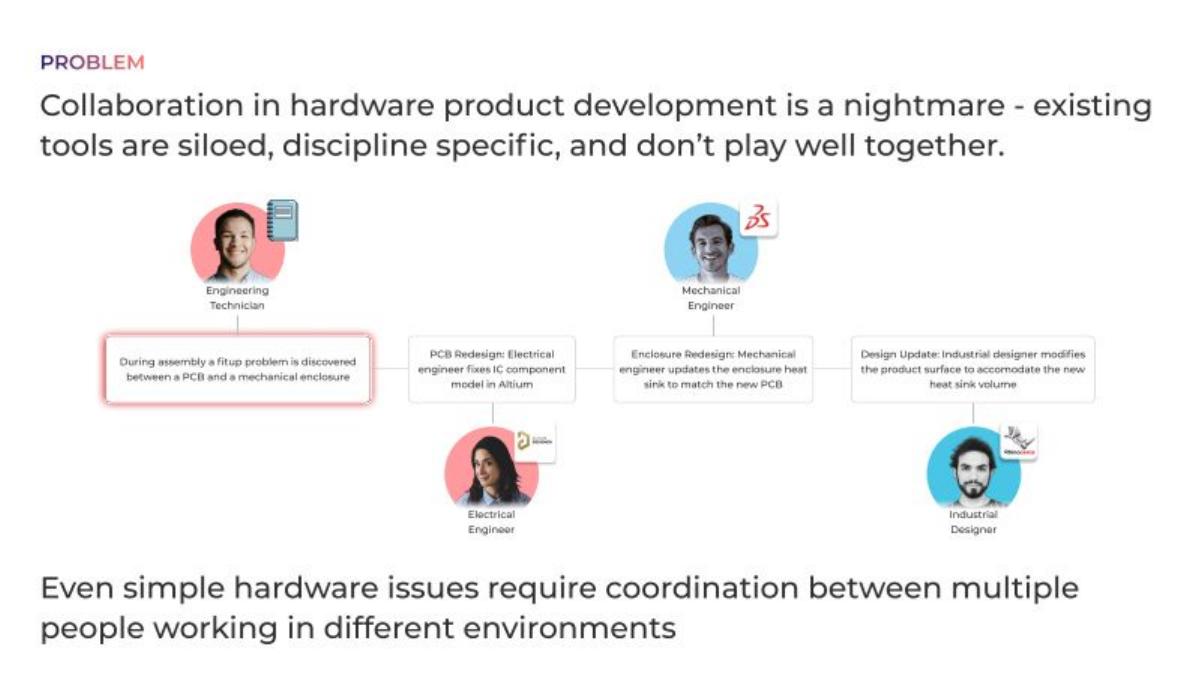
- The problem is defined as a 'nightmare' of siloed tools that force manual coordination across different environments (Slide 4).
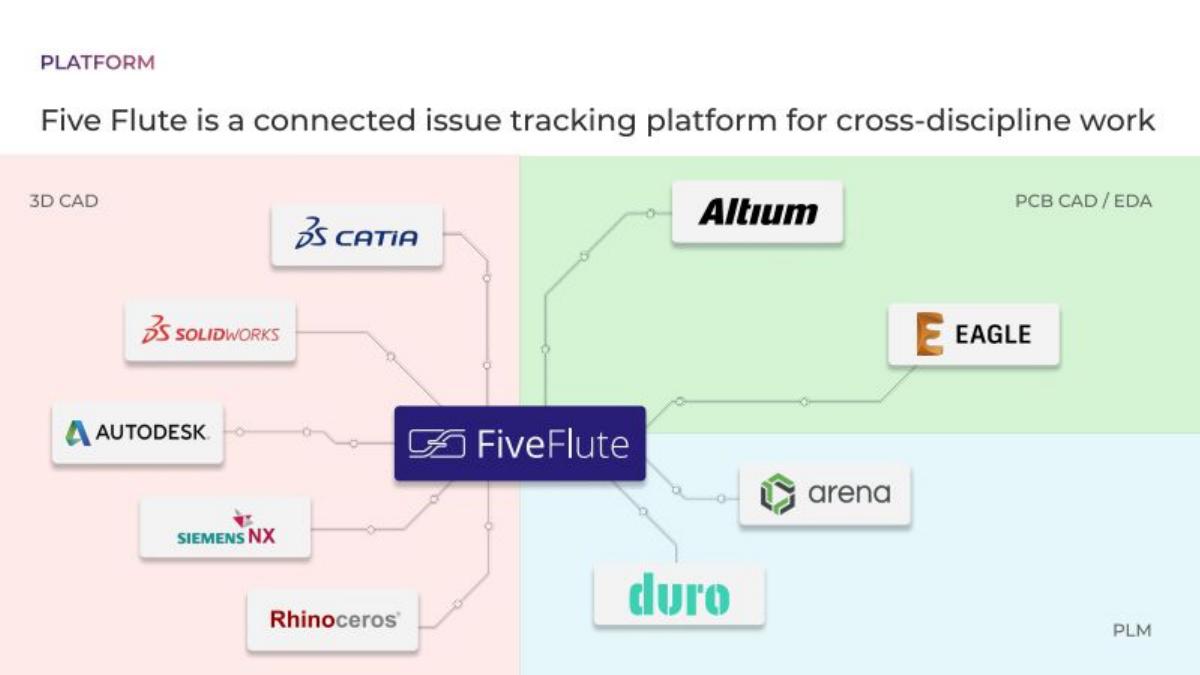
- Five Flute positions itself as the central hub connecting 3D CAD, PCB CAD, and PLM software (Slide 6).
- The product strategy relies on 'living where real work is done' through direct CAD integration (Slide 7).
- The company uses Frame.io as a successful analog for their integration-first strategy in a specialized creative field (Slide 10).
- The market opportunity is quantified at a $12B global total, with a $1.95B beachhead in the SolidWorks ecosystem (Slide 13).
- The go-to-market strategy is product-led, aiming to 'land' with individual engineers and 'spread' to managers and VPs (Slide 14).
- The roadmap clearly delineates the expansion from mechanical CAD to electrical CAD and PLM integrations (Slide 15).
Introduction and Team
Slide 1: Title Slide
The deck opens with a clean, minimalist title slide. It features the Five Flute logo and the tagline: Issue Tracking SaaS for Physical Product Developers . Below this, a sub-headline explains the core value proposition: bringing issue tracking and team collaboration directly into 3D design tools. This immediately establishes the product's niche and its primary integration-led strategy.
Slide 2: Team
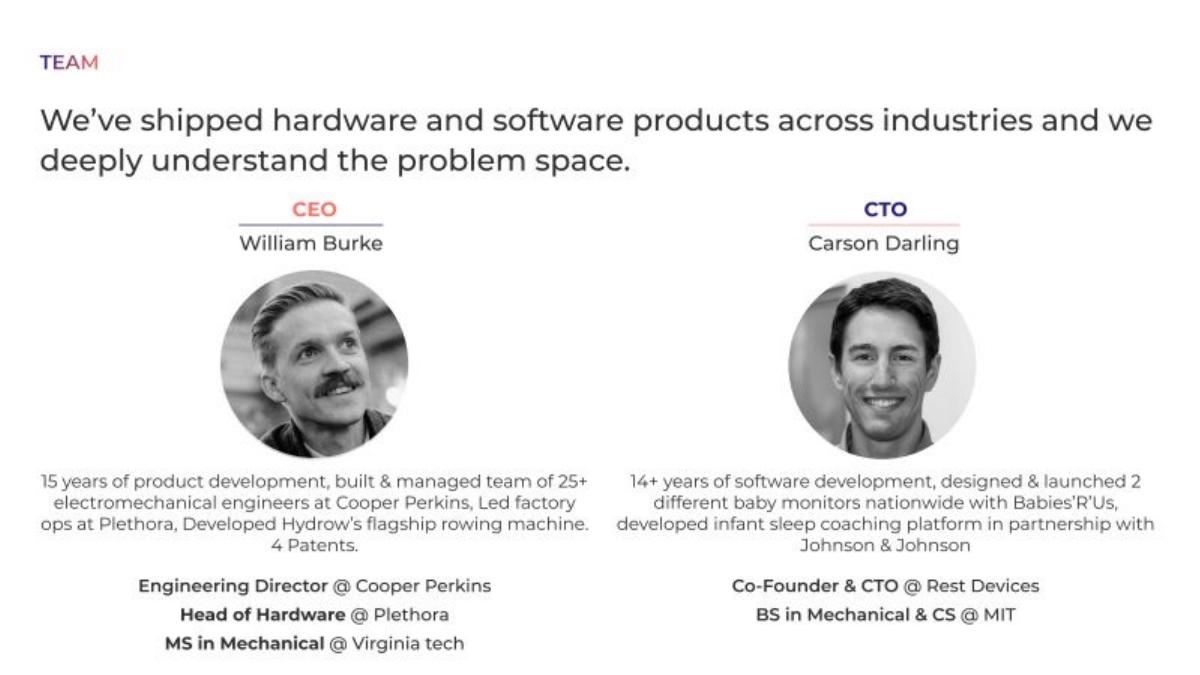
The team slide emphasizes deep domain expertise. CEO William Burke is credited with 15 years of product development, having managed a team of 25+ engineers and developed flagship products like Hydrow's rowing machine. He holds 4 patents. CTO Carson Darling is listed with 14+ years of software development, a degree from MIT, and experience launching products with Babies'R'Us and Johnson & Johnson. The slide's header, We’ve shipped hardware and software products across industries , reinforces their credibility in a complex technical space.
The Problem and Market Context
Slide 3: Product Development Overview
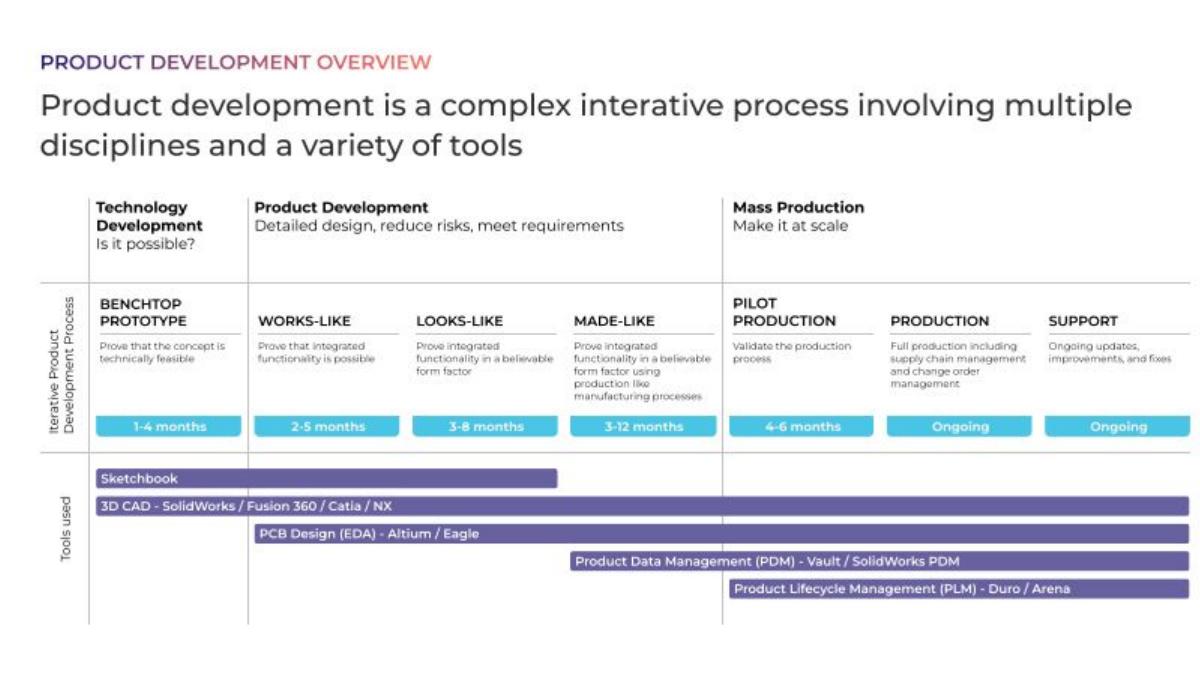
This slide provides a timeline of the iterative product development process, from benchtop prototypes (1-4 months) to mass production (ongoing). It maps out the various tools used at each stage, such as SolidWorks, Altium, and Arena. This serves to educate the investor on the complexity of the workflow and sets the stage for where the 'nightmare' of collaboration occurs.
Slide 4: Problem
The problem is stated bluntly: Collaboration in hardware product development is a nightmare . The slide uses a flow diagram to show how a simple fitup problem discovered during assembly requires a chain of manual coordination between an engineering technician, an electrical engineer, a mechanical engineer, and an industrial designer. It highlights that these individuals work in different, siloed environments, leading to friction.
Slide 5: Discovery
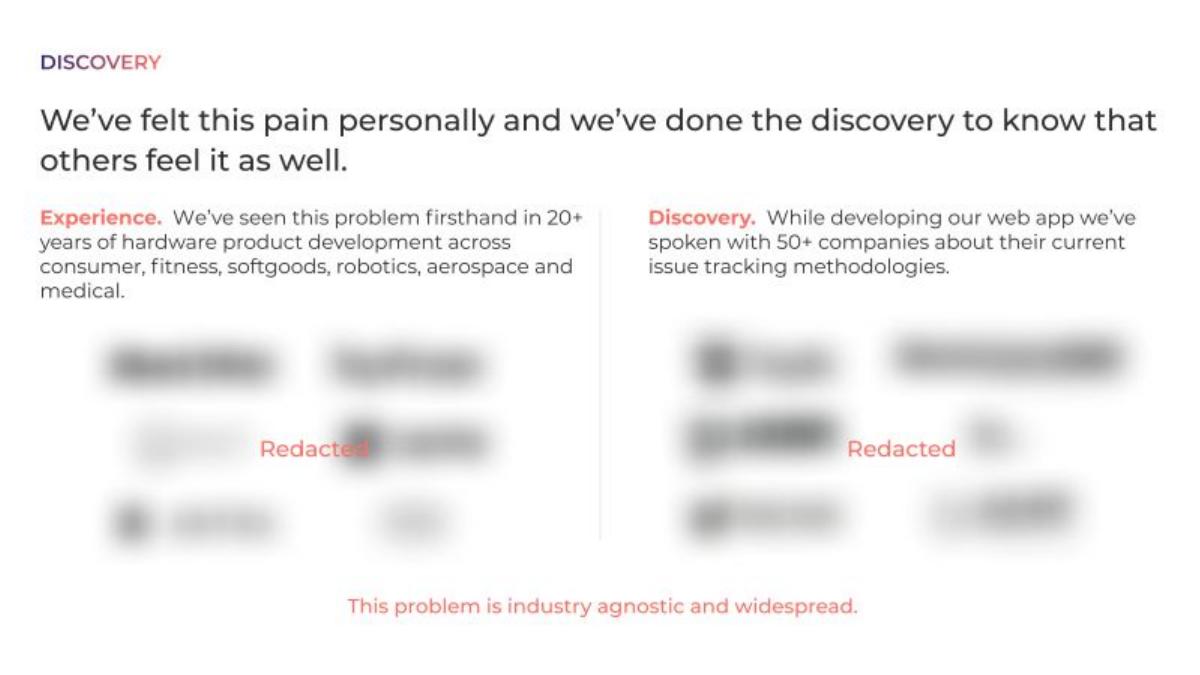
To validate the problem, the founders cite their personal experience (20+ years in hardware development) and their discovery process (speaking with 50+ companies). The slide includes blurred logos of companies they interviewed, labeled as 'Redacted.' The takeaway is that the problem is industry agnostic and widespread .
The Solution and Platform
Slide 6: Platform Overview
This slide positions Five Flute as the central connector. A diagram shows Five Flute at the center, with spokes connecting to 3D CAD (CATIA, SolidWorks, Autodesk, Siemens NX, Rhinoceros), PCB CAD (Altium, Eagle), and PLM (Arena, Duro). It visually represents the product as the 'glue' for cross-discipline work.
Slide 7: Platform Interface
The deck shows the product in three contexts: CAD Integrated for engineers, Desktop Webview for management, and Mobile for technicians and manufacturing. This demonstrates that the platform is accessible to all stakeholders in the product lifecycle, regardless of their primary toolset.
Slide 8: Product Demo
Slide 8 is a placeholder for a demo, showing a Five Flute sidebar integrated directly into the SolidWorks interface next to a 3D model of a mechanical gripper. This proves the 'CAD Native' claim made later in the deck.
Slide 9: Why We Win
This slide outlines four pillars of their competitive advantage: Customer Experience (visual context), Simpler Adoption (integrating into existing workflows), Product Led (transparent pricing and easy onboarding), and Stickiness and Defensibility (integration across the entire toolchain).
Slide 10: Integration is Key
The founders use a powerful analogy here: What Frame.io did for video, Five Flute will do for hardware product development . It shows Frame.io's integrations with video editors (After Effects, Premiere) alongside Five Flute's integrations with 3D design editors. This helps investors understand the potential for a category-defining integration platform.
Competition and Market Opportunity
Slide 11: The Competition Isn't Focused
A standard 2x2 matrix places Five Flute in the top-right quadrant (CAD Native and Connected to engineering data). Competitors (redacted) are categorized as either 'Web Only' or 'Siloed.' The slide claims competitors are structurally unable to address this niche because they force teams to change their workflows.
Slide 12: Market Segments
This slide breaks down the user base from VPs of Engineering (big-picture status) to Engineers (daily design work) and Technicians (reporting issues in physical hardware). It notes a land and spread strategy starting with individual engineers.
Slide 13: Market Opportunity
The market is quantified using three figures: a $1.95B SolidWorks beachhead market , a $12B global opportunity , and 19.3M global CAD users . By focusing on the 3.25M active SolidWorks users first, the company demonstrates a realistic and targeted entry point.
Go-To-Market and Future
Slide 14: Go To Market
The GTM strategy is described as Inbound and Product Led . It details a funnel: finding engineers through 'evergreen engineering focused content' and partner content (Xometry, Fictiv), landing them through self-onboarding, and converting the rest of the team through product interactions. This aligns with modern SaaS growth playbooks.
Slide 15: Roadmap
The roadmap shows a progression from the core platform (launched 2021) to Mechanical CAD integration (launched 1Q2022), followed by Electrical CAD/EDA integration and PLM integration. It lists specific target partners like Altium, Eagle, Duro, and Arena, showing a clear path to becoming the cross-discipline hub promised in Slide 6.
Slide 16: Fundraise
The final content slide outlines the $XX pre-seed target. While the numbers are redacted in this version, it lists the focus areas: Engineering (refining the SolidWorks add-in) and Marketing/Sales (building infrastructure for self-onboarding). It also lists the intended results: runway, ending subscriptions, target MRR, and CAC. The presence of these placeholders suggests a highly disciplined approach to metrics.
Slide 17-18: Closing
The deck concludes with a contact slide and a promotional slide for the pitch deck library source. No additional company information is provided on these slides.
What Works and What is Missing
What Works
Domain Expertise: The founders' backgrounds (Slide 2) are perfectly aligned with the problem they are solving. · Analogy Usage: Comparing themselves to Frame.io (Slide 10) is a brilliant way to explain a complex technical product to a generalist investor. · Workflow Integration: The deck successfully argues that 'living where the work is done' (Slide 7) is the only way to solve the collaboration problem in hardware. · Clear Beachhead: Targeting SolidWorks users specifically (Slide 13) provides a tangible starting point rather than just claiming a massive, vague TAM.
What is Missing
Specific Financials: The fundraise slide (Slide 16) uses 'XX' placeholders for all key metrics, including the amount raised, MRR, and runway. While common in public teardowns, the lack of even a range for the target raise is notable. · Current Traction: While the deck mentions the platform launched in 2021, it does not provide specific numbers on current users, pilots, or revenue. · Unit Economics: There is no mention of LTV, churn, or specific pricing tiers, although 'transparent pricing' is mentioned as a strategy.
What a Founder Should Copy
The 'Problem Flow' Diagram: Slide 4 is an excellent way to visualize the 'nightmare' of a manual process. Founders in complex B2B spaces should use similar diagrams to show the friction in current workflows. · The Integration Map: Slide 6 clearly shows how the product fits into an existing ecosystem. This is vital for any 'middleware' or collaboration tool. · The Analogous Success Story: If your product is a 'X for Y,' use a slide like Slide 10 to show why that model has already worked in a different industry.
Frequently asked questions
- What is Five Flute's core value proposition?
- Five Flute provides issue tracking specifically designed for physical product developers. Unlike general-purpose tools, it integrates directly into 3D design software (CAD), allowing engineers to track and resolve technical issues without leaving their primary workspace. This reduces the friction of cross-disciplinary collaboration between mechanical engineers, electrical engineers, and industrial designers.
- How does the company plan to compete with established tools like Jira?
- The deck argues that general-purpose tools are 'structurally unable' to address this niche because they are web-only and siloed from engineering data. Five Flute wins by being 'CAD Native,' meaning it connects directly to parts, assemblies, and drawings, providing visual context that generic software lacks.
- What is the size of Five Flute's target market?
- The deck identifies a $12 billion global opportunity. Their immediate beachhead is the SolidWorks ecosystem, which contains 3.25 million active users and represents a $1.95 billion market. They also cite a broader pool of 19.3 million global CAD users as their total addressable market.
- Who are the founders and what is their background?
- The team consists of CEO William Burke and CTO Carson Darling. Burke has 15 years of experience in product development, including roles at Cooper Perkins and Plethora, and holds 4 patents. Darling has 14+ years of software development experience, including co-founding Rest Devices and earning a degree from MIT.
- What was the outcome of this pitch deck?
- According to the catalogue facts, Five Flute successfully raised $1.2 million in a pre-seed round in 2022. The round was led by Baukunst, with participation from the Fenton Founders Fund, Christian Thönes, and Andy Palmer of Koa Labs.