FlexPay positions itself as a fintech solution for the gig economy, targeting the specific pain points of delayed payments and high transaction fees. The deck showcases a platform with instant processing, multiple withdrawal options, and a dual revenue model consisting of transaction fees and premium subscriptions. While the traction slide reports impressive figures—100,000 users and $200 million in processed payments—the deck's credibility is severely undermined by a fundamental narrative conflict. Slide 8 claims the company already raised a $10 million Series A led by 'Venture Capital,' yet…
Key takeaways
- The deck identifies three core problems for freelancers: delayed payments, high transaction fees, and a lack of financial flexibility (Slide 2).
- FlexPay reports significant traction with over 100,000 users and more than $200 million in payments processed through the platform (Slide 8).
- A major internal contradiction exists between the claim of a $10 million Series A raise (Slide 8) and an active ask for $2 million in seed funding (Slide 14).
- The business model relies on a mix of transaction fees and optional premium subscriptions for advanced analytics and priority support (Slide 6).
- Financial projections show a break-even point reached by the end of 2024, with revenue scaling to over 1 million by Q2 2025 (Slide 13).
- The roadmap includes a Q2 2024 partnership with Gigster and a Q4 2024 launch of a dedicated FlexPay debit card (Slide 7).
- The market slide projects the gig economy to grow at a 17% CAGR, reaching a $4.6 billion valuation with 1.4 million freelancers by the end of the forecast period (Slide 10).
- The competitive landscape is mapped on a radar chart, positioning FlexPay as the leader in 'No Delays' and 'Real-Time Payments' compared to rivals like Banko and Payo (Slide 11).
FlexPay: A Fintech Solution for the Freelance Economy
The FlexPay pitch deck presents a comprehensive vision for a financial technology platform designed specifically for the growing gig economy. With a focus on speed, transparency, and flexibility, the deck outlines a product that seeks to replace traditional, slow-moving payment methods with a real-time alternative. However, as an analyst, the most striking feature of this deck is not the product itself, but the significant internal inconsistencies regarding its funding stage and the use of seemingly placeholder data in key sections.
Slide 1: Title Slide
The deck opens with a clean, modern aesthetic. The company name, FlexPay , is accompanied by the tagline "Empowering Freelancers in the Gig Economy." The visual features a young professional using a smartphone, immediately signaling a mobile-first, user-centric approach. There are no dates or specific version numbers on this slide.
Slide 2: The Problem
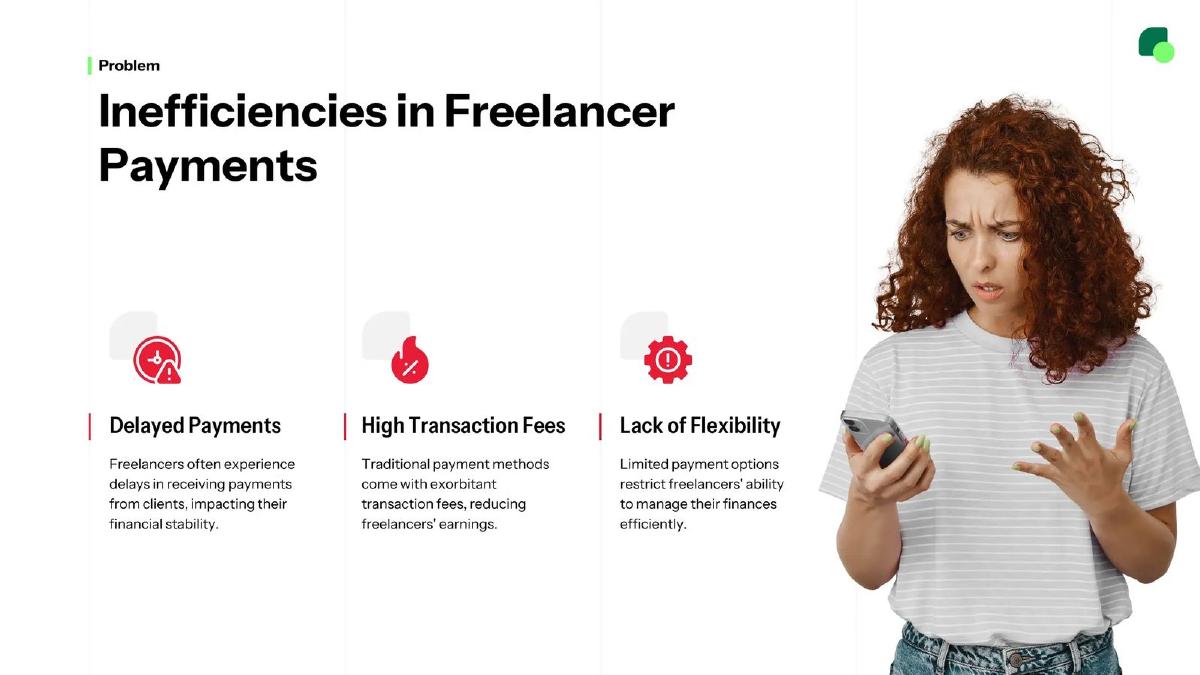
Slide 2 identifies three specific pain points for freelancers. Delayed Payments are highlighted as a threat to financial stability. High Transaction Fees are noted for reducing total earnings. Finally, a Lack of Flexibility in payment options is cited as a barrier to efficient financial management. The slide uses a frustrated user image to emphasize the emotional weight of these financial hurdles.
Slide 3: The Solution
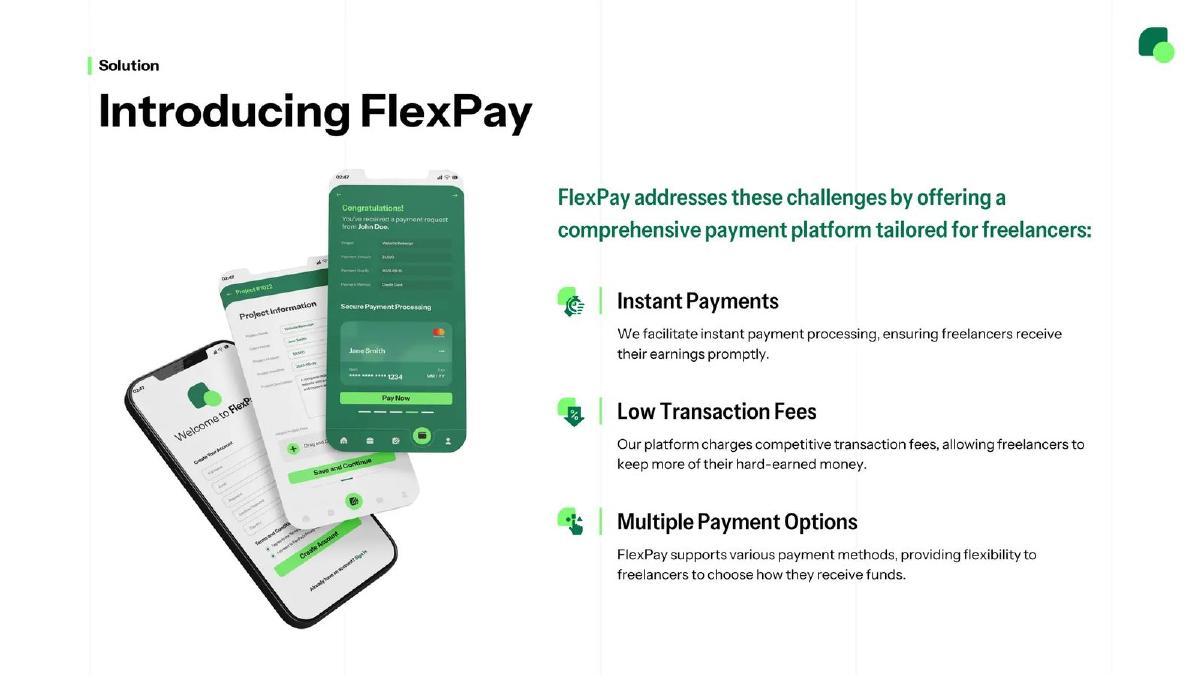
The solution slide introduces FlexPay as a "comprehensive payment platform tailored for freelancers." It promises Instant Payments , Low Transaction Fees , and Multiple Payment Options . This slide introduces the first mobile app mockups, showing a green-themed interface with project details and payment processing screens.
Slide 4: Product Overview
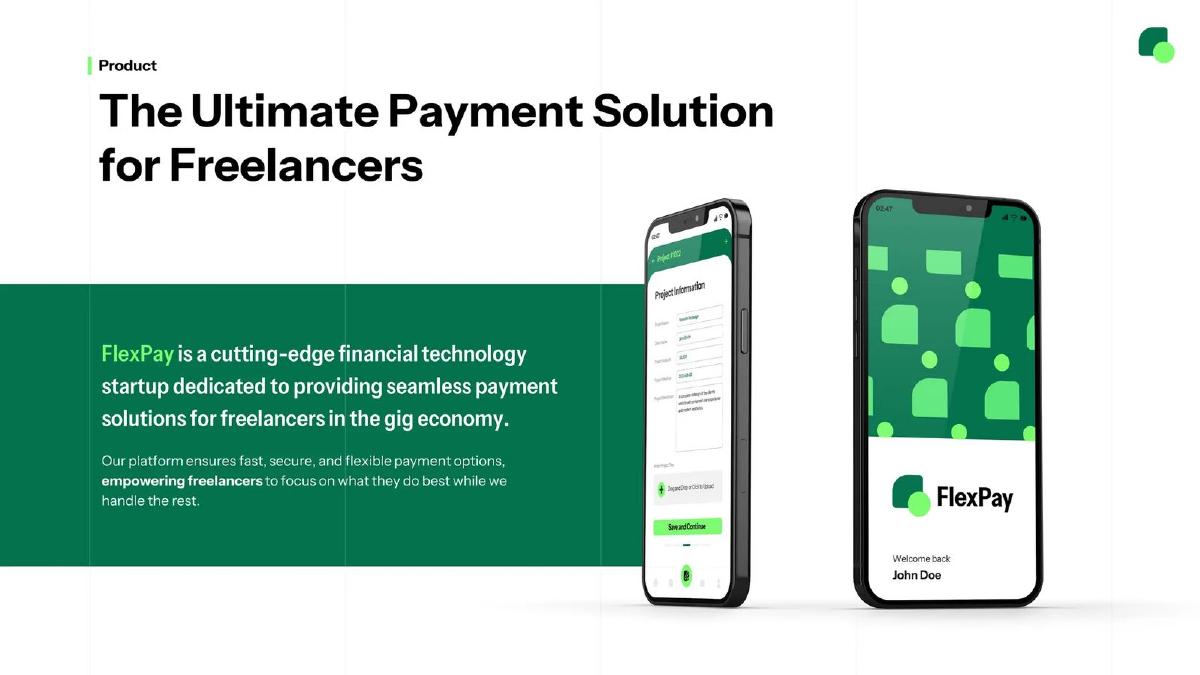
This slide reinforces the brand identity, describing FlexPay as a "cutting-edge financial technology startup." It repeats the core value propositions of being fast, secure, and flexible. The visual focus remains on the mobile hardware, suggesting the product is primarily delivered via a smartphone application.
Slide 5: The Process
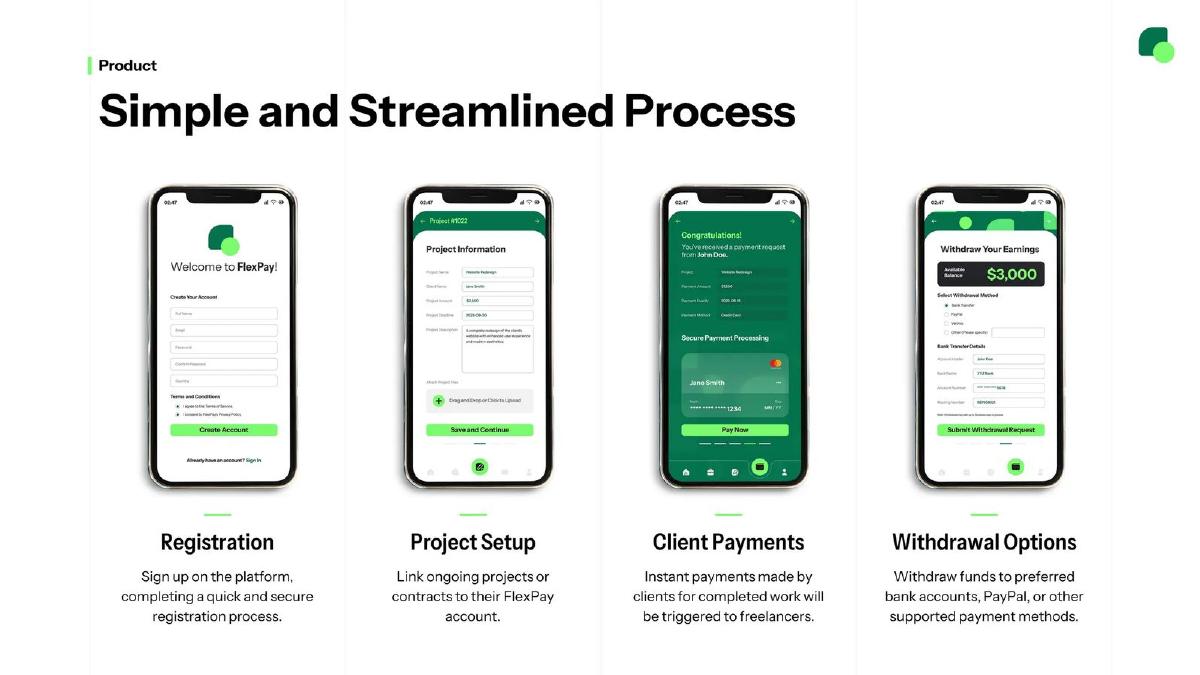
Slide 5 provides a four-step user journey: Registration , Project Setup (linking contracts to the account), Client Payments (triggered by completed work), and Withdrawal Options . The withdrawal screen mockup explicitly lists Bank Transfer, PayPal, and Venmo as supported methods, with an "Available Balance" of $3,000 shown in the example.
Slide 6: Business Model
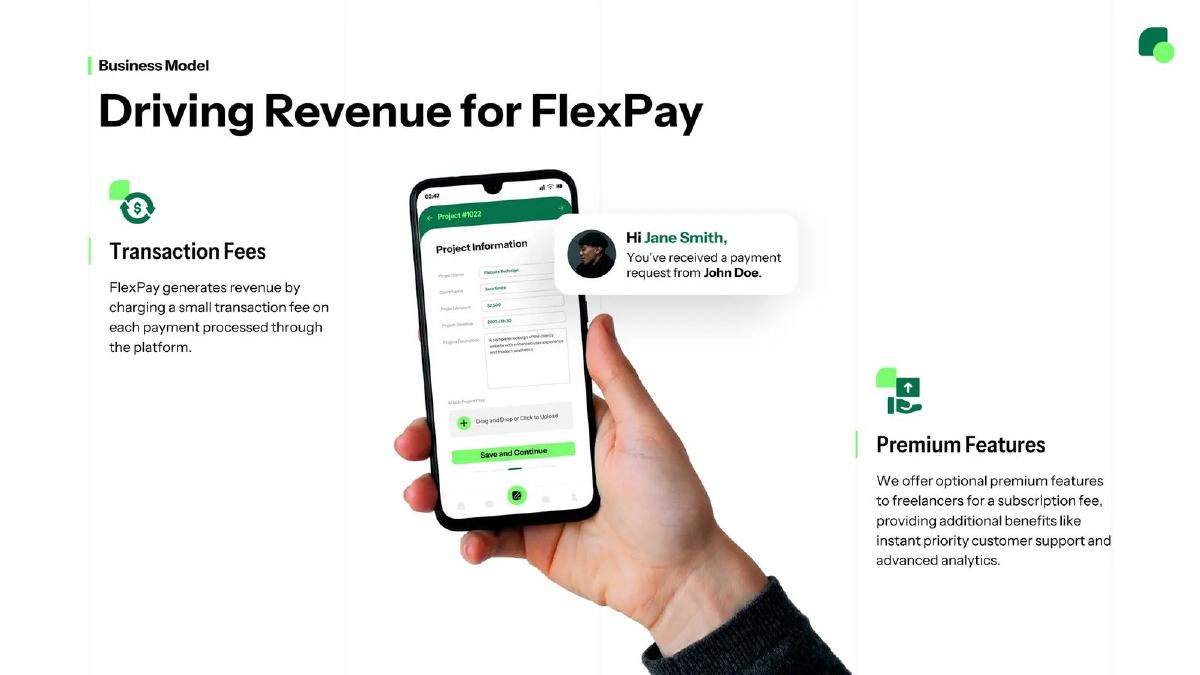
The revenue strategy is split into two categories. Transaction Fees are the primary driver, earned on every payment processed. Premium Features are offered for a subscription fee, which includes "instant priority customer support and advanced analytics." This dual-revenue approach is standard for modern fintech but lacks specific pricing tiers or percentage figures.
Slide 7: Milestones and Roadmap
The roadmap covers a period from Q4 2023 to Q4 2024. Key events include:
Q4 2023: Launch of iOS and Android apps. · Q2 2024: Partnership with Gigster for API integration. · Q3 2024: Expansion into Europe and Asia. · Q4 2024: Introduction of the FlexPay Card , a dedicated debit card for freelancers.
Slide 8: Traction and Funding Claims
This is the most controversial slide in the deck. It claims FlexPay has raised $10 million in a Series A round led by "Venture Capital" and joined by "Accelerator," "Payment Solutions," and "Online Payments." These names appear to be generic placeholders. Despite this, the slide reports impressive metrics: +100K users , +$200 M in processed payments, and an 85% retention rate . Logos for "FINEX," "skillify," "Zeno," and "Velocity" are included as partners or clients.
Slide 9: Go-to-market Strategy
The growth strategy relies on Targeted Advertising , Partnerships with freelancing platforms, and Word-of-Mouth referrals. The slide uses personas like "Emma Davis (Graphic Designer)" and "Alex Ramirez (Web Developer)" to illustrate how the platform solves specific user problems.
Slide 10: Market Opportunity
Slide 10 quantifies the gig economy market. It projects a 17% CAGR over five years. A bar chart shows the number of freelancers growing from 1M to 1.4M, while the "Gig economy growth" (presumably market value) moves from $3.0B to $4.6B . These figures seem low for a global market, suggesting they may refer to a specific niche or geographic region, though this is not specified.
Slide 11: Competition
A radar chart compares FlexPay against competitors named Banko, Payo, Spark, Nexo, Zest, and Lendy . FlexPay is positioned in the top-right quadrant, excelling in "No Delays" and "Real-Time Payments." The chart suggests that while competitors offer "Multiple Options" or "Fast Processing," none match FlexPay's specific combination of freelancer-centric design and instant payouts.
Slide 12: The Team
Jane Anderson (CEO & Co-Founder): Background in Finance and Business Strategy. · Mark Johnson (CTO & Co-Founder): Expertise in Software Development and Payment Systems. · Henry Ramirez (CFO & Finance Director): Experience in Fintech and Accounting. · Michael Chen (Head of Marketing): Focused on Branding and User Acquisition.
No previous company names or specific career achievements are listed for the team members.
Slide 13: Financial Projections
The financial chart shows revenue (green line) and expenses (red line) from Q3 2022 to Q2 2025. A vertical dashed line indicates the Break-even point is expected by the end of 2024. By Q2 2025, the chart shows revenue reaching 1,033,552 against expenses of 600,795 . The units for these figures (e.g., thousands or millions) are not explicitly stated, though the decimal notation suggests absolute dollar values.
Slide 14: The Ask
Contradicting the Series A claim on Slide 8, this slide states: "We are looking for $2 million in seed funding to scale our fintech startup." The funds are intended to help freelancers get paid faster and more securely without third-party intermediaries.
Slide 15: Contact Information
The deck concludes with a "Get in Touch" slide providing a generic email (info@flexpay.com), website (www.flexpay.com), and a placeholder phone number (+1 (800) 123-4567).
What FlexPay Does Well
The deck excels at identifying a very specific, high-pain problem: the lag between finishing work and receiving money. By focusing exclusively on freelancers, FlexPay avoids the "generalist" trap that many payment platforms fall into. The visual design is consistent, professional, and uses mockups effectively to show that the product is more than just a concept. The roadmap is logical, particularly the move from a software platform to a physical debit card, which represents a significant step up the value chain for a fintech company.
Omissions and Critical Weaknesses
The primary weakness of this deck is a lack of credibility due to internal contradictions and placeholder data. The discrepancy between a $10 million Series A (Slide 8) and a $2 million seed ask (Slide 14) is a "red flag" that would likely end an investor conversation immediately. Furthermore, the use of generic names like "Venture Capital" as a lead investor and a placeholder phone number suggests that this deck may be a template or a mock-up rather than a document used for a real fundraise. Additionally, the team slide lacks "social proof"—there are no mentions of past successful exits, specific big-name companies they worked for, or prestigious universities. Finally, the market size figures on Slide 10 ($4.6B) seem remarkably small for a global gig economy play, which usually cites figures in the hundreds of billions or trillions.
What Founders Should Copy
Founders should emulate the clear, three-point problem/solution structure used in Slides 2 and 3. It is easy to digest and immediately establishes the "why." The use of a radar chart for competition (Slide 11) is also a superior choice compared to the standard "check-box" grid, as it allows for a more nuanced comparison of where a company sits in the market ecosystem. Lastly, the inclusion of a clear break-even point in the financial projections (Slide 13) is a strong move, as it shows investors that the founders are thinking about sustainability and the path to profitability, not just top-line growth.
Frequently asked questions
- What is the primary value proposition of FlexPay?
- FlexPay aims to solve the cash flow issues inherent in the gig economy. According to Slide 3 and Slide 5, the platform offers instant payment processing and multiple withdrawal options (Bank Transfer, PayPal, Venmo). By facilitating immediate access to earnings for completed work, it addresses the 'Delayed Payments' problem cited on Slide 2, allowing freelancers to maintain better financial stability.
- How does FlexPay generate revenue?
- The company utilizes a two-pronged revenue strategy as detailed on Slide 6. First, it charges a transaction fee on every payment processed through the platform. Second, it offers a subscription-based 'Premium' tier. This premium model provides users with additional benefits such as priority customer support and advanced financial analytics, diversifying the income stream beyond pure volume-based fees.
- Is the funding status of FlexPay clear in this deck?
- No, the funding status is highly contradictory. Slide 8 states that FlexPay has already raised $10 million in a Series A round led by 'Venture Capital.' However, Slide 14 concludes the deck with a request for $2 million in seed funding. This suggests the deck might be using placeholder text or that the slides were compiled from different versions of a business plan.
- What are the key milestones on the FlexPay roadmap?
- As shown on Slide 7, the roadmap began with an app launch in Q4 2023. Future milestones include an API integration partnership with Gigster in Q2 2024, expansion into European and Asian markets in Q3 2024, and the introduction of a physical FlexPay debit card in Q4 2024 to allow freelancers direct access to their funds.
- Who are the key members of the FlexPay leadership team?
- The team consists of four key executives listed on Slide 12. Jane Anderson (CEO) brings a background in finance and business strategy. Mark Johnson (CTO) is described as a 'tech wizard' focused on payment systems. Henry Ramirez (CFO) handles financial stability, and Michael Chen (Head of Marketing) manages brand awareness and user acquisition.