First Round's on Me (FROM) successfully raised a $3M Seed round in 2023 by positioning itself as the antithesis to the 'swipe culture' fatigue. The 16-slide deck focuses heavily on product differentiation, specifically a mechanic that requires users to propose a physical date—location and time included—before meaningful interaction begins. While the deck highlights a robust multi-pronged revenue model including physical cafes, media networks, and venue partnerships, it is notably light on specific financial performance metrics and unit economics. Instead, it leans on the pedigree of an execut…
Key takeaways
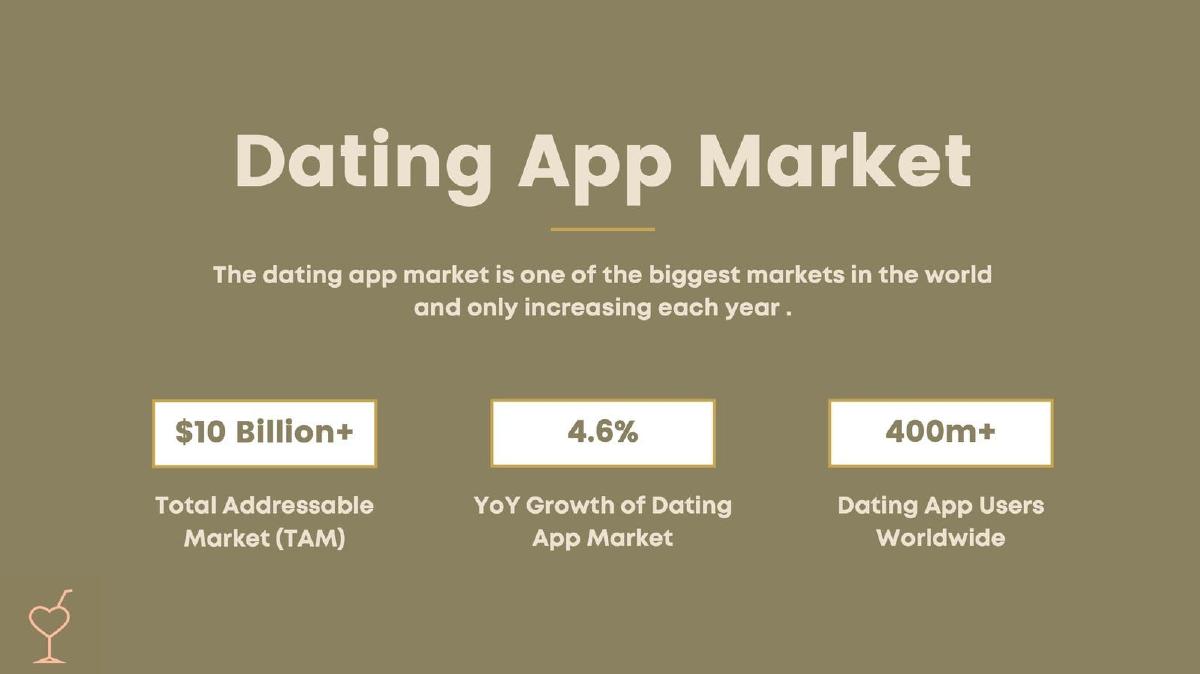
- The company identifies a $10 Billion+ Total Addressable Market with 400m+ global users on Slide 3.
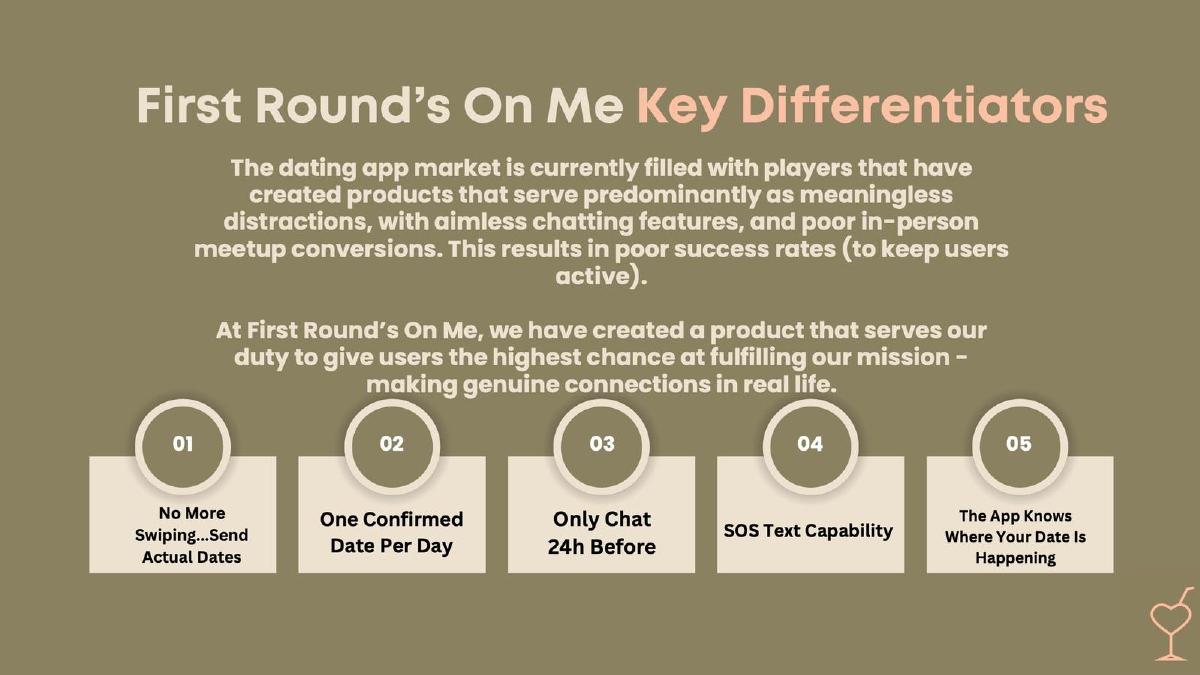
- FROM differentiates itself by limiting users to one confirmed date per day and restricting chat to 24 hours before the event (Slide 5).
- The product workflow requires users to pick a drink type, time, and specific venue (e.g., 'Employees Only, NYC') to send an invite (Slide 7).
- Revenue is diversified across six streams, including physical 'FROM Cafes,' a media network, and venue partnerships (Slide 9).
- The app reports a baseline of 6,000+ monthly paying subscribers as of the deck's creation (Slide 9).
- The executive team features former employees from NTT/Mizuho, JPMorgan, Microsoft, and UberEats (Slide 13).
- The deck omits a specific dollar amount for the 'Ask,' stating that the use of funds and 5-year forecast are available only upon request (Slide 15).
- Press coverage is used as a primary validation tool, citing features in Women's Health, Mashable, and The List (Slide 11).
The Anti-Swipe Narrative: A $3M Seed Deck Analysis
First Round's on Me (FROM) entered a saturated dating market with a clear villain: the 'meaningless distraction' of endless swiping. Their 16-slide deck, which facilitated a $3M Seed round in 2023, is a masterclass in positioning a product as a cultural corrective. By focusing on real-life meetups rather than digital engagement, FROM attempts to solve the 'poor in-person meetup conversions' that plague industry giants.
Slide 1-2: The Vision and Mission
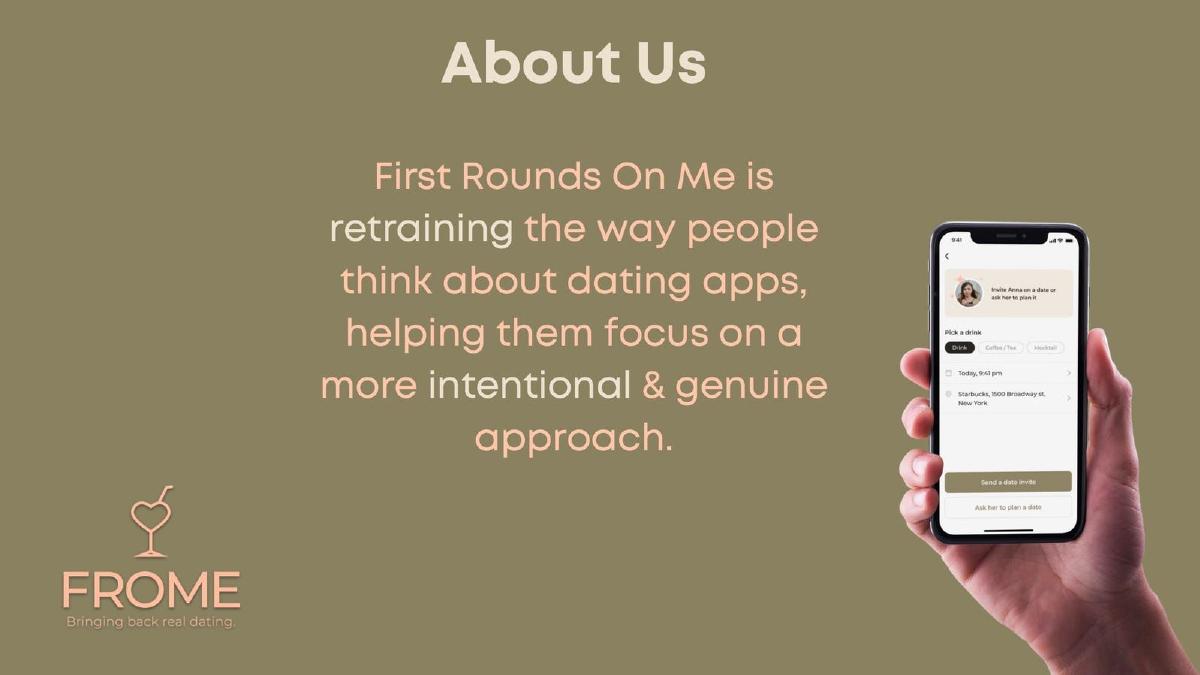
The deck opens with a minimalist title card and moves quickly into the company's ethos. The branding is consistent—a muted olive and salmon palette that feels more like a lifestyle brand than a tech utility. Slide 2 establishes the 'why,' framing the app as a solution for genuine connection in a world of digital fatigue.
Slide 3: Quantifying the Opportunity
Slide 3 provides the macro-economic justification for the business. It cites a $10 Billion+ Total Addressable Market (TAM) and notes a 4.6% YoY growth in the dating app sector. With 400m+ dating app users worldwide , the company argues that even a small slice of this market is significant. However, the slide lacks a 'Serviceable Obtainable Market' (SOM) figure, which would have shown how much of that $10B they realistically expect to capture with their niche 'date-first' approach.
Slide 4-6: The Competitive Edge
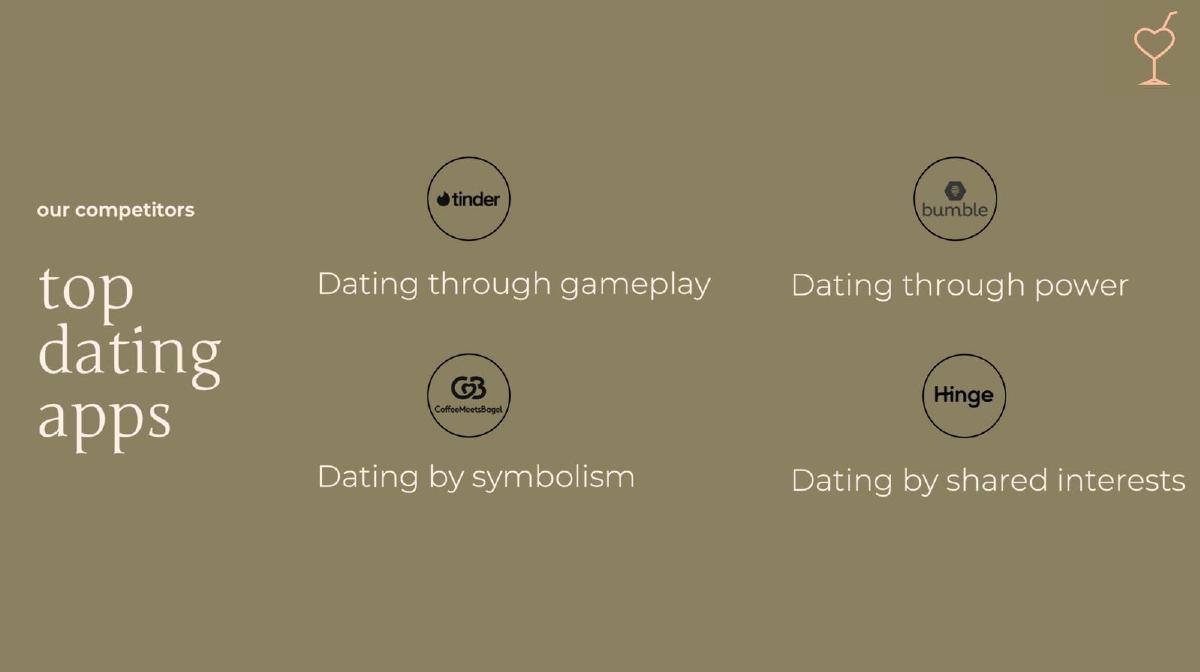
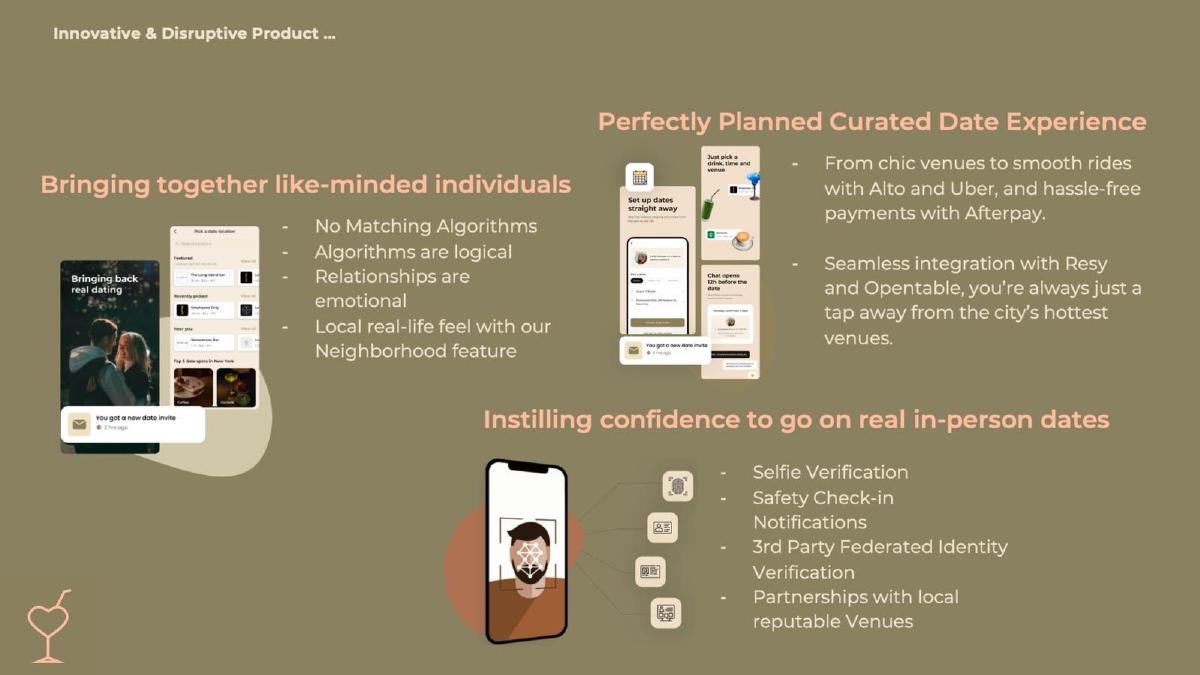
Slide 4 identifies the incumbents, while Slide 5 delivers the core value proposition. The company lists five 'Key Differentiators': No More Swiping , One Confirmed Date Per Day , Only Chat 24h Before , SOS Text Capability , and Location Awareness . This is a bold product strategy. By intentionally limiting user activity (only one date per day), they are prioritizing quality and safety over the 'dopamine loop' metrics that most social apps optimize for. Slide 6 reinforces this by labeling these choices as 'innovative' departures from the status quo.
Slide 7: Product Walkthrough
Slide 7 , titled 'Simplifying Dating,' shows the UI in action. The process is broken into three steps: Invite, Confirm, and Date. The 'Invite' screen is the most critical; it shows a user picking a drink type (Drink, Coffee/Tea, Mocktail), a specific time (Aug 16, 7:30 pm), and a specific location ( Employees Only, 510 Hudson St, New York ). This slide proves the product isn't just a concept—it's a functional tool that forces logistics upfront, removing the 'we should hang out sometime' ambiguity that leads to ghosting.
Slide 8-10: Growth and The Business Model
Slide 8 covers user growth (though specific charts were not provided in the summary, the text indicates growth data was present). Slide 9 is perhaps the most ambitious slide in the deck. It lists six 'Revenue Generators': Subscriptions (noting 6,000+ monthly paying subscribers ), Venue Partnerships , Social Media Advertising , Events , a Media Network , and a Physical Cafe in NYC . While investors often prefer a single, scalable revenue stream, FROM is pitching a 'lifestyle ecosystem' approach. The mention of a physical cafe suggests they view themselves as a community brand, not just a software company.
Slide 11-12: Traction and Social Proof
Slide 11 displays press logos to build credibility. Notable mentions include Women's Health (Jan 6, 2024), Mashable (Jan 5, 2024), and DatingAdvice.com . Using recent press dates (early 2024) suggests this deck was updated mid-round or for a follow-on extension. Slide 12 provides further growth statistics to bolster the narrative that the market is responding to their 'real dating' message.
Slide 13-14: The Team
Slide 13 presents the 'Executive Team.' The pedigree is strong for a Seed stage startup. Joseph Feminella (CEO) brings a background from NTT and Mizuho Securities. The supporting cast includes Justin Cipriano (Ops) from JPMorgan , Shawn Sanford (Marketing) from Microsoft , and Jimmy Zamani (Growth) from UberEats . This mix of high-finance discipline and big-tech growth experience is likely what gave investors confidence in the $3M raise. Slide 14 lists additional staffers, showing a built-out team rather than a skeleton crew.
Slide 15-16: The Ask
Slide 15 is surprisingly vague. It identifies the round as a 'Series Seed' but does not list a target dollar amount or valuation cap. It explicitly states: 'Use of funds & 5-year forecast will be shared upon request.' In modern fundraising, this is often a tactic to ensure a follow-up meeting, though some investors find it frustrating to not see the 'Ask' clearly defined in the initial deck.
What Works in This Deck
Strong Product-Market Fit Narrative: The deck leans heavily into 'dating app fatigue,' a well-documented cultural sentiment. By positioning the product as the cure for 'meaningless distractions,' they create an emotional hook for the investor.
Concrete Product Mechanics: Slide 7 leaves no doubt about how the app works. Showing the specific venue selection (Employees Only, NYC) demonstrates how the app integrates with the real world, which leads naturally into their 'Venue Partnerships' revenue stream.
Diversified Revenue: While risky, the inclusion of physical cafes and media networks shows a 'moat' strategy. If they can own the physical space where the dates happen, they are less dependent on the whims of the App Store's subscription fees.
What Is Missing
Unit Economics: There is no mention of Customer Acquisition Cost (CAC) or Lifetime Value (LTV). In the consumer social space, these metrics are usually the first thing a Seed or Series A investor looks for to determine if the growth is sustainable.
Churn and Retention Data: Dating apps have a unique problem: if the app works perfectly, the user leaves because they found a partner. The deck doesn't address how they handle this 'success-based churn' or if their 'Events' and 'Media Network' are intended to keep users in the ecosystem post-dating.
The 'Ask' Details: By omitting the specific amount being raised and the intended allocation of those funds, the deck feels slightly incomplete as a standalone document. It functions more as a 'teaser' than a full investment memorandum.
Founder's Playbook: Lessons from FROM
Use 'Constraints' as Features: FROM's best move is turning limitations (one date a day, limited chat) into premium features. Founders should look for ways to frame their product's restrictions as a benefit to the user's mental health or success rate.
Build a 'Team of Experts': The executive slide is highly effective because it maps specific corporate backgrounds to startup roles (e.g., UberEats for Growth, JPMorgan for Ops). This reduces the 'execution risk' in the eyes of an investor.
Connect Digital to Physical: For consumer apps, showing a path to real-world revenue (like venue partnerships) can be more compelling than just another subscription model. It proves the app has value to businesses, not just end-users.
Conclusion: First Round's on Me used this deck to pivot away from the 'tech' of dating and toward the 'experience' of dating. While light on the hard numbers that usually define a Seed deck, the strength of the team and the clarity of the product's 'anti-swipe' mission were clearly enough to secure $3M in capital.
Frequently asked questions
- How much did First Round's on Me raise with this deck?
- According to publisher reports from Business Insider, the company raised $3 million in a Seed round in 2023. The deck itself does not state the specific amount raised, only identifying the round as a 'Series Seed' on Slide 15.
- What is the primary product differentiator for FROM?
- As shown on Slide 5, the app eliminates swiping in favor of sending actual date invites. It also enforces a 'one confirmed date per day' rule and limits chatting to the 24-hour window preceding the scheduled date to prevent 'aimless chatting.'
- How does the company plan to make money beyond subscriptions?
- Slide 9 outlines a highly diversified strategy: venue partnerships, physical FROM Cafes (starting in NYC), ticketed events, social media advertising, and a dedicated media/podcast network to drive traffic.
- Does the deck include detailed financial projections?
- No. Slide 15 explicitly states that the 'Use of funds & 5-year forecast will be shared upon request.' The only hard financial-adjacent metric provided is the mention of 6,000+ monthly paying subscribers on Slide 9.
- Who is on the leadership team?
- The team is led by Founder/CEO Joseph Feminella (ex-NTT/Mizuho). Other key executives include Justin Cipriano (Ops, ex-JPMorgan), Shawn Sanford (Marketing, ex-Microsoft), and Jimmy Zamani (Growth, ex-UberEats), as detailed on Slide 13.