Fireside presents a peer-to-peer marketplace model designed to solve the isolation and high costs associated with international college applications. By connecting high schoolers with vetted university students for 1-hour 'Fireside Chats,' the company targets a $1.2B SAM within the international student segment. The deck emphasizes a B2B approach, selling annual contracts to international high schools rather than individual parents. While the roadmap is ambitious—targeting 20 paid school clients and 250+ university hosts by 2022—the deck lacks current traction data, financial projections, and…
Key takeaways
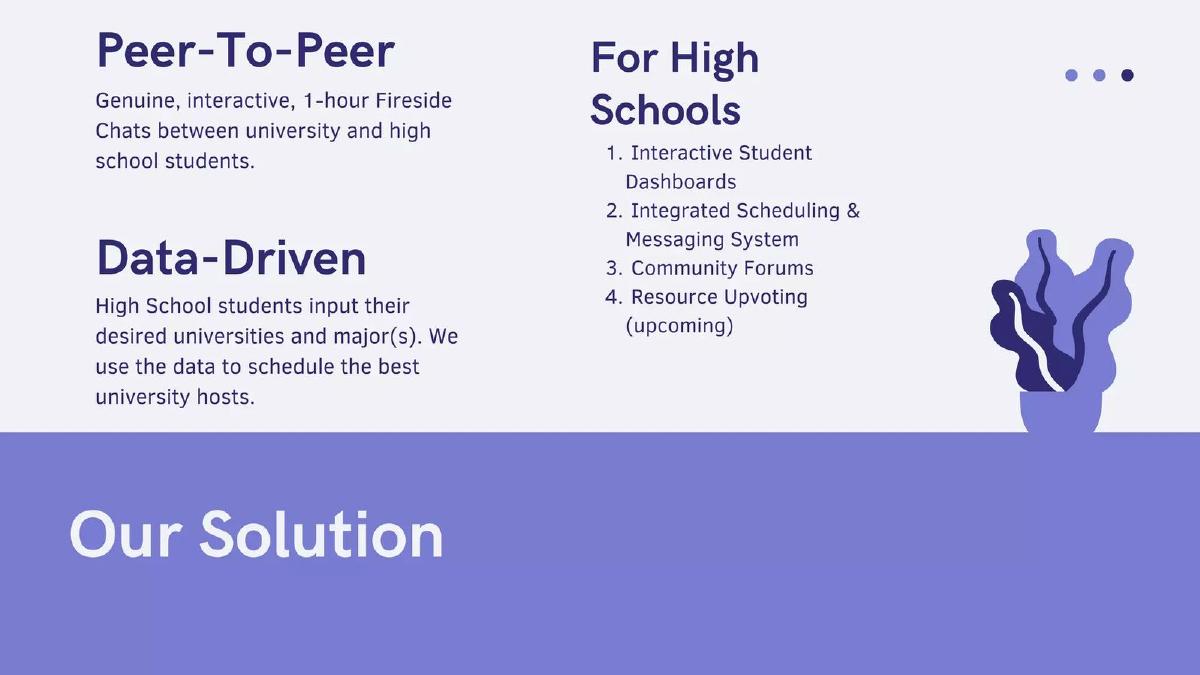
- The platform facilitates interactive 1-hour peer-to-peer sessions between university and high school students (Slide 2).
- Market sizing identifies a $27.9B TAM for U.S. college counseling, narrowed to a $1.2B SAM for international students (Slide 7).
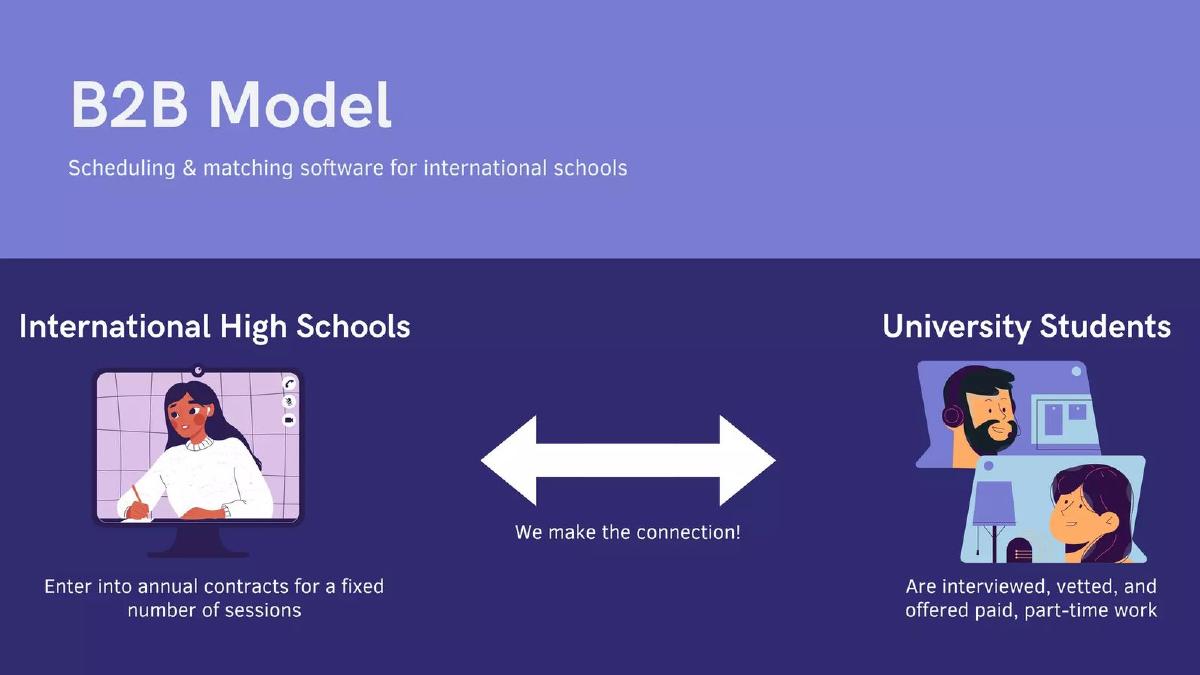
- The business model relies on B2B annual contracts with international high schools for a fixed number of sessions (Slide 6).
- University students acting as hosts are interviewed, vetted, and offered paid, part-time work (Slide 6).
- The problem slide cites a 2020 Pearson study claiming 72% of students reported a mental health issue during applications (Slide 3).
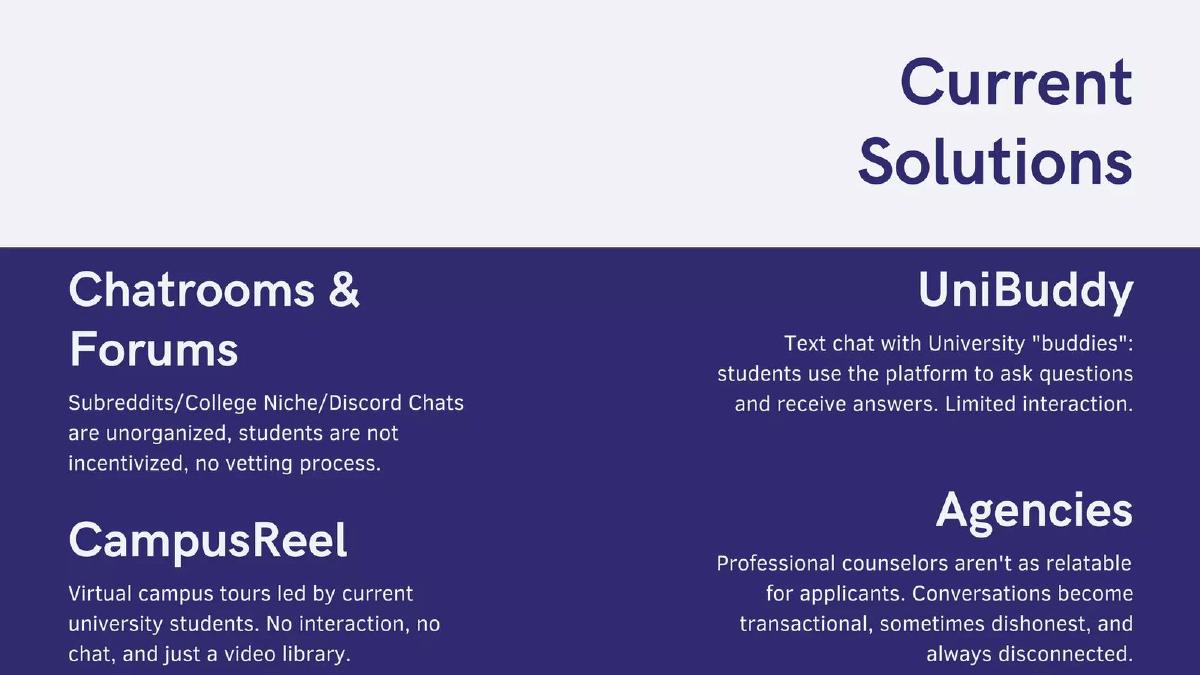
- Fireside positions itself against competitors like UniBuddy and CampusReel by offering deeper interaction and relatability (Slide 4).
- The 2022 roadmap includes gaining organizational membership into IACAC and raising institutional capital (Slide 9).
- The deck omits a specific dollar amount for the current funding round and provides no historical revenue figures (Slide 9).
Executive Summary: The Peer-to-Peer Counseling Pivot
Fireside is a platform designed to bridge the gap between high school applicants and the reality of university life. By leveraging a marketplace of vetted university students, they aim to provide a more relatable and affordable alternative to traditional high-priced college consultants. The deck focuses heavily on the international school market, where geographic and cultural barriers make traditional outreach difficult for universities.
Slide 1: Title and Vision
The cover slide introduces Fireside with the tagline "Peer-To-Peer College Counseling." The visual language uses modern, flat illustrations of diverse individuals in video call windows, immediately signaling a digital-first, remote-friendly product. The branding is clean, utilizing a flame icon that ties into the "Fireside" name, suggesting warmth and informal conversation.
Slide 2: Value Proposition
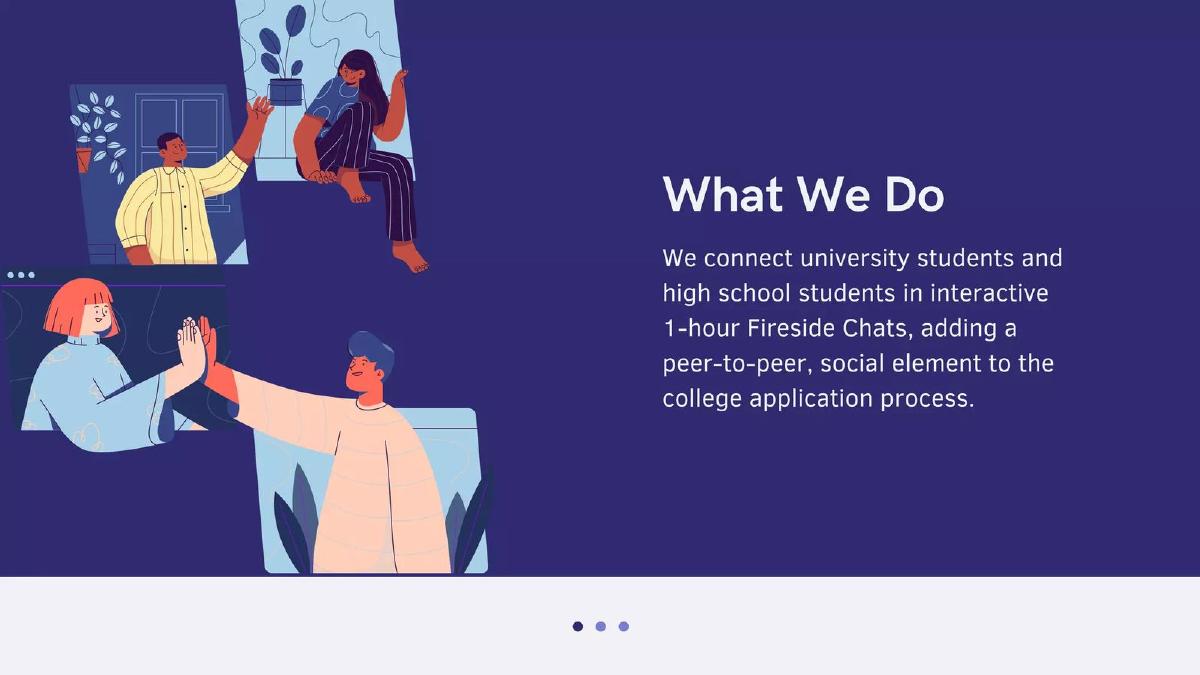
Slide 2, titled "What We Do," defines the core product: interactive 1-hour "Fireside Chats." It emphasizes the connection between university students and high school students. The key differentiator mentioned here is the "social element," positioning the service as more than just information gathering—it is presented as a mental health and community support tool for the application process.
Slide 3: Defining the Problem
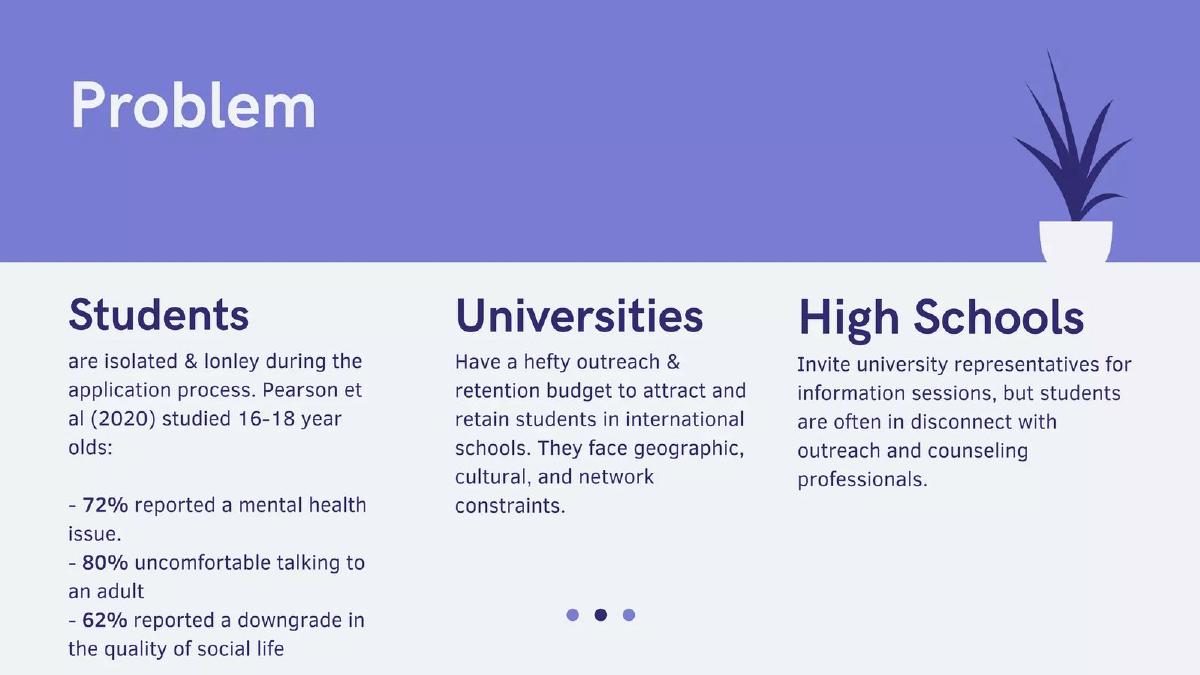
The problem slide breaks down pain points for three stakeholders: Students, Universities, and High Schools. For students, it cites a 2020 Pearson study stating that 72% of 16-18 year olds reported mental health issues and 80% felt uncomfortable talking to adults. For universities, it highlights the "hefty outreach & retention budget" required for international recruitment. For high schools, it notes a "disconnect" between students and professional counseling staff. This multi-sided problem approach justifies the marketplace solution.
Slide 4: Competitive Landscape
Slide 4 addresses "Current Solutions." It lists four categories: Chatrooms & Forums (unorganized/unvetted), CampusReel (static video library, no interaction), UniBuddy (limited to text chat), and Agencies (transactional and disconnected). By highlighting the flaws in these—specifically the lack of relatability and interaction—Fireside carves out a niche for live, peer-led video sessions.
Slide 5: The Solution Architecture
The "Our Solution" slide details the platform's features. It describes the system as "Data-Driven," using student inputs (desired universities and majors) to match them with the "best university hosts." For high schools, it offers a dashboard, integrated scheduling, and community forums. A "Resource Upvoting" feature is noted as "upcoming," indicating the product was still in active development at the time of the deck's creation.
Slide 6: The B2B Business Model
This is a critical slide that clarifies how Fireside makes money. Instead of a D2C (Direct-to-Consumer) model where parents pay per session, Fireside targets International High Schools . These schools enter into "annual contracts for a fixed number of sessions." On the supply side, university students are "interviewed, vetted, and offered paid, part-time work." This creates a controlled marketplace where the school acts as the gatekeeper and payer, potentially lowering customer acquisition costs (CAC).
Slide 7: Market Sizing (TAM/SAM/SOM)
Slide 7 provides a top-down market analysis. TAM is cited at $27.9B, based on 18.6M U.S. undergraduate students spending an average of $1,500 on counseling. The SAM (Serviceable Addressable Market) narrows this to $1.2B by focusing on 800,000 international students. The SOM (Serviceable Obtainable Market) is calculated at $200.25M, specifically targeting 720 IACAC schools and 615 CIS schools with 100 seniors each. The slide also notes international student growth rates in markets like Brazil (+9.8%) and India (+2.9%).
Slide 8: The Team
The team slide introduces two co-founders: Danny Liu and Owen Bai . Liu's background includes an internship at VU Venture Partners and a role as Project Lead at the Economic Science Institute. Bai is listed as a Full Stack Engineer at Shot Quality and a former intern at Clinova. The slide also mentions a "Student Cohort Program" involving 5-10 students every 2 months, suggesting a pipeline for product feedback or early host recruitment. The team appears to be young, likely recent graduates or students themselves, which aligns with the peer-to-peer nature of the product but may raise questions about enterprise sales experience.
Slide 9: Growth Roadmap
The roadmap covers Q2 2021 through 2022. Key milestones include:
Q2 2021: Grow host network to 50+ in Canada and enter 10 pilot agreements. · Q3 2021: Convert 50% of pilots to annual contracts and reach 100+ Canadian hosts. · Q4 2021: Launch D2C marketplace and referral programs. · 2022: Secure 20 paid international school clients and expand to 250+ U.S. university hosts.
The final bullet point for 2022 is "Raise Institutional Capital," which suggests this deck was intended for a pre-seed or angel round.
Slide 10: Contact Information
The final slide provides a phone number, a "prosodyeducation.com" email address, and a "fireside.world" URL. This indicates that Fireside may be a product under a larger entity called Prosody Education.
What Works in This Deck
Specific Market Targeting: By focusing on international high schools (Slide 6 and 7), Fireside avoids the crowded general U.S. counseling market. The use of specific school associations like IACAC and CIS in the SOM calculation shows a sophisticated understanding of their sales channel.
Clear B2B Transition: Many marketplace startups fail by trying to acquire individual users one by one. Fireside’s decision to sell annual contracts to schools (Slide 6) provides a more stable, recurring revenue stream and a clearer path to scale.
Psychological Angle: The problem slide (Slide 3) uses mental health data to move the conversation from "better grades" to "student well-being." This is a powerful hook for school administrators who are increasingly focused on holistic student support.
What Is Missing from This Deck
The Ask: The most significant omission is a slide detailing how much capital the company is seeking and how those funds will be allocated. Without a clear "Ask," investors cannot evaluate the opportunity's scale or urgency.
Traction Data: While the roadmap mentions pilots, the deck does not show the results of any completed pilots. There are no testimonials, user satisfaction scores, or data on how many "Fireside Chats" have actually occurred to date.
Unit Economics: There is no mention of the price point for the annual school contracts or the payout rate for the university hosts. Investors need to see the margin structure of the marketplace to understand if the business is viable at scale.
Founder Takeaways
Quantify Your SOM: Fireside does an excellent job of calculating their Serviceable Obtainable Market by identifying specific organizations (IACAC/CIS) and multiplying them by a realistic student count (Slide 7). Founders should copy this bottom-up approach rather than just taking a percentage of a global TAM.
Address Relatability: In the EdTech space, "relatability" is a competitive advantage. Fireside’s comparison against "professional agencies" (Slide 4) highlights a common pain point: that expensive experts often can't connect with Gen Z students. If your product has a human element, emphasize why your humans are better suited for the task than the incumbents.
Visual Consistency: The deck uses a consistent illustration style and color palette throughout. While this may seem superficial, it creates a sense of professional polish that is often lacking in early-stage decks. It suggests the founders value design and user experience, which is critical for a student-facing platform.
Frequently asked questions
- What is the primary service Fireside offers?
- Fireside provides a peer-to-peer counseling platform where high school students participate in 1-hour interactive video sessions called 'Fireside Chats' with current university students. The service is designed to add a social, relatable element to the college application process, which the founders argue is currently too isolated and transactional.
- How does Fireside generate revenue?
- The company utilizes a B2B model, selling annual contracts to international high schools. These schools pay a fixed fee for a set number of counseling sessions, which are then made available to their students. This shifts the cost away from individual families and integrates the service into the school's existing counseling infrastructure.
- Who are the competitors mentioned in the deck?
- The deck identifies four main competitive categories: unorganized chatrooms/forums (Reddit, Discord), CampusReel (video libraries without interaction), UniBuddy (limited text-based chat), and professional agencies (which are described as expensive and less relatable to young applicants).
- What are the key milestones on the growth roadmap?
- For 2021, the company aimed to grow its host network to 100+ in Canada and convert 50% of pilots into annual contracts. By 2022, the goal was to secure 20 paid international school clients, expand to 250+ U.S. university hosts, and raise institutional capital.
- What critical information is missing from the Fireside deck?
- The deck lacks a 'The Ask' slide, meaning there is no mention of how much money they are raising or the valuation. It also lacks unit economics (CAC/LTV), a detailed breakdown of the current pilot results, and comprehensive financial projections beyond high-level market sizing.