Female Invest's 12-slide deck is a masterclass in demonstrating community-led growth and strong unit economics. By reporting 73,474 paying members across 123 countries (Slide 3) and a 5.9x LTV/CAC ratio ($301 LTV vs. $51 CAC), the company proves it has moved beyond a niche blog into a scalable global platform. The deck leans heavily on social proof, citing endorsements from figures like Hilary Clinton and Emma Watson (Slide 9), and showcases a significant business model pivot where yearly subscriptions grew from 3% to 94% of the user base (Slide 11). While the deck is light on technical infra…
Key takeaways
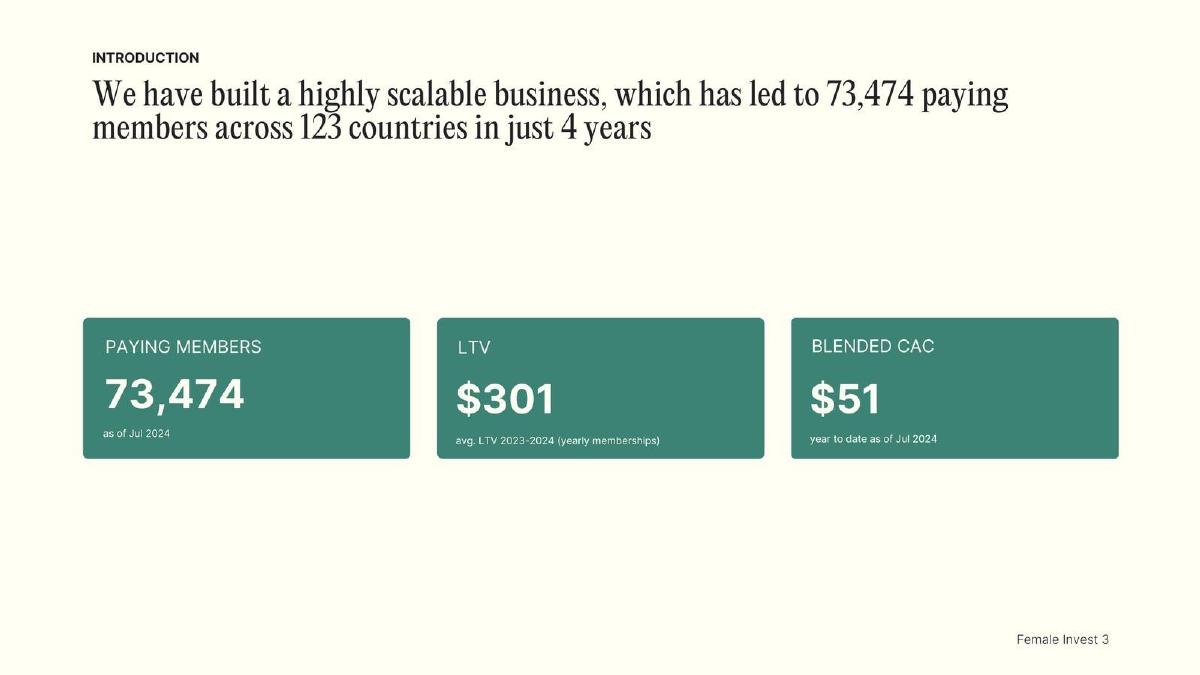
- The company reports a highly efficient customer acquisition strategy with a $51 blended CAC against a $301 LTV as of July 2024 (Slide 3).
- Female Invest has achieved global reach, claiming paying members in 123 different countries within four years of operation (Slide 3).
- The product positioning uses a 'Masterclass meets Duolingo' analogy to describe its educational learning paths (Slide 5).
- Social media growth is a primary traction metric, showing an increase from 46,549 followers in 2020 to 512,000 in 2024 (Slide 9).
- High-profile political and cultural endorsements, specifically Hilary Clinton and Emma Watson, are used to validate the brand's mission (Slide 9).
- A major shift in revenue quality is evidenced by the transition from 97% monthly members in Q1 2020 to 94% yearly members by QTD 2024 (Slide 11).
- The platform is evolving from pure education to a transactional fintech, stating they are 'soon investing' to allow users to manage money directly (Slide 1).
- The deck omits a traditional 'Team' slide, 'Competitor' matrix, and a specific 'Use of Funds' breakdown in the provided 12-slide sequence.
Executive Summary: The Mission to Close the Gender Gap
Female Invest’s 12-slide deck, used to secure an $11.2M Series A in 2024, is a focused narrative on community-led fintech. The deck moves quickly from a mission statement to hard metrics, emphasizing that the company is no longer a startup experiment but a global platform with paying users in 123 countries. The core thesis is that by providing education (the 'Masterclass meets Duolingo' model), they create a proprietary funnel for a future investment platform.
Slide 1: Mission and Vision
The opening slide sets a high-level tone, stating that Female Invest is on a mission to "close the financial gender gap." It defines the business as a combination of community, learning, and "soon investing." This last point is critical for a Series A deck; it signals to investors that the company is moving from a lower-multiple EdTech model to a higher-multiple Fintech/Brokerage model. The branding is bold, using high-contrast typography and lifestyle imagery that departs from traditional, sterile banking aesthetics.
Slide 3: The Introduction to Scale
Slide 3 is the 'meat' of the early presentation. It leads with a headline claiming a "highly scalable business" and provides three key pillars of data as of July 2024. First, they report 73,474 paying members . Second, they disclose an LTV of $301 (specifically for yearly memberships). Third, they cite a blended CAC of $51 . By placing these numbers upfront, the founders preemptively answer questions about unit economics. A 5.9x LTV/CAC ratio is exceptionally strong for a consumer subscription business, suggesting that their organic community growth is offsetting paid acquisition costs.
Slide 5: The Solution - Learning Paths
This slide focuses on the product experience. It uses the phrase "Think Masterclass meets Duolingo" to categorize the app. This is a strategic choice; Masterclass implies high-quality, aspirational content, while Duolingo implies gamification, daily habits, and high retention. The slide shows mobile mockups of "Personal Finance" and "Financial Wellbeing" paths, emphasizing that the education is structured rather than a random collection of blog posts. The mention of experts, webinars, and podcasts suggests a multi-modal approach to learning.
Slide 7: The Solution - Market Trends
To differentiate from static educational platforms, Slide 7 highlights real-time content. It mentions "Monday morning live streams," "weekly podcasts," and "news articles." The mockup shows a "Market News" feature and a headline about Elon Musk and Twitter. This slide aims to prove that the app is a utility for active investors who need to stay "up to date," which increases the frequency of app opens and, by extension, the opportunity to cross-sell future investment products.
Slide 9: Traction - Social Proof and Ambassadors
Slide 9 shifts from product to brand power. It features a line graph showing social media follower growth from 46,549 in 2020 to 512,000 in 2024 . While social followers are often considered a vanity metric, Female Invest ties this growth to "Celebrity Endorsements." The slide prominently features a photo of the founders with Hilary Clinton and mentions Emma Watson. For a Series A round, this level of cultural capital serves as a moat, suggesting that competitors would have to spend significantly more to achieve the same level of brand recognition and trust among the target demographic.
Slide 11: Traction - Revenue Quality and Retention
The final data-heavy slide in the provided set is perhaps the most impressive from a financial perspective. It tracks the composition of paying members from Q1 2020 to QTD 2024. The chart shows that in 2020, the vast majority of users were on monthly plans. Over four years, the company successfully inverted this, reaching a point where 94% of members have yearly subscriptions . The headline notes this is "great for both cashflow and retention." Investors value yearly subscriptions because they provide upfront capital and typically have lower churn rates than monthly plans. The sheer volume of the green area (yearly) vs. the pink area (monthly) visually demonstrates a stabilizing and maturing business model.
What Works in This Deck
Clarity of Unit Economics: By putting LTV and CAC on Slide 3, the company establishes immediate credibility. They aren't hiding behind vague 'engagement' metrics; they are showing that for every $51 they spend, they expect to generate $301 in value. This is the exact language Series A investors want to hear.
Business Model Evolution: Slide 11 is a powerful visual of 'negative churn' or at least high-quality revenue migration. Showing a 94% shift to annual billing is a strong indicator of product-market fit. It proves that users don't just want a quick tip; they want a year-long relationship with the platform.
The 'Funnel' Narrative: The deck successfully argues that education is the 'hook.' By teaching women how to invest, they are building a captive audience that will naturally use their 'soon to be released' investment tools. This lowers the future CAC for their fintech products, which is a compelling competitive advantage over traditional neo-banks that have to buy customers directly into a crowded trading market.
What Is Missing from This Deck
The Team Slide: In the provided 12-slide sequence, there is no dedicated team slide. While the founders appear in a photo with Hilary Clinton, a Series A deck usually requires a breakdown of the leadership's background, particularly their expertise in fintech, compliance, and scaling global operations. Given they are moving into regulated 'investing' services, the absence of a 'Head of Compliance' or 'CTO' profile is a notable gap.
Competitive Landscape: The deck does not address other female-focused financial platforms (like Ellevest) or broader competitors like Robinhood or Etoro. A 'Competitor Matrix' would help clarify why their 'community-first' approach is superior to the 'transaction-first' approach of incumbents.
The Ask and Use of Funds: While we know from publisher reports that they raised $11.2M, the deck itself (in this version) does not state the amount they are seeking or how they plan to spend it. A standard Series A deck should detail how much goes to product development, how much to marketing, and how much to regulatory licensing for the new investment features.
Founder's Playbook: Lessons to Copy
Use Analogies for Product Positioning: The "Masterclass meets Duolingo" comparison is highly effective. It allows an investor to instantly categorize the product's value proposition without needing a 10-minute demo. Founders should find two well-known, successful companies that represent different facets of their product and combine them.
Highlight Revenue Quality, Not Just Revenue: Many founders just show a 'Total Revenue' bar chart. Female Invest went a step further by showing the type of revenue. Proving that your users are willing to commit to a full year (Slide 11) is much more impressive than showing a high number of monthly 'tourists' who might churn next month.
Leverage High-Profile Validation: If you have a celebrity or a world leader using your product or endorsing your mission, it shouldn't be a footnote. Female Invest gave Hilary Clinton and Emma Watson significant real estate on Slide 9. This isn't just about 'fame'; it's about signaling that the brand has the 'permission' to lead this specific cultural conversation, which is a form of brand equity that is hard to replicate with venture dollars alone.
Frequently asked questions
- What are the core unit economics for Female Invest?
- According to Slide 3, Female Invest reports an average Lifetime Value (LTV) of $301 for yearly memberships (2023-2024) and a blended Customer Acquisition Cost (CAC) of $51 for the year to date as of July 2024. This represents a healthy LTV/CAC ratio of approximately 5.9x, suggesting a very efficient and scalable marketing engine.
- How does Female Invest describe its product offering?
- The company positions itself as a hybrid of community and education. Slide 5 describes their 'learning paths' as 'Masterclass meets Duolingo,' featuring courses, webinars, and podcasts. Slide 7 highlights real-time engagement through Monday morning live streams and weekly market trend updates, positioning the app as a daily or weekly financial companion rather than a one-time course.
- What is the significance of their membership type data?
- Slide 11 shows a dramatic shift in their business model. In early 2020, almost all users (97%) were on monthly plans. By mid-2024, 94% of their 73,474 members had shifted to yearly subscriptions. For investors, this indicates significantly improved cash flow, higher retention, and a more committed user base compared to month-to-month churn risks.
- Who are the brand ambassadors mentioned in the deck?
- Slide 9 explicitly names Hilary Clinton and Emma Watson as famous brand ambassadors. The slide includes a photograph of the founders with Hilary Clinton holding their book, 'Girls Just Wanna Have Funds.' The company uses these endorsements to argue they are on the path to becoming the 'next fintech unicorn.'
- What is the long-term vision for the platform?
- The vision is to move from financial education to financial execution. Slide 1 states they are 'combining community, learning, and soon investing.' This suggests the Series A capital is likely intended to build out the brokerage or investment infrastructure required to allow women to trade and manage assets directly within the Female Invest app.