FaZe Clan utilized this 40-slide presentation in October 2021 to facilitate a merger with B. Riley Principal 150 Merger Corp (BRPM). The deck successfully pivots the narrative away from pure competitive gaming toward a 'digital native lifestyle brand' reaching a difficult-to-capture Gen Z demographic. By highlighting that 80% of their audience is between 13 and 34 years old (Slide 9), FaZe positioned itself as a media conglomerate rather than just a gaming team. The financial projections were aggressive, bridging from a $38 million revenue base in 2020 to a projected $651 million by 2025 (Sli…
Key takeaways
- The transaction was valued at a $713mm post-money enterprise value, representing a 3.8x multiple of 2023E revenue (Slide 7).
- FaZe claimed a massive social reach of 350mm+ followers and 120mm+ unique audience members as of July 2021 (Slide 9).
- The core audience is highly concentrated in the Gen Z and Millennial brackets, with 80% of followers aged 13-34 (Slide 19).
- FaZe outperformed traditional sports brands in social engagement, ranking #3 in U.S. individual organization brands by actions, ahead of the Golden State Warriors (Slide 13).
- Revenue diversification is a central theme, moving from niche gaming sponsors like G FUEL to blue-chip brands like McDonald's and Nissan (Slide 33).
- The financial bridge to 2025 relies on $178mm in revenue from future M&A and $92mm from emerging areas like NFTs and the metaverse (Slide 23).
- Existing stockholders agreed to roll 100% of their equity into the combined company, retaining 67.9% ownership (Slide 39).
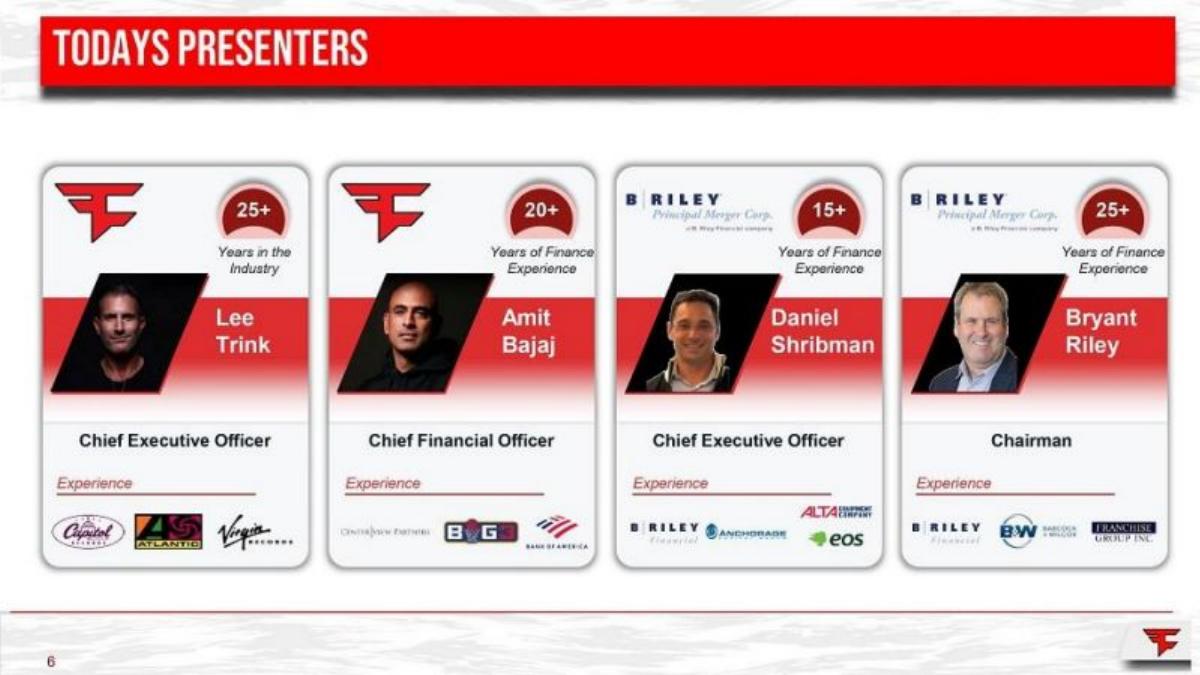
- The management team is presented as a mix of entertainment veterans and gaming specialists, led by CEO Lee Trink who has 25+ years of media experience (Slide 31).
FaZe Clan: The SPAC Era Lifestyle Brand
In late 2021, the SPAC (Special Purpose Acquisition Company) craze was reaching its zenith, and FaZe Clan, the world's most recognizable esports organization, sought to capitalize on the trend. This 40-slide deck, presented in October 2021, served as the primary marketing document for their merger with B. Riley Principal 150 Merger Corp. The deck is less about 'gaming' and more about 'culture,' a strategic choice intended to broaden the company's appeal to institutional investors who might not understand Call of Duty but certainly understand the value of 350 million social media followers.
Slides 1-5: The Legal Foundation
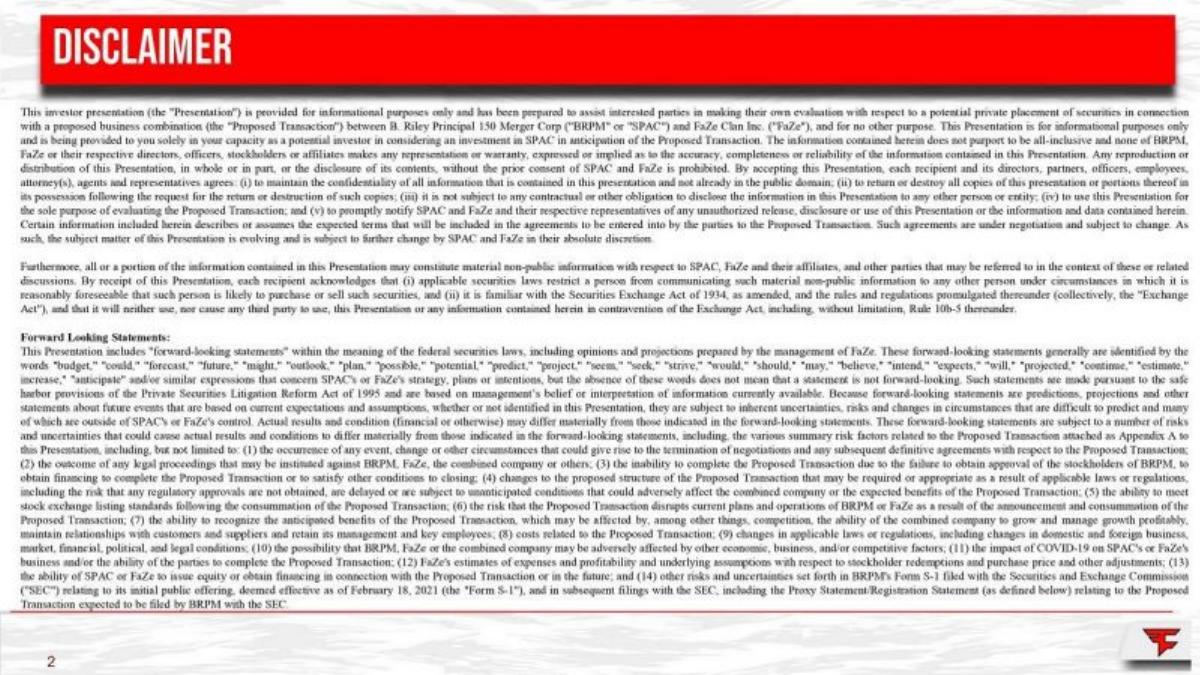
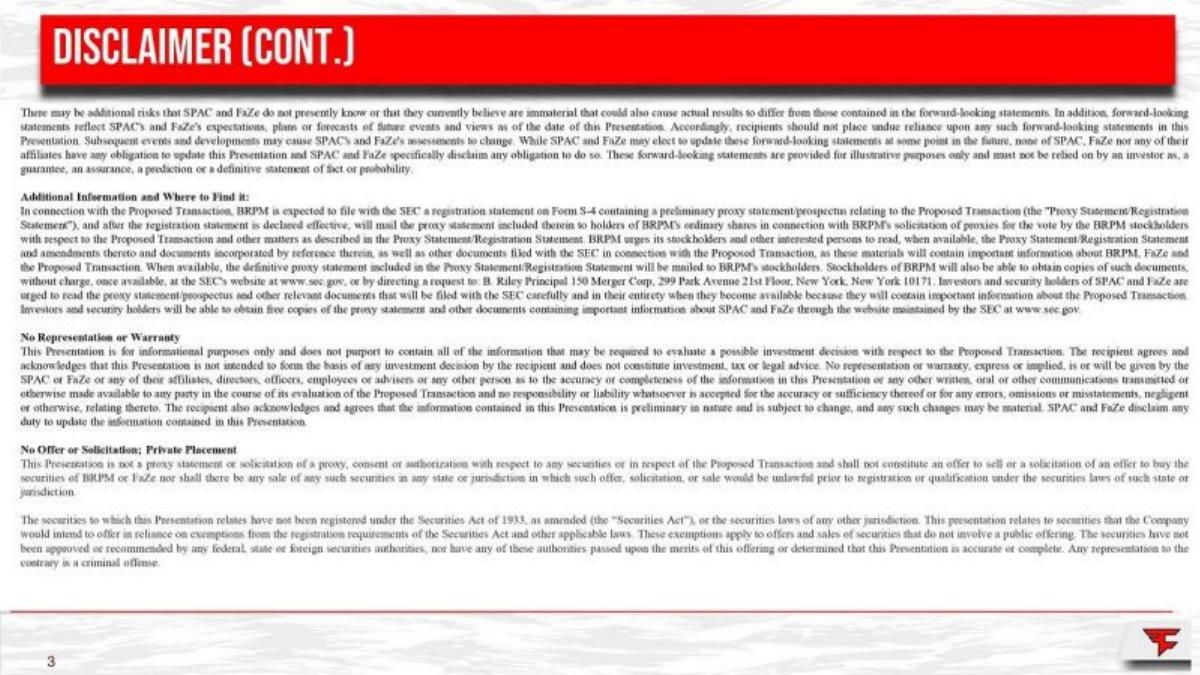
The presentation begins with a standard cover slide (Slide 1) featuring the iconic red FaZe logo alongside the B. Riley Principal Merger Corp branding. What follows is a dense, multi-slide disclaimer (Slides 3 and 5). In the context of a SPAC, these slides are mandatory and exhaustive. They cover forward-looking statements, the lack of warranties, and a pointer toward the 'Risk Factors' in the appendix. For a founder, the takeaway here is the sheer volume of legal protection required when moving from private to public markets; the 'Disclaimer (Cont.)' headers indicate that the legalities are as important as the business metrics in this stage of fundraising.
Slide 7: Transaction Overview
Slide 7 provides the hard mechanics of the deal. It establishes the $713mm post-money enterprise value . Crucially, it sets the valuation against future revenue multiples: 3.8x for 2023E, 1.9x for 2024E, and 1.1x for 2025E. This is a classic SPAC tactic—valuing the company based on projected earnings several years out rather than current performance. The 'Sources and Uses' table shows a total of $971 million in capital movement, with $670 million representing the FaZe Equity Rollover, meaning the founders and early investors were not cashing out, but rather moving their stakes into the new public entity.
Slide 9: The Investment Thesis
This is the 'Why Now' slide. FaZe outlines six pillars for investment. The most compelling for investors is point number 4: 'Lucrative and Hard to Reach Demographic.' By stating that 80% of their audience is between 13 and 34 years old, FaZe positions itself as the gatekeeper to Gen Z. They also mention a 'revenue growth opportunity of ~10x to ~200x+ today's levels' based on monetization per audience member compared to traditional sports leagues. This slide sets the stage for the company to be viewed as a media play rather than a competitive sports team.
Slide 11: The FaZe Timeline
The timeline slide is a visual history of the brand's evolution from a 'group of young trickshotters' in 2010 to a cultural powerhouse in 2021. Key milestones include hitting 1mm YouTube subs in 2012, signing G FUEL in 2012, and the appointment of Lee Trink as CEO in 2018. The timeline is color-coded by business vertical (Merch, Talent, Esports, Other, Analytics). The inclusion of the Juice WRLD collaboration ($1.7mm+ in 24 hours) and the Murakami collab ($1.2mm+ in a day) on Slide 11 serves as proof of their ability to convert social followers into retail customers.
Slides 13-15: Dominance in Engagement
Slides 13 and 15 are the 'flex' slides. Slide 13 compares FaZe to massive traditional sports brands like the Lakers, Cowboys, and Yankees. While FaZe ranks lower in total 'actions' than the NBA or NFL, the deck highlights that they are the #3 U.S. Individual Organization Brand by Actions . Slide 15 narrows the focus to esports, showing that FaZe has 143 million cross-platform actions—more than the next 8 esports organizations combined. This data, sourced from Shareablee, is the backbone of their valuation; it argues that while they might not have the revenue of the Yankees yet, they have the attention, which is the precursor to revenue in the digital economy.
Slides 17-19: The Gen Z Mandate
These slides double down on the demographic shift. Slide 17 cites that Gen Z will have an estimated global income of $33tn by 2030 and that 61% prefer to watch esports over traditional sports. Slide 19 provides a stark visual comparison of audience ages: 80% of FaZe's audience is 13-34, compared to much smaller percentages for general social media (28%) and television (40%). The message to investors is clear: if you want to reach the next generation of consumers, you have to go through FaZe.
Slide 21: The Opportunity Set
Slide 21 maps out the transition from 'Current Opportunities' to 'Opportunities of Tomorrow.' Current revenue comes from content, sponsorships, and esports. The 'Tomorrow' column is a grab-bag of 2021 trends: Metaverse / NFTs, Real Money Gambling, and Virtual Dining Concepts . This slide is designed to show 'infinite' scalability, though it notably lacks specific execution plans for these highly disparate industries.
Slide 23: The Financial Bridge
This is the most critical and, in hindsight, most controversial slide in the deck. It shows a revenue bridge from $38 million in 2020 to $651 million in 2025 . To get there, FaZe assumes $178 million from M&A (acquisitions they hadn't made yet) and $92 million from 'Emerging Monetization Areas.' The 'Key Assumptions' box notes that they expect to reach $3.52 per unique fan by 2025 . This slide represents a massive leap in monetization efficiency that the company had not yet demonstrated at scale.
Slides 25-29: Risk Factors
In a rare move for a typical startup pitch deck, but standard for a SPAC, there are three full slides of risks. Slide 25 admits that the company has 'incurred and expect to continue to incur operating losses' and that they rely heavily on third-party platforms. Slide 27 mentions involvement in legal proceedings and regulatory matters. These slides are a sobering counterpoint to the hype of the previous sections and are essential for any investor performing due diligence.
Slide 31: The Management Team
The team slide features 12 executives, emphasizing 'seasoned and experienced' leadership. CEO Lee Trink’s background in the music industry (Capitol Records, Virgin Records) is highlighted to reinforce the 'lifestyle and entertainment' angle. The team includes specialists for every vertical: Content, Esports, Global, Talent, Marketing, and Consumer Products. This breadth is intended to show that the company has the infrastructure to manage the aggressive growth projected on Slide 23.
Slides 33-37: Vertical Deep Dives
The final section of the main deck breaks down specific business units. Slide 33 shows the evolution of sponsors from niche gaming brands (G FUEL) to blue-chip giants ( McDonald's, Nissan, General Mills ). Slide 35 illustrates the growth of consumer products, projecting a massive expansion into 'Mass Retail' and 'Food' by 2024. Slide 37 addresses international expansion, noting that while 50% of the audience is outside the U.S., only 5% of revenue currently comes from those markets, representing a 'large and untapped opportunity.'
Slide 39: Final Transaction Details
The deck concludes with a detailed breakdown of post-transaction ownership. Existing shareholders retain 67.9% , PIPE investors get 11.9%, and the SPAC public shareholders get 17.5%. The valuation analysis reiterates the $713 million Enterprise Value and the aggressive revenue multiples. It is a final reminder that the investment is a bet on the 2025 projections, not the 2021 reality.
What FaZe Clan Got Right
Demographic Dominance: The deck identifies a clear problem (traditional media can't reach Gen Z) and positions FaZe as the sole solution. The data on Slide 19 is the strongest part of the presentation. · Brand Positioning: By comparing themselves to the Lakers and Cowboys rather than just other esports teams, they successfully reframed the company as a mainstream entertainment entity. · Visual Storytelling: The use of the red-and-black color palette and high-energy imagery maintains the brand's 'cool' factor while still delivering the dense financial data required for a public listing.
What Was Missing
Path to Profitability: While Slide 9 mentions a 'rapid path to profitability,' the deck never actually shows when the company will break even. The financial bridge on Slide 23 focuses entirely on top-line revenue growth. · Unit Economics: There is no breakdown of the cost of goods sold (COGS) for their merchandise or the margins on their sponsorship deals. Investors are asked to trust that the $3.52 per fan (Slide 23) will be profitable. · M&A Strategy: A significant portion of the 2025 revenue ($178mm) is attributed to M&A, yet the deck provides no criteria for these acquisitions or examples of past successful integrations.
Founder Takeaways
Sell the Future, Prove the Past: FaZe used their past social engagement (the 'Actions' on Slide 13) to sell a future revenue model. If you have a massive top-of-funnel, use it as your primary leverage. · Know Your Multiples: The deck explicitly compares its valuation to future revenue (Slide 39). Founders should always know what multiples their industry peers are trading at and be prepared to justify their own. · The Power of 'Blue Chip': Showing the transition from niche sponsors to household names like McDonald's (Slide 33) is a powerful way to signal that your company has 'graduated' to the big leagues.
Frequently asked questions
- What was the primary goal of this pitch deck?
- The deck was designed to convince PIPE (Private Investment in Public Equity) investors and SPAC shareholders of the long-term viability of FaZe Clan as a public company. It aimed to justify a $713 million enterprise value by showcasing the company's unique access to Gen Z, a demographic that traditional media struggles to reach, and outlining a path to $651 million in annual revenue by 2025.
- How did FaZe Clan define its business model in the deck?
- FaZe defined itself as a 'Leading Digital Native Lifestyle Brand.' The model is multi-platform, generating revenue through brand sponsorships, content (ad revenue and products), consumer products (merchandise and player lines), and international expansion. Slide 21 specifically highlights 'Opportunities of Tomorrow' including subscription offerings, real-money gambling, and virtual dining concepts.
- What were the most significant risks identified in the presentation?
- The deck includes three full slides of risk factors (Slides 25, 27, 29). Key risks included the company's history of operating losses, heavy reliance on third-party platforms like YouTube and Twitch, the potential for negative publicity surrounding its influencers, and the speculative nature of new revenue streams like the metaverse and NFTs.
- How did FaZe compare itself to traditional sports leagues?
- FaZe used social media 'actions' (likes, shares, comments) as a primary benchmark. Slide 13 shows FaZe generating 143 million actions, which, while lower than the NBA (1.8 billion) or NFL (957 million), was higher than the Dallas Cowboys and New York Yankees. This was used to argue that FaZe has 'transcended esports' to become a top-tier global sports brand.
- What was the planned use of the $118 million PIPE proceeds?
- According to Slide 39, the $118 million in PIPE proceeds, combined with $173 million of cash in the SPAC trust, was intended to fund organic investment, support M&A activity, pay transaction expenses, and cover general corporate purposes. The 'Sources and Uses' table shows $264 million in new cash being added to the balance sheet post-transaction.