FastBox is a logistics platform designed to disrupt the traditional courier market by leveraging the sharing economy. By connecting private commuters who have unused vehicle space with individuals needing urgent, low-cost shipping, FastBox claims it can offer 24-hour delivery at a fraction of the price of incumbents like DHL, UPS, and CTT. The deck focuses heavily on price comparisons, showing a 2kg parcel delivery for €9.08 compared to DHL’s €29.49. While the financial projections suggest reaching breakeven by the 15th month with a €380k investment, the deck lacks critical information regard…
Key takeaways
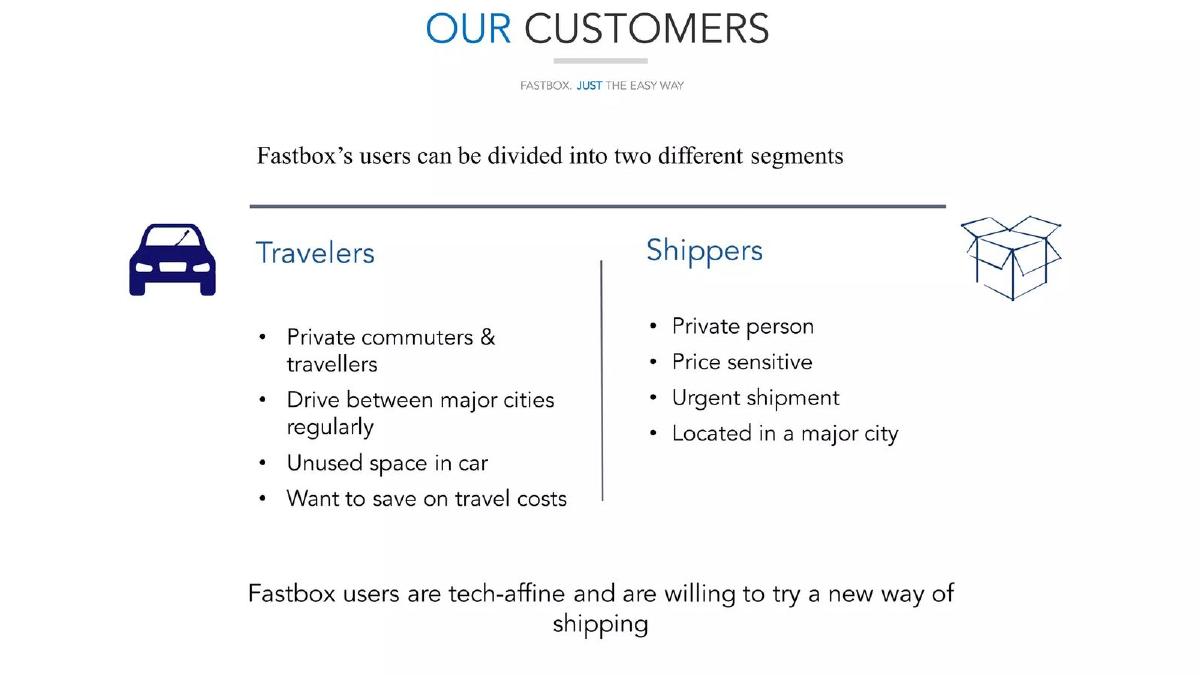
- The platform targets two distinct segments: Travelers looking to save on travel costs and Shippers seeking urgent, low-cost delivery (Slide 2).
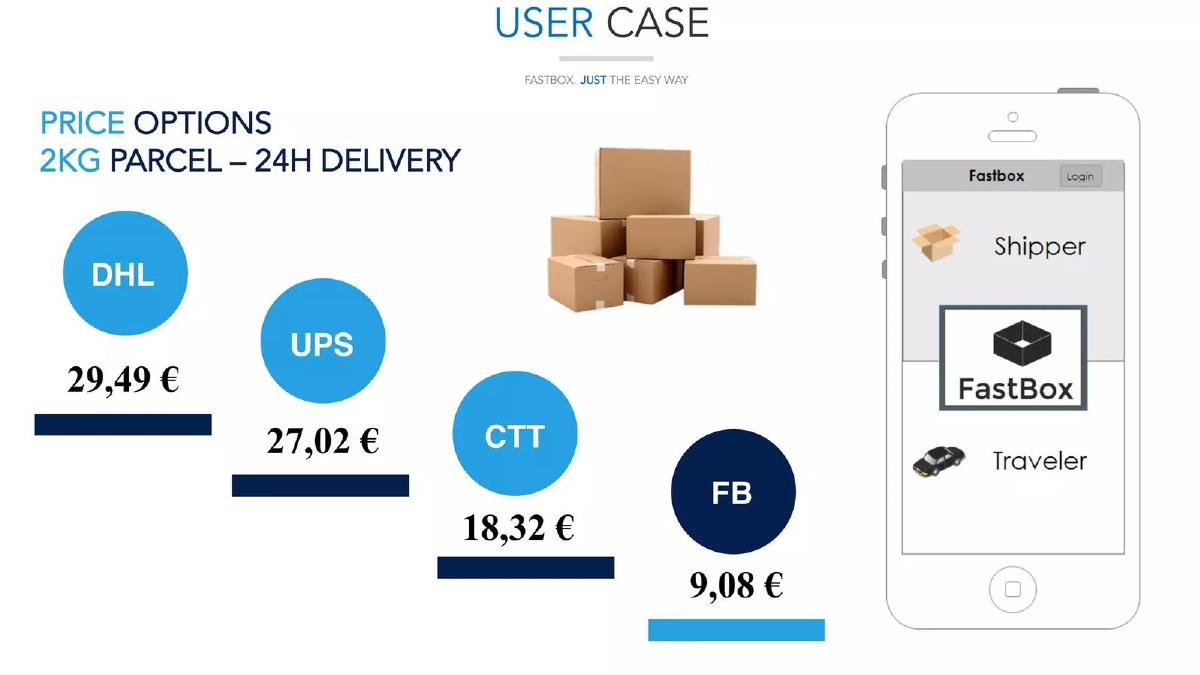
- FastBox claims a significant price advantage, offering 24-hour delivery for a 2kg parcel at €9.08, which is less than half the price of CTT at €18.32 (Slide 3).
- The pricing strategy maintains a lower cost curve than DHL, UPS, and CTT across all weight classes from 50g to 20kg (Slide 4).
- The entry strategy focuses on a 'City to City' model in Portugal, specifically Lisbon, Porto, Coimbra, and Faro (Slide 5).
- Future growth plans include international expansion into Spain (Madrid, Barcelona) and Italy (Milan, Rome), as well as an 'In City' model for major capitals (Slide 5).
- Financial projections estimate revenue growing from €125,000.17 in the first year to €2.97 million by the third year (Slide 6).
- The company identifies a need for €380k to reach the breakeven point, which is projected for the 15th month of operation (Slide 6).
- Marketing and communication rely on Facebook, landing pages, and word of mouth, with a 32% gross margin target (Slide 5, Slide 6).
FastBox Pitch Deck Analysis
The FastBox pitch deck, dated December 7th, 2015, presents a peer-to-peer (P2P) logistics solution aimed at disrupting the traditional courier market in Southern Europe. The deck is structured around a clear price-advantage narrative, positioning the startup as a sharing-economy alternative to established giants like DHL and UPS. However, the presentation relies heavily on financial projections and price comparisons while omitting the operational and human elements of the business.
Slide 1: Title Slide
The deck opens with a minimalist title slide featuring the FastBox logo—a stylized open box—and the tagline "JUST THE EASY WAY." The date, December 7th, 2015, places this deck in the mid-2010s, a period characterized by the rapid expansion of the sharing economy following the success of platforms like Uber and Airbnb.
Slide 2: Our Customers
FastBox defines its ecosystem through two distinct user segments. Travelers are described as private commuters who drive between major cities regularly and have unused space in their cars; their motivation is to save on travel costs. Shippers are defined as private individuals who are price-sensitive, have urgent shipment needs, and are located in major cities. The slide notes that both groups are "tech-affine," suggesting a mobile-first user acquisition strategy.
Slide 3: User Case and Price Comparison
This slide serves as the primary hook for the deck. It presents a specific use case: a 2kg parcel with 24-hour delivery. The slide compares FastBox (FB) against three competitors. DHL is listed at 29,49 €, UPS at 27,02 €, and CTT (the Portuguese national postal service) at 18,32 €. FastBox claims a price point of 9,08 €. A mobile mockup on the right side of the slide shows a simple interface where users choose between being a "Shipper" or a "Traveler."
Slide 4: Pricing Strategy
Slide 4 expands on the price advantage with a line graph titled "Gross Price Increase / Weight." The graph tracks prices for parcels ranging from 50g to 20kg. FastBox (represented by a yellow line) remains consistently lower than CTT, DHL, and UPS. Notably, the gap between FastBox and competitors widens as the weight increases, particularly against UPS, which shows the steepest price climb. The slide also mentions "Survey 1" and "Survey 2," implying that these price points were validated through market research, though the details of those surveys are not provided.
Slide 5: Entry and Growth
The go-to-market strategy is divided into two phases. The Entry Approach focuses on Portugal, utilizing a "City to City" model between Lisbon, Porto, Coimbra, and Faro. The communication strategy relies on Facebook, a landing page, and word of mouth. The Future Growth section outlines geographic expansion into Spain (Madrid, Barcelona, Valencia, Bilbao) and Italy (Milan, Rome). It also introduces an "In City" model for larger metropolises like London, Moscow, Paris, and Rome, suggesting a shift from long-distance commuting to intra-city courier services.
Slide 6: Our Financials
This slide provides a three-year financial forecast. In the First Year , the company projects €125,000.17 in revenue with an EBITDA loss of €212,680.26. By the Second Year , revenue scales to €1.11 million with a positive EBITDA of €91,963.21. The Third Year targets €2.97 million in revenue and €444,800.58 in EBITDA. The slide highlights a 32% Gross Margin and states that €380k is required to reach the breakeven point by the 15th month.
Slide 13: Our Contacts
The contact slide (numbered 13, indicating some slides were omitted from this selection) shows a Facebook page mockup, a landing page preview, and a contact email: fastboxucp@aol.com. The use of an AOL email address and a university-related acronym (UCP likely referring to Universidade Católica Portuguesa) suggests this may have been a project originating from an academic or incubator environment.
Slide 15: Thank You & Q&A
The deck concludes with a standard Q&A slide, repeating the logo and providing a final opportunity for engagement. There are no additional metrics or summary points on this slide.
What FastBox Does Well
The deck excels at establishing a clear competitive advantage based on price . By visualizing the cost savings on Slide 3 and Slide 4, the founders make a compelling case for why a price-sensitive customer would switch from a traditional courier to a P2P platform. The financial slide is also specific, providing exact figures down to the cent, which suggests a detailed underlying financial model.
The geographic focus is also a strength. Rather than attempting to launch across Europe simultaneously, the deck identifies a logical starting point (Portugal) and specific expansion cities (Spain and Italy) that share similar market characteristics and geographic proximity.
What is Missing from the Deck
The most glaring omission is the Team Slide . In early-stage fundraising, the pedigree and experience of the founders are often more important than the idea itself. Without knowing who is building FastBox, an investor cannot assess the technical or operational feasibility of the project.
Furthermore, the deck lacks a Risk and Mitigation section. P2P shipping faces massive hurdles regarding insurance (what happens if a traveler steals a package or is in an accident?), legality (postal monopolies and transport regulations), and trust. The deck assumes that "tech-affine" users will simply trust the platform without explaining the verification or rating systems intended to ensure safety.
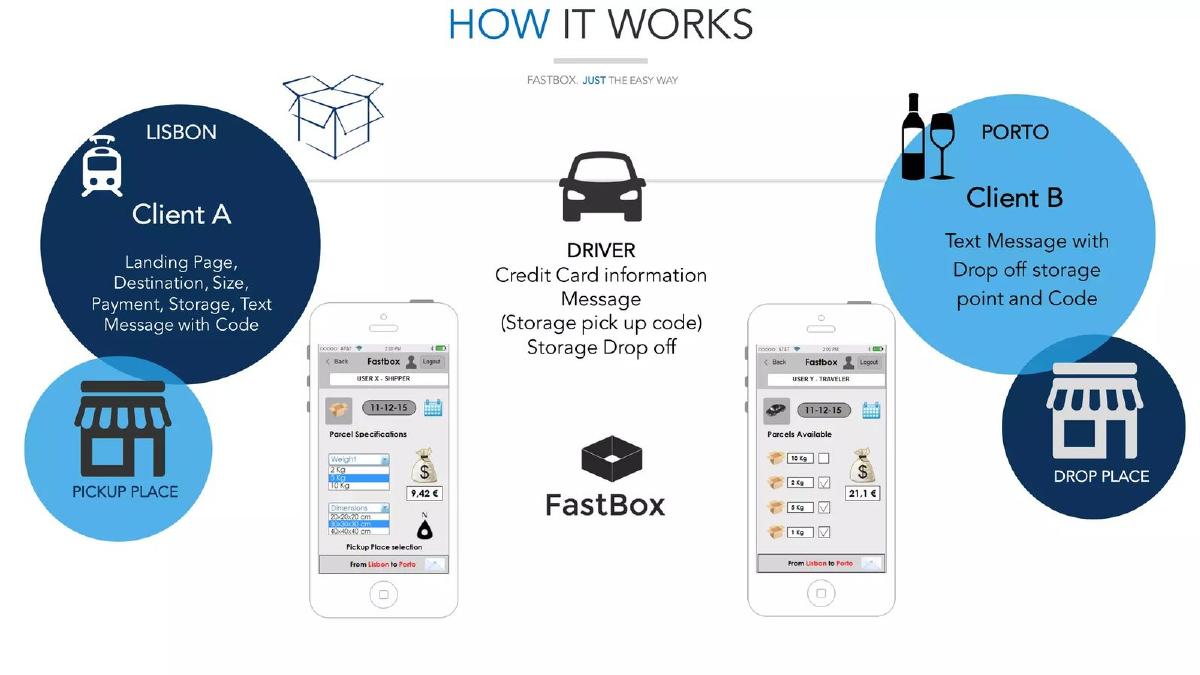
Finally, there is no Product Roadmap . While a mockup is shown on Slide 3, there is no detail on the technology stack, the algorithm for matching travelers with shippers, or how the platform handles payments and tracking.
Founder Takeaways: What to Copy and What to Avoid
Copy the Price Visualization: If your startup’s main advantage is cost, use a simple, high-contrast chart like the one on Slide 3. Comparing your price directly against household names (DHL, UPS) immediately contextualizes your value. · Copy the Staged Expansion: Clearly defining your "Entry Approach" versus "Future Growth" shows that you have a realistic understanding of operational constraints. · Avoid Omiting the Team: Never send a deck without a team slide. Investors need to see relevant experience in logistics, technology, or marketplace management. · Avoid Academic Contact Info: Using an AOL or university email address can make a startup look like a student project rather than a professional venture. Use a custom domain email to establish credibility. · Address Operational Realities: In a marketplace business, the "how" is just as important as the "what." A slide explaining the trust and safety mechanism (insurance, ID verification) is mandatory for P2P models.
Frequently asked questions
- What is the core value proposition of FastBox?
- FastBox operates on a peer-to-peer logistics model. Its primary value proposition is cost reduction for shippers and cost offset for travelers. By utilizing the 'unused space' in private cars already traveling between cities, the company avoids the heavy overhead of traditional courier fleets, allowing them to undercut market leaders like DHL and UPS by over 60% on certain delivery windows.
- How does FastBox plan to acquire its first users?
- According to slide 5, the entry strategy is localized to Portugal. The company plans to use a 'City to City' model connecting major hubs like Lisbon and Porto. Their communication strategy is lean, focusing on social media (Facebook), a dedicated landing page, and organic word-of-mouth growth among 'tech-affine' users willing to try new shipping methods.
- What are the projected financials for the first three years?
- The deck outlines a rapid scaling phase on slide 6. Year one shows a revenue of €125,000.17 against expenses of €337,680.43, resulting in an EBITDA loss. By year two, revenue is projected to jump to €1.11 million with a small positive EBITDA of €91,963.21. By year three, they forecast nearly €3 million in revenue and €444,800.58 in EBITDA.
- What is missing from this pitch deck?
- The deck is missing several high-priority slides for investors. There is no 'Team' slide, which is critical for assessing execution capability. It also lacks a 'Problem' slide that explains why current solutions are failing beyond just price. Most importantly, there is no mention of insurance, security, or regulatory compliance for transporting packages via unvetted private drivers.
- What is the specific 'Ask' from investors?
- Slide 6 explicitly states that the company needs €380k to reach its breakeven point. While it doesn't specify the equity offered or the exact use of funds (e.g., hiring vs. marketing spend), it sets a clear milestone: achieving profitability by the 15th month of operations.