Fessup’s 15-slide deck (8 slides reviewed) positions itself as a 'community frontpage for college confessions,' explicitly targeting the shortcomings of first-generation anonymous apps like Whisper and Yik Yak. The deck highlights specific product features designed to foster a sense of belonging, such as school-verified labels and private messaging, while proposing a growth strategy that mirrors Facebook’s early campus-by-campus rollout. However, the deck is notably light on business fundamentals; it lacks a clear monetization model beyond a vague quote about hashtags and provides no user met…
Key takeaways
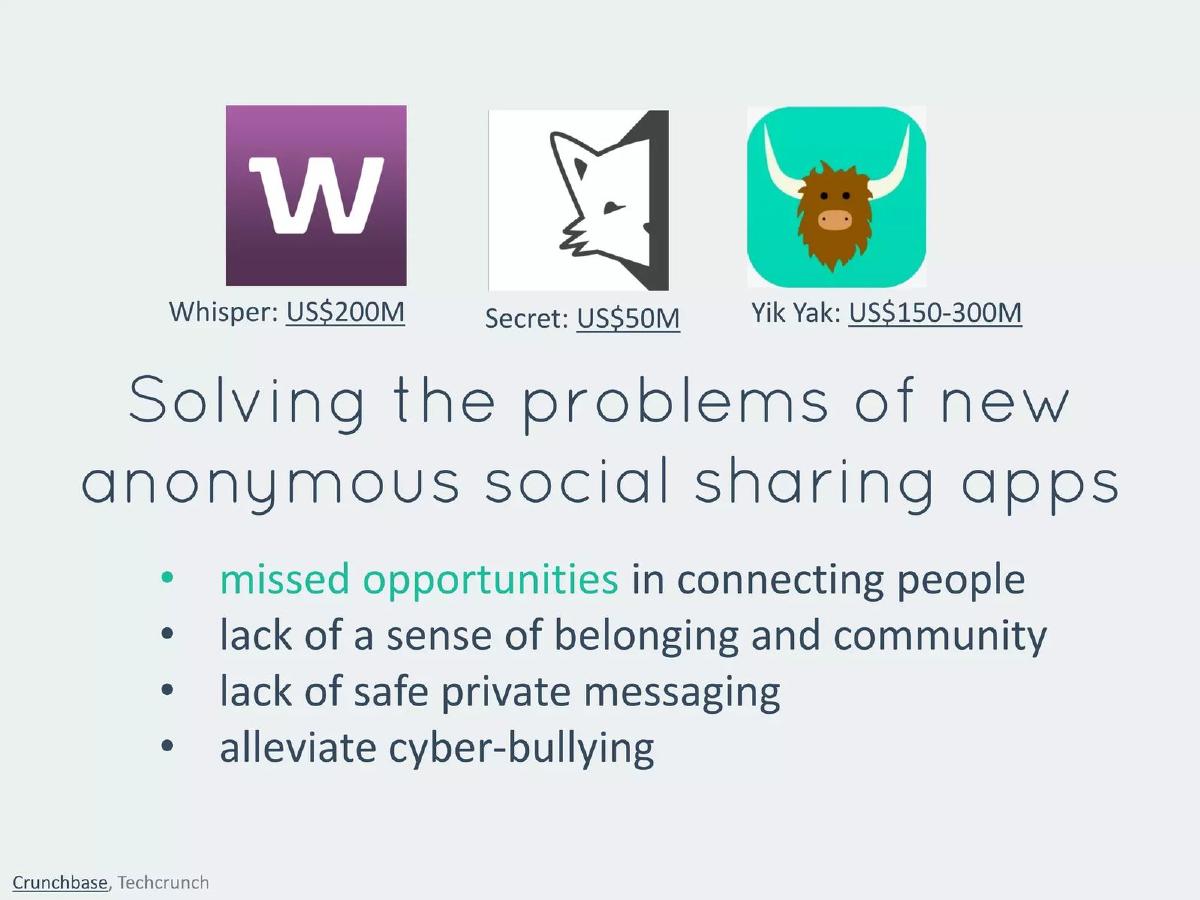
- The company positions itself as a solution to the 'missed opportunities' and 'cyber-bullying' found in apps like Whisper and Yik Yak (Slide 2).
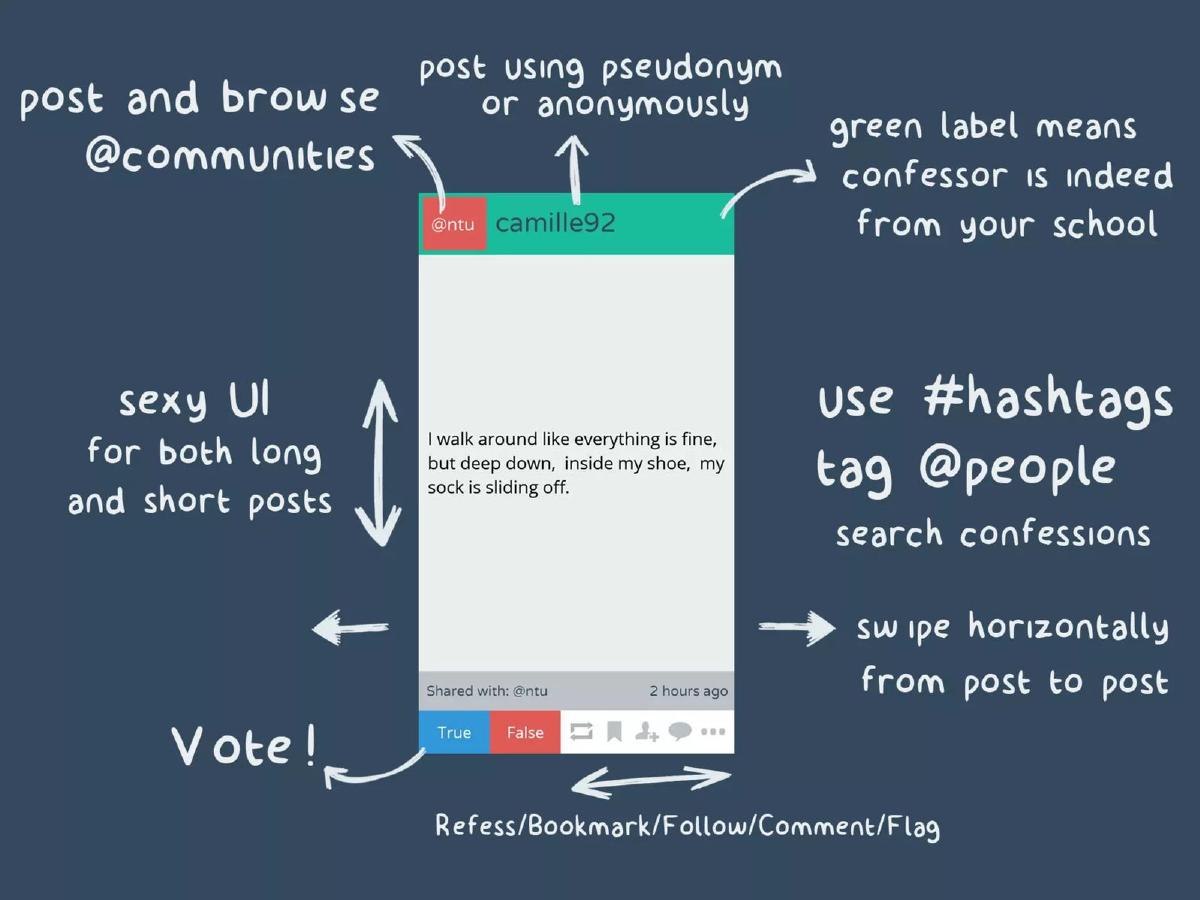
- Product features include a 'green label' to verify a user is from a specific school and a 'True/False' voting mechanism on posts (Slide 3).
- The competitive landscape is mapped on a 'Pressure vs. Privacy' axis, placing Fessup in a 'Sweet Spot' of low-pressure public sharing (Slide 4).
- Growth strategy follows a geographic sequence starting with Singapore as a testbed, moving to Malaysia/USA, and then the 'English speaking world' (Slide 5).
- The deck explicitly compares its expansion strategy to Facebook, targeting school communities first, then workplaces (Slide 5).
- Monetization is only addressed through a third-party quote suggesting that hashtags are the 'key to monetizing social media' (Slide 6).
- The team consists of five members, including a CEO, COO, CTO, and two engineering leads, though no professional backgrounds or past achievements are listed (Slide 7).
- The deck lacks any mention of current user numbers, engagement metrics, or a specific financial ask for investors.
Slide-by-Slide Teardown
Slide 1: Title and Vision
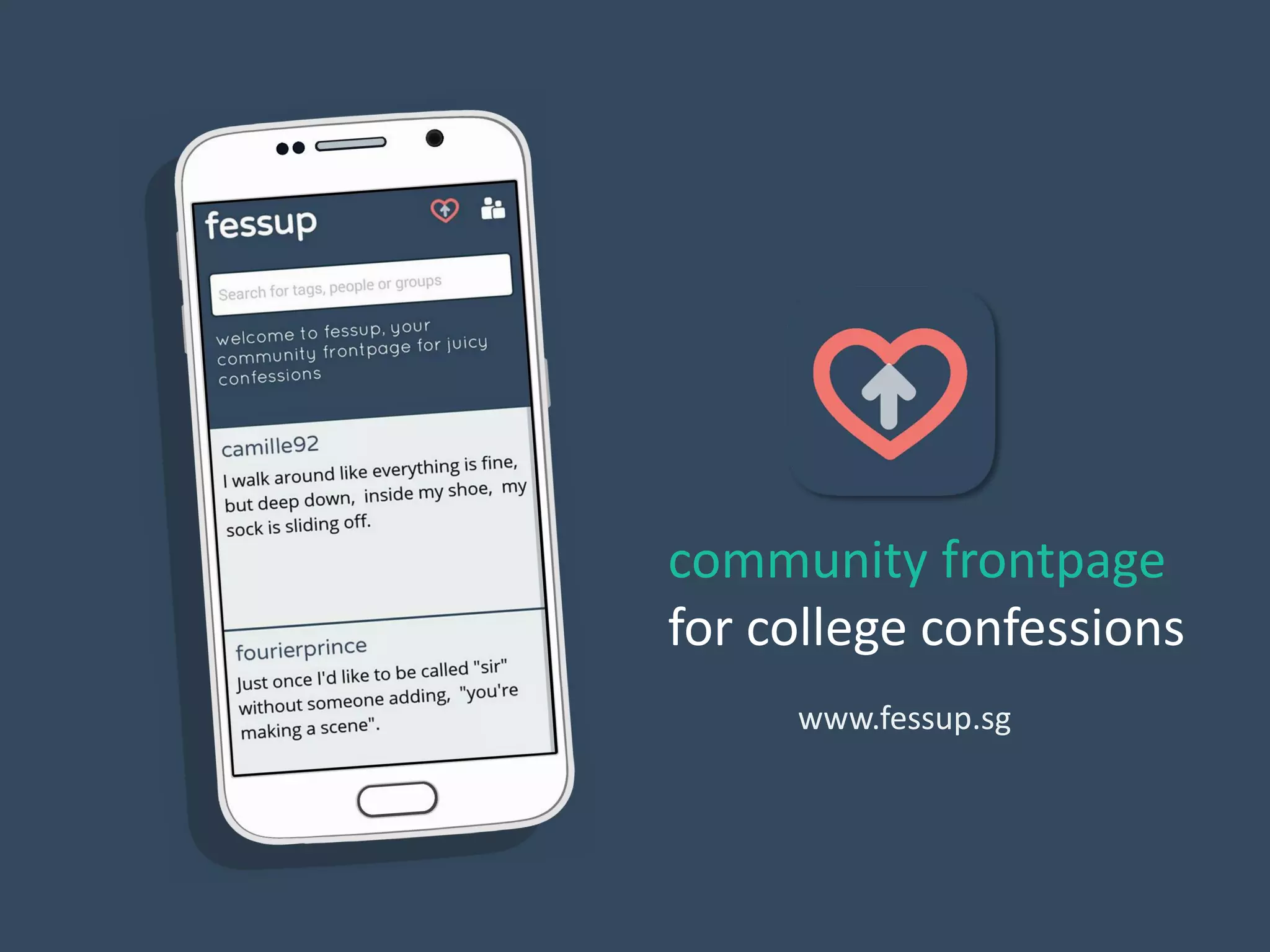
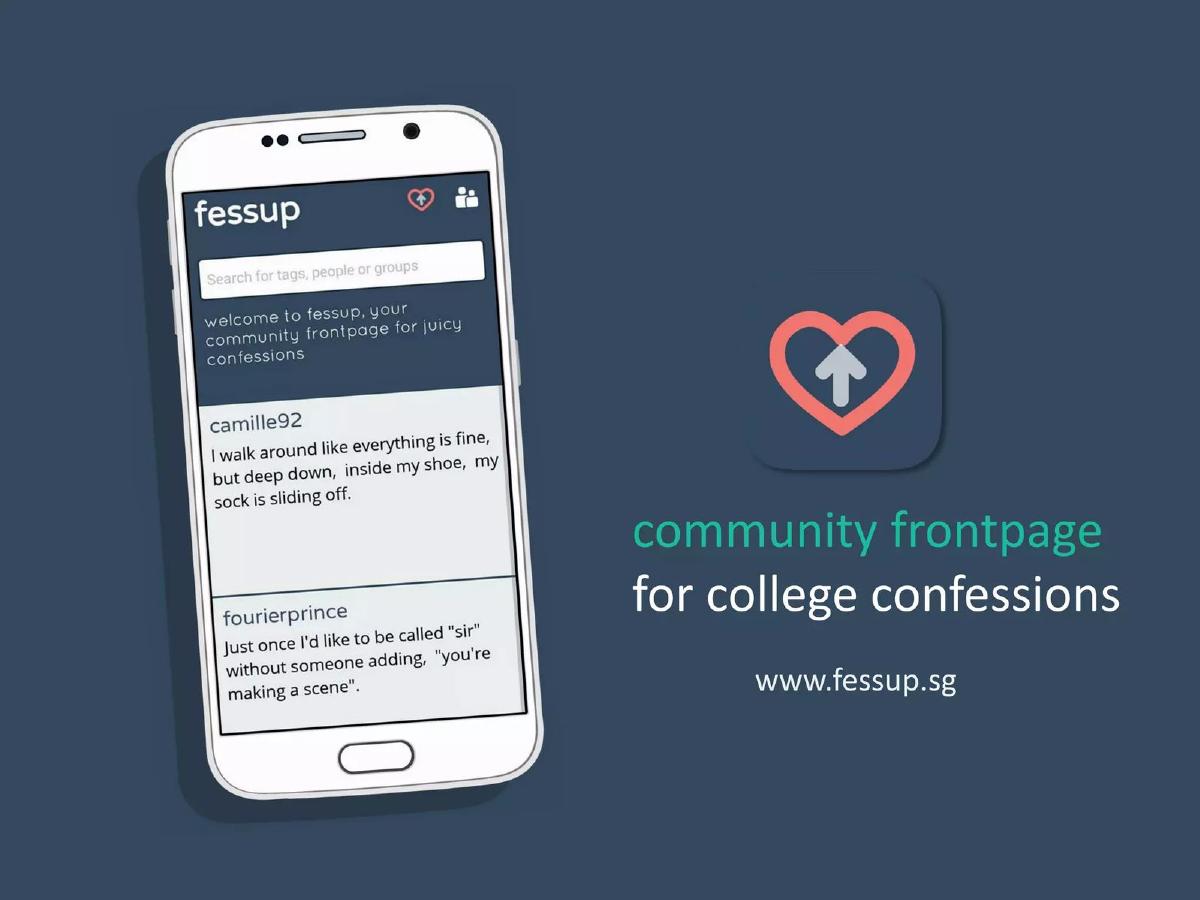
The cover slide introduces Fessup as a 'community frontpage for college confessions.' It features a smartphone mockup showing the app interface, which includes a search bar for tags, people, or groups, and a feed of short text posts. The branding uses a heart icon with an upward arrow. A URL, www.fessup.sg, indicates the company's Singaporean origins. The tagline is clear and identifies the target demographic (college students) and the content type (confessions) immediately.
Slide 2: The Problem and Opportunity
This slide uses the logos and reported valuations of competitors to establish market size: Whisper (US$200M), Secret (US$50M), and Yik Yak (US$150-300M). It positions Fessup as a solution to the 'problems of new anonymous social sharing apps.' The listed pain points are missed opportunities in connecting people, lack of community, lack of safe private messaging, and the need to 'alleviate cyber-bullying.' By citing these specific failures of the first generation of anonymous apps, Fessup attempts to justify its entry into a crowded market.
Slide 3: Product Features
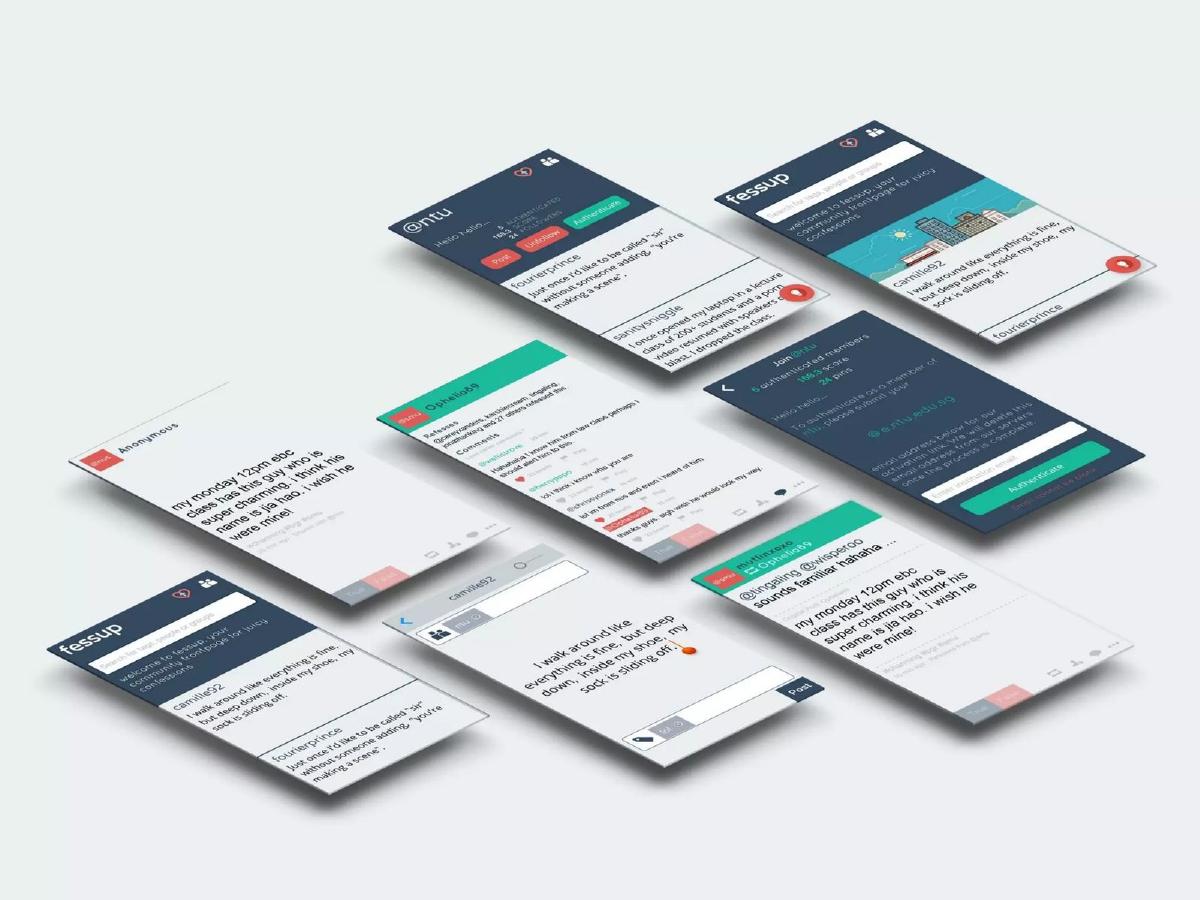
This slide provides a detailed breakdown of the user interface. Key features highlighted include the ability to post under a pseudonym or anonymously, and a 'green label' that verifies a 'confessor is indeed from your school.' Interaction mechanics include a 'True/False' voting system, swiping horizontally between posts, and standard social features like bookmarking, following, and commenting. The inclusion of '@communities' suggests a structured group hierarchy rather than a purely location-based feed like Yik Yak.
Slide 4: Competitive Landscape
Fessup uses a standard 2x2 matrix to map the competition. The axes are 'Public vs. Private' and 'Low Pressure vs. High Pressure.' Fessup places itself in the 'Sweet Spot' of Public/Low Pressure, alongside Tumblr and Yik Yak, but slightly more 'Public' than Whisper. It labels the High Pressure/Public quadrant (Facebook, LinkedIn, Instagram) as 'Too crowded' and the Low Pressure/Private quadrant (Snapchat, WhatsApp) as also 'Too crowded.' A 'Region of Pointlessness' is identified in the High Pressure/Private quadrant, containing only the app 'B.' This slide attempts to show a gap in the market for low-stakes public sharing.
Slide 5: Growth Road Map
The roadmap is a linear progression of geographic expansion. It starts with Singapore as a 'testbed,' moving to Malaysia and the USA. The strategy then expands to the English-speaking world, followed by Southeast Asia, and eventually East Asia and the rest of the world. A footer note explicitly states the strategy is to target 'School communities, then workplaces – just like Facebook.' This is a bold comparison that sets a high bar for the company's viral growth expectations.
Slide 6: Monetization Philosophy
Rather than showing a business model with projected revenues, this slide features a quote from Sangeet Paul Choudary: 'Hashtags are the new keywords, and the key to monetizing social media.' A small sub-caption explains that Fessup 'organizes unstructured data of user conversations through hashtags, a form of metadata.' This implies a future advertising or data-play model but lacks any concrete details on how the company will actually generate cash flow.
Slide 7: The Team
The team slide features five members: Herbert Eng (CEO), Rason Lee (COO), Adeel Bhyria (CTO), Yaw Boakye (VP Engineering), and Lee Kai Quan (Head, Mobile Development). Two members have GitHub icons next to their names, suggesting a technical focus. However, the slide is entirely devoid of credentials. There are no mentions of universities attended, previous startups founded, or companies worked for, which makes it difficult for an investor to assess the team's execution capability.
Slide 8: Closing Slide
The final slide repeats the logo and the Singaporean web address. It serves as a visual bookend but provides no contact information or call to action. In a standard 15-slide deck, this would typically be preceded by a financial ask or a summary of milestones, which are missing from the provided selection.
What Works
Clear Market Positioning: The deck does an excellent job of identifying exactly who the product is for (college students) and what it does (confessions). The comparison to Yik Yak and Whisper immediately gives investors a frame of reference. · Feature-Benefit Alignment: Slide 3 connects specific UI elements (like the green verification label) directly to the problems identified on Slide 2 (lack of community and safety). · Visual Simplicity: The deck is not cluttered. It uses a consistent color palette and clean mockups, making it easy to digest the core message quickly.
What is Missing
Traction and Metrics: There is no data regarding how many students are currently using the app, the daily active user (DAU) count, or retention rates. For a social app, these are the most important metrics. · Monetization Detail: Relying on a quote about hashtags is not a business plan. Investors need to see how the company will reach profitability or at least cover its server costs. · Team Credentials: A team of five unknown founders without listed backgrounds is a high-risk signal for investors. The deck needs to highlight why this specific group is capable of scaling a global social network. · The Ask: There is no information on how much money is being raised, the valuation, or how the funds will be used to achieve the milestones on the roadmap.
Founder's Takeaway
Fessup's deck is a classic example of a 'vision-heavy' pitch that lacks 'execution-proof.' While the founders correctly identified the safety and community gaps left by the first wave of anonymous apps, they failed to provide the data necessary to prove they have solved them. If you are building a social platform, your deck must prioritize traction. Even a small 'testbed' in Singapore should yield engagement data that can be extrapolated. Furthermore, comparing your growth strategy to Facebook is a double-edged sword; it shows ambition, but without a unique viral mechanism or 'moat' described in the deck, it can come across as naive. Finally, never leave your team's pedigree to the investor's imagination—list your wins, your schools, and your technical proficiencies clearly.
Frequently asked questions
- What is Fessup's primary value proposition?
- Fessup describes itself as a 'community frontpage for college confessions.' It aims to provide a safer, more community-oriented version of anonymous social sharing by introducing features like school verification labels and private messaging to alleviate the cyber-bullying and lack of belonging associated with competitors like Yik Yak.
- How does Fessup plan to make money?
- The deck does not provide a concrete revenue model. It includes a slide featuring a quote from Sangeet Paul Choudary stating that 'Hashtags are the new keywords, and the key to monetizing social media.' This suggests a plan to use metadata for targeted advertising or data insights, but no specific implementation is detailed.
- What is the team's background?
- The team slide lists five individuals: Herbert Eng (CEO), Rason Lee (COO), Adeel Bhyria (CTO), Yaw Boakye (VP Engineering), and Lee Kai Quan (Head of Mobile Development). The slide includes photos and titles but omits any information regarding their education, previous work experience, or technical accomplishments.
- What is the proposed growth roadmap?
- Fessup plans a phased international rollout. It starts with Singapore as a 'testbed,' followed by Malaysia and the USA. The third phase targets the broader English-speaking world (UK, Canada, Australia, Europe), followed by General Southeast Asia, then East Asia (China, HK, Taiwan, Japan, Korea), and finally the 'Rest of the World.'
- What are the most significant omissions in this deck?
- The deck lacks three critical components for a professional fundraise: traction metrics (users, retention, or growth rates), a clear monetization strategy, and a specific 'Ask' slide detailing how much capital is being raised and how it will be deployed.