GrabHut’s 2014 pitch deck outlines a vision for a unified mCommerce and mWallet platform in the Philippines, utilizing QR codes to bridge the gap between online browsing and offline payments. At the time of the deck, the company was operating a beta prototype with two large B2B customers and a team of seven staff. The deck is notable for its transparency regarding operational costs—stating a P200,000 monthly burn—and a specific valuation ask of P10,000,000 for 20% equity. While it identifies a lack of direct QR-based competition in the local market, it acknowledges established payment gateway…
Key takeaways
- The company claims to have no direct competition in the Philippines for QR code-based eCommerce as of 2014 (Slide 4).
- GrabHut reports having two large B2B customers currently beta testing their working web app prototype (Slide 5).
- The technical infrastructure includes a proprietary mobile wallet and a real-time cloud platform for inventory and analytics (Slide 3).
- Operational efficiency is highlighted by a team of seven staff running on a monthly expense of P200,000 (Slide 6).
- The funding ask is explicitly stated as P10,000,000 in exchange for 20% equity in the company (Slide 6).
- The deck lists existing partnerships with PesoPay and local banks for mWallet fulfillment (Slide 3).
- Management projects a 10x return on investment within a maximum three-year period (Slide 6).
- The development timeline includes one year of alpha development involving five developers (Slide 5).
GrabHut: The 2014 QR Code Pioneer
The GrabHut pitch deck, dated September 2014, represents an early attempt to digitize the Philippine retail economy through mobile wallets and QR codes. At a time when mobile commerce was still nascent in Southeast Asia, GrabHut sought to position itself as the bridge between traditional merchants and the growing smartphone user base. The deck is a straightforward, functional document that prioritizes utility and status over high-end design, reflecting a bootstrapped startup looking for its first major infusion of capital.
Slide 1: Title Slide
The deck opens with a simple title slide: "GrabHut mCommerce and mWallet platform." It includes a logo featuring a shopping cart inside a crosshair/magnifying glass icon, suggesting a focus on finding and purchasing goods. The date "September 2014" establishes the context of the mobile payment landscape at that time.
Slide 2: The Solution
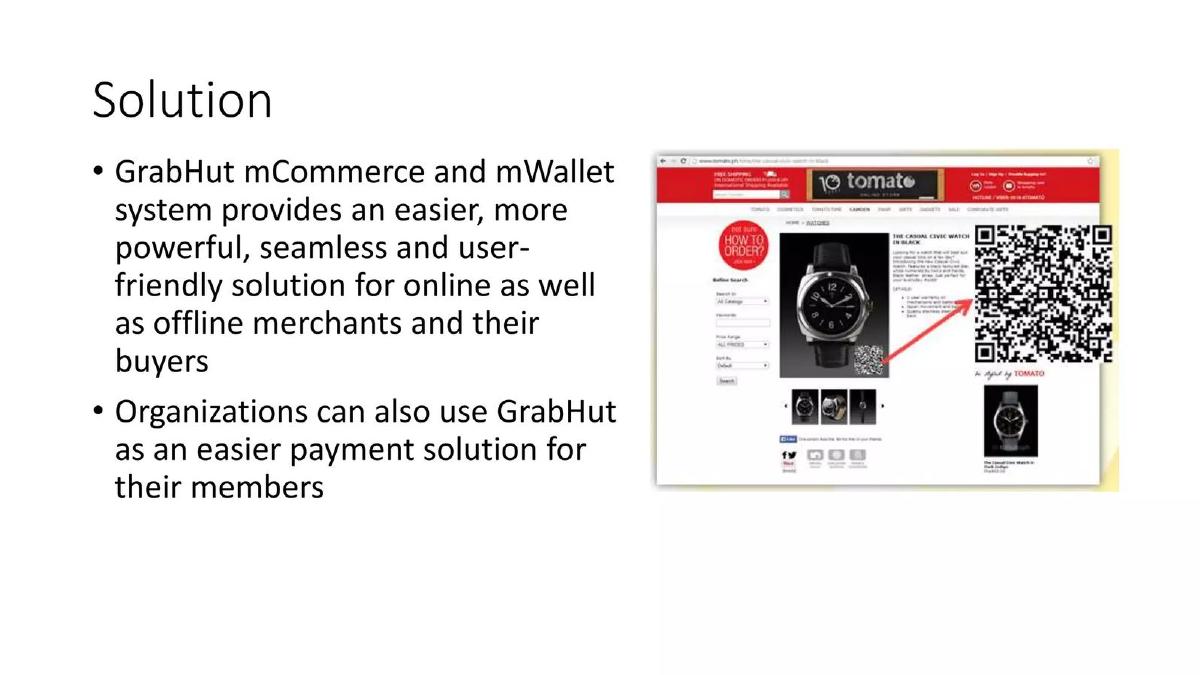
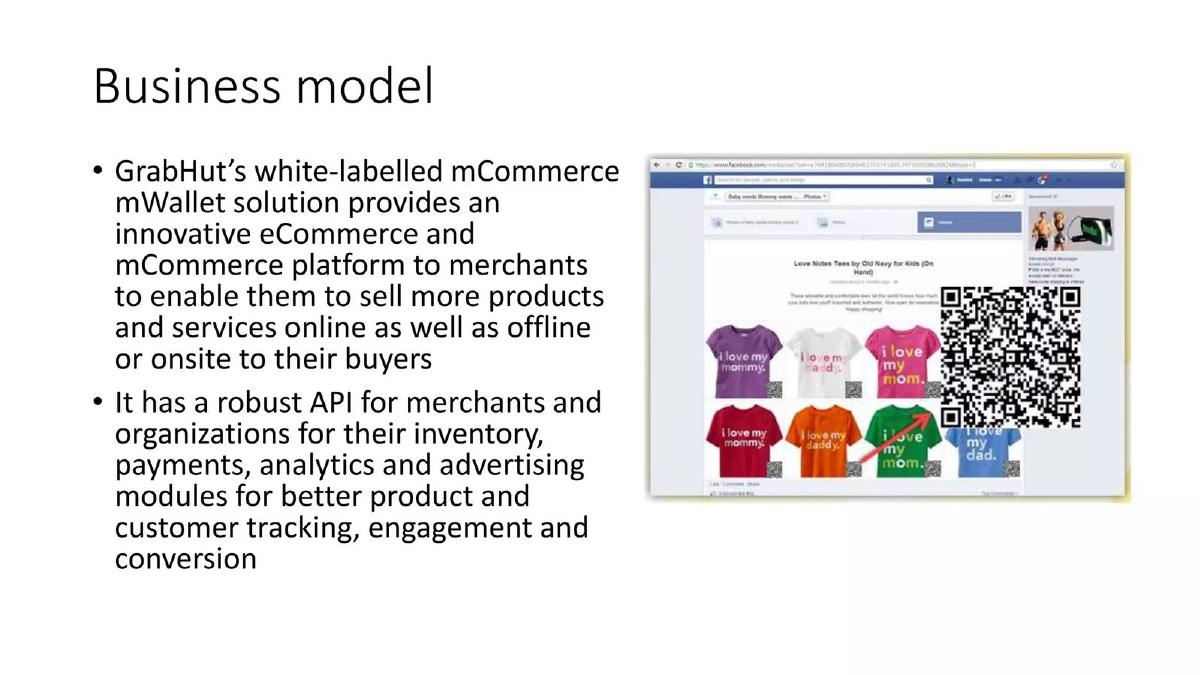
Slide 2 defines the solution as an "easier, more powerful, seamless and user-friendly solution for online as well as offline merchants and their buyers." It also mentions that organizations can use GrabHut as a payment solution for their members. The slide includes a screenshot of an e-commerce site ("10 Tomato") with a large QR code overlay, illustrating the primary interaction model: scanning a code on a screen to initiate a purchase. This visual is critical as it demonstrates the intended user flow for mCommerce transactions.
Slide 3: Underlying Magic/Technology
This slide details the technical stack and ecosystem. Key points include:
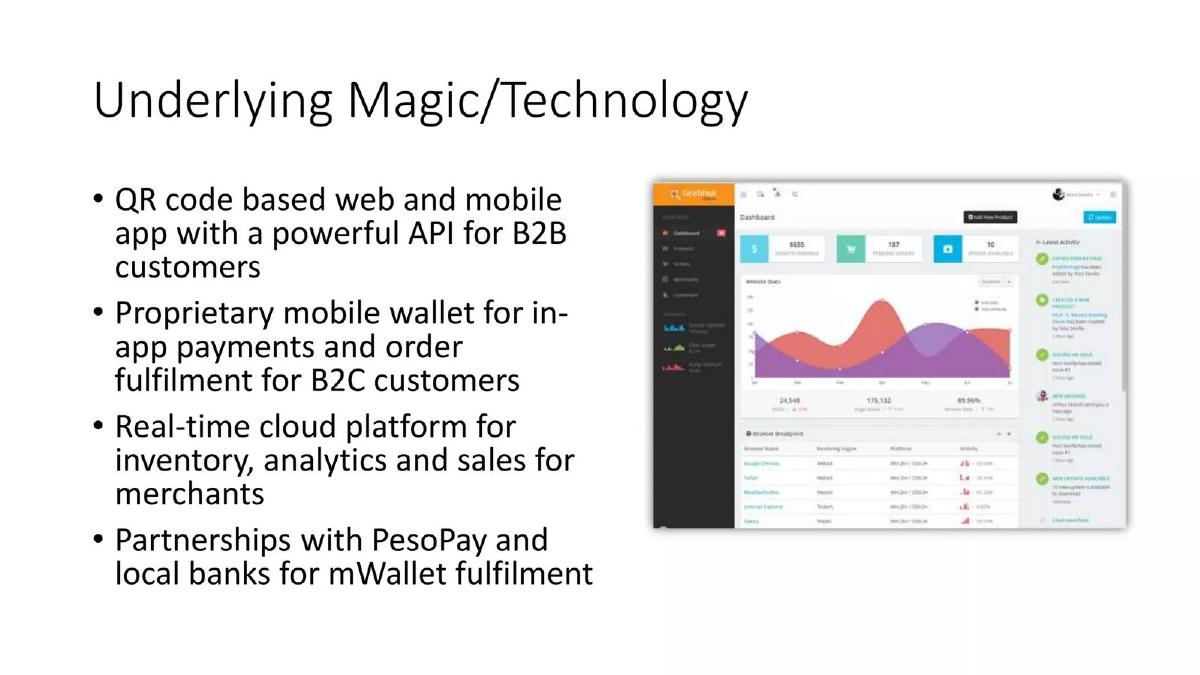
QR code based web and mobile app with a B2B API. · Proprietary mobile wallet for in-app payments and B2C order fulfillment. · Real-time cloud platform for merchant inventory, analytics, and sales. · Partnerships with PesoPay and local banks for fulfillment.
The inclusion of a dashboard screenshot shows a merchant interface with metrics like "Today's Earnings," "Pending Orders," and "Website Stats," suggesting the product was built to be a comprehensive business management tool, not just a payment button.
Slide 4: Competition
GrabHut makes a bold claim on Slide 4: "No competition in the Philippines yet for QR code based eCommerce or mCommerce apps." However, it acknowledges the broader payment landscape by listing "regular online, COD and OTC payment providers like PesoPay, DragonPay, etc." as existing players. By framing the competition this way, GrabHut attempts to carve out a blue ocean strategy based on the specific technology (QR codes) rather than the general function (payments). The slide is accompanied by a "Customer Directory" screenshot from their platform.
Slide 5: Status and Timeline
This slide provides the most concrete evidence of progress. It notes a "two months working web app prototype in beta testing with two large B2B customers." It also mentions one year of alpha development involving five developers and the registration of software patents with government agencies. The visual shows a physical billing statement with a QR code, demonstrating the "offline-to-online" use case where a customer could scan a paper bill to pay via the mobile app.
Slide 6: Summary and Call to Action
The final slide serves as the financial pitch. It restates the company's status (one year developed, patented, and bootstrapped) and provides a rare look at early-stage startup economics in the region:
7 staff with P200,000/month expenses . · Raising P10,000,000 for 20% equity . · Use of funds: Product development, staff, rent, customer acquisition, and marketing. · Projected returns: 10x in a maximum three-year period.
This slide is highly specific, leaving no ambiguity about the valuation or the intended runway.
What GrabHut Does Well
The deck is exceptionally clear about its business model and current standing. By providing the exact number of staff and the monthly burn rate (Slide 6), the founders demonstrate a high level of transparency and a firm grasp on their operational costs. This is often missing in early-stage decks, where founders tend to be vague about how they spend money.
Furthermore, the deck successfully identifies a specific technological gap in the local market. By focusing on QR codes in 2014, GrabHut was ahead of the curve in the Philippines, anticipating the shift toward scan-to-pay systems that would eventually become dominant in the region via players like GCash and Maya.
What is Missing from the Deck
The most significant omission is a dedicated Team Slide . While Slide 6 mentions "7 staff," it does not name the founders or detail their professional backgrounds. In early-stage fundraising, the pedigree and experience of the team are often more important than the prototype itself. Without this, investors cannot assess the team's ability to execute the vision.
Additionally, there is no Market Size (TAM/SAM/SOM) slide. While the deck mentions the lack of competition, it fails to quantify the total addressable market in the Philippines. Investors need to see the scale of the opportunity to justify a P50,000,000 post-money valuation. The deck also lacks a Business Model slide that explains the specific fee structure (e.g., transaction percentages or SaaS fees for merchants).
What a Founder Should Copy
Founders should emulate the Status and Timeline slide (Slide 5). It clearly separates alpha development from beta testing and provides a headcount for the engineering team. This gives investors a sense of the "velocity" of the company—how much has been built and how long it took.
The Call to Action (Slide 6) is also a model of clarity. Many founders are afraid to put a specific valuation or equity percentage in a deck, preferring to "negotiate." However, stating the terms upfront can save time by filtering for investors who are comfortable with those parameters. The breakdown of the use of funds is also well-categorized, showing a balance between product development and market growth.
Final Analysis
The GrabHut deck is a product of its time—utilitarian, focused on a specific emerging technology, and grounded in the local realities of the Philippine market in 2014. While it lacks the polish and narrative depth of modern Silicon Valley decks, its directness regarding financials and progress makes it a functional fundraising tool. Its success would have ultimately depended on the founders' ability to prove the team's capability (which was omitted) and the scalability of the two initial B2B partnerships.
Frequently asked questions
- What is the core technology behind GrabHut?
- According to Slide 3, GrabHut relies on a QR code-based web and mobile application. This is supported by a proprietary mobile wallet for B2C payments and a real-time cloud platform that provides merchants with inventory management, sales analytics, and B2B API access.
- How does GrabHut differentiate itself from other Philippine payment providers?
- Slide 4 states that while providers like PesoPay and DragonPay exist for regular online, Cash on Delivery (COD), and Over-the-Counter (OTC) payments, GrabHut was the first to market with a specific focus on QR code-based mCommerce apps in the Philippines.
- What is the current stage of the product in this deck?
- As of the September 2014 deck, the product was in a beta testing phase. Slide 5 notes a 'two months working web app prototype' in beta with two B2B customers, following a full year of alpha development for both web and mobile platforms.
- What are the specific financial requirements and terms mentioned?
- Slide 6 outlines a requirement for P10,000,000 (Philippine Pesos) for a 20% equity stake. It also reveals the company's burn rate at the time was P200,000 per month for a staff of seven people.
- How does the company plan to use the raised funds?
- The 'Summary and call to action' on Slide 6 specifies that funds will be allocated toward product development, hiring additional developer and management staff, office rental, utilities, and a heavy focus on customer acquisition, marketing, and PR.