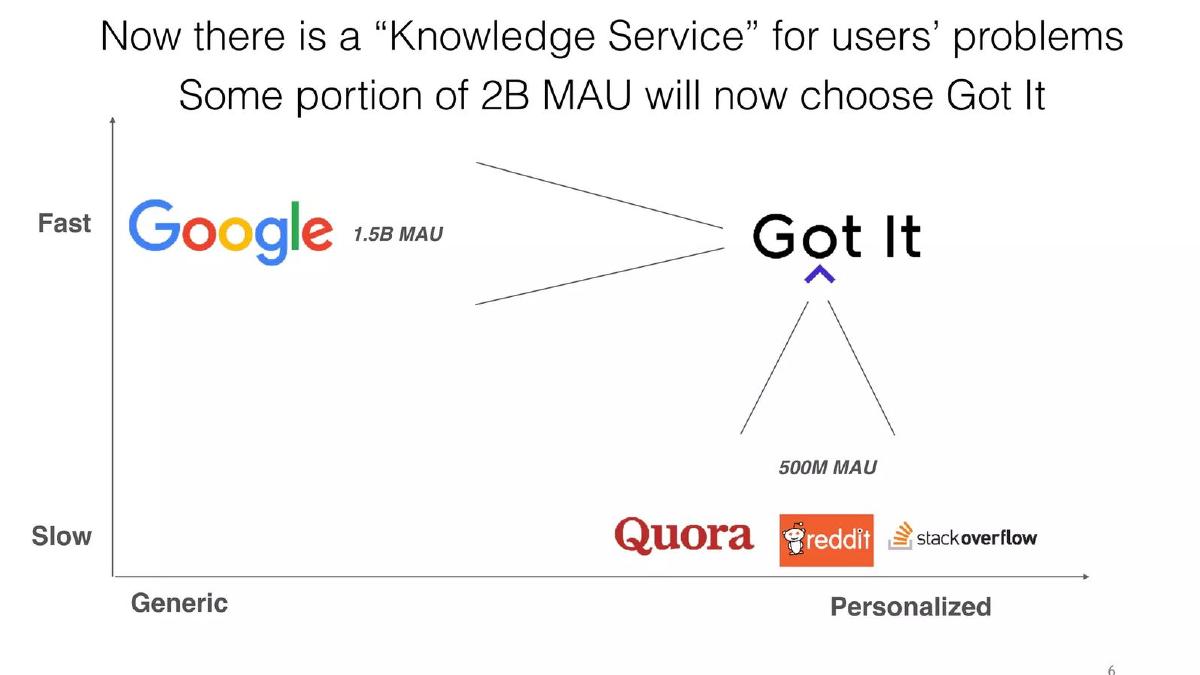
Got It positions itself as the missing 'on-demand service for knowledge,' filling a gap between generic search (Google) and slow community platforms (Quora, Reddit). The company leverages a machine-learning-driven 'ExpertMatch' system to connect users with experts for 10-minute chat sessions. Having established a foothold in STEM education with 1M+ users and 2.5M sessions, the deck outlines a transition from 'Learners' to 'Professionals' and eventually a global consumer base of 5B users. The core value proposition is speed and personalization, utilizing AI to verify both the problem and the e…
Key takeaways
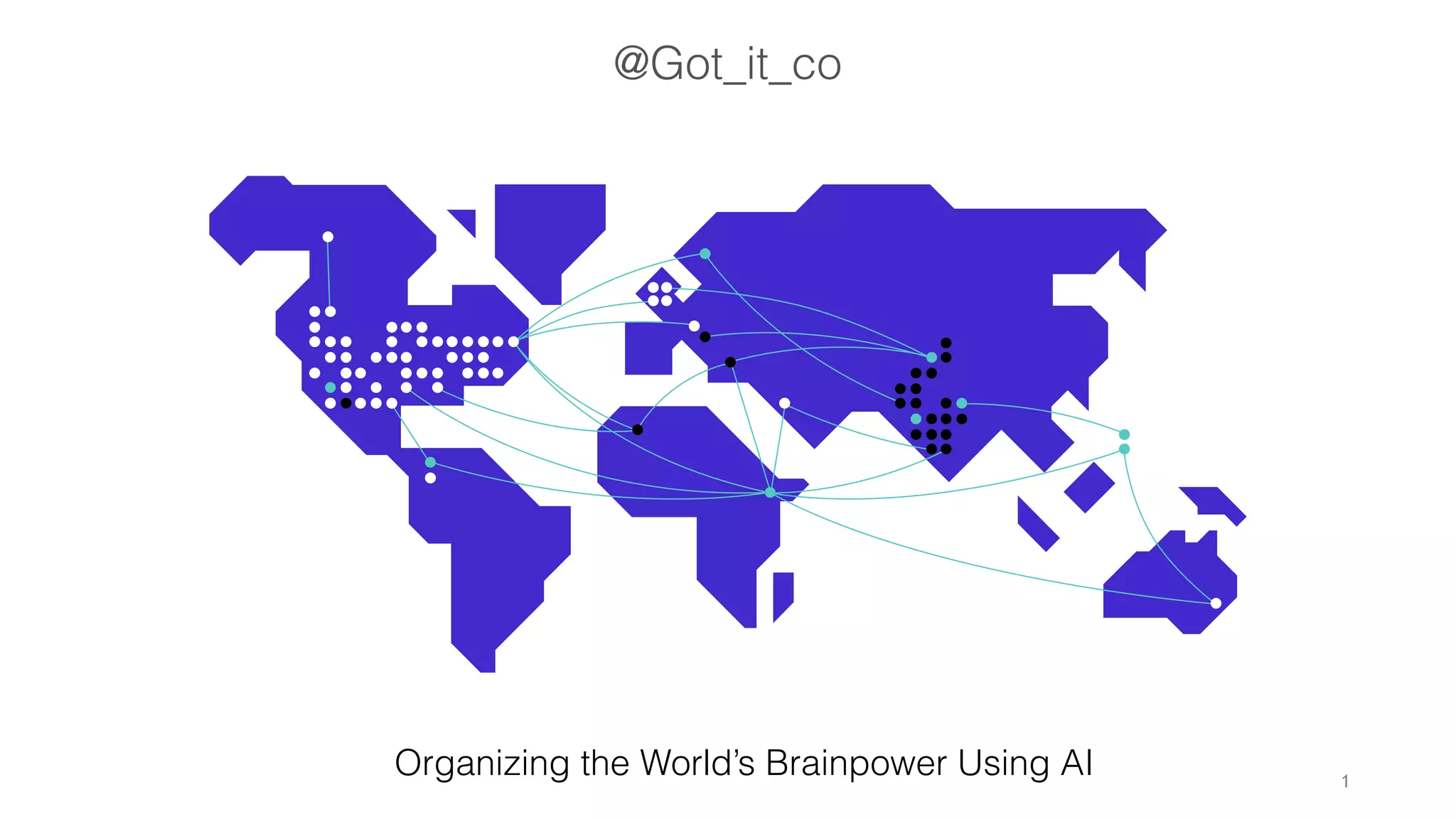
- The company defines its mission as 'Organizing the World’s Brainpower Using AI' on slide 1.
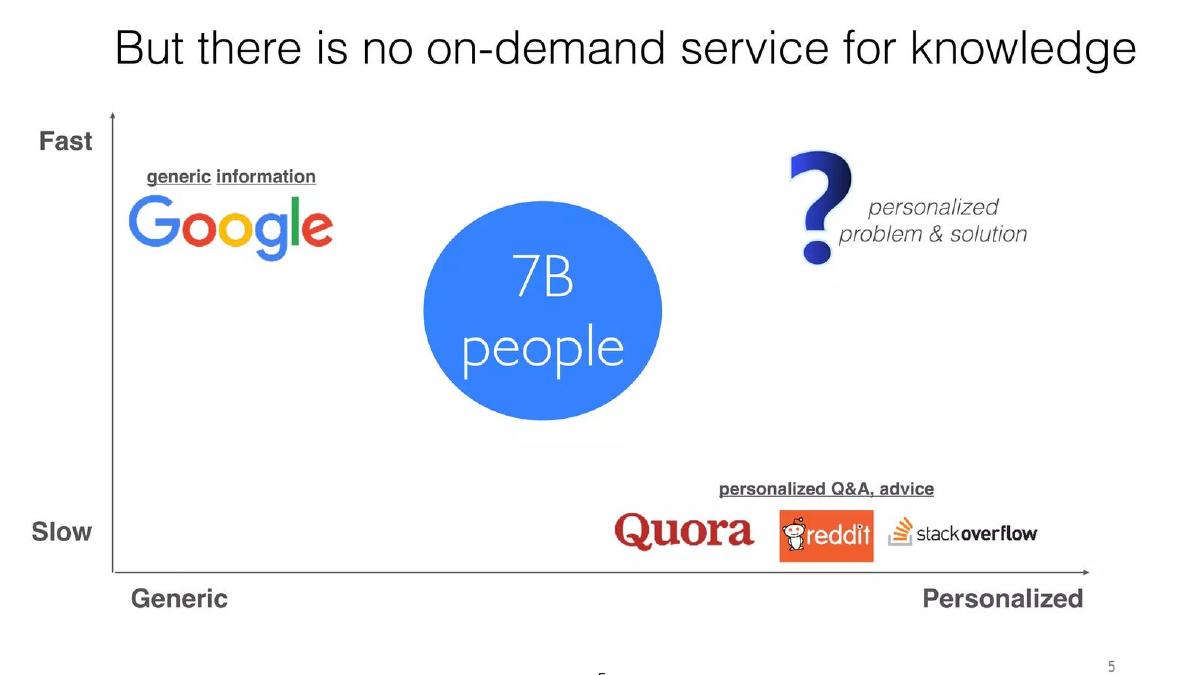
- A competitive matrix on slide 5 identifies a market gap for 'fast' and 'personalized' problem-solving that current players like Google or Quora do not fill.
- Got It uses a quote from Satya Nadella regarding the $26B LinkedIn acquisition to validate the vision of expert-matching within productivity tools on slide 9.
- Traction in the education sector includes 1M+ users, 3M problems posted, and 2.5M sessions as shown on slide 13.
- The expert supply side is highly selective, with only 12,500 experts accepted from 250,000 applicants across 70+ countries (slide 13).
- The technical approach utilizes machine learning for two specific applications: understanding the user's problem and assessing expert quality (slide 21).
- The roadmap on slide 25 targets a progression from 500M STEM learners to 1B professionals, and eventually 5B consumers in fields like Agri, Health, and Finance.
- The platform claims a 'Playbook in action' capable of launching a new knowledge topic in just one week (slide 29).
Executive Summary: The Knowledge-as-a-Service Vision
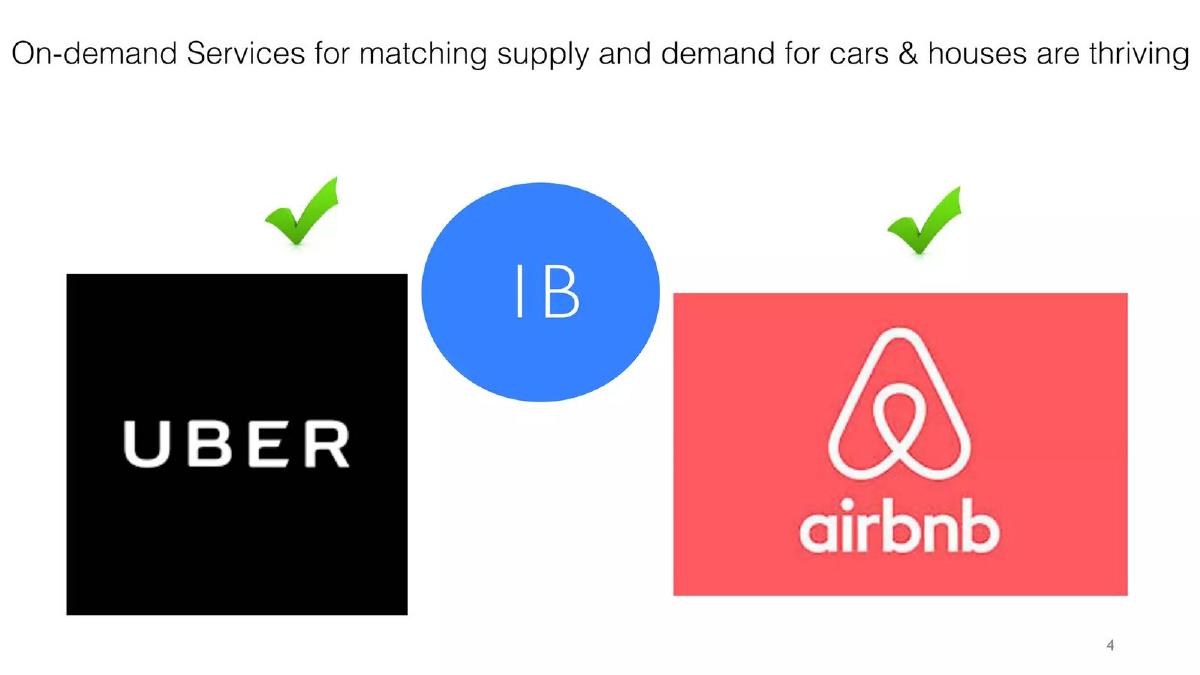
The Got It Vision & Approach deck is a strategic document that outlines the company's transition from a successful niche education app to a horizontal Knowledge-as-a-Service (KaaS) platform. The narrative is built on the premise that while information is abundant, personalized expertise is difficult to access quickly. By leveraging a massive, vetted expert pool and machine learning, Got It aims to do for knowledge what Uber did for transportation: create a reliable, on-demand marketplace.
Slide 1: The Mission Statement
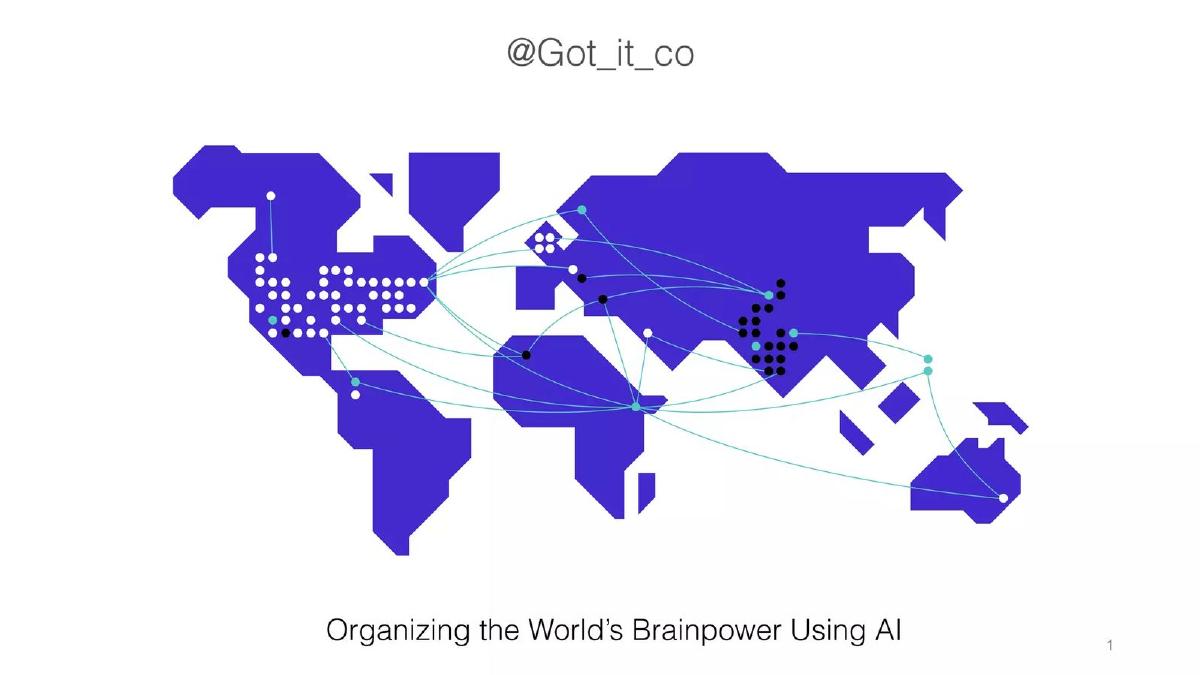
The deck opens with a high-level vision: "Organizing the World’s Brainpower Using AI." The visual features a stylized world map with nodes and connections, suggesting a global network of experts and users. This sets the stage for a company that views itself not just as a tutoring app, but as a foundational layer for human intelligence exchange.
Slide 5: Market Positioning and the 'Knowledge Gap'
This slide is critical for establishing the 'Why Now.' It uses a standard four-quadrant matrix with 'Generic vs. Personalized' on the X-axis and 'Slow vs. Fast' on the Y-axis. Google is placed in the Fast/Generic quadrant. Quora, Reddit, and Stack Overflow are placed in the Slow/Personalized quadrant. Got It identifies a vacancy in the Fast/Personalized quadrant. The slide notes there are "7B people" but "no on-demand service for knowledge," framing the problem as a massive, unaddressed market opportunity.
Slide 9: External Validation via Microsoft and LinkedIn
To prove that their vision is shared by industry giants, Got It cites Satya Nadella regarding the $26B LinkedIn acquisition . The quote, "..new experiences such as ..... Office suggesting an expert to connect with via LinkedIn to help with a task..." serves as a powerful appeal to authority. It suggests that the world's largest software companies are moving toward the exact expert-matching model that Got It is building, validating the exit potential or partnership value of the technology.
Slide 13: Traction in the 'Learners' Vertical
This slide provides the 'Proof of Concept.' It focuses on Got It Study , which it claims is a "top 20 edu app." The metrics are impressive: 1M+ users, 3M problems posted, and 2.5M sessions. Each session is described as a "STEM problem solving chat session" lasting 10 minutes. Crucially, it highlights the supply side: 250,000 applicants with only 12,500 accepted from 70+ countries. This 5% acceptance rate emphasizes quality control and the scale of their global expert network.
Slide 17 & 21: The Machine Learning Framework
These two slides use a parallel structure to explain their technical moat. Slide 17 uses Uber as an analogy for ML in self-driving cars, moving from deterministic/hardcoded rules to mathematical/machine-learned rules. Slide 21 applies this same logic to User-Expert Matching . Got It identifies two specific applications for their AI: "1. Do we understand your problem?" and "2. How good is the expert?" This framing attempts to demystify their AI, showing it as a tool for efficiency and quality assurance rather than just a buzzword.
Slide 25: The Roadmap to 5 Billion Users
This is the 'Big Ask' or 'Big Vision' slide. It shows three concentric circles representing growth phases. The first (checked off) is 500M Learners in STEM . The second is 1B Professionals , with icons representing Excel and SQL. The third and largest is 5B Users , covering Agriculture, Health, and Finance. The slide introduces the concept of a "KaaS Platform" featuring ExpertMatch, Marketplace & Service Management, AI, and Trust & Safety. It describes the expansion as a "long tail of topics" managed "by approval only like 'App Store'," implying a platform play rather than just a series of apps.
Slide 29: The Playbook in Action
To demonstrate the versatility of the platform, this slide shows a "new Topic in a week." It features a mockup of an entrepreneur (user) pitching a startup to a VC (expert) in a 10-minute chat session. The UI shows a user asking for feedback on a pitch deck for "SEOMoz." This serves as a functional demo of how the STEM tutoring logic can be applied to high-value professional consulting, proving the platform's agility.
What Works in This Deck
Clear Market Gap: The quadrant on slide 5 is a textbook example of how to visualize a market opportunity. It makes the company's existence feel inevitable. · Strong Traction: The numbers on slide 13 (2.5M sessions) prove that the core mechanic of a 10-minute expert chat is not just theoretical—it is a proven consumer behavior. · Supply-Side Rigor: By highlighting the 5% acceptance rate for experts, the company addresses the primary concern of marketplace quality early on. · Scalable Framework: The transition from STEM to Excel to general consumer topics (slide 25) provides a logical path for how a small app becomes a multi-billion dollar platform.
What Is Missing from This Deck
Unit Economics: While the deck mentions 2.5M sessions, it does not state the cost per session, the price charged to users, or the margin kept by the platform. Without these, it is impossible to judge the business's sustainability. · Team Slide: The provided slides do not include a team overview. In a vision-heavy deck, knowing who is building the AI and managing the global expert pool is essential. · Competition Detail: While slide 5 mentions Google and Reddit, it ignores direct competitors in the on-demand tutoring or expert network space (e.g., Chegg, GLG, or newer AI-first startups). · Financial Ask: There is no slide detailing how much capital is being raised or how it will be allocated to reach the "1B Professionals" milestone.
Founder Takeaways: Lessons to Copy
The Power of Analogy: Using Uber and Microsoft/LinkedIn (slides 9 and 17) helps investors categorize a new concept (KaaS) by relating it to successful, known entities. · Vertical to Horizontal Strategy: Starting with a high-frequency, high-pain-point niche (STEM homework) to build a proprietary technology (ExpertMatch) before expanding is a classic, effective growth narrative. · Defining the AI's Job: Instead of saying "we use AI," slide 21 tells you exactly what the AI does (understands the problem and vets the expert). This builds technical credibility. · Visualizing the Roadmap: The 'bubbles' on slide 25 clearly communicate the scale of ambition while acknowledging the current progress with checkmarks.
Frequently asked questions
- What is the core product offered by Got It?
- Got It offers a Knowledge-as-a-Service (KaaS) platform that facilitates 10-minute live chat sessions between users and experts. The platform uses AI to match users with the right expert instantly. According to slide 13, the initial product focus was a top 20 education app for STEM problem solving, but the vision is to expand this to all professional and consumer knowledge areas.
- How does Got It differentiate itself from Google or Reddit?
- As illustrated on slide 5, Got It differentiates based on speed and personalization. Google provides generic information quickly, while Reddit and Quora provide personalized advice slowly. Got It aims to occupy the 'Fast and Personalized' quadrant, providing immediate, one-on-one expert solutions to specific problems rather than static search results or community-voted threads.
- What metrics does the company share regarding its education vertical?
- Slide 13 lists significant traction metrics: over 1 million users, 3 million problems posted, and 2.5 million completed sessions. It also highlights a robust supply chain of experts, noting that they received 250,000 applications but only accepted 12,500, ensuring a high quality of service across more than 70 countries.
- What is the role of AI in the Got It platform?
- The deck specifies two primary roles for machine learning on slide 21. First, it is used to determine if the system understands the user's specific problem. Second, it evaluates the quality of the expert. This 'ExpertMatch' technology is intended to move the platform away from hardcoded rules toward a mathematical, machine-learned approach to user-expert pairing.
- What are the future expansion plans for Got It?
- Slide 25 outlines a three-stage growth strategy. The company started with 500M learners in STEM. The next phase targets 1B professionals (specifically mentioning Excel and SQL). The final goal is to reach 5B consumers by adding a 'long tail of topics' including Agriculture, Health, and Finance, managed via an approval process similar to an App Store.