Feroot’s 8-slide Series A deck is a masterclass in brevity and fear-based value propositions. By highlighting that non-compliant websites can cost companies hundreds of millions of dollars, the deck immediately establishes a high-stakes problem. The solution is presented as an 'Always-on AI Agent platform' that replaces manual, error-prone human audits with a 45-second automated process. While the deck is exceptionally light on traditional venture metrics—omitting revenue, growth rates, and a specific funding ask—it leans heavily on social proof. The inclusion of high-profile media mentions (…
Key takeaways
- The deck identifies a massive financial liability, stating non-compliant websites cost 10s to 100s of millions of dollars on slide 2.
- Feroot claims their AI agents can complete compliance tasks in just 45 seconds, contrasting this with months of manual FTE time on slide 4.
- The platform supports over 50 regulations, including GDPR, HIPAA, and CCPA, as listed on slide 2.
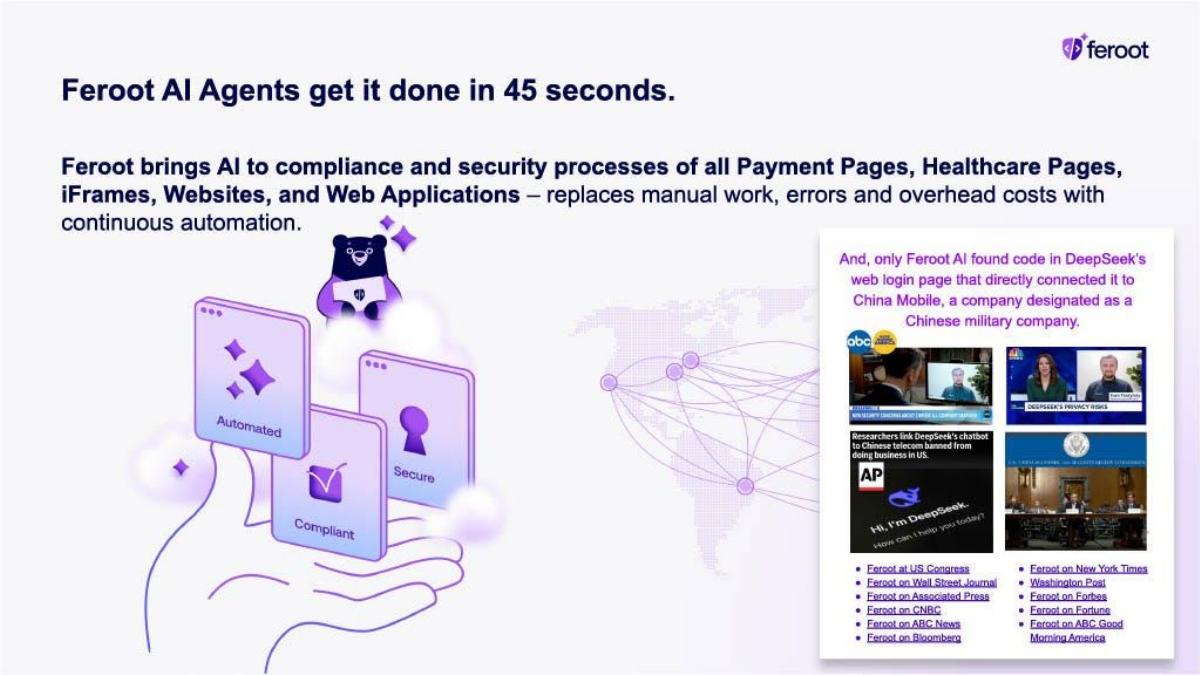
- The deck uses a 'DeepSeek' case study on slide 4 to demonstrate real-world utility in identifying prohibited foreign telecom connections.
- Social proof is a core pillar, with slide 4 listing appearances at the US Congress and in major outlets like the New York Times and Forbes.
- The investor roster on slide 7 features prominent names including True Ventures, Y Combinator, and Preface Ventures.
- The deck completely omits financial metrics, business model details, and a specific 'Ask' for the round.
- The team slide (7) highlights two co-founders but lacks detailed professional biographies, relying instead on advisor and investor logos for credibility.
The 8-Slide Series A: High Stakes and High Speed
Feroot’s 2024 Series A deck, which helped secure $14M as reported by Business Insider, is an exercise in minimalism. In an era where Series A decks often stretch to 20 slides with deep-dive cohorts and unit economics, Feroot opts for a narrative driven by risk mitigation and automation speed. The deck focuses on the 'why now'—a world where privacy regulations are exploding—and the 'how'—AI agents that do in seconds what humans do in months.
Slide 1: The Value Proposition
The opening slide establishes Feroot as an 'Always-on AI Agent platform.' It immediately defines the scope: websites, web applications, and mobile applications. The core promise is twofold: security and compliance. By mentioning '50+ regulations, standards and laws' right on the cover, Feroot signals that they are a comprehensive solution for global enterprises, not just a niche tool for a single jurisdiction like GDPR.
Slide 2: The Cost of Inaction
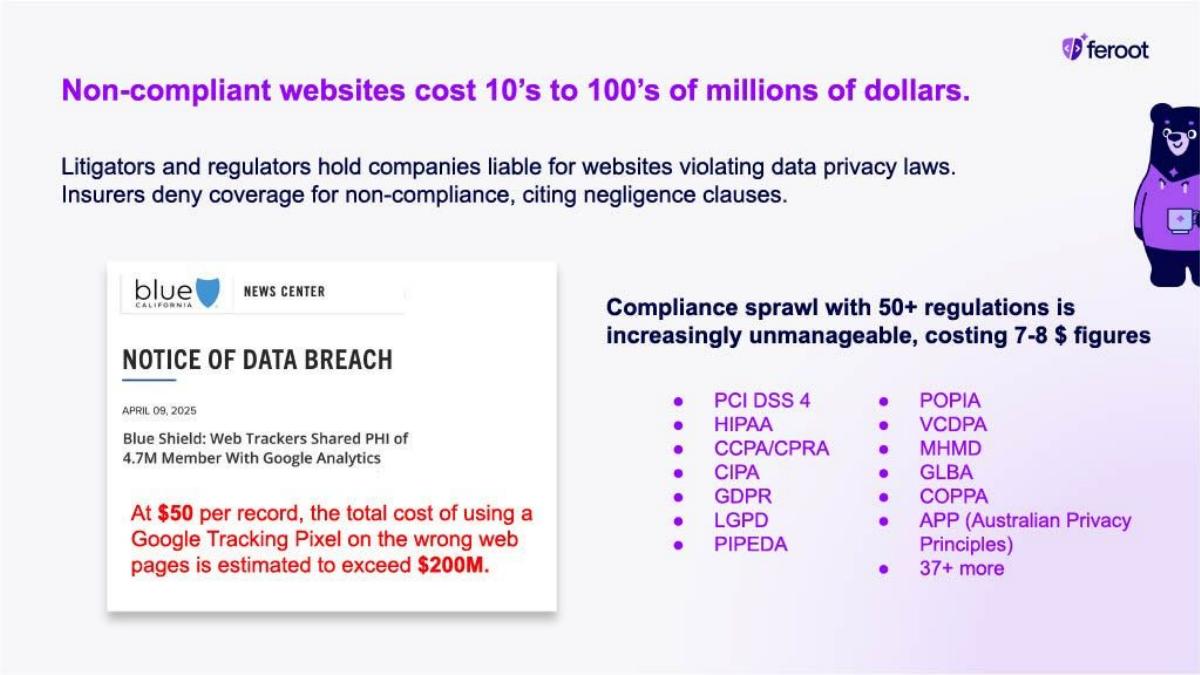
Slide 2 is the 'Fear' slide, and it is highly effective. It quantifies the problem by stating that non-compliance costs '10's to 100's of millions of dollars.' It lists three specific threats: litigation/regulation, liability for data privacy violations, and the denial of insurance coverage. The inclusion of a 'Notice of Data Breach' graphic for Blue Shield California, estimating a $200M cost for a Google Tracking Pixel error, provides a concrete, high-stakes example. The slide also lists specific regulations like PCI DSS 4, HIPAA, GDPR, and LGPD, reinforcing the complexity of the 'compliance sprawl.'
Slide 3: The Human Failure Point
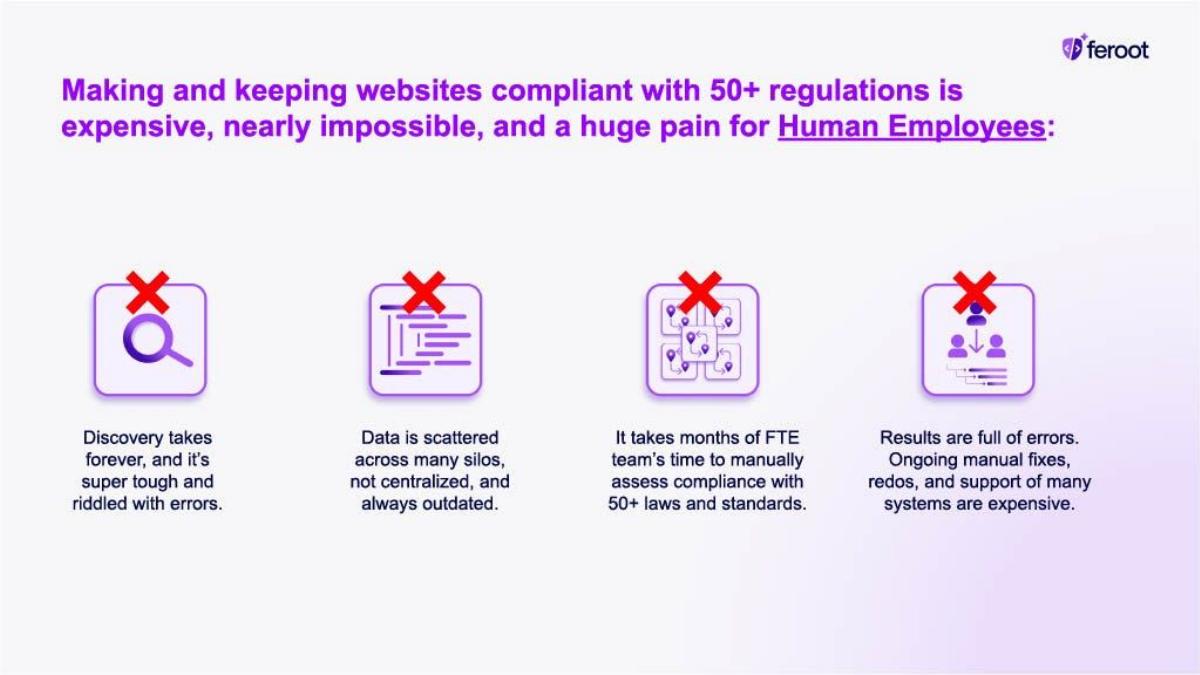
This slide contrasts the problem with the current solution: 'Human Employees.' Using four red 'X' icons, it describes manual compliance as 'nearly impossible.' The specific pain points cited are: discovery takes 'forever,' data is 'scattered across many silos,' it takes 'months of FTE team’s time,' and results are 'full of errors.' This sets up a classic 'Before vs. After' narrative, where the current state is portrayed as expensive and fundamentally broken.
Slide 4: The 45-Second Solution
Slide 4 introduces the 'After.' The headline claim is bold: 'Feroot AI Agents get it done in 45 seconds.' This is a massive leap from the 'months' mentioned on the previous slide. The slide also includes a significant amount of social proof. It references a case study where Feroot found code in a DeepSeek login page connecting to a 'Chinese military company.' Below this, a list of media logos (WSJ, Bloomberg, Forbes) and a mention of the 'US Congress' suggest that Feroot is already a recognized authority in the cybersecurity space.
Slide 5: The AI Agent Differentiator
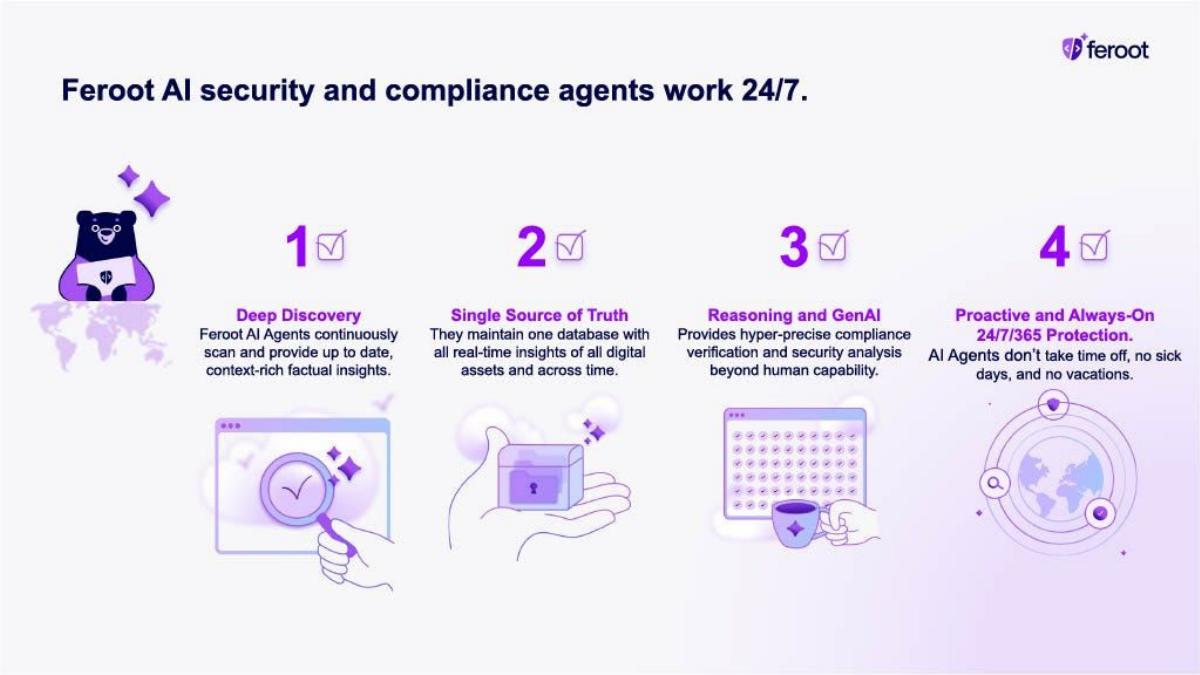
Slide 5 breaks down the product's functional advantages into four pillars: Deep Discovery, Single Source of Truth, Reasoning and GenAI, and Proactive 24/7 Protection. The copy emphasizes that AI agents 'don't take time off, no sick days, and no vacations.' This reinforces the automation angle, positioning the software as a tireless digital workforce rather than just a static scanning tool.
Slide 6: Product Evidence
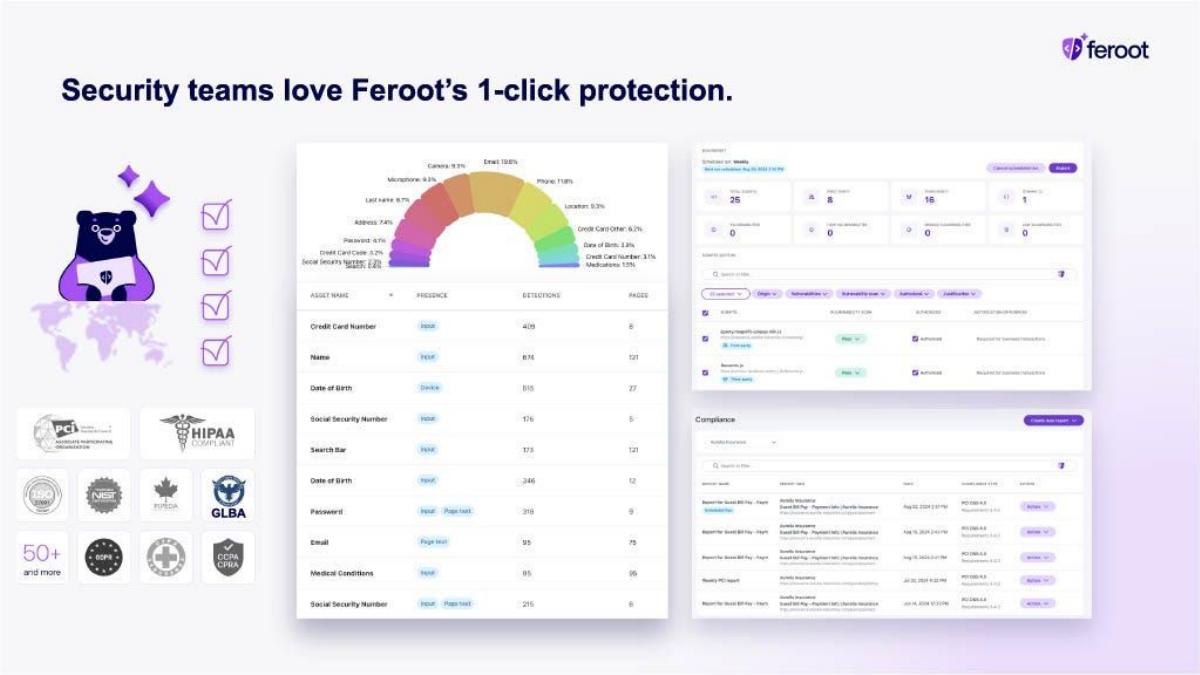
Slide 6 provides the 'receipts' by showing the actual UI. The screenshots are legible enough to see that the platform detects sensitive data types (Credit Card Numbers, SSNs, Medical Conditions) and maps them to specific pages. It also shows a '1-click protection' workflow and a compliance reporting dashboard. The presence of logos for NIST, SOC2, and HIPAA at the bottom left serves as a final reminder of the platform's breadth.
Slide 7: The Team and The Backing
The team slide is surprisingly sparse on bios. It lists Ivan Tsarynny (CEO) and Vitaliy Lim (CTO) but provides no text regarding their previous exits or industry experience. Instead, the slide relies on the 'Today's Investors' section to carry the credibility. With True Ventures and Y Combinator at the top, followed by a list of angel investors from major security firms (Duo, Lookout, Signal Sciences), the message is clear: the experts in the field have already vetted this team.
Slide 8: The Conclusion
The final slide repeats the core mission statement: 'Always-on compliance and security protection.' It’s a standard closing that brings the focus back to the product's primary utility across all digital platforms.
What Works in This Deck
The Urgency of the Problem: By leading with a $200M breach example, Feroot moves compliance from a 'boring back-office task' to a 'board-level existential risk.' This is crucial for securing high valuations in cybersecurity.
The Speed Claim: The '45 seconds' vs. 'months' comparison is a powerful hook. It makes the ROI of the software immediately obvious—if a company can replace months of human labor with a minute of compute time, the software pays for itself instantly.
Social Proof: For a Series A company, having your findings cited by the US Congress and the Wall Street Journal is an elite level of validation that offsets the lack of revenue data in the deck.
What is Missing from This Deck
Financial Metrics: There is zero mention of revenue, ARR, or growth. While the publisher reports a $14M raise, the deck itself doesn't show the traction that justified it. This suggests this deck may have been a 'teaser' or a high-level vision deck used alongside a more data-heavy appendix.
Market Size (TAM): The deck assumes the investor already knows that the privacy market is huge. It doesn't quantify the Total Addressable Market, which is a standard requirement for most venture pitches.
The Ask: There is no slide stating how much money they are raising or what the milestones for the next 18-24 months will be. Again, this points to the deck being used as a narrative tool rather than a comprehensive business plan.
Founder Takeaways
Lead with the 'Big Scary Number': If your product prevents a catastrophic loss, lead with the cost of that loss. Feroot’s use of the $200M Blue Shield example is a perfect anchor for their value proposition. · Quantify the Time Saved: Don't just say your tool is 'faster.' Say it takes '45 seconds' instead of 'months.' Specificity creates belief. · Leverage Your Cap Table: If you have Tier-1 investors or industry-heavyweight angels, give them their own section. In the absence of revenue data, the quality of your backers acts as a proxy for the quality of your tech. · Keep it Visual: Feroot uses a consistent purple-and-white aesthetic with a mascot (the bear) that makes a dry subject like 'compliance' feel modern and accessible.
Frequently asked questions
- What is the primary problem Feroot solves?
- Feroot addresses the 'compliance sprawl' created by over 50 different data privacy regulations. According to slide 2, manual compliance is increasingly unmanageable and carries a risk of 7-8 figure fines, lawsuits, and denied insurance coverage due to negligence clauses.
- How does Feroot's AI technology differ from manual audits?
- Slide 3 notes that manual discovery is 'super tough' and 'always outdated,' often taking months of human effort. Slide 4 and 5 claim Feroot AI agents work 24/7/365 and can complete these assessments in 45 seconds, providing a 'single source of truth' for digital assets.
- Does the deck show the actual product interface?
- Yes, slide 6 provides three screenshots of the dashboard. These show data privacy visualizations (like a breakdown of credit card numbers, SSNs, and medical conditions detected), a script vulnerability scanner, and a compliance report log.
- Who are the investors behind Feroot?
- As shown on slide 7, the company is backed by True Ventures, Y Combinator, Preface Ventures, Haystack, and Stonemill Ventures. The slide also lists several individual angel investors with backgrounds at Duo Security, Lookout, and Signal Sciences.
- What metrics are missing from this pitch deck?
- This deck is notably missing all standard performance metrics. There is no mention of Annual Recurring Revenue (ARR), customer count, churn rates, or year-over-year growth. It also lacks a slide detailing how the $14M Series A funds will be allocated.