Onit Security’s 7-slide pitch deck is a textbook example of a 'founder-market fit' play. By prioritizing a heavy-hitting team slide (Slide 2) featuring multiple exits and military cyber backgrounds, the company established immediate credibility. The narrative focuses on the transition from manual ticketing to 'Decision-Based Exposure Management,' arguing that LLM maturity finally makes autonomous remediation possible. While the deck is light on specific product screenshots or financial projections, it successfully frames a $23B+ market opportunity (Slide 7) by highlighting the failure of exis…
Key takeaways
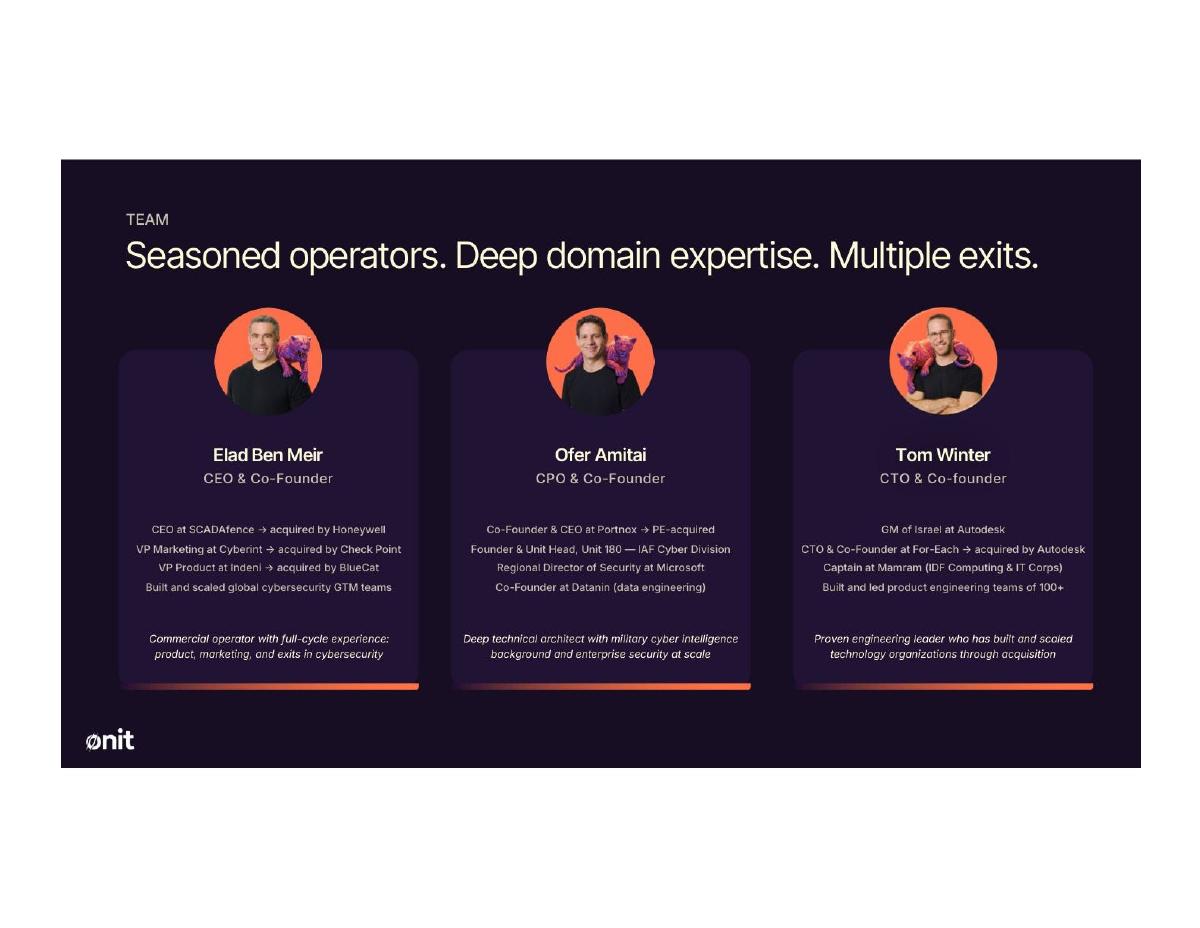
- The team slide (Slide 2) is the deck's strongest asset, showcasing three founders with deep domain expertise, military cyber backgrounds, and multiple successful exits to companies like Honeywell and Autodesk.
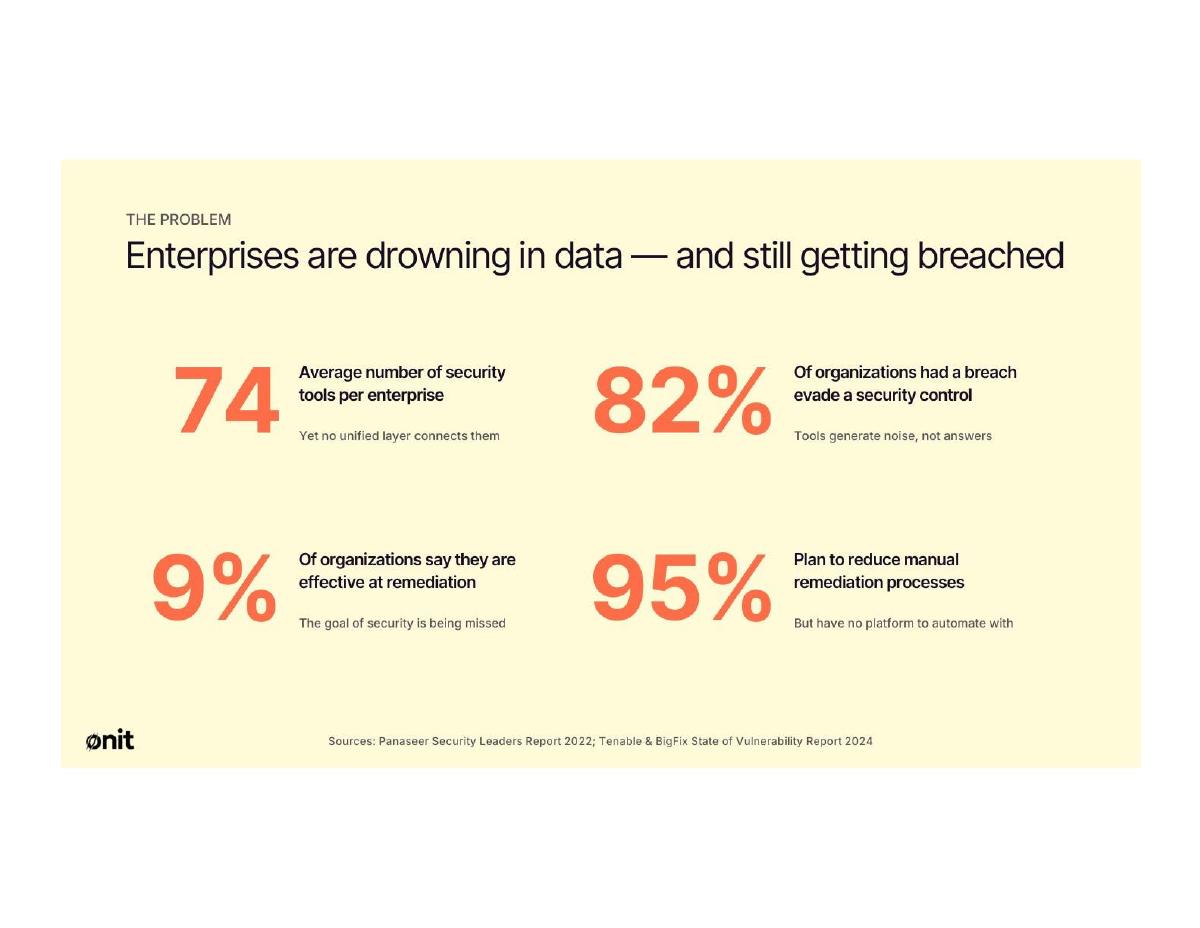
- Enterprises are overwhelmed by tool sprawl, with an average of 74 security tools per organization, yet 82% still experience breaches (Slide 3).
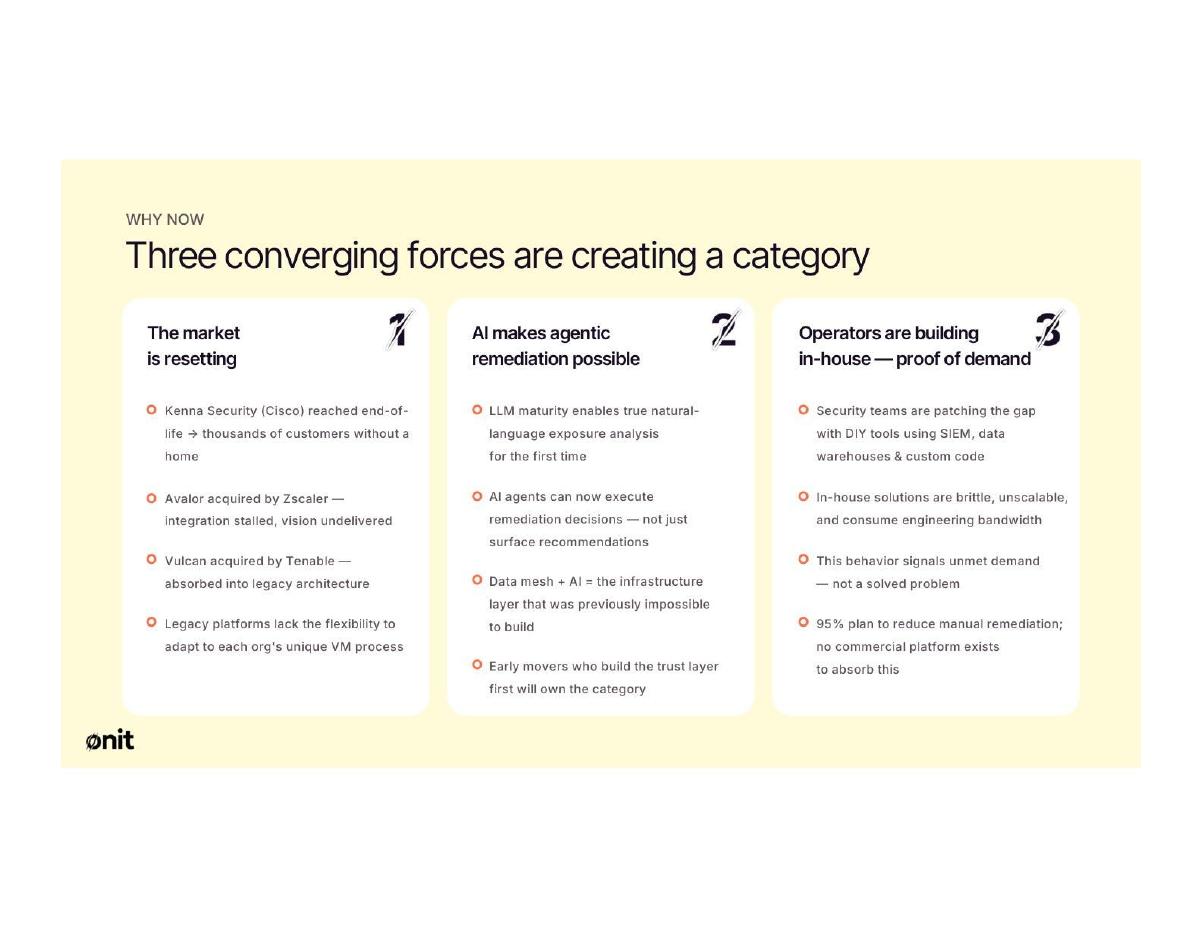
- The deck identifies a specific market 'reset' caused by competitors like Kenna Security reaching end-of-life and others being absorbed into legacy architectures (Slide 4).
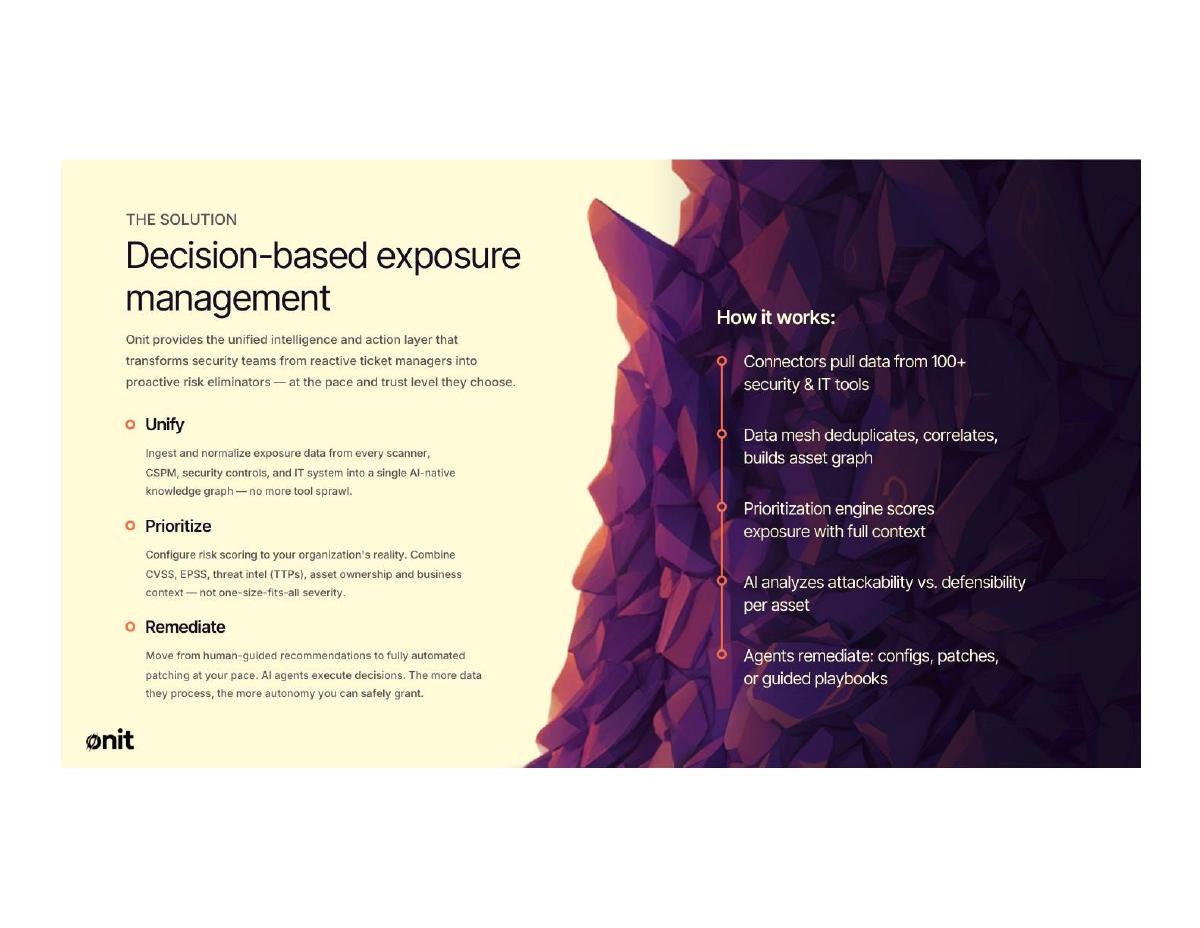
- Onit positions itself as the 'unified intelligence and action layer,' moving beyond recommendations to actual autonomous remediation (Slide 5).
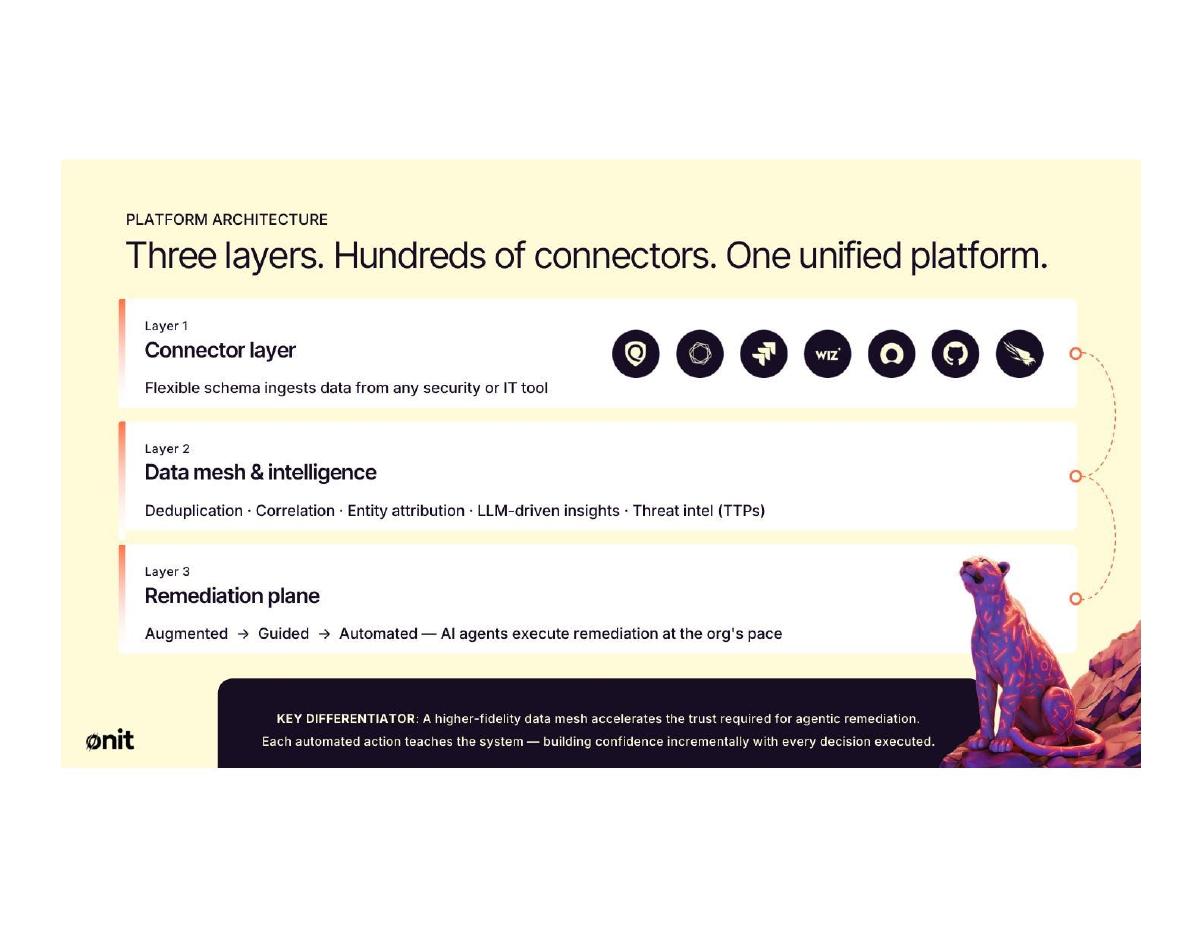
- The technical architecture is built on a three-layer model: a connector layer for 100+ tools, a data mesh for intelligence, and a remediation plane for execution (Slide 6).
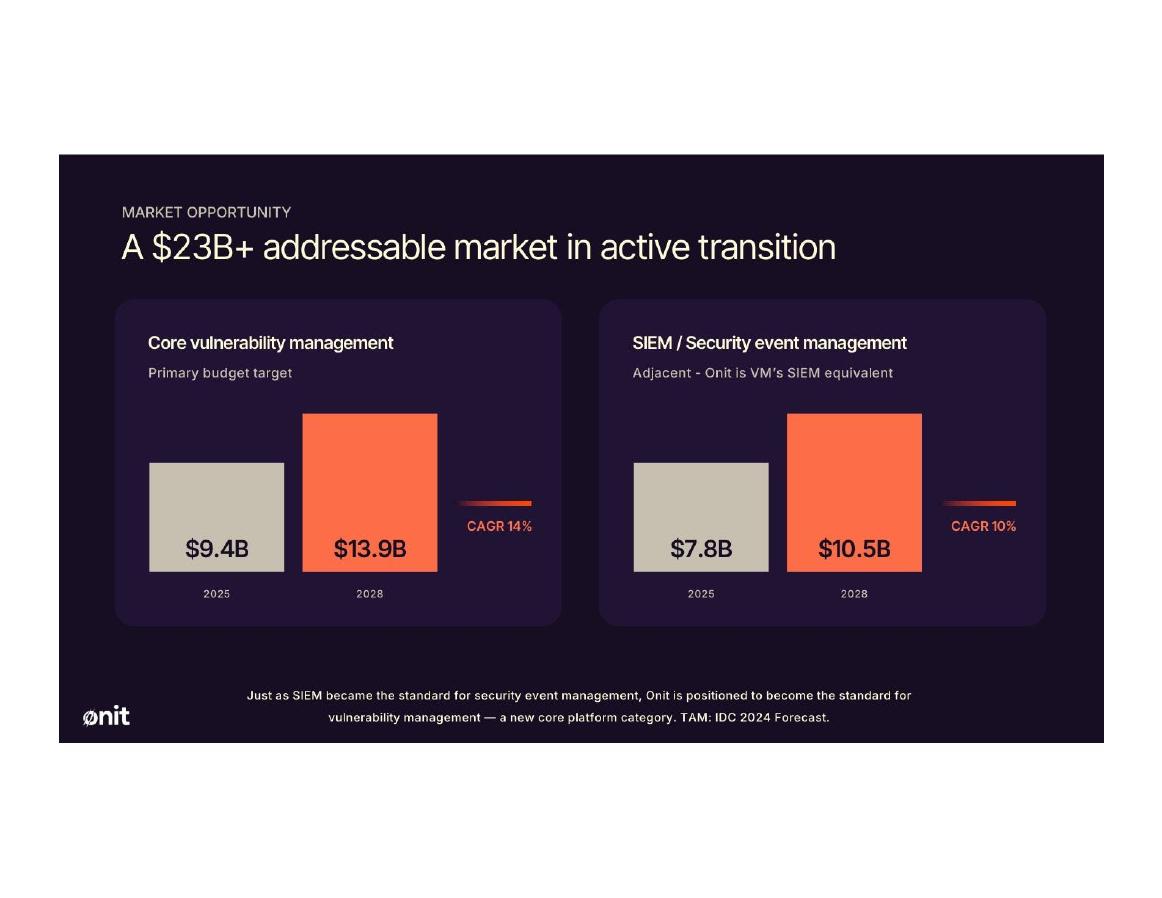
- The company targets a combined $23B+ addressable market across vulnerability management and SIEM equivalents by 2028 (Slide 7).
- The deck completely omits a formal 'Ask' slide, financial projections, or a specific go-to-market roadmap, relying instead on the strength of the problem-solution fit.
- The 'Why Now' argument (Slide 4) hinges on the belief that LLM maturity finally enables natural-language exposure analysis and agentic remediation that was previously impossible.
The Power of a 7-Slide Narrative
Onit Security’s pitch deck is remarkably lean. At only seven slides, it ignores many of the traditional 'requirements' of a pitch deck—such as a detailed competition grid, a multi-year financial forecast, or a specific use-of-funds slide. Instead, it focuses entirely on the three pillars that matter most for a high-conviction seed round: a world-class team, a massive and broken market, and a timely technological shift. As reported by Business Insider, this approach helped them secure $11M in 2025.
Slide 1: The Vision Statement
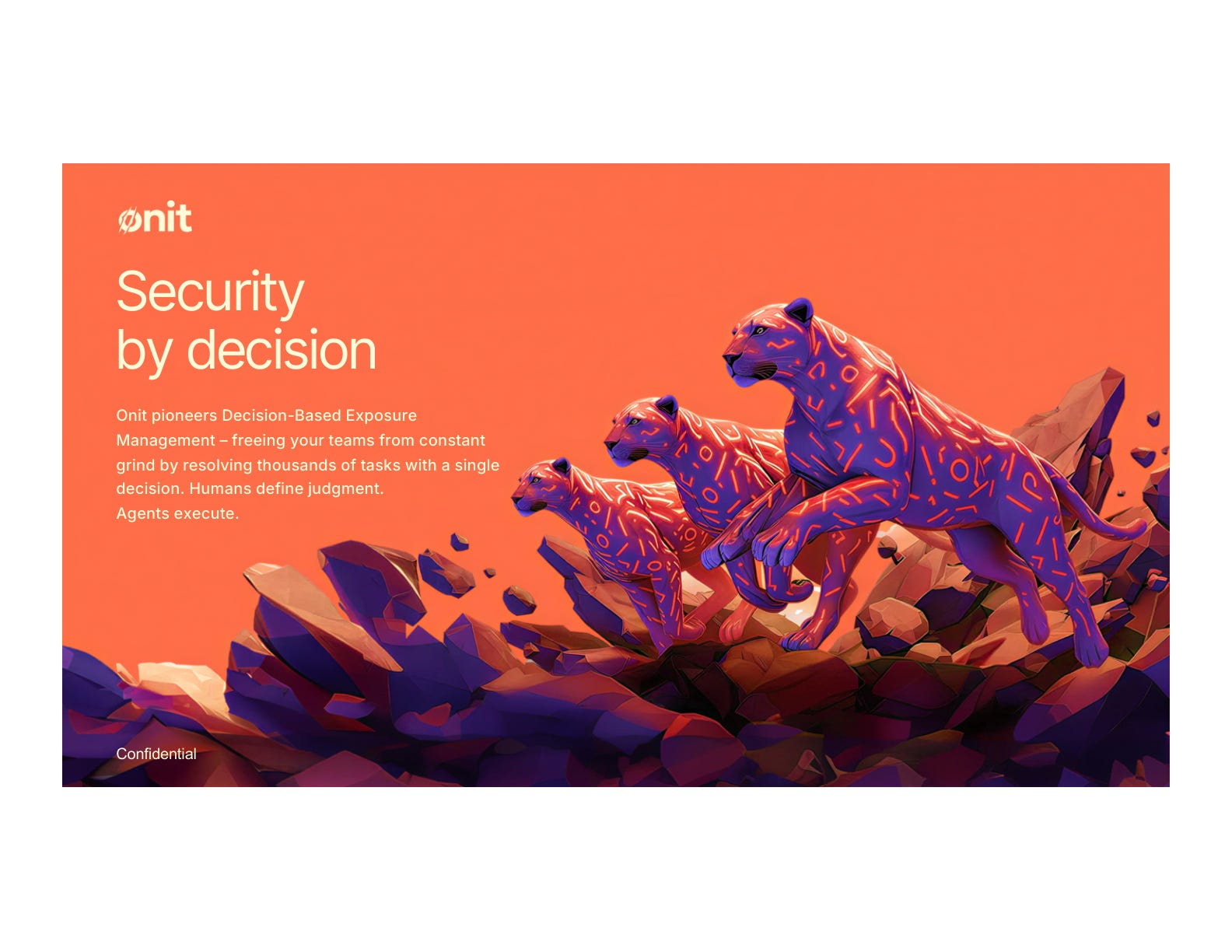
The cover slide introduces the concept of 'Security by decision.' It immediately defines their category: 'Decision-Based Exposure Management.' The subtext is clear: the industry has enough 'detection' tools; what it lacks is 'execution.' The phrase 'Humans define judgment. Agents execute' sets the stage for their AI-native approach. The visual of the stylized panthers suggests speed and predatory precision, a common trope in cybersecurity branding that works well here to establish a professional, high-stakes tone.
Slide 2: The 'Bet on Us' Team Slide
Placing the team slide second is a strategic move often used by serial entrepreneurs. It tells the investor, 'Before you look at the tech, look at who is building it.' The credentials here are dense and impressive. CEO Elad Ben Meir highlights an exit to Honeywell; CPO Ofer Amitai highlights a PE acquisition for Portnox and military cyber experience in Unit 180; CTO Tom Winter highlights an acquisition by Autodesk and leadership of 100+ person engineering teams. This slide effectively de-risks the execution side of the investment, suggesting that the founders have the 'full-cycle experience' necessary to scale and exit again.
Slide 3: The Data Drowning Problem
Slide 3 uses four stark statistics to justify the company's existence. The most damning figure is '74: Average number of security tools per enterprise.' This highlights the 'tool sprawl' that plagues CISOs. By pairing this with the fact that 82% of organizations still suffer breaches, Onit creates a logical gap: more tools do not equal more security. The slide concludes that the missing piece is a 'unified layer' for remediation, noting that 95% of organizations want to automate but lack the platform to do so.
Slide 4: Why Now? The Market Reset
The 'Why Now' slide is perhaps the most critical for a seed-stage cybersecurity company. Onit identifies three forces: a market reset (competitors like Kenna and Avalor being acquired or reaching end-of-life), the maturity of LLMs making 'agentic remediation' possible, and the fact that operators are currently forced to build brittle in-house DIY tools. By naming specific competitors (Kenna, Avalor, Vulcan) and their current status (absorbed, stalled, end-of-life), Onit positions itself as the modern, flexible alternative for thousands of 'homeless' customers.
Slide 5: The Solution Architecture
This slide transitions from the 'what' to the 'how.' It breaks the solution into three phases: Unify, Prioritize, and Remediate. The key differentiator mentioned is the 'AI-native knowledge graph' which replaces traditional tool sprawl. The 'How it works' sidebar provides a technical sequence: pulling data from 100+ tools, deduplicating via a data mesh, scoring risk with full context, and finally, agents executing patches or configs. This slide promises a move from 'reactive ticket managers' to 'proactive risk eliminators.'
Slide 6: Platform Architecture and Trust
Slide 6 provides a high-level view of the three-layer platform: Connector, Data Mesh, and Remediation Plane. It includes logos of common enterprise tools (Qualys, Wiz, GitHub, etc.) to show how Onit sits on top of the existing stack. The 'Key Differentiator' callout at the bottom is vital: it addresses the 'trust' problem in AI. It explains that the system builds confidence incrementally, moving from augmented to guided to fully automated remediation at the organization's own pace.
Slide 7: The $23B+ Opportunity
The final slide quantifies the market. Using IDC 2024 forecasts, it shows Core Vulnerability Management growing to $13.9B and SIEM growing to $10.5B by 2028. The core argument is that Onit is 'VM’s SIEM equivalent.' This is a powerful analogy; just as SIEM became the standard for event management, Onit aims to become the standard for vulnerability management. It frames the company not as a niche tool, but as a 'new core platform category.'
What Onit Security Does Well
Credibility First: By leading with a team that has already 'been there and done that,' the deck creates an aura of inevitability. Investors are more likely to forgive a lack of product screenshots when the founders have a track record of building and selling similar technologies to giants like Honeywell and Autodesk.
Clear Categorization: The deck doesn't just say they are 'AI for security.' They coin a specific term—'Decision-Based Exposure Management'—and compare themselves to the SIEM category. This gives investors a mental bucket to place them in while still feeling like they are seeing something new.
Identifying the Gap: The distinction between 'detection' and 'remediation' is the deck's strongest narrative thread. By proving that enterprises are 'drowning in data' but 'effective at remediation' only 9% of the time, they create a high-urgency problem that feels unsolved by the current market leaders.
What is Missing from the Deck
The Ask: There is no slide detailing how much they are raising or what the milestones for the next 18 months look like. While the publisher reports an $11M raise, the deck itself is silent on the terms or the plan for the capital.
Product UI: For a technical platform, there is a total absence of the actual interface. While the panther graphics are high-quality, a sophisticated investor might want to see how a CISO actually interacts with the 'Decision-Based' dashboard.
Competitive Matrix: While Slide 4 mentions a few competitors in the context of 'market resets,' there is no direct feature-by-feature comparison. This suggests the founders are relying on their reputation to signal that they know the landscape better than anyone else.
Business Model: There is no mention of pricing strategy (per asset, per seat, etc.) or the specific go-to-market motion (PLG vs. top-down enterprise sales). Given the 'large enterprise' focus mentioned in the publisher summary, the lack of a sales strategy is a notable omission.
What Other Founders Should Copy
The 'Why Now' Logic: Founders should emulate Slide 4’s structure. Don't just say 'AI is better now.' Point to specific market exits, end-of-life products, and the 'brittle' nature of current in-house workarounds. It makes the need for your product feel like a market requirement rather than just a good idea.
The Analogy Strategy: Comparing a new category to an established one ('Onit is VM’s SIEM equivalent') is a shortcut to investor understanding. If you are building a new category, find the 'standard' in an adjacent space and explain why you are that standard for your specific niche.
Visual Consistency: The deck is aesthetically cohesive. The use of the panther motif and a consistent color palette (orange, purple, and cream) makes the startup feel like a 'real company' from slide one. For a seed round, professional design can significantly amplify the perceived maturity of the venture.
Frequently asked questions
- How much did Onit Security raise with this deck?
- According to publisher-reported facts from Business Insider, Onit Security raised $11M in a Seed round in 2025.
- Who are the founders of Onit Security?
- The team consists of Elad Ben Meir (CEO), formerly of SCADAfence; Ofer Amitai (CPO), former CEO of Portnox; and Tom Winter (CTO), former GM of Israel at Autodesk. All three have prior exit experience.
- What is the core problem Onit Security aims to solve?
- Onit addresses the 'remediation gap.' Slide 3 notes that while 95% of organizations plan to reduce manual remediation, only 9% feel effective at it because current tools generate noise rather than executing fixes.
- What is 'Decision-Based Exposure Management'?
- As described on Slide 5, it is a process where AI agents execute remediation decisions (patches, configs) based on human-defined judgment, moving away from simple reactive ticket management.
- What market size is Onit Security targeting?
- Slide 7 identifies a $23B+ total addressable market by 2028, split between Core Vulnerability Management ($13.9B) and SIEM/Security Event Management ($10.5B).