Onfido’s overview deck is designed for a later-stage audience, focusing heavily on market dominance and operational scale rather than early-stage experimentation. The company, founded in 2012, uses this 10-slide presentation to highlight a massive 150%+ net retention rate and a global footprint spanning 9 offices. By framing the identity market as a three-stage evolution—from in-person legacy to 'Portable Identity'—Onfido positions itself as the inevitable leader of the next era. The deck is notably light on technical AI details, choosing instead to emphasize business outcomes: reducing risk,…
Key takeaways
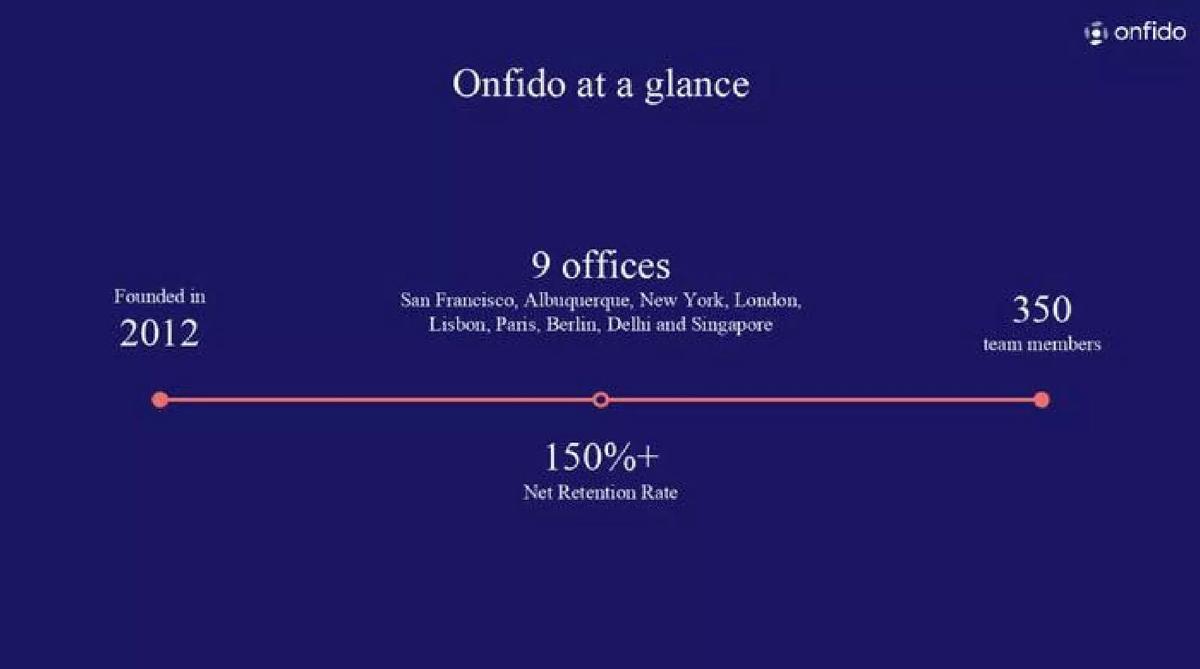
- The company reports a Net Retention Rate of 150%+, a top-tier metric for enterprise SaaS (Slide 2).
- Onfido operates a global footprint with 9 offices, including locations in San Francisco, London, Delhi, and Singapore (Slide 2).
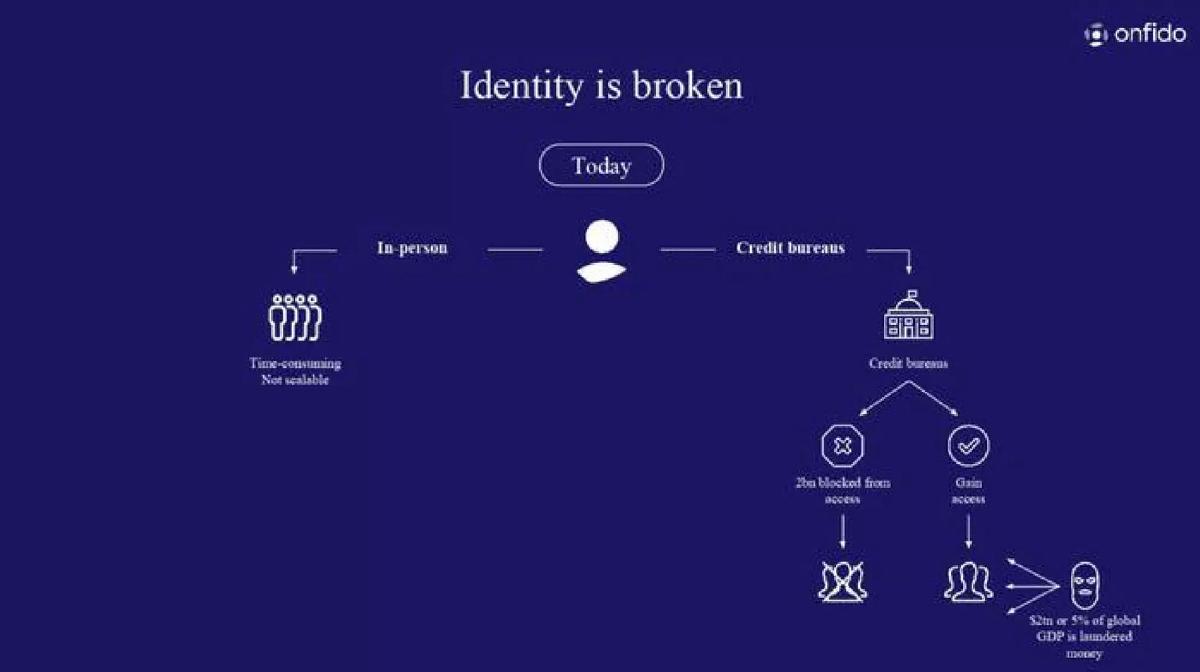
- The deck identifies a massive market inefficiency where $2tn or 5% of global GDP is laundered annually due to broken identity systems (Slide 3).
- The product is positioned as a speed play, claiming to reduce identity verification from hours to seconds (Slide 5).
- A dedicated slide highlights 50+ instances of clients switching from competitors to Onfido, though specific competitor names are redacted (Slide 7).
- The market vision is framed as 'Identity 3.0,' moving toward 'Portable Identity' from 2020 onwards (Slide 8).
- The leadership team features executives with prior experience at high-profile firms like PayPal, Spotify, Symantec, and Bain (Slide 9).
- The deck omits a specific funding ask, valuation, or detailed revenue breakdown, functioning more as a high-level overview (General).
Overview: The 10-Slide Enterprise Power Play
Onfido’s pitch deck is a concise, high-level overview that leans heavily on the company's maturity and market position. Founded in 2012, the company had already reached a 'Later' stage by the time this deck was in circulation, having raised a total of $182,100,000. The deck does not behave like a seed-stage presentation trying to prove a concept; instead, it functions as a validation tool for institutional investors, emphasizing scale, retention, and a world-class executive bench.
Slides 1-2: The Global Footprint
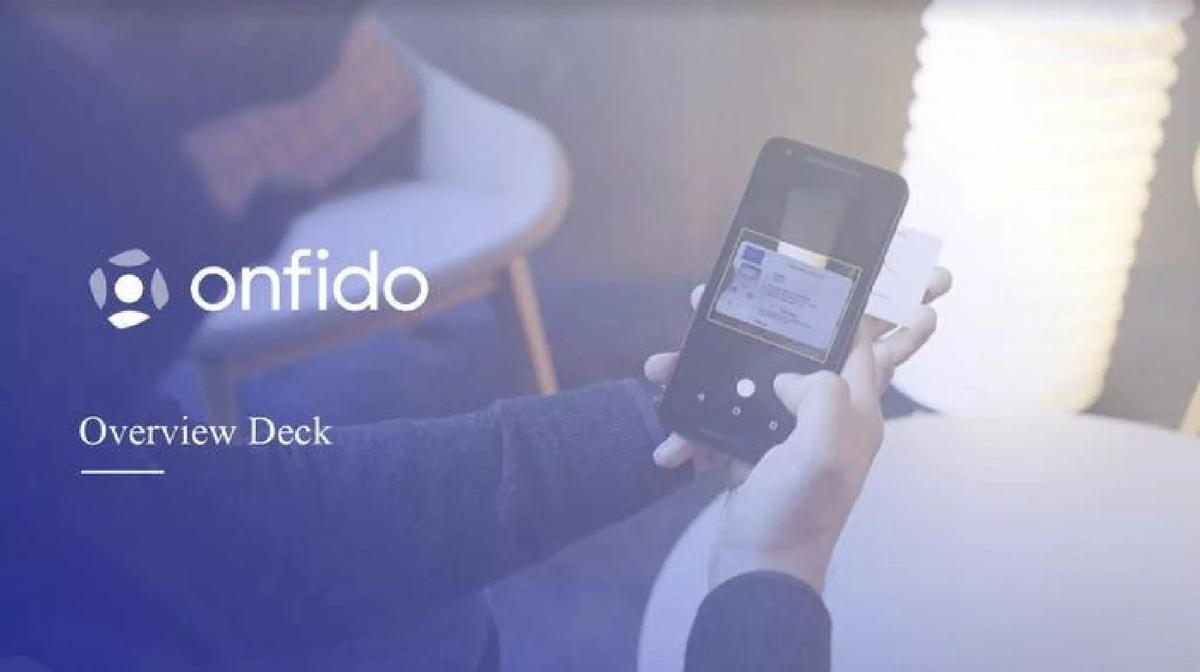
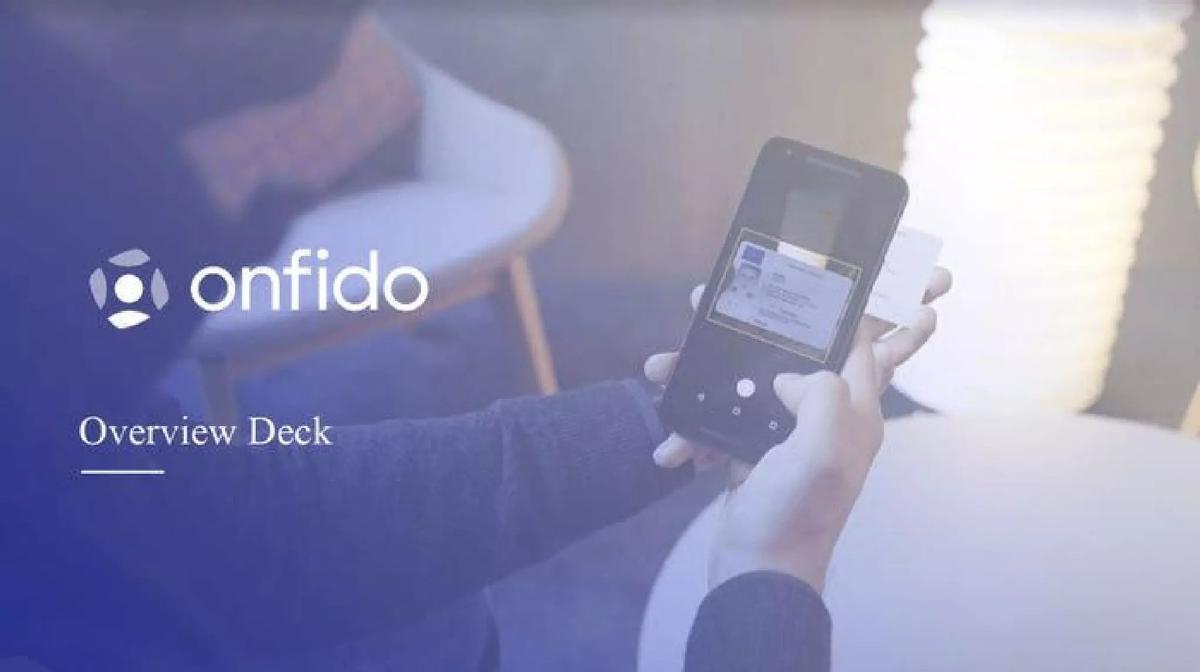
Slide 1 is a standard title card featuring the Onfido logo and a background image of a user performing a facial biometric scan on a smartphone. It immediately establishes the product's mobile-first, user-centric nature.
Slide 2 , titled 'Onfido at a glance,' is the deck's first heavy hitter. It lists four key metrics that establish immediate credibility: the company was founded in 2012, it maintains 9 global offices (ranging from San Francisco to Delhi), it employs 350 team members, and most importantly, it boasts a 150%+ Net Retention Rate . In the world of enterprise SaaS, a net retention rate over 120% is considered excellent; 150% suggests that existing customers are expanding their usage of Onfido at an extraordinary pace, which is a massive signal of product-market fit and 'stickiness.'
Slides 3-4: The Problem and the Pervasiveness of Identity
Slide 3 tackles the 'Identity is broken' narrative. It uses a flow chart to contrast today's methods—in-person checks and credit bureaus—against the modern need for speed. The slide notes that in-person checks are 'Time-consuming' and 'Not scalable.' More critically, it points out the failure of credit bureaus, stating that 2 billion people are blocked from access and that $2tn or 5% of global GDP is laundered money . This frames the problem not just as a convenience issue, but as a multi-trillion-dollar global security and economic crisis.
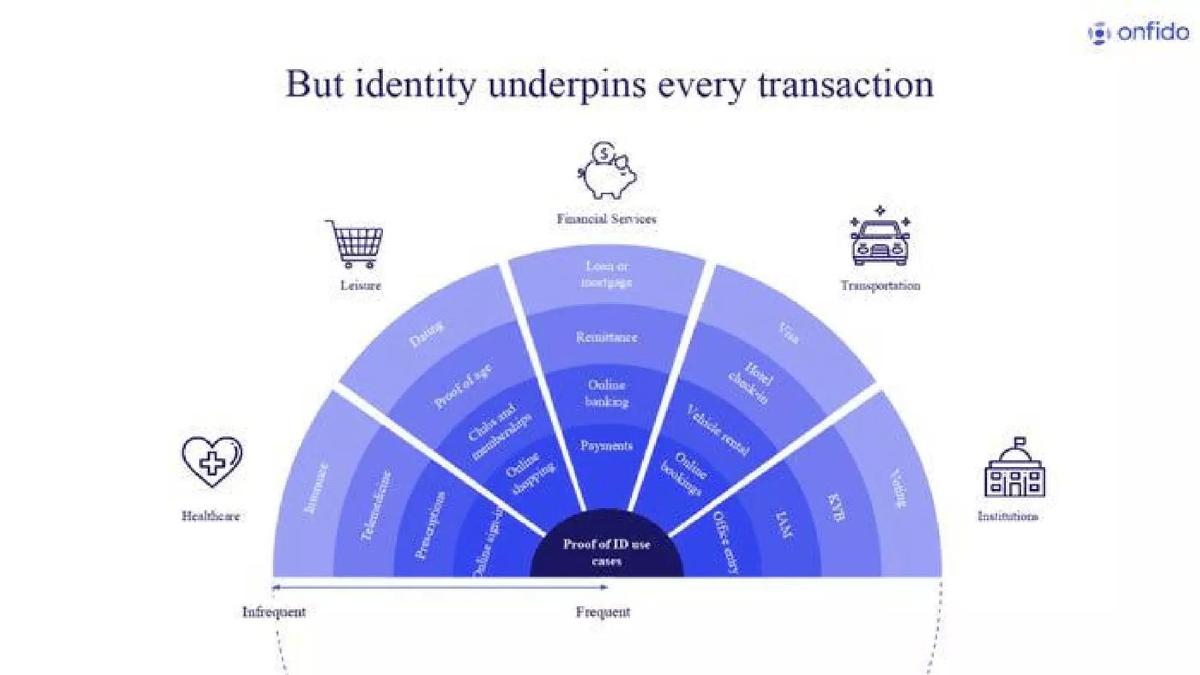
Slide 4 expands the scope of the solution. Titled 'But identity underpins every transaction,' it uses a semi-circle diagram to map out use cases across Healthcare, Leisure, Financial Services, Transportation, and Institutions. It categorizes these by frequency, showing that while voting or mortgages might be 'Infrequent,' activities like online shopping, payments, and office entry are 'Frequent.' This slide effectively argues that Onfido isn't just a banking tool; it is the foundational layer for the entire digital economy.
Slides 5-7: Product, Value, and Competitive Displacement
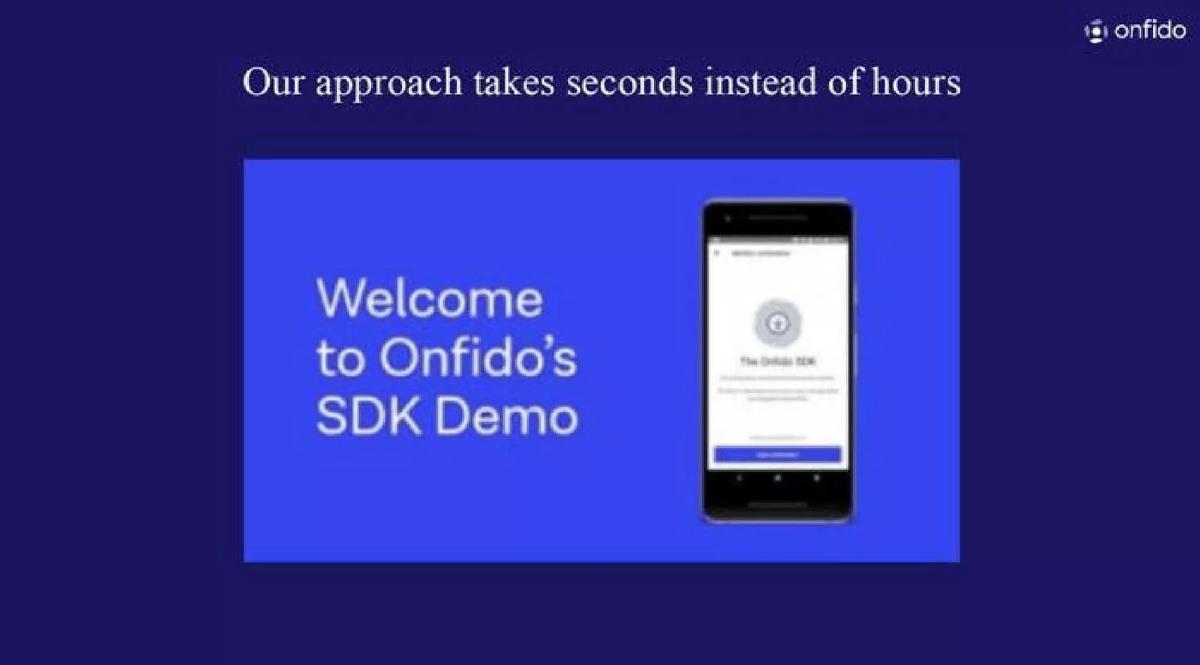
Slide 5 is a simple product demonstration slide. The headline, 'Our approach takes seconds instead of hours,' is a direct counter to the 'Time-consuming' label applied to legacy systems on Slide 3. It features a graphic of the 'Onfido SDK Demo' on a mobile device, emphasizing that the solution is a developer-friendly kit (SDK) that can be integrated into other apps.
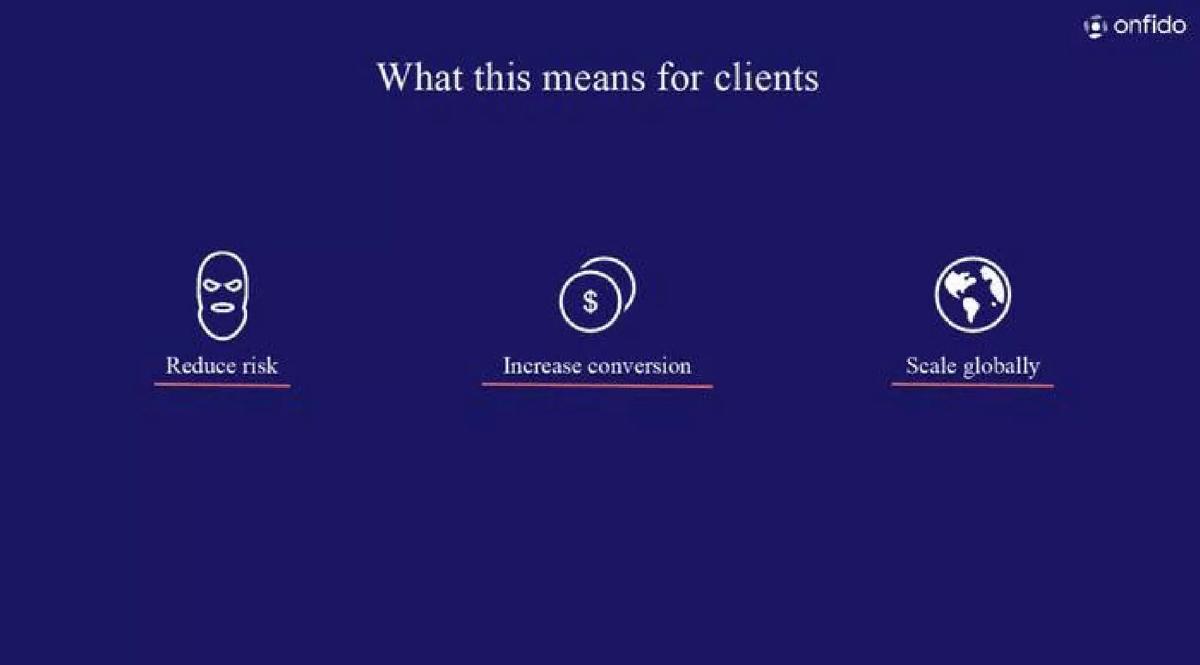
Slide 6 distills the business value into three pillars: Reduce risk (represented by a masked icon), Increase conversion (dollar icon), and Scale globally (globe icon). This is a classic 'benefits over features' approach. It tells the CFO they will save money on fraud, the Product Manager they will get more users through the door, and the CEO they can expand into new territories without friction.
Slide 7 is perhaps the most aggressive slide in the deck. Titled '50+ Client Switches from Competitors to Onfido,' it shows four clusters of 'Clients who switched' pointing toward the Onfido logo. While the specific names of the competitors and clients are redacted in this version, the claim itself is a powerful testament to their competitive advantage. It suggests that not only is the market growing, but Onfido is actively taking territory from established incumbents.
Slides 8-10: The Future and the Team
Slide 8 presents a vision of market evolution. It charts a timeline from 'In-person Legacy' to 'Identity 1.0' (Credit Bureaus like Experian and Equifax), to 'Identity 2.0' (ID Proofing, 2010-2020), and finally to 'Identity 3.0: Portable Identity' (2020 onwards). By placing their logo in the largest circle at the end of the timeline, Onfido positions itself as the architect of the future, not just a participant in the current market.
Slide 9 introduces 'A World-Class Leadership Team.' This is a high-pedigree slide. Beyond the co-founders, it lists a CFO from PayPal , a CPO from Symantec , a CTO from Spotify , a CRO from ForgeRock , and a General Counsel from Sony . For a later-stage raise, this slide is designed to prove that the company has the 'adults in the room' necessary to manage a global enterprise and potentially head toward an IPO.
Slide 10 is a simple contact card with the company logo, a social media handle (@onfido), and a general inquiry email (info@onfido.com). It maintains the clean, minimalist aesthetic found throughout the deck.
What Works in the Onfido Deck
High-Signal Metrics: Leading with a 150%+ Net Retention Rate (Slide 2) immediately answers the most important question for any growth investor: 'Do customers love this product?' · Clear Market Evolution: The 'Identity 1.0 to 3.0' framework (Slide 8) is an excellent way to simplify a complex industry. It makes the transition to Onfido’s solution feel like an inevitable historical progression. · Competitive Aggression: Explicitly stating that 50+ clients have switched from competitors (Slide 7) is a bold move that signals confidence and market dominance. · Executive Pedigree: The team slide (Slide 9) is exceptionally strong. Seeing names like PayPal, Spotify, and Symantec reduces the perceived execution risk for investors.
What is Missing from the Onfido Deck
The 'Ask': There is no slide detailing how much money the company is looking to raise or what the specific milestones for the next round will be. · Financial Depth: While the retention rate is mentioned, there are no charts showing ARR growth, CAC (Customer Acquisition Cost), or LTV (Lifetime Value) figures. · Technical Moat: The deck mentions AI technology in its self-description, but the slides themselves are very light on how the AI actually works or why it is superior to other automated verification tools. · Unit Economics: There is no mention of the pricing model or the margins associated with each verification check.
What a Founder Should Copy
The 'At a Glance' Slide: Every deck should have a slide like Slide 2. It provides a 30-second summary of the company’s scale and health, allowing the investor to anchor the rest of the presentation in reality. · The Problem-Scale Connection: Onfido doesn't just say identity is hard; they link it to a $2tn global GDP loss (Slide 3). Connecting your startup's problem to a massive, quantifiable macroeconomic figure makes the 'why now' much more compelling. · Visual Consistency: The deck uses a consistent dark blue and white color palette with simple, professional iconography. It looks like a product from a billion-dollar company, which helps build trust. · Use Case Mapping: Slide 4 is a great example of how to show a 'Land and Expand' strategy. By showing how identity touches everything from hotel check-ins to voting, they demonstrate that their Total Addressable Market (TAM) is essentially the entire digital world.
Frequently asked questions
- What is Onfido's core value proposition according to the deck?
- Onfido focuses on three primary outcomes for its clients: reducing risk, increasing conversion, and enabling global scale. By replacing 'broken' legacy systems like in-person checks and credit bureaus with an AI-driven SDK, they claim to turn a process that takes hours into one that takes seconds, thereby reducing the $2tn lost annually to money laundering.
- How does Onfido demonstrate market traction?
- Traction is demonstrated through two primary signals: a Net Retention Rate exceeding 150% and a slide dedicated to competitive wins. The deck claims over 50 clients have switched from competitors to Onfido. Additionally, the company highlights its scale with 350 team members and 9 global offices, signaling a mature, high-growth enterprise.
- What is the 'Identity 3.0' concept mentioned in the deck?
- Onfido categorizes the market into three eras. Identity 1.0 was the 20th-century reliance on credit bureaus (Experian, Equifax). Identity 2.0 (2010-2020) focused on ID proofing. Identity 3.0, which Onfido aims to lead, is defined as 'Portable Identity,' where users can carry their verified status across different platforms seamlessly.
- Who are the key people leading Onfido?
- The leadership team is a mix of founders and seasoned enterprise executives. Co-founders Husayn Kassai (CEO) and Eamon Jubbawy (COO) are joined by a CFO from PayPal, a CPO from Symantec, a CTO from Spotify, and a CMO from ForgeRock. This 'World-Class' framing suggests the company is built for a public market or large-scale acquisition trajectory.
- What is missing from this pitch deck?
- This is an 'Overview Deck,' so it lacks several standard fundraising elements. There is no slide detailing the specific amount of capital being raised, no use of proceeds, and no detailed financial projections. It also lacks a deep dive into the underlying AI technology, focusing instead on the user experience and business results.