One Point Five’s 10-slide deck presents a compelling case for disrupting the $1.5 trillion packaging market by moving away from traditional manufacturing toward an asset-light IP licensing model. The company leverages a computational discovery engine to mine centuries of material science data, identifying sustainable biopolymer solutions faster than traditional R&D. By positioning themselves as a technology provider rather than a manufacturer, they claim an 80% operating IP margin. The deck effectively uses regulatory tailwinds, such as the Green New Deal, to create urgency. However, it lacks…
Key takeaways
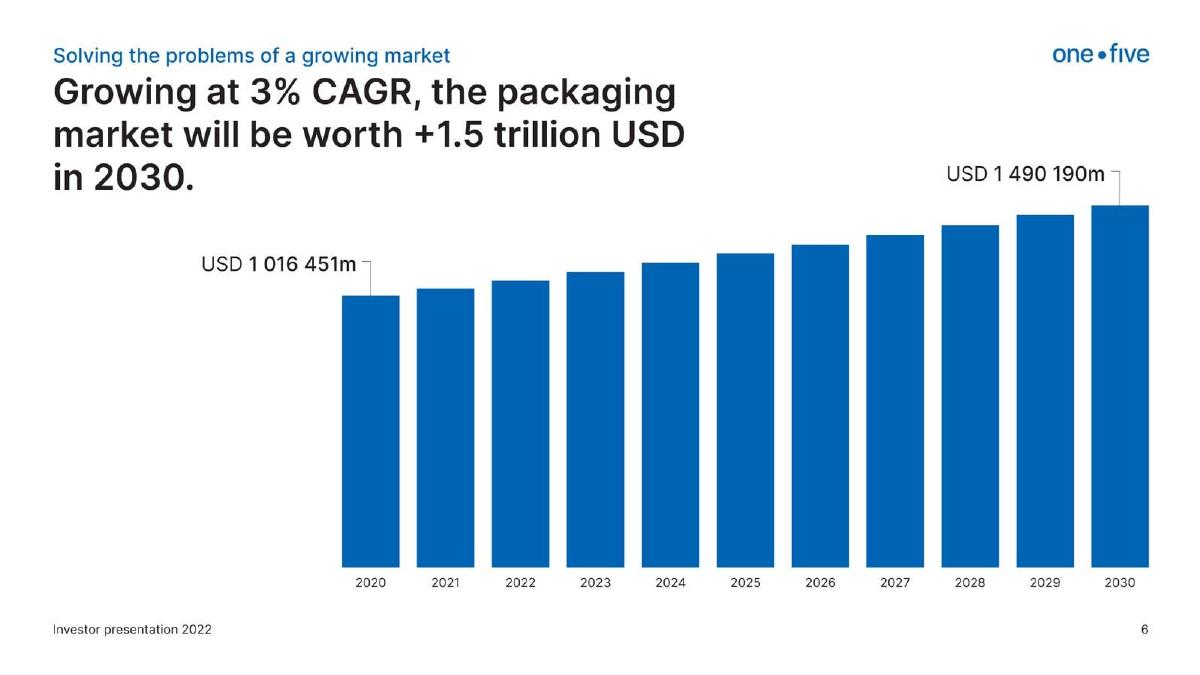
- The company projects the packaging market will exceed $1.5 trillion by 2030, growing at a 3% CAGR (Slide 6).
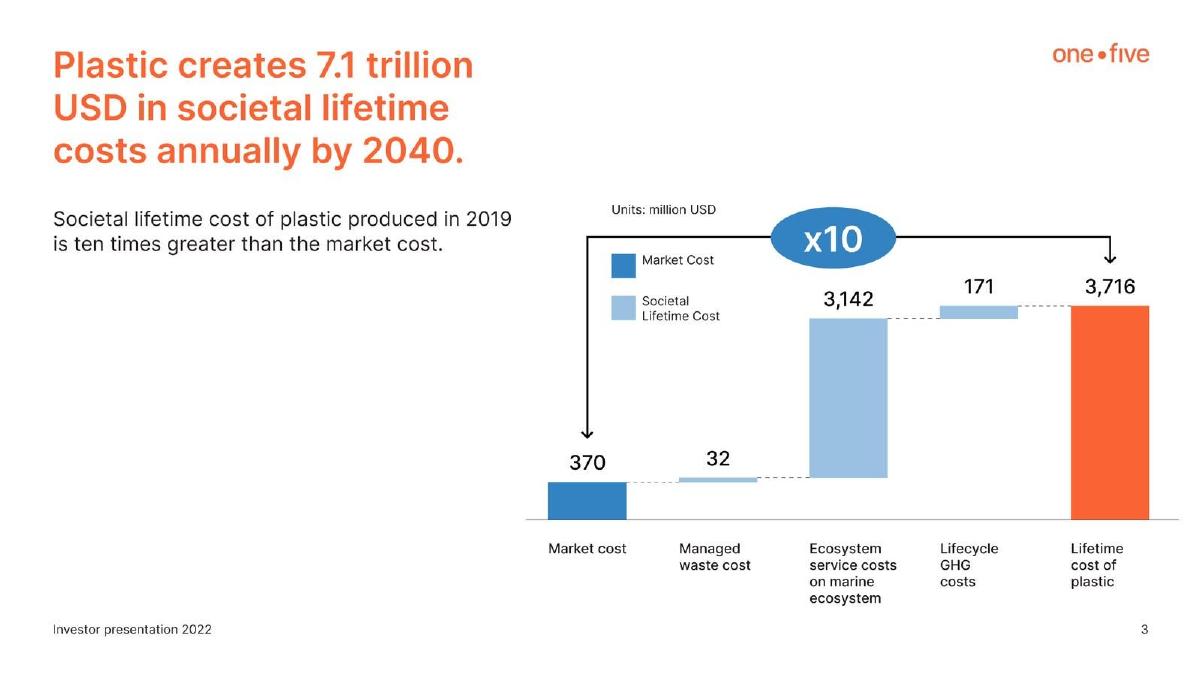
- One Point Five claims that the societal lifetime cost of plastic is ten times its market cost, reaching $7.1 trillion annually by 2040 (Slide 3).
- The business model is strictly asset-light, focusing on IP licensing to achieve an 80% operating IP margin (Slide 8).
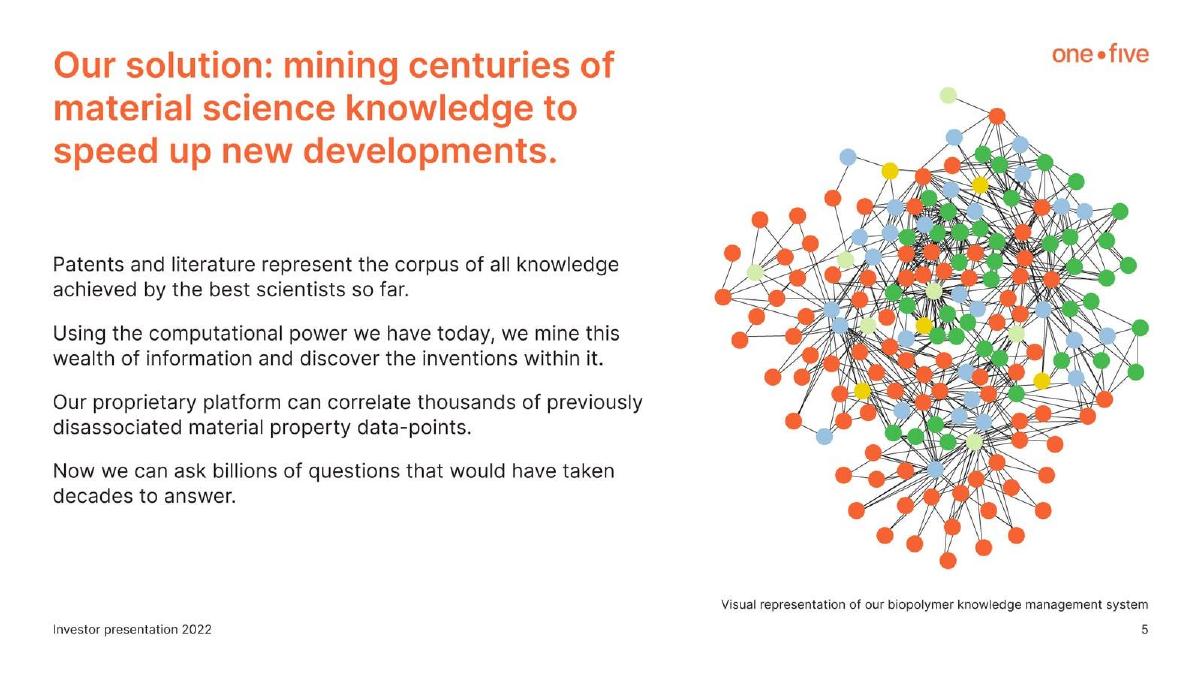
- A proprietary computational platform is used to correlate thousands of disassociated material property data points from existing patents and literature (Slide 5).
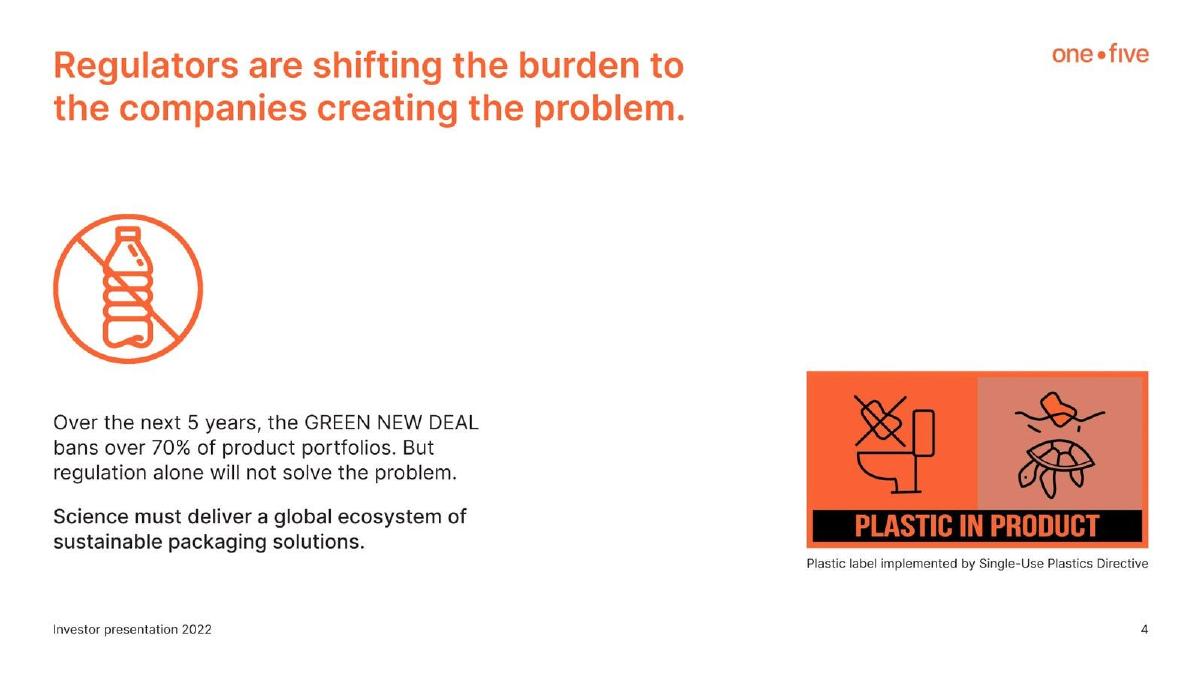
- The deck identifies a specific regulatory driver: the Green New Deal, which is expected to ban over 70% of current product portfolios (Slide 4).
- The first commercial product, a flexible high-barrier paper packaging for a global cosmetics company, was slated for 2023 (Slide 9).
- Operating costs are projected to account for only 20% of revenue, with a $0.02 licensing fee per item produced (Slide 8).
- The deck lacks a dedicated team slide with names, titles, or professional backgrounds, showing only a group photo (Slide 10).
Executive Summary: The Shift from Manufacturing to Material Intelligence
One Point Five (stylized as one.five) presents a Seed-stage deck that is as much about data science as it is about environmental impact. The company, which raised $10.1M in 2024 according to publisher reports, uses this presentation to argue that the solution to the plastic crisis isn't just new materials, but a faster way to find them. By positioning themselves as an 'asset-light' technology provider, they attempt to bypass the low-margin, high-CAPEX traps of traditional packaging manufacturing. The deck is visually clean, data-driven, and focused heavily on the economic and regulatory inevitability of their solution.
Slide 1: Title and Branding
The cover slide features a high-quality photograph of the team in a modern, timber-framed office space. The text is minimal: 'Investor Presentation 2022' and the company logo 'one.five'. The use of a team photo immediately humanizes the company, though it lacks a specific mission statement or 'one-liner' that defines the value proposition right out of the gate.
Slide 2: The Mission - 'What we fix'
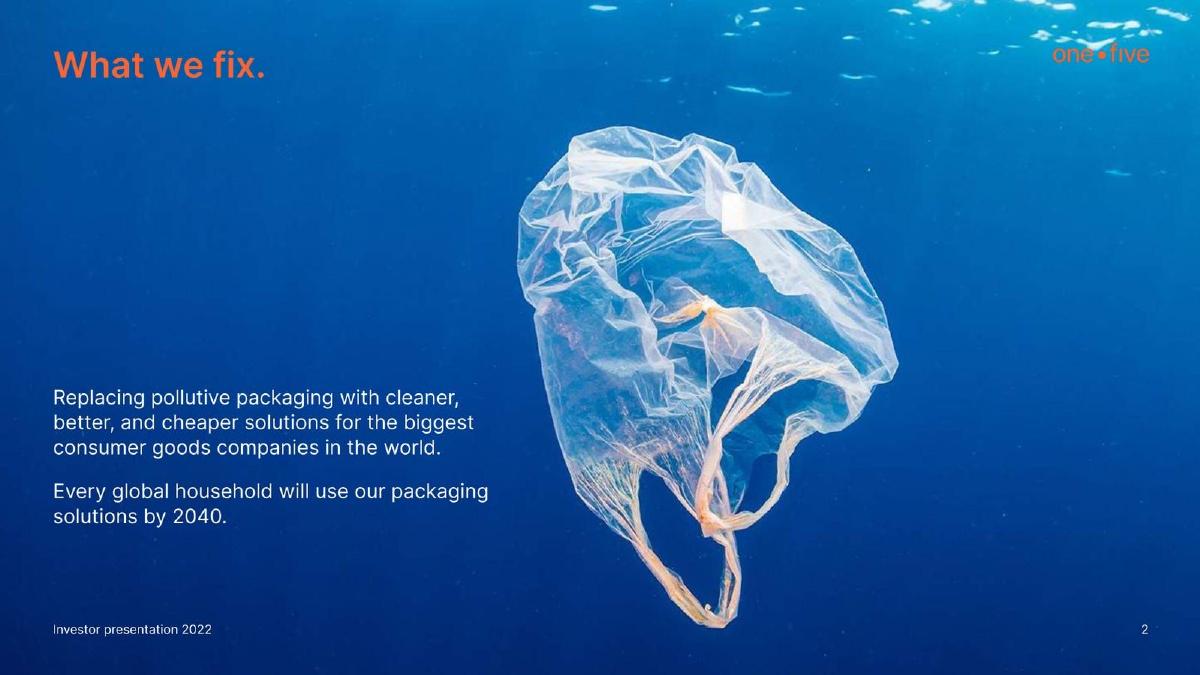
Slide 2 establishes the problem and the vision. It uses a striking image of a plastic bag underwater to represent 'pollutive packaging.' The text states their goal is to replace these with 'cleaner, better, and cheaper solutions for the biggest consumer goods companies in the world.' Crucially, it sets a long-term target: 'Every global household will use our packaging solutions by 2040.' This is a bold, high-level vision statement intended to show the scale of their ambition.
Slide 3: The Economic Burden of Plastic
This slide moves from environmental sentiment to hard economics. It claims plastic will create $7.1 trillion in societal lifetime costs annually by 2040. A waterfall chart breaks down the 'Societal Lifetime Cost' of plastic produced in 2019, showing that the lifetime cost ($3,716 million USD) is ten times greater than the market cost ($370 million USD). The chart identifies specific externalities: managed waste costs ($32M), ecosystem service costs on marine ecosystems ($3,142M), and lifecycle GHG costs ($171M). This slide is designed to show investors that the current plastic economy is fundamentally broken and inefficient.
Slide 4: The Regulatory Catalyst
One Point Five identifies regulation as the primary driver for market adoption. The slide notes that 'Regulators are shifting the burden to the companies creating the problem.' It specifically cites the 'GREEN NEW DEAL,' which it claims will ban over 70% of current product portfolios within five years. By referencing the 'Single-Use Plastics Directive' and the 'Plastic in Product' labeling requirements, the company creates a sense of urgency for consumer goods companies to adopt their technology.
Slide 5: The Solution - Computational Material Science
This is the 'how' slide. One Point Five explains their 'proprietary platform' that mines 'centuries of material science knowledge.' They argue that patents and literature contain a wealth of information that can be unlocked using modern computational power. The slide features a network graph representing their 'biopolymer knowledge management system.' The core value proposition here is speed: the ability to ask 'billions of questions that would have taken decades to answer' through traditional R&D.
Slide 6: Market Size and Growth
The deck addresses the Total Addressable Market (TAM) with a bar chart showing the packaging market growing at a 3% CAGR. It projects the market will be worth over $1.5 trillion USD by 2030, starting from $1.016 trillion in 2020. This slide confirms the massive scale of the industry they are entering, ensuring investors that there is plenty of room for a new, disruptive player.
Slide 7: Product Readiness and Specifications
Slide 7 (labeled as slide 14 in the footer, indicating a condensed version of a larger deck) showcases their 'First product.' It is a flexible high-barrier paper packaging for a 'leading global cosmetics company.' The slide lists technical specifications: 100% recyclable, 95% paper monomaterial, FSC certified, food safe, and heat-sealable. Most importantly, it claims the product is 'compatible with standard coating machines,' which supports their 'drop-in' solution narrative.
Slide 8: The Asset-Light Business Model
This is perhaps the most important slide for a Seed investor. It details the 'Strong profitability' of their model. One Point Five claims their operating costs account for only 20% of revenue. A bar chart shows an 'IP Licensing Revenue' of $0.02 per item produced. After deducting costs for Audit & Controlling (5%), Royalties TTOs (5%), Patent Fees (5%), and Royalties IP sponsors (5%), they are left with an 80% 'Operating IP Margin.' This slide explicitly contrasts their 'asset-light' model against traditional 'asset-heavy' manufacturing.
Slide 9: Competitive Landscape
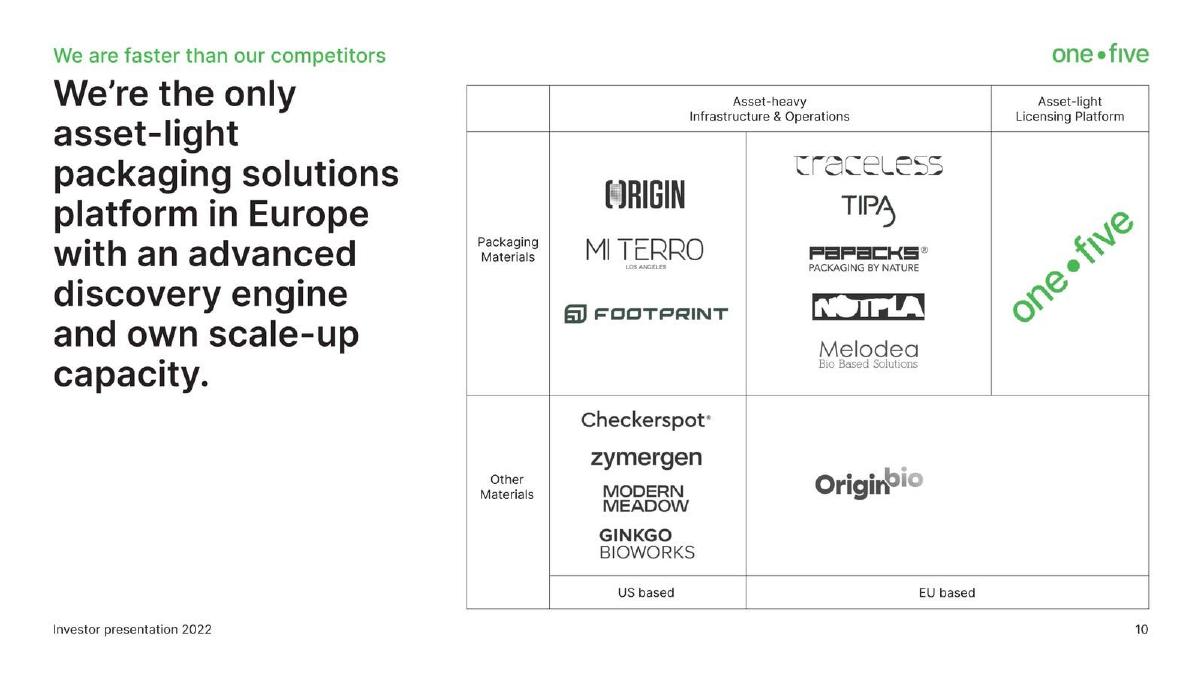
The competition slide uses a 2x2 matrix. The X-axis separates 'US based' from 'EU based' companies, while the Y-axis separates 'Other Materials' from 'Packaging Materials.' The top of the chart distinguishes between 'Asset-heavy Infrastructure & Operations' and 'Asset-light Licensing Platform.' One Point Five places itself alone in the 'EU based, Asset-light, Packaging Materials' quadrant. They list competitors like Footprint, Tipa, and Notpla in the asset-heavy category, and Ginkgo Bioworks and Zymergen in the US-based 'other materials' category.
Slide 10: The Team
The final slide is a group photo of approximately 20 people in front of a large barn-like structure with the text 'Thank you!'. While it shows a sizable team, it is a significant omission that there are no names, titles, or bios. Investors at the Seed stage typically invest in the founders' pedigree and expertise, which is not detailed here.
What One Point Five Does Well
Economic Framing: The deck does an excellent job of framing the plastic problem as an economic inefficiency rather than just an environmental one. By quantifying the 'societal lifetime cost' as 10x the market cost, they speak the language of institutional investors and regulators.
Business Model Clarity: The decision to explicitly model an 80% operating margin and a $0.02 per-unit licensing fee is very effective. It clearly differentiates them from the low-margin manufacturing startups that often struggle in the climate-tech space.
Urgency via Regulation: Citing the Green New Deal and the specific percentage of product portfolios (70%) that will be banned creates a 'why now' that is hard to ignore. It transforms their product from a 'nice-to-have' for CSR departments into a 'must-have' for business continuity.
What is Missing from the Deck
Founder Pedigree: The lack of a detailed team slide is the most glaring omission. In a deep-tech/material science company, the technical credentials of the founders and the scientific advisory board are paramount. A group photo does not convey the expertise required to build a 'computational discovery engine.'
The Ask: The deck does not state how much money they are raising or how they intend to spend it. While this might be handled in a separate document or a verbal pitch, a standard pitch deck should include a slide on the funding round and milestones.
Traction Metrics: While they mention a 'leading global cosmetics company,' they don't provide details on the stage of the partnership (e.g., LOI, pilot, paid contract). For a 2022 deck, more specific evidence of market validation would have strengthened the case.
Founder Takeaways: Copy the Strategy, Not the Omissions
Focus on Margins: Founders in the hardware or material space should take note of how One Point Five avoids the 'factory trap.' By positioning themselves as an IP and software layer on top of existing infrastructure, they present a much more scalable and venture-backable business model.
Use Waterfall Charts for Unit Economics: The waterfall chart on Slide 8 is a masterclass in showing how a small per-unit fee can lead to massive margins. It simplifies a complex licensing model into a single, digestible visual.
Quantify the 'Why Now': Don't just say 'regulations are coming.' Quote the specific directive, the specific timeline, and the specific impact on the customer's bottom line, as seen on Slide 4. This turns a macro trend into a concrete sales catalyst.
Don't Forget the Bios: Even if you have a great team photo, you must include a slide that highlights the specific wins, degrees, and past companies of your leadership team. Investors need to know why this team is the one to solve a $7 trillion problem.
Frequently asked questions
- What is One Point Five's core technology?
- One Point Five utilizes a computational discovery engine that mines centuries of material science knowledge, specifically patents and scientific literature. This proprietary platform correlates thousands of previously disassociated material property data points to discover new biopolymer inventions and sustainable packaging solutions significantly faster than traditional laboratory methods.
- How does the company plan to make money?
- The company employs an asset-light IP licensing model. Instead of manufacturing packaging themselves, they provide 'drop-in' solutions for existing supply chain infrastructure. They charge a licensing fee (cited as $0.02 per item produced) and maintain high margins by avoiding the heavy capital expenditures associated with infrastructure and operations.
- What market problem are they addressing?
- They are addressing the environmental and economic impact of single-use plastics. The deck highlights that plastic creates $7.1 trillion in societal costs annually and that upcoming regulations like the Green New Deal will soon ban 70% of existing packaging portfolios, forcing consumer goods companies to find cleaner, cheaper alternatives.
- Who are their main competitors according to the deck?
- The deck categorizes competitors into 'Asset-heavy' and 'Asset-light' groups. Asset-heavy competitors include companies like Footprint, Tipa, and Traceless. One Point Five positions itself as the only asset-light packaging solutions platform in Europe with advanced discovery engines and scale-up capacity, distinguishing itself from US-based firms like Ginkgo Bioworks.
- What is the status of their product development?
- As of the 2022 presentation, One Point Five stated their first product—a flexible high-barrier paper packaging designed for a leading global cosmetics company—would be ready in 2023. This product is described as 100% recyclable, 95% paper monomaterial, and compatible with standard coating machines.