Glambot’s seed deck is a lean, 8-slide presentation that relies heavily on impressive early-stage traction to validate a counter-intuitive business model: selling pre-owned makeup. Founded in 2012, the company used this deck to showcase a $1MM revenue run rate and 60% gross margins, effectively silencing skeptics of the 'used cosmetics' niche. The deck highlights a $256B total market and positions Glambot as the safe, curated alternative to unmanaged platforms like eBay or Amazon. While the deck is visually sparse and lacks detailed unit economics or a specific 'ask' slide, the hockey-stick r…
Key takeaways
- The company reports a $1MM revenue run rate as of the deck's production (Slide 2).
- Glambot claims 60% gross margins, which is exceptionally high for a physical goods marketplace (Slide 2).
- The platform achieved 30% Month-over-Month (MoM) growth during its early scaling phase (Slide 2).
- The total addressable market is cited at $256B, encompassing the broader beauty and cosmetics industry (Slide 3).
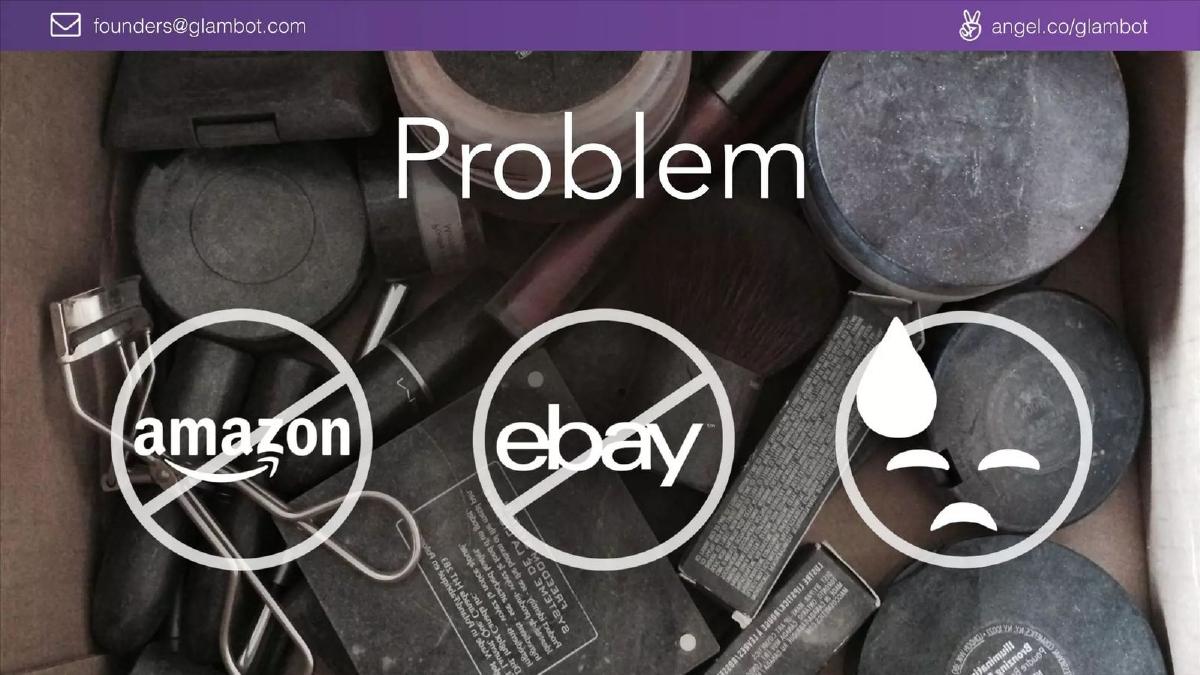
- The problem slide identifies Amazon and eBay as inadequate for this niche due to safety and quality concerns (Slide 4).
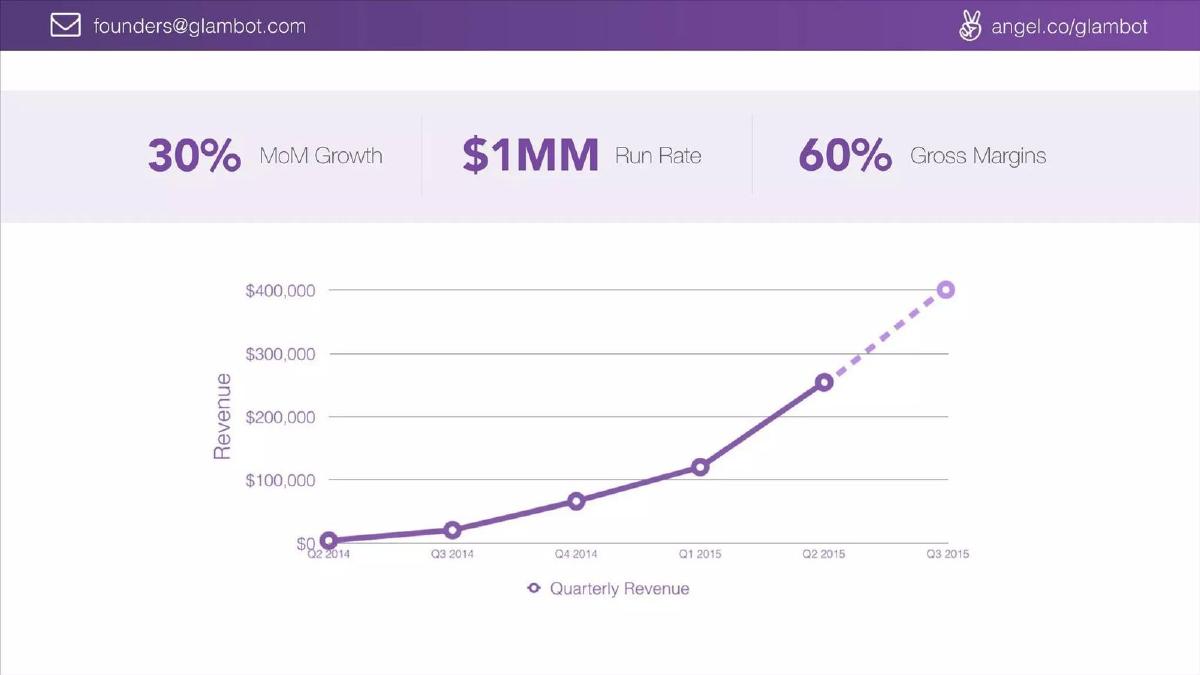
- Revenue growth shows a clear hockey-stick trajectory, rising from near-zero in Q2 2014 to over $400,000 projected for Q3 2015 (Slide 6).
- The team consists of three core members with backgrounds from UC Davis, Berkeley, and companies like Cloudflare/Risico (Slide 7).
- The deck completely omits a formal 'Ask' slide, leaving the funding amount and terms to be discussed offline (Slide 8).
The 8-Slide Traction Play: Glambot's Pitch Deck Teardown
Glambot entered the market in 2012 with a proposition that many investors initially found difficult to swallow: a marketplace for pre-owned cosmetics. However, their seed deck proves that traction is the ultimate antidote to skepticism. By the time this deck was circulated, the company had already moved past the 'idea' phase and into a high-growth scaling phase, boasting a $1MM run rate.
This teardown examines how a lean, visually-driven deck can succeed by focusing on three core pillars: massive market size, high margins, and undeniable growth. While the deck lacks the technical depth of a Series A presentation, it serves as a perfect example of a Seed-stage 'traction first' strategy.
The Hook: Identity and Immediate Value
Slide 1: Title The cover slide is minimalist, featuring the Glambot logo in a dot-matrix style against a purple gradient. The sub-headline, "We Sell Preowned Makeup," is a direct, no-nonsense value proposition. It tells the investor exactly what the business does within three seconds.
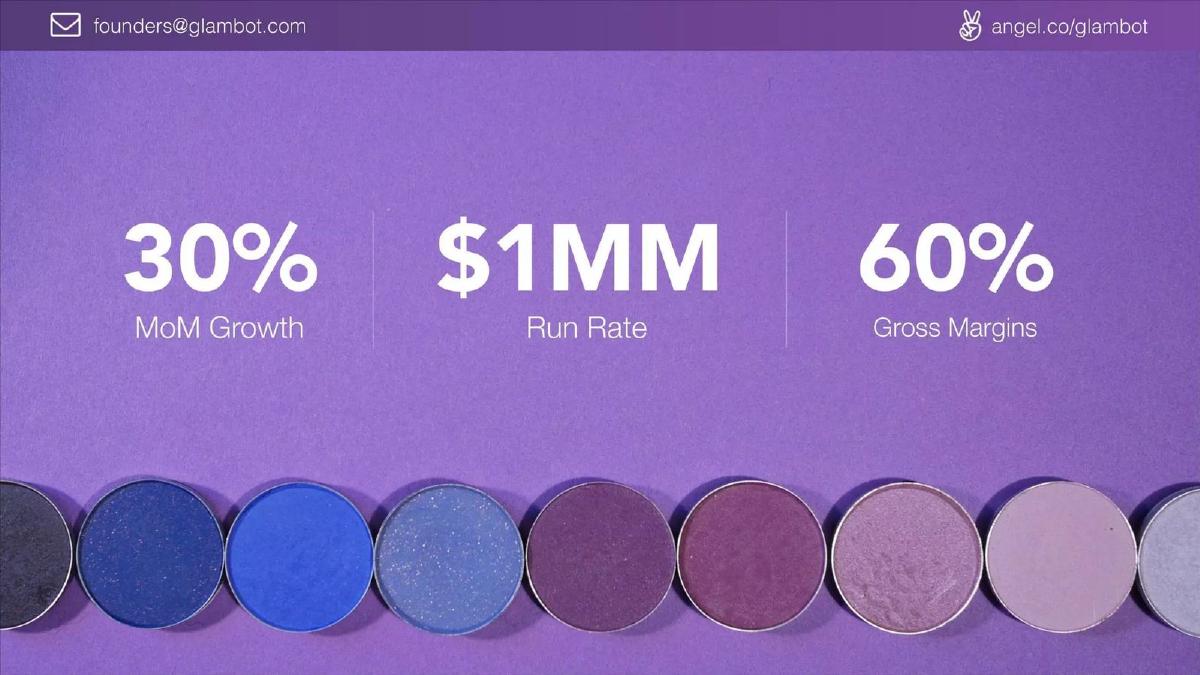
Slide 2: The Teaser Metrics Glambot chooses to lead with its strongest foot. Before explaining the problem or the solution, they present three massive numbers: 30% MoM Growth, $1MM Run Rate, and 60% Gross Margins. For a seed-stage company in 2012-2015, a $1MM run rate was a significant milestone. The 60% gross margin is particularly notable for a company dealing with physical inventory and shipping, suggesting a very efficient buy-low, sell-high engine.
Market and Problem Definition
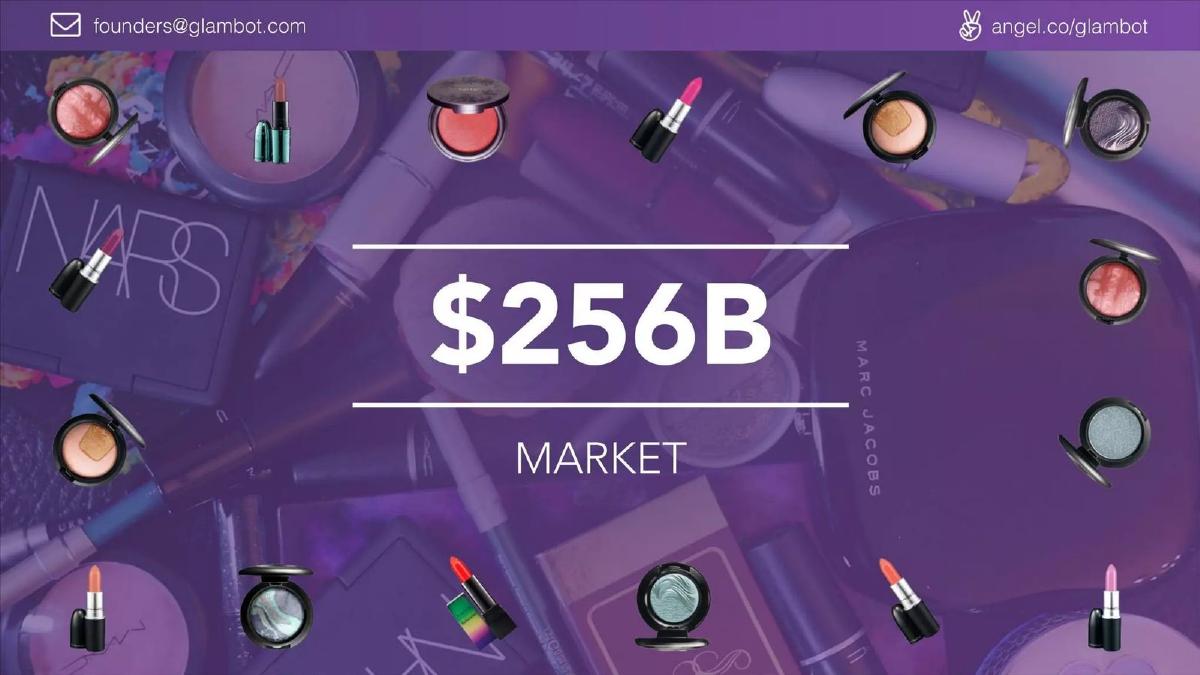
Slide 3: Market Size The deck cites a $256B market. This is a Total Addressable Market (TAM) figure for the entire beauty industry. While aggressive, it frames the "makeup hoarder" problem mentioned in their catalog listing as a multi-billion dollar opportunity. The visual uses high-end product photography (NARS, Marc Jacobs, MAC) to signal that they are targeting the premium/luxury segment of the market where resale value is highest.
Slide 4: The Problem The problem slide is purely visual. It shows a cluttered, somewhat dirty box of used makeup. Overlaid are the logos for Amazon and eBay with 'prohibited' slashes through them, alongside a sweating, sad emoji. This effectively communicates that while people want to sell these items, the major platforms don't support the niche well due to hygiene, authenticity, and categorization issues. It highlights a gap in the existing e-commerce infrastructure.
The Solution and Product
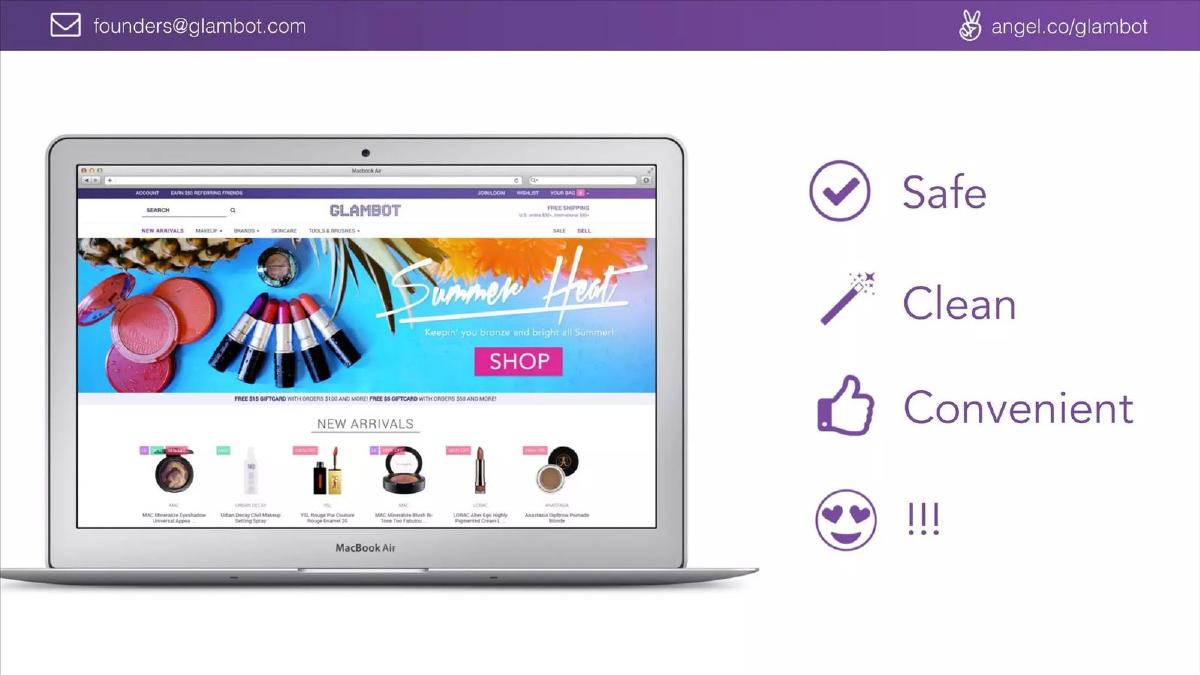
Slide 5: The Product This slide features a MacBook Air showing the Glambot website. The UI looks like a standard high-end e-commerce site, which is a deliberate choice to counteract the 'dirty' image of used makeup shown on the previous slide. To the right, four icons and words summarize the value prop: Safe, Clean, Convenient, and a heart-eyes emoji indicating customer love. This slide addresses the primary objection to the business model (hygiene) by promising a curated, professional experience.
The Proof: Traction and Team
Slide 6: Revenue Growth This is the 'money slide.' It displays a quarterly revenue chart from Q2 2014 to Q3 2015. The growth is exponential, moving from roughly $10,000 in Q2 2014 to a projected $400,000+ in Q3 2015. The slide repeats the 30% MoM, $1MM Run Rate, and 60% Margin stats at the top, reinforcing the message that this growth is both fast and profitable. The use of a dashed line for the final quarter indicates a projection based on current month performance.
Slide 7: Team The team slide features the three principals. Karen Horiuchi (CEO) and Patricia Li (Marketing) provide the domain expertise and brand vision, while Robert Zimțea (CTO) provides the technical backbone. The inclusion of UC Davis and Berkeley logos adds institutional credibility, and the mention of Cloudflare under the CTO's name suggests the ability to build scalable infrastructure.
The Conclusion
Slide 8: Contact and Reiteration The final slide repeats the core metrics one last time. This is a tactical move—if an investor leaves the deck open on their screen, the $1MM run rate and 60% margins are the last things they see. Interestingly, there is no "Ask" slide. There is no mention of how much money they are raising or what the valuation is. This suggests the deck was used as a teaser to secure meetings rather than a final document to close a round.
What Works in the Glambot Deck
Margin Focus: In e-commerce, margins are everything. By highlighting 60% gross margins on three separate slides, Glambot differentiates itself from low-margin 'drop-shipping' or standard retail businesses. · Visual Storytelling: The transition from the 'gross' problem slide (Slide 4) to the 'clean' solution slide (Slide 5) is a classic marketing technique that works well in a pitch format. · Traction as Validation: The hockey-stick growth chart on Slide 6 makes it very difficult for an investor to argue that "no one wants to buy used makeup." The data proves the market exists.
What is Missing
The Ask: Every pitch deck should ideally state how much capital is being sought and what the primary use of funds will be (e.g., "Raising $1.5M for warehouse expansion and marketing"). · Unit Economics: While 60% gross margin is great, we don't see the Customer Acquisition Cost (CAC). If it costs $50 to acquire a customer who only generates $40 in gross profit, the business isn't sustainable. · Operations/Logistics: Selling used makeup requires a rigorous sanitization and authentication process. A slide explaining how they ensure safety would have been a strong addition to de-risk the investment. · Competition: The deck mentions Amazon and eBay as 'problems,' but it doesn't address emerging peer-to-peer fashion apps like Poshmark or Mercari which were gaining steam during this period.
What a Founder Should Copy
The 'Rule of Three' Metrics: Pick your three strongest numbers and repeat them. Glambot’s repetition of Growth, Run Rate, and Margins ensures that even a distracted investor remembers their core strengths. · Minimalist Design: The deck uses a consistent color palette (purple) and very little text. This forces the presenter to tell the story and prevents the audience from getting lost in bullet points. · Leading with Traction: If your numbers are good, don't hide them at the end. Putting the $1MM run rate on Slide 2 immediately changes the tone of the conversation from "Is this a good idea?" to "How big can this get?"
Frequently asked questions
- How does Glambot handle the hygiene issues of used makeup?
- While the deck doesn't detail the specific sanitization process, Slide 5 explicitly labels the service as 'Safe' and 'Clean.' The business model relies on being a managed marketplace where items are sent to Glambot first for inspection and cleaning before being listed, differentiating it from peer-to-peer sites like eBay where quality is unverified.
- What is Glambot's revenue model?
- Based on the 60% gross margins cited on Slide 2 and the catalog description, Glambot operates as a buy-sell marketplace. They purchase items from sellers for cash or 'Glambucks' (store credit) and resell them at a significant markup, retaining the spread. This inventory-holding model explains the high margins compared to traditional 10-15% commission-based marketplaces.
- Is the $256B market figure realistic?
- Slide 3 uses the $256B figure to represent the total global beauty market. While Glambot only operates in the pre-owned segment, the slide suggests they view their opportunity as a significant disruption of the primary retail market, similar to how RealReal or Poshmark disrupted luxury fashion.
- Who are the founders of Glambot?
- As shown on Slide 7, the company was co-founded by Karen Horiuchi (CEO), a UC Davis alumna, and Robert Zimțea (CTO), who has experience with Risico and Cloudflare. Patricia Li serves as the Marketing & Design Director, bringing a background from UC Berkeley.
- What is missing from this pitch deck?
- The deck is missing several standard components: a specific fundraising goal (the 'Ask'), a breakdown of Customer Acquisition Cost (CAC) vs. Lifetime Value (LTV), a detailed competitive matrix, and a roadmap for future product categories or international expansion.