Beachhead Market on a Pitch Deck: 11 Real Examples
How to name and size the first market you will win: a tight definition, a figure inside the bigger market.
How to Name and Size Your Beachhead Market on a Pitch Deck
Ten slides from ten real pitch decks show how founders name the first market they plan to win, size it inside the larger opportunity, explain why they start there and, in the best cases, show they are already winning it.
TL;DR
A beachhead slide answers one question: which narrow group of customers will you win first, and how big is it compared with everything else you could sell to? Define the group tightly enough that an investor could list the customers, give its size in the same unit as the bigger market, and say why you start there. Alba sizes babysitting in Latin America at $6B inside a $30B care market. Five Flute sizes 3.25M active SolidWorks users at $1.95B inside $12B for 19.3M CAD users, and both figures work out to about $600 per user. Geodesic Life narrows from Scandinavia (EUR 5.4bn) to Sweden (2.8bn) to the Stockholm area (560mln) to turn-key prefab homes there (390mln). Liberare, Haystack Oncology and Crossbeam size their beachhead in people or companies rather than money. Jack & Jill and Miren show evidence that the beachhead is responding. Numan is the weak example: it names "taboo male health" as its beachhead and calls it multi-billion with no figures.
Beachhead market slides from real pitch decks
Each example shows the exact stored slide above its analysis and links to the full teardown. Stage and year are given only where the deck states them. Figures are the company's own claims.
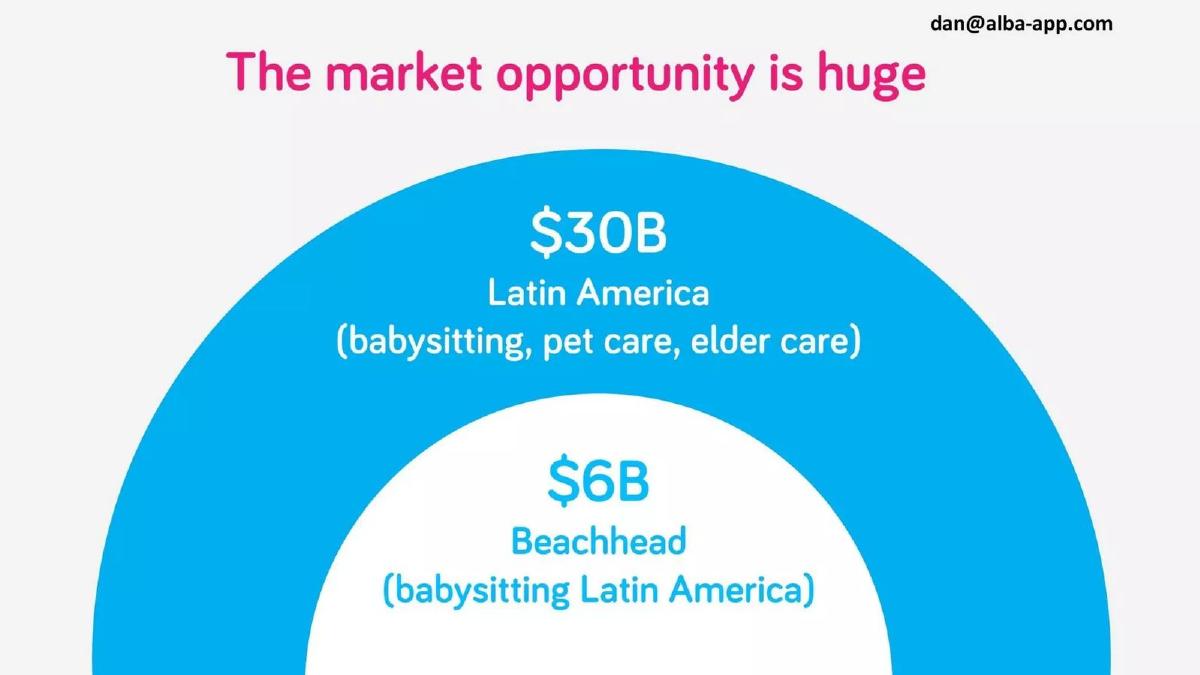
Alba market slide — slide 5
Care marketplace in Latin America.
Alba deck, slide 5. Exact stored slide matched to this analysis.
Our analysis: Two figures in the same unit; the beachhead is one category across the region.
Evidence and limitation: A beachhead figure with no method behind it.
What a founder can adapt: Say how the $6B was calculated and why babysitting comes first.
Supporting analysis
What the deck claims: The market opportunity is huge. $30B Latin America (babysitting, pet care, elder care). $6B beachhead (babysitting Latin America).
Presentation choice: Two figures in the same unit; the beachhead is one category across the region.
When it does not fit: A beachhead figure with no method behind it.
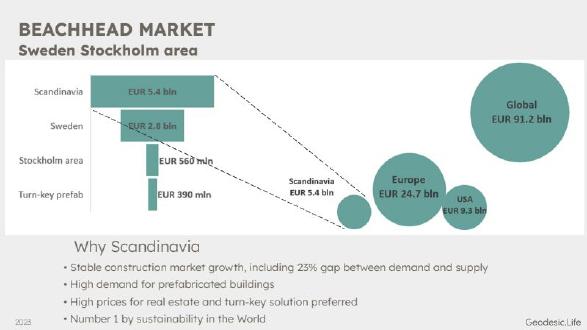
Geodesic Life deck, slide 9. Exact stored slide matched to this analysis.
Our analysis: Narrows step by step, each a subset of the last, ending in a product and a place.
Evidence and limitation: Funnels that switch categories halfway down.
What a founder can adapt: Add how many homes 390mln represents.
Supporting analysis
What the deck claims: Scandinavia EUR 5.4bn; Sweden 2.8bn; Stockholm area 560mln; turn-key prefab in Stockholm area 390mln. Europe 24.7bn, USA 9.3bn, global 91.2bn. 23% demand-supply gap.
Presentation choice: Narrows step by step, each a subset of the last, ending in a product and a place.
When it does not fit: Funnels that switch categories halfway down.
Jack & Jill deck, slide 9. Exact stored slide matched to this analysis.
Our analysis: Shows the chosen segment is already signing up.
Evidence and limitation: Growth charts with no labelled values.
What a founder can adapt: Print the latest figure rather than relying on the chart.
Supporting analysis
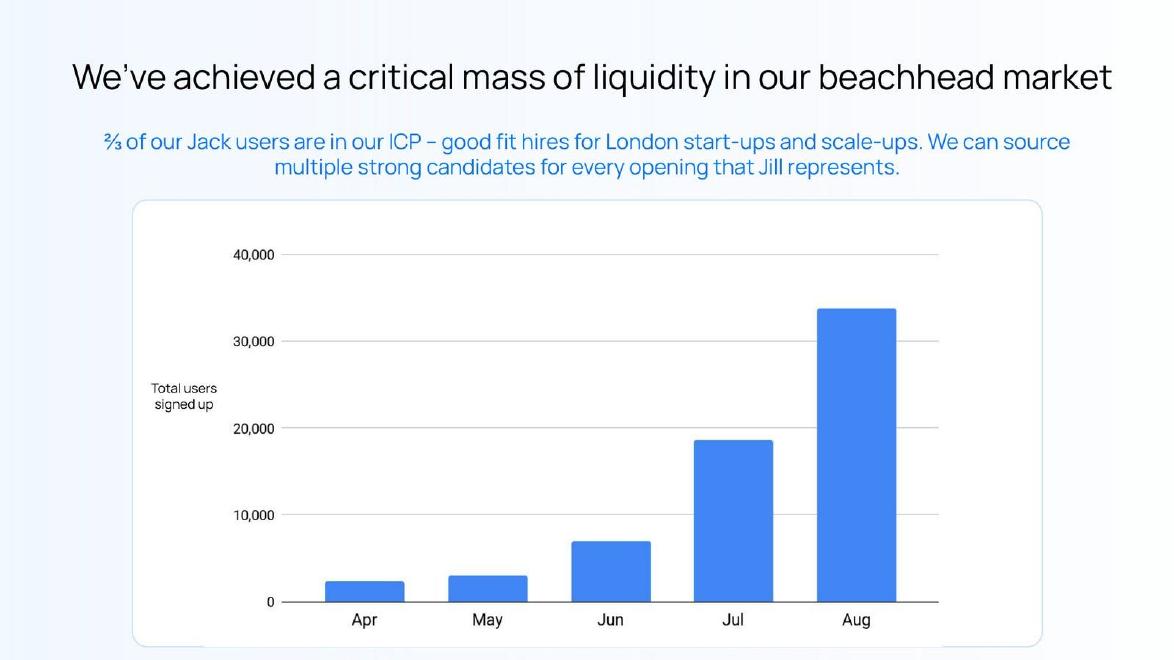
What the deck claims: User sign-ups April to August, reaching about 34K on the chart; about two-thirds in the ideal customer profile (London start-ups).
Presentation choice: Shows the chosen segment is already signing up.
When it does not fit: Growth charts with no labelled values.
Most slides name the beachhead; fewer size it in the same unit as the total and give a reason.
Example
Beachhead size
Same unit as total
Reason given
Early proof
Alba
$6B
Yes
No
No
Five Flute
$1.95B
Yes, consistent
Implied
No
Geodesic Life
EUR 390mln
Yes, funnel
Yes
No
Liberare
18M people
Yes
Yes (definition)
No
Haystack Oncology
~700K patients
No ($ total)
Partly
No
Crossbeam
Tens of thousands
Rough
No
No
Chef Robotics
Not sized
No
Yes
No
Jack & Jill
London start-ups
No
No
Yes
Miren
Not sized
No
Partly
Yes
Numan
"Multi-billion"
No
No
No
Key Takeaways
Define the beachhead so an investor could name the customers in it.
Size it in the same unit as the bigger market, so the two can be compared.
Check that the figures agree with each other (price per user, counts adding up).
Give a reason to start there: urgency, access, a gap competitors leave.
Show early proof you are winning it, if you have any.
Test your beachhead before you send it
Answer these with numbers, even if they are estimates.
Definition. Could an investor list the customers in your beachhead?
Size. How many customers, and at what price each?
Same unit. Is the total market in the same unit and at a similar price?
Reason. Why do you start here rather than anywhere else?
Proof. What evidence shows this segment is responding?
Copyable framework: Beachhead: [n] [customers] in [place], at [price] each = [size], inside [total n] / [total size]. Why first: [reason]. Proof: [evidence]. Next: [segment]
Illustrative example 1 — written by us
Before: Taboo male health as the beachhead. Multi-billion opportunity.
After: Beachhead: [n] men in [country] with [condition] who have not seen a doctor, at [price] a year = [size]. Why first: [reason]. Proof: [evidence]
What improved: Our illustrative rewrite, not Numan's text. Bracketed parts are placeholders, not company facts. It turns a label into a size and a reason.
What this guide covers
A beachhead market is the first, narrow segment a startup sets out to dominate before expanding. The term comes from military landings: take one small stretch of coast, secure it, then move inland. On a pitch deck it usually appears on the market slide, sometimes on the go-to-market slide, as a small circle inside larger ones or as the first step on a staircase.
Investors ask about it because a huge total market says little about what a small company can actually win next year. A well-chosen beachhead shows focus: a group of customers with the same urgent need, reachable through the same channel, small enough to lead and big enough to matter. It also shows the founder has thought about what comes next.
Several of our published guides mention the idea in passing, including the TAM, SAM and SOM guide and the bottom-up sizing guide, but none is about it. We searched the corpus for beachhead and related terms (first market, initial market, phase 1 market), found 62 hits, shortlisted 13 slides from their text and read each from images made from the original deck files. Two decks were missing and two slides were already used in other guides. One more deck was later excluded because a page carries a restriction notice. Ten slides from ten private companies remain.
Size the beachhead in the same unit as the bigger market
The simplest strong beachhead slide gives two figures in the same unit: the whole market and the part you start with. The reader can see the ratio at once.
Alba, a care marketplace in Latin America, titles its slide "The market opportunity is huge" and gives two figures: $30B for babysitting, pet care and elder care across Latin America, and $6B for the beachhead, babysitting in Latin America. The beachhead is a fifth of the total. That is a clear choice: one care category first, across the whole region. (The slide text in our search index read these as "$308" and "$68"; the image clearly shows $30B and $6B, which is why we read every figure from the slide image.) What the slide does not say is how the $6B was calculated or why babysitting comes before pet or elder care.
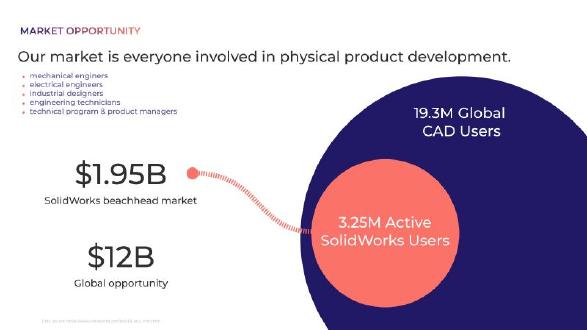
Five Flute, which makes design-review software for engineers, does the calculation for you. It shows 19.3M global CAD users worth $12B and, inside them, 3.25M active SolidWorks users worth $1.95B as the beachhead. Divide each money figure by its user count and you get about $600 per user for the beachhead ($1.95B ÷ 3.25M) and about $622 for the whole market ($12B ÷ 19.3M). The two prices are close, which suggests both figures come from the same assumption. That is a quiet sign of care. A slide where the beachhead implied $600 per user and the total implied $60 would raise questions.
Choosing SolidWorks users is also a sensible beachhead in itself: one software platform, one place to sell an add-on, one group of engineers who talk to each other.
Narrow step by step
Some founders show the narrowing as a funnel, with a figure at each step. This lets an investor see exactly how the beachhead was defined.
Geodesic Life, a 2023 deck for prefabricated homes, gives four nested figures: Scandinavia EUR 5.4bn, Sweden 2.8bn, the Stockholm area 560mln and turn-key prefab homes in the Stockholm area 390mln. Beside the funnel it gives the larger markets it could later enter (Europe 24.7bn, USA 9.3bn, global 91.2bn) and a short list of reasons for starting in Scandinavia, including a 23% gap between housing demand and supply. Each step is smaller than the last, every figure is in euros, and the final step describes a product and a place. This is the clearest beachhead definition in the set.
One thing to check on a funnel like this is that each step really is a subset of the one above. Here it is: Stockholm is in Sweden, Sweden is in Scandinavia, and turn-key prefab is a part of all homes. A funnel that jumped from one product category to another halfway down would be harder to trust.
Count customers when money is the wrong unit
Not every beachhead is best sized in dollars. For hardware sold to institutions, the number of possible sites can be more useful. For a consumer product, the number of people with the need may be clearer than a guessed spend.
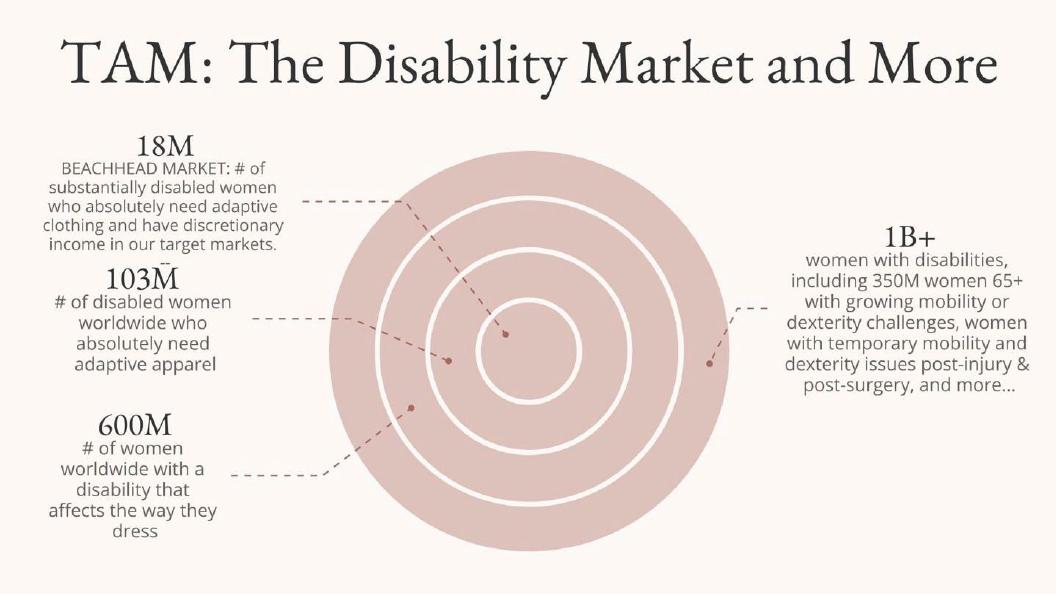
Liberare, a company making products for people with disabilities, uses nested people counts: 1B+ people, then 600M, then 103M, then an 18M beachhead. The beachhead is defined by both need and the ability to pay, people with the relevant condition and discretionary income. That tight definition is the slide's strength. It gives no money figure, so an investor has to supply a price to judge how much revenue 18M people might mean.
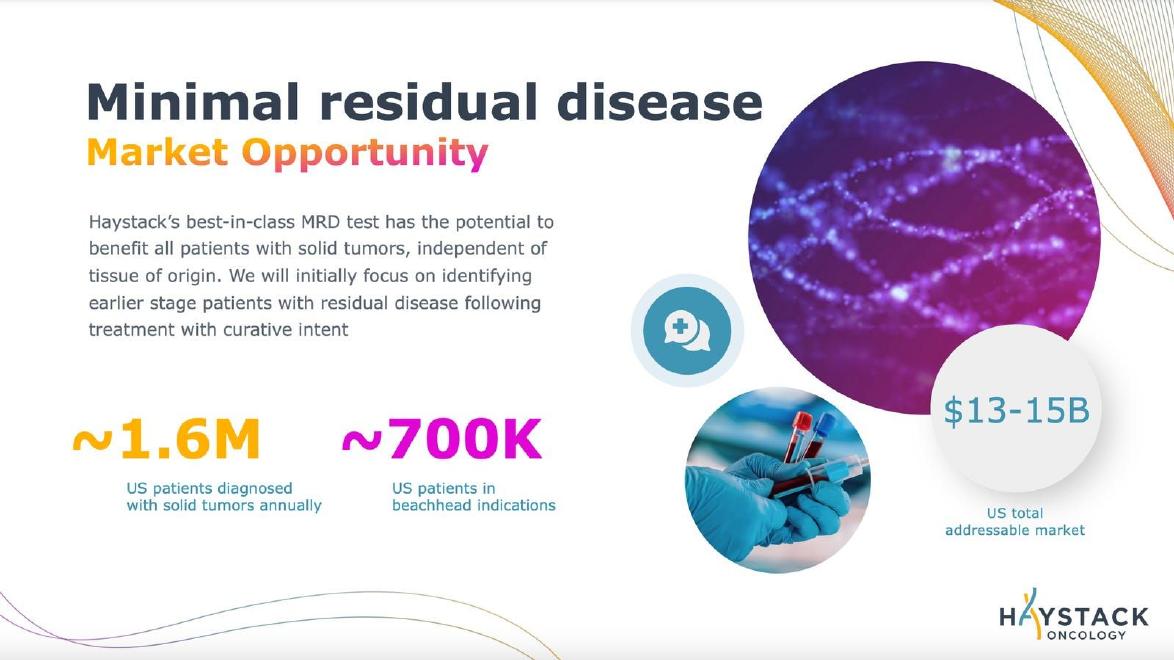
Haystack Oncology, a cancer blood-test company, sizes its beachhead as about 700,000 US patients in its first cancer types out of about 1.6M diagnosed each year, and gives a total market of $13-15B. The patient counts are clear; there is no money figure for the beachhead itself, so the reader cannot compare it directly with the $13-15B. Adding one would complete the picture.
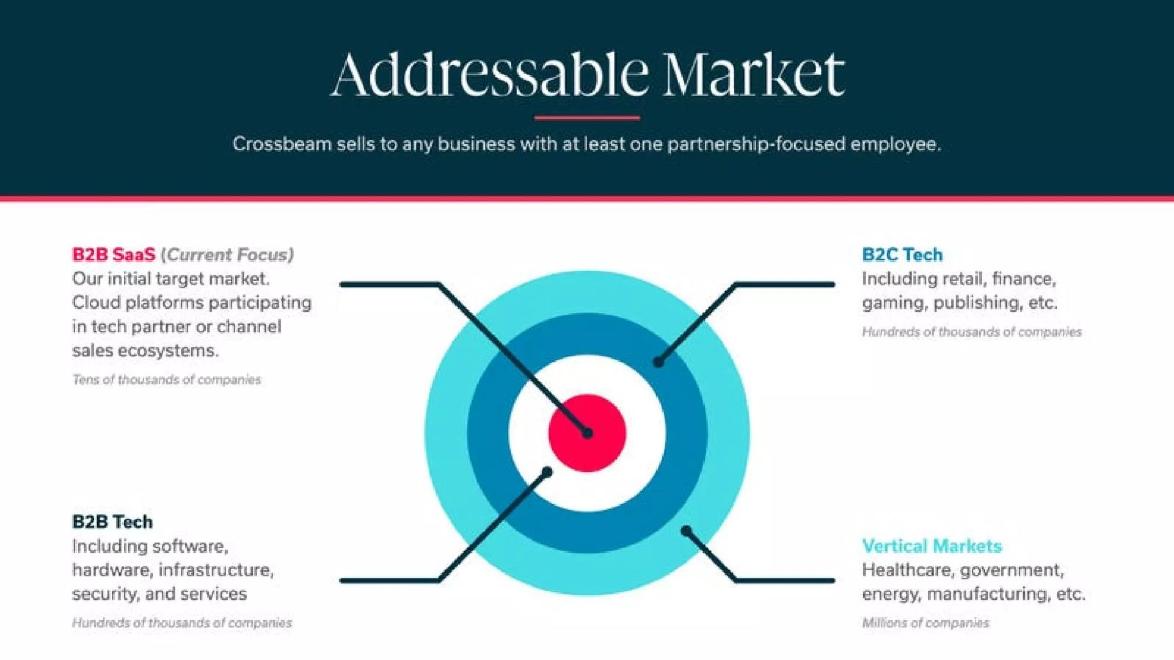
Crossbeam, a partner data platform, describes its current focus as B2B SaaS companies, "tens of thousands of companies", inside outer rings of hundreds of thousands and millions of businesses. These are rough counts, honest about their precision, but loose enough that an investor cannot do much arithmetic with them.
Explain why you start there
A figure tells an investor how big the beachhead is. A reason tells them why it is the right one. The best reasons are about urgency (customers need this most), access (you can reach them cheaply) and a gap (competitors are not serving them well).
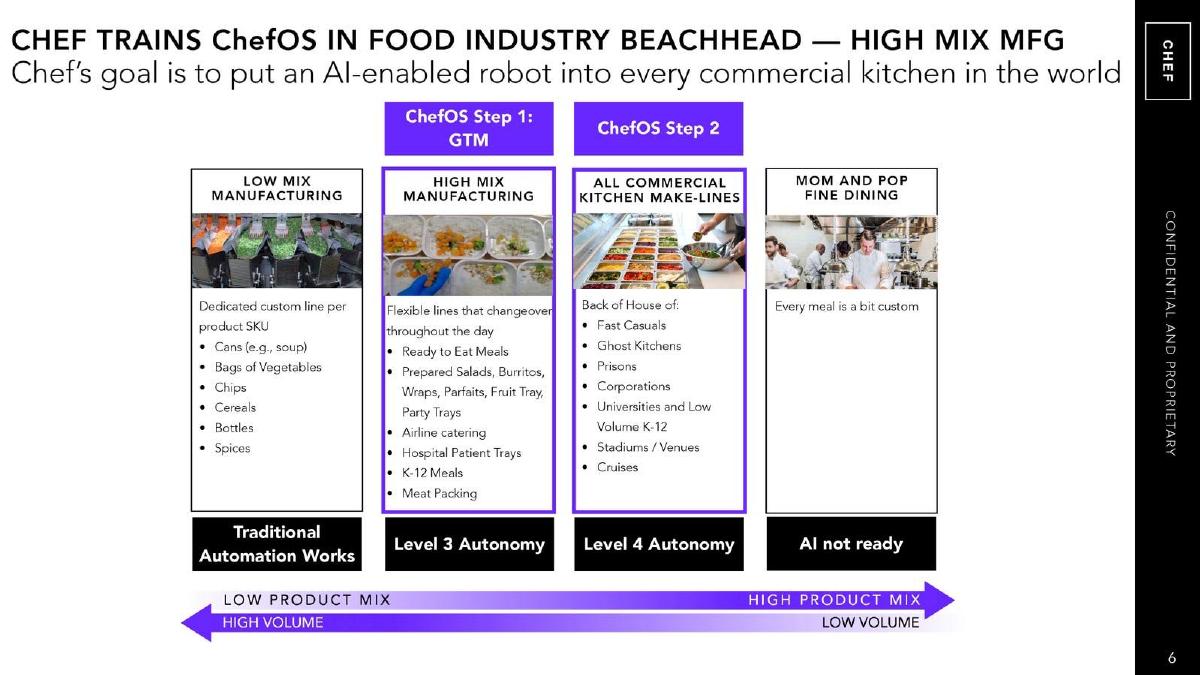
Chef Robotics, which makes food-assembly robots, gives no sizes on its slide but explains its choice. It ranks possible markets by how much autonomy a robot needs and picks high-mix manufacturing, where many different meals are assembled on the same line, as step one. The argument is that this is where today's robots can work reliably and where labour shortages hurt most. It is a reasoned choice, and a sizing figure beside it would make it a strong slide.
Geodesic Life gives reasons too, as noted above: a housing gap and conditions suited to prefab building. Alba and Five Flute give sizes but say little about why; a single line would fix that.
Show early proof you are winning it
The strongest evidence that a beachhead is well chosen is that it is already responding. Two slides in this set make that their main point.
Jack & Jill, an AI recruitment service, shows user sign-ups from April to August climbing to about 34,000 on a chart (we read the level from the chart, not a printed number) and says about two-thirds are in its ideal customer profile, London start-ups. That pairs a narrow target with evidence that the target is signing up, which is more persuasive than a size alone.
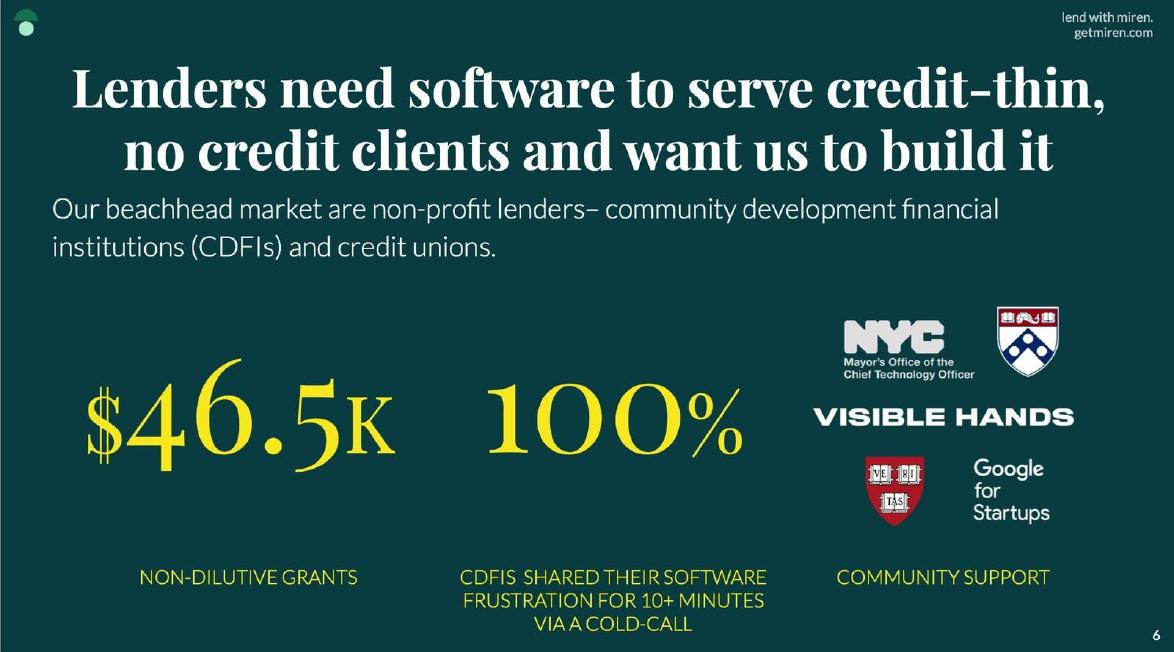
Miren, which sells software to community lenders, names CDFIs (community development financial institutions) and credit unions as its beachhead. Its evidence is qualitative but specific: 100% of the CDFIs it cold-called shared their frustration for 10+ minutes, and the company has won $46.5K in grants. There is no market size, but the slide makes a believable case that these customers feel the problem.
The weak version: a beachhead with no figures
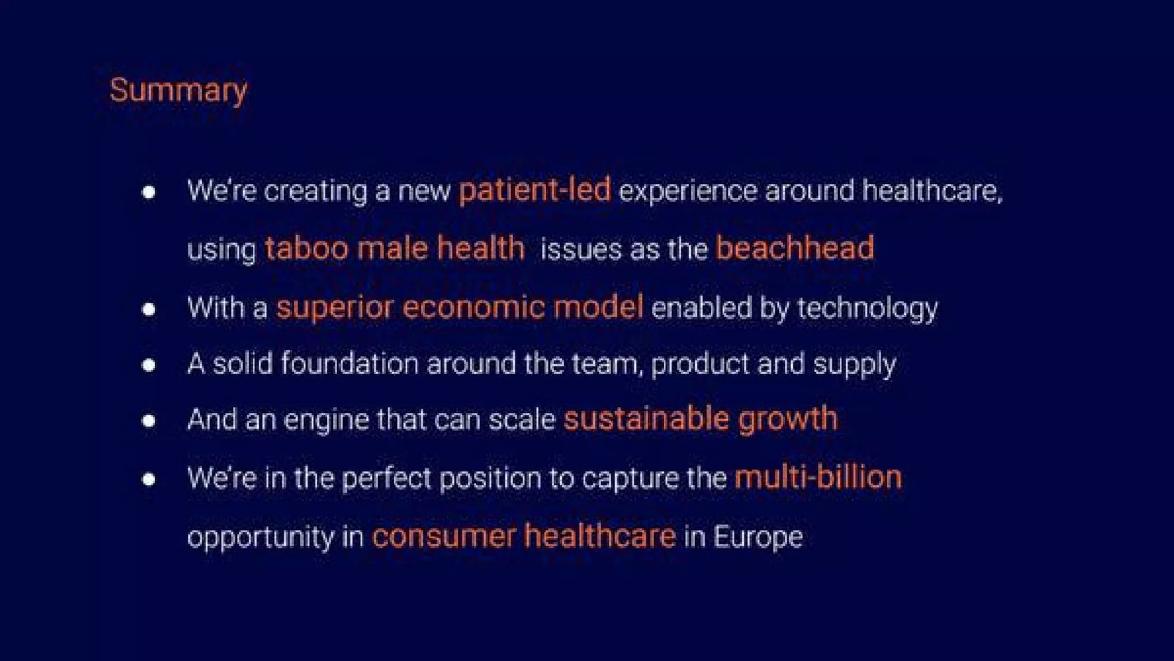
Numan, a men's health company, names "taboo male health" as its beachhead and calls the opportunity multi-billion. There is no figure, no count of men, no country and no reason given on the slide for starting there rather than elsewhere. The idea itself is reasonable: conditions people are embarrassed to discuss with a doctor suit an online service. But as written, an investor learns only the name of the segment. Numan went on to raise substantial funding, which shows a weak slide is not fatal, but it is not a model to copy.
A worked example
Here is how a founder might set out a beachhead on one slide. All figures are illustrative, not from any company in this guide.
Total market: 400,000 independent restaurants in the US, at about $1,200 a year each, $480M. Beachhead: 9,000 independent restaurants in New York City with online ordering, $10.8M. Why first: highest delivery-app commission costs, a dense area one sales team can cover, and 40 of our 60 pilot customers are already here. Next: Los Angeles and Chicago, adding 14,000 restaurants.
Check the arithmetic before sending: 400,000 × $1,200 = $480M and 9,000 × $1,200 = $10.8M, so the beachhead is about 2% of the total at the same price per customer. That is four things an investor looks for: a definition precise enough to list the customers, a size in the same unit as the total, a reason and some proof.
Common mistakes
A beachhead with no figure. Give a count or a value, not just a name.
Different units. Size the beachhead in the same unit as the total.
Figures that disagree. Check the implied price per customer matches.
No reason. Say why this segment comes first.
Too broad. A beachhead should be narrow enough to lead.
Diagnostic checklist
Beachhead defined precisely.
Size in the same unit as the total market.
Arithmetic checked (parts add up, prices agree).
Reason for starting there.
Early proof, if you have it.
Frequently asked questions
How we chose these examples
Corpus: published pitch deck teardowns on StartupFundraising.com. Founder-uploaded private decks are excluded.
Removed in v2 (2026-10-05): MAUI Imaging, because a page of its deck carries a restriction notice. Selection (2026-10-01): we searched extracted slide text for beachhead and related terms, found 62 hits, shortlisted 13 and read each from images made from the original deck files. Figures were read from images; the search index misread Alba's $30B and $6B as "$308" and "$68".
Eligibility: each company was private when its deck was made. Haystack Oncology (private until acquired by Quest Diagnostics in 2023; never listed itself), Chef Robotics, Crossbeam, Numan and Jack & Jill were checked against public funding announcements. Alba, Five Flute, Geodesic Life, Liberare and Miren rest on their own early-stage decks, with no sign of a listing.
Not used: Plantt and Exeq (deck files missing); Canndescent and MySwimPro (slides already used in other guides).
Arithmetic: Five Flute $1.95B ÷ 3.25M ≈ $600 and $12B ÷ 19.3M ≈ $622 per user.
Overlap check: the TAM, SAM and SOM, bottom-up and go-to-market guides mention beachheads only in passing; none of these slides appears in another guide.
Review: all ten slide images were inspected on 2026-10-01 and matched to company, deck and slide number (AI editorial model review). No person has yet completed an editorial review of this page. The worked example uses illustrative figures, not company data.
Figures are the companies' own claims; we did not verify underlying data. We make no claim that any slide caused a fundraising outcome.