Macro’s seed deck is a masterclass in narrative-driven fundraising. In just 11 slides, the company addresses the paradox of the modern workplace: we hate email and PDFs, yet we cannot leave them because of their massive network effects. Instead of proposing a 'Slack-killer' or a new file format, Macro argues for an 'upgrade' to existing infrastructure. The deck uses a clean, minimalist aesthetic to present a $60B TAM and high-fidelity product mockups that reimagine email as chat and documents as interactive webpages. While the deck entirely omits traditional slides like Team, Traction, and Fi…
Key takeaways
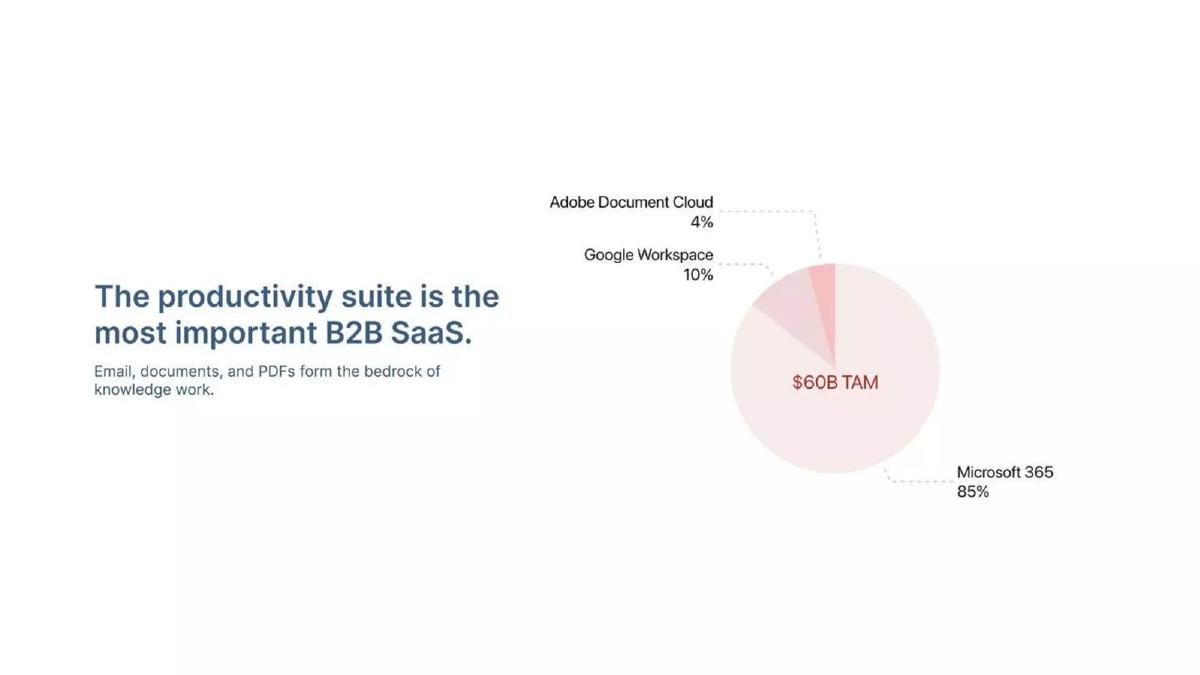
- Macro identifies a $60B Total Addressable Market (TAM) for productivity suites, noting that Microsoft 365 holds 85% of the market (Slide 2).
- The deck leans heavily on 'extensible formats,' arguing that email and PDFs can be upgraded while maintaining backwards compatibility (Slide 7).
- The 'Problem' is defined as chaos caused by siloed information, specifically citing '17 simultaneous email threads' and '14 different proposal versions' (Slide 5).
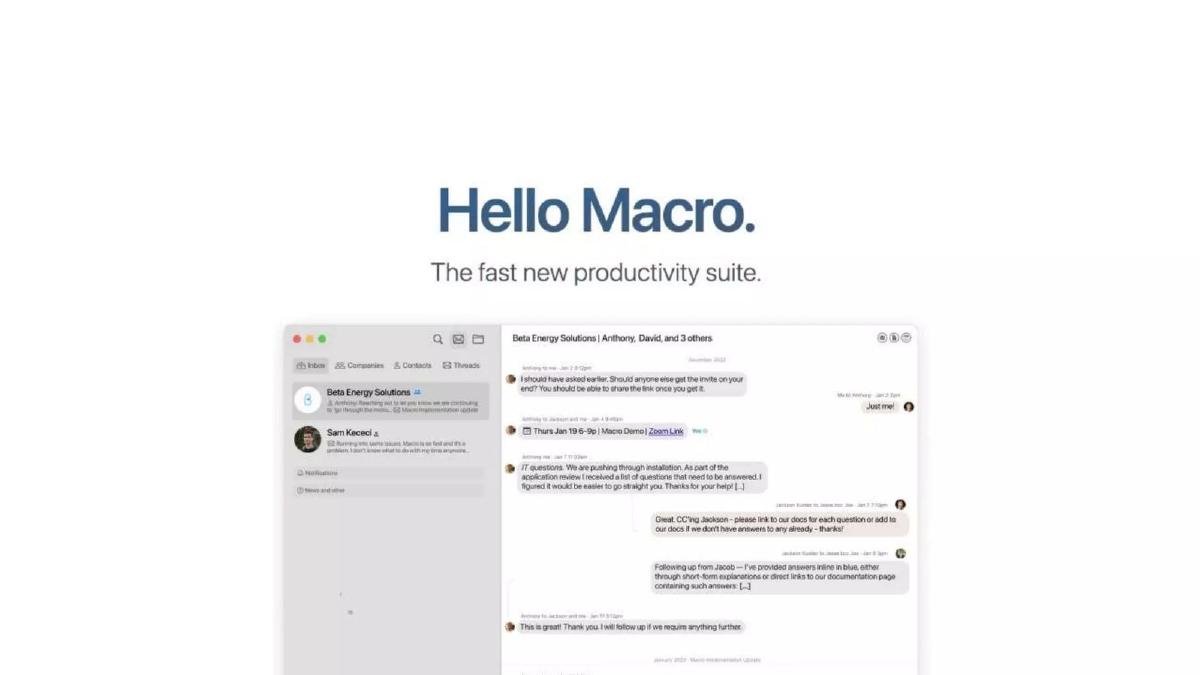
- Macro positions its product as a 'fast new productivity suite' that turns email into a collaborative chat interface (Slides 1, 8).
- Documents are reimagined as 'webpages' with hyperlinks, tabs, and popups to solve the static nature of PDFs and .docx files (Slide 9).
- The deck acknowledges the 'massive network effects' of legacy software, choosing to work with them rather than against them (Slide 6).
- There is a total absence of a Team slide, Go-To-Market strategy, or any specific financial 'Ask' within the 11 slides provided.
- The visual language is consistent and high-end, using a 'What if...' questioning framework to lead the investor through the solution (Slides 8, 9, 10).
The Narrative-First Approach to a $60B Market
Macro’s pitch deck is a striking example of how to pitch a 'Red Ocean' market by reframing the problem. The productivity software space is notoriously difficult to enter because of the entrenched dominance of Microsoft and Google. Macro raised $9.3M in 2023 by arguing that the solution isn't to replace these giants, but to build a better interface on top of the formats they created. The deck is short, visually cohesive, and follows a strict logical progression from market size to problem to solution.
Slide 1: The Hook
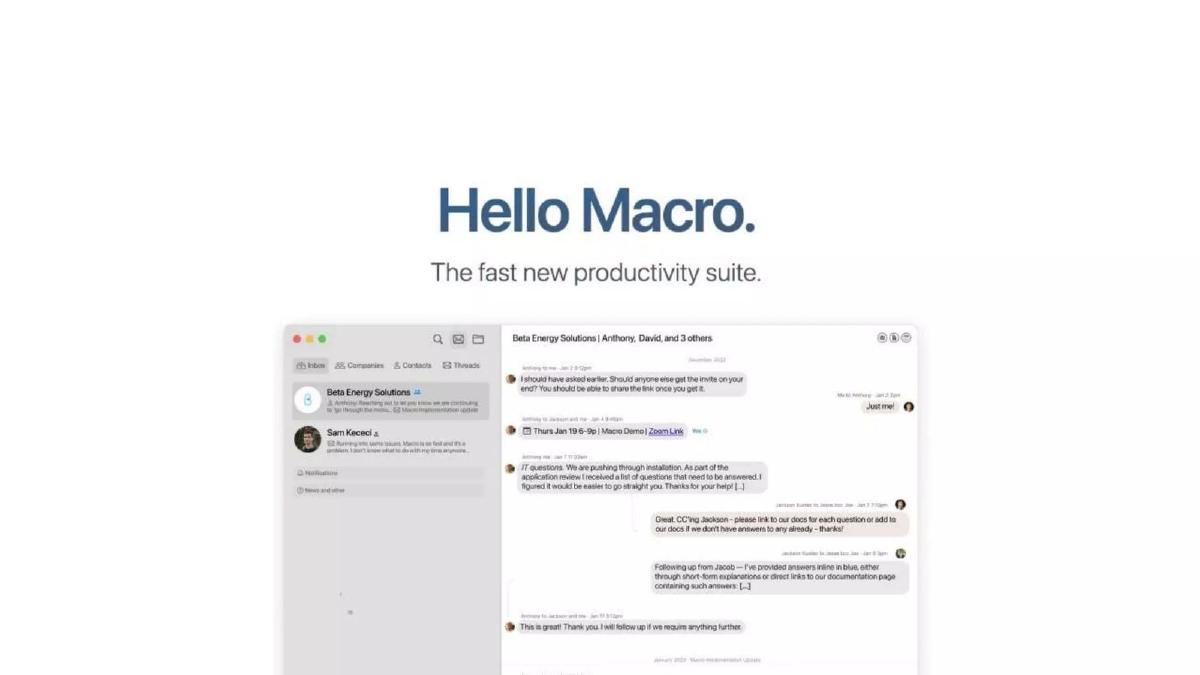
The deck opens with a simple greeting: 'Hello Macro.' The subtitle defines the company as 'The fast new productivity suite.' Below the text is a high-fidelity mockup of the application interface. It looks like a hybrid between a modern chat app and an email client. This slide immediately establishes the product's aesthetic—clean, professional, and native to macOS. It sets the stage for a product-led pitch.
Slide 2: The $60B Opportunity
Macro doesn't waste time on 'why now' before establishing 'how much.' Slide 2 states, 'The productivity suite is the most important B2B SaaS.' It provides a pie chart of a '$60B TAM' dominated by Microsoft 365 (85%) , Google Workspace (10%) , and Adobe Document Cloud (4%) . By citing these figures, Macro isn't just showing market size; they are identifying the specific incumbents they intend to disrupt or augment. The slide notes that email, documents, and PDFs form the 'bedrock of knowledge work.'
Slide 3: Target Verticals
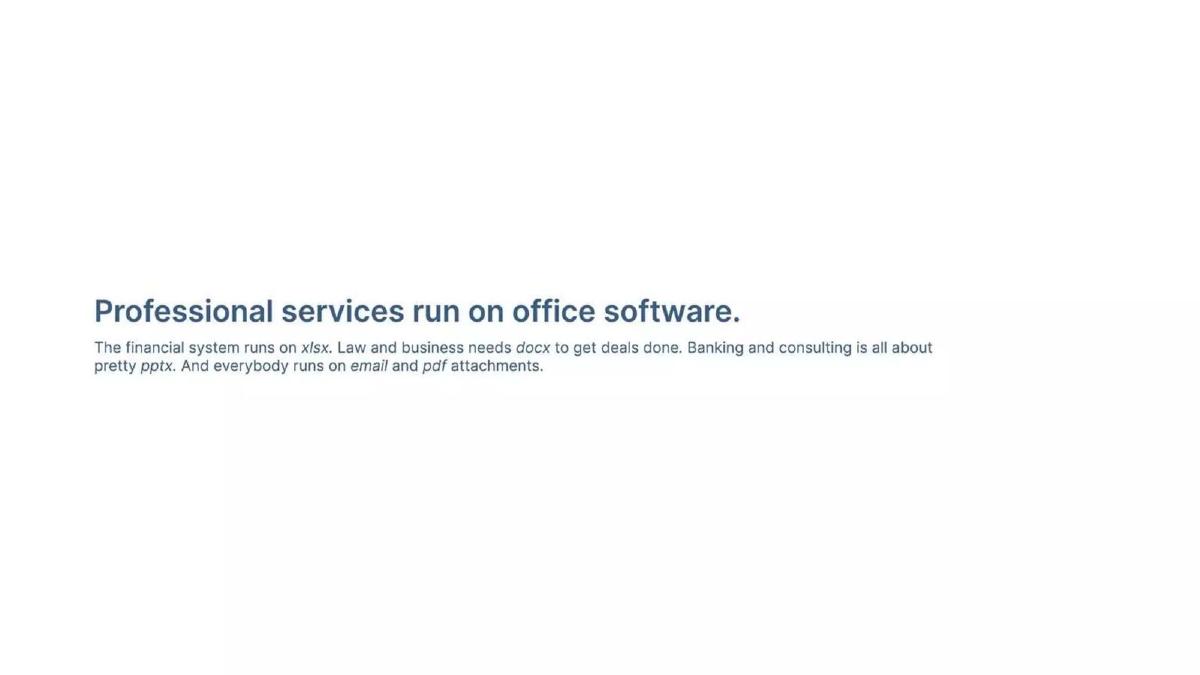
Slide 3 narrows the focus to 'Professional services.' It lists specific file types for specific industries: xlsx for finance, docx for law and business, and pptx for banking and consulting. This is a crucial strategic move. By naming these industries, Macro signals that they are targeting high-value users who handle complex, document-heavy workflows where 'productivity' translates directly to billable hours and deal velocity.
Slide 4 & 5: Defining the Chaos
Slide 4 acknowledges a hard truth: 'External communication still lives in email and attachments.' Instead of calling this a failure, they call it a 'common language.' This leads into Slide 5, which defines the 'Problem.' The slide lists the symptoms of modern work: '17 simultaneous email threads, 14 different proposal versions, people missing from CC,' and the dreaded 'clientversionfinalfinalv3.pdf.' This is a highly relatable pain point for any investor or professional, making the 'Problem' slide feel urgent and authentic.
Slide 6 & 7: The Strategic Pivot
Slide 6 asks the pivotal question: 'But can we really change anything?' It admits that PDFs, Office, and email have 'massive network effects.' This honesty builds credibility. Slide 7 provides the answer: 'What if we could upgrade these old formats and apps?' Macro introduces the concept of 'extensible' formats , meaning they can be improved while maintaining 'backwards compatibility.' This is the 'aha' moment of the deck. It promises the benefits of a new tool without the friction of a platform migration.
Slide 8 & 9: The Product Vision
Slides 8 and 9 are the 'What if' slides. Slide 8 asks, 'What if email was chat?' and shows a mockup where email threads are displayed as a continuous, collaborative stream. Slide 9 asks, 'What if documents were like webpages?' and demonstrates a document interface with 'hyperlinks, tabs, and popups.' The mockup shows a 'License Agreement' where clicking a term like 'Syndicate Lenders' opens a popup definition. This directly addresses the 'siloed information' problem mentioned in Slide 5.
Slide 10: The Vision of Sync
The final content slide (Slide 10) asks, 'What if everything and everybody were in sync?' This serves as a summary of the value proposition. It moves from the specific features (chat-like email, interactive docs) to the high-level benefit: a unified workspace where the friction of version control and fragmented communication is eliminated.
Slide 11: The Library
Slide 11 is a standard promotional slide for the platform hosting the deck, offering more examples of winning presentations. It does not contain any Macro-specific data, team information, or a call to action.
What Works in the Macro Deck
The Narrative Arc: The deck follows a perfect 'Problem/Solution' framework but adds a layer of 'Strategic Insight.' By identifying 'backwards compatibility' as the key to overcoming network effects, Macro makes a difficult task (disrupting Microsoft) seem plausible.
Visual Consistency: The use of high-fidelity mockups (Slides 1, 8, and 9) is essential. In a productivity suite pitch, the 'feel' of the software is the product. The mockups look fast and modern, supporting the claim on Slide 1.
Relatable Pain Points: Every investor has dealt with 'finalfinalv3.pdf.' By using specific, almost humorous examples of office chaos (Slide 5), Macro ensures the audience feels the problem personally.
What is Missing from the Macro Deck
The Team Slide: This is a glaring omission. Raising $9.3M usually requires a team with significant technical or industry pedigree, especially when building a 'productivity suite.' The absence of this slide suggests it was either removed for public viewing or the founders relied on their existing reputation.
Traction and Metrics: There are no mentions of user growth, waitlist numbers, or pilot programs. While this is common in pre-product seed decks, for a 2023 round of nearly $10M, one would expect some evidence of market validation.
The Ask and Use of Funds: The deck does not state how much they are raising or what the milestones for the next 18 months are. This information is typically found on the final slide of a pitch deck.
Go-To-Market (GTM) Strategy: How does Macro intend to get these 'Professional Services' firms to switch? Selling into law firms and banks is notoriously difficult. A slide explaining their distribution strategy would have strengthened the 'backwards compatibility' argument.
What Founders Should Copy
The 'What If' Framework: Using questions to lead an investor through a product demo is highly effective. It invites the investor to imagine the solution rather than just being told what it is.
Market Contextualization: Slide 2 is a great example of how to show a massive TAM while acknowledging the reality of the competition. Don't just say the market is big; show who owns it and why you can take a piece.
Focus on 'Extensibility': If you are building in a space with high switching costs, don't pitch a 'replacement.' Pitch an 'upgrade.' This reduces the perceived risk for both the investor and the future customer.
Minimalist Text: Notice that no slide has more than three sentences of body text. The deck relies on bold headers and clear visuals to tell the story, which is ideal for a presentation that will likely be skimmed in under three minutes.
Frequently asked questions
- How did Macro raise $9.3M without a team or traction slide?
- While the deck omits these slides, it is likely they were part of a larger data room or that the founders' pedigree was already known to the VCs. In high-conviction seed rounds, a compelling product vision and a clear understanding of a massive market (like the $60B productivity space) can often outweigh the need for early-stage traction metrics.
- What is the core 'hook' of the Macro pitch?
- The hook is 'backwards compatibility.' Most startups try to replace email or PDFs, which fails due to network effects. Macro proposes 'upgrading' these formats. By promising that their suite works with the files everyone already uses, they lower the barrier to entry for B2B customers.
- Who is Macro's primary competitor according to the deck?
- Slide 2 explicitly names Microsoft 365 as the dominant force with 85% market share, followed by Google Workspace at 10% and Adobe Document Cloud at 4%. Macro isn't competing on features alone; they are competing for a slice of the 'bedrock of knowledge work.'
- What specific industries does Macro target?
- Slide 3 identifies professional services as the core user base, specifically mentioning finance (xlsx), law (docx), and banking/consulting (pptx). These industries are chosen because they are heavily dependent on external communication via email and attachments.
- Is Macro an AI company?
- Although catalogue facts list AI as a sector, the pitch deck itself does not mention 'AI' or 'Machine Learning' once. It focuses entirely on interface design, productivity, and the 'extensibility' of file formats. This suggests the AI components are likely under the hood rather than the primary value proposition.