M3ter's 12-slide Series A deck is a masterclass in identifying a specific, high-value operational gap within the SaaS ecosystem. By focusing on the transition from simple recurring subscriptions to complex usage-based pricing (UBP), M3ter positions its platform not just as a billing tool, but as essential infrastructure. The deck highlights the 'Pricing Operations Gap'—where existing tools fail to handle the complexity of modern B2B billing—and maps out a clear path from basic billing operations to advanced machine learning-driven pricing design. While the deck is light on specific financial…
Key takeaways
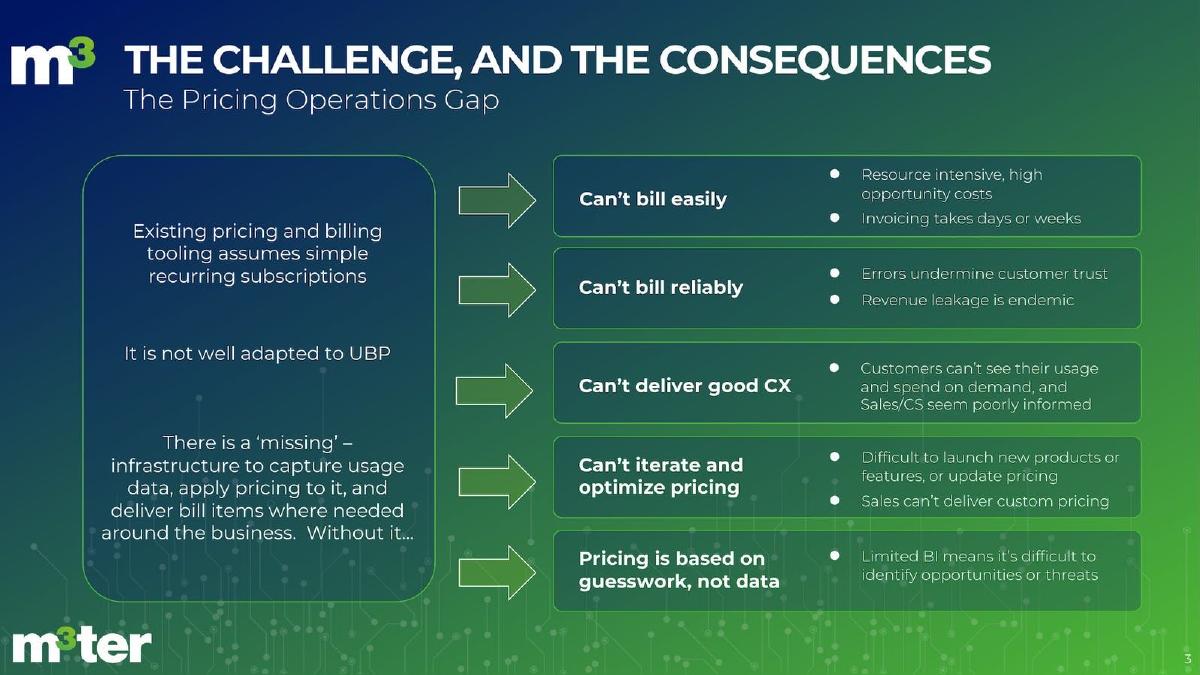
- M3ter identifies the 'Pricing Operations Gap' as a core challenge where existing tools assume simple subscriptions but fail at UBP (Slide 3).
- The deck lists five specific consequences of poor pricing infrastructure, including revenue leakage and the inability to iterate on pricing (Slide 3).
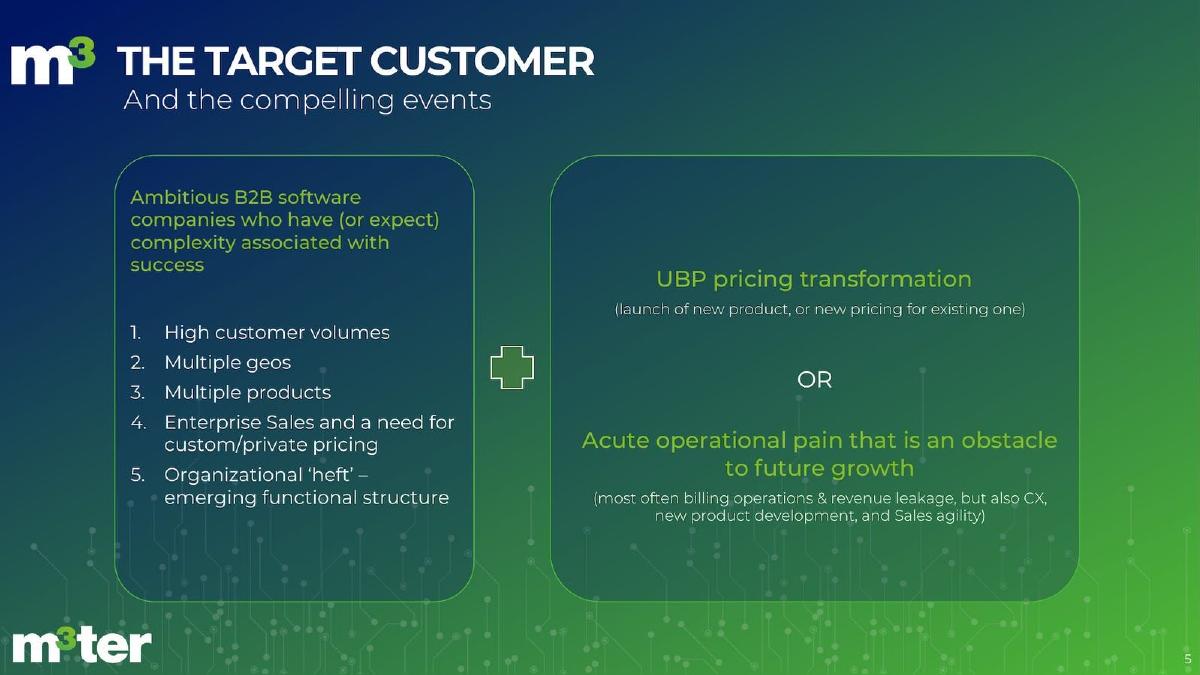
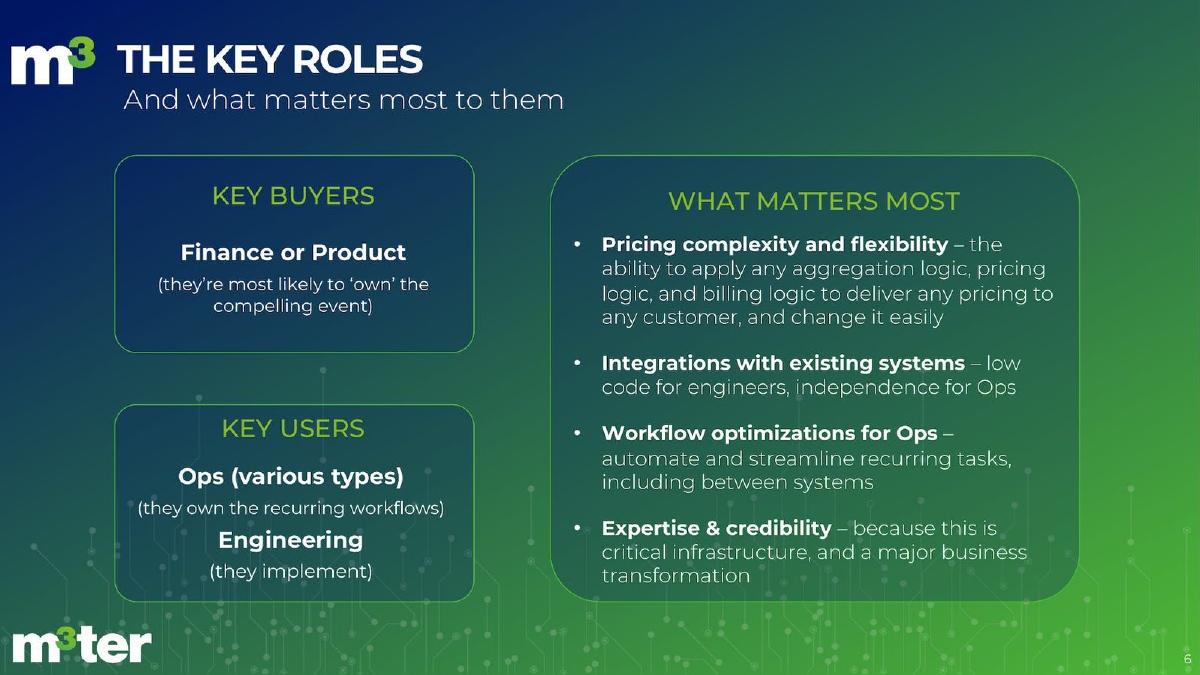
- Target customers are defined as ambitious B2B software companies with high volumes, multiple products, and complex enterprise sales needs (Slide 5).
- The 'compelling events' for adoption are narrowed down to UBP pricing transformations or acute operational pain blocking growth (Slide 5).
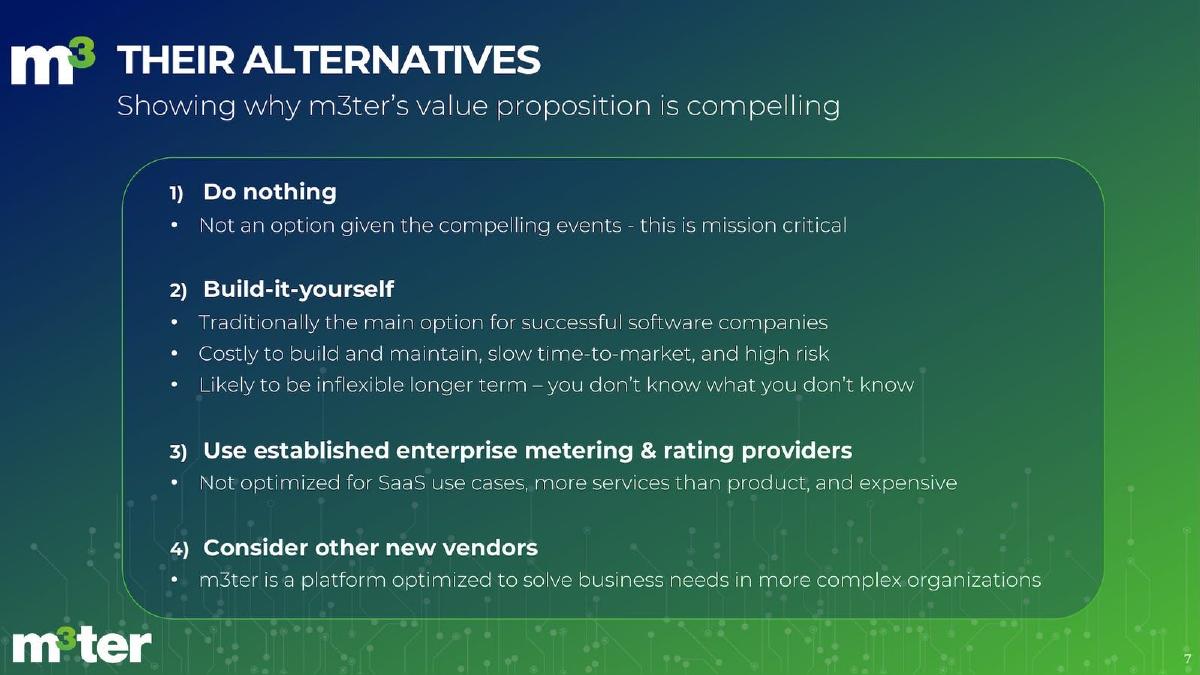
- M3ter dismisses the 'Build-it-yourself' alternative as costly, slow, and risky for even successful software companies (Slide 7).
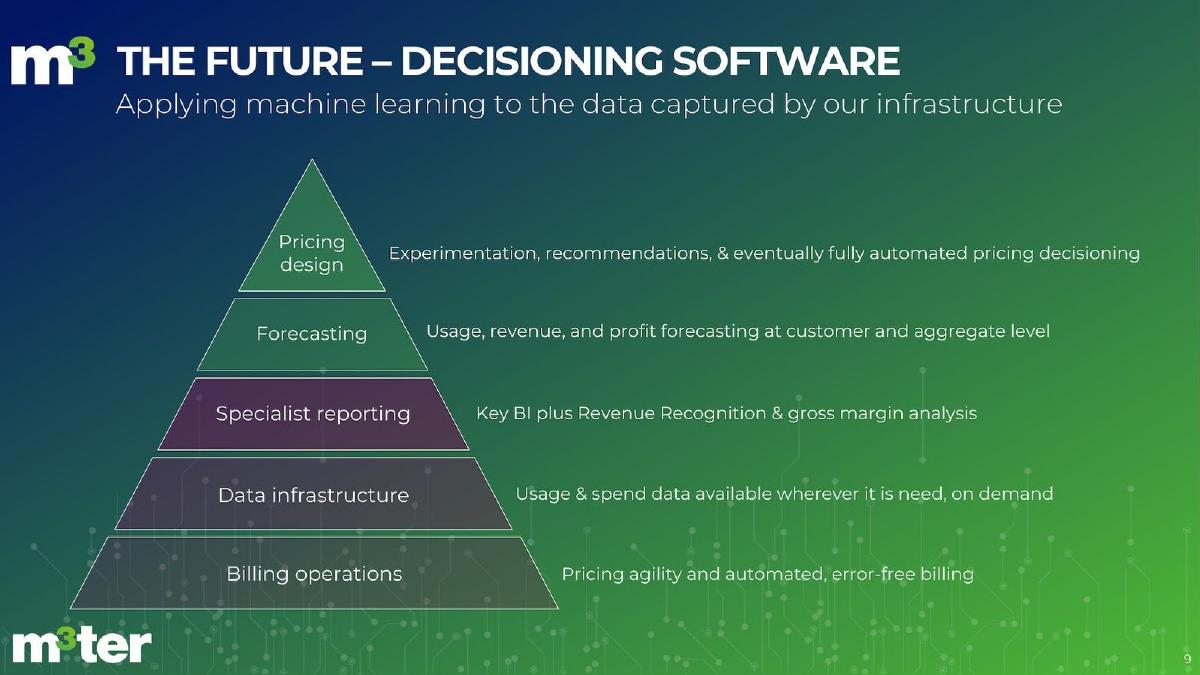
- The product vision follows a hierarchy from billing operations up to automated pricing design using machine learning (Slide 9).
- The company emphasizes its 'Minimum viable team' of 50 and SOC 1 and 2 certifications as evidence of being 'Ready to Grow' (Slide 11).
- The deck notes a shift from founder-led sales to an established sales-led motion with multiple lead sources (Slide 11).
The Strategic Narrative of Usage-Based Pricing
M3ter’s Series A deck is a focused argument for a new category of infrastructure. In the world of SaaS, the shift from flat-rate subscriptions to usage-based pricing (UBP) has created a technical vacuum. Most legacy billing systems were designed for the 'set it and forget it' model of the early 2010s. M3ter identifies this shift not just as a trend, but as a fundamental breakdown in business operations. The deck, consisting of 12 slides, moves methodically from the pain of the status quo to a vision of AI-driven pricing optimization. While it lacks the granular revenue charts often seen in Series A decks, it compensates with a very clear definition of its Ideal Customer Profile (ICP) and the 'compelling events' that trigger a purchase.
Slide 1-2: Brand and Identity
The deck opens with a clean, minimalist aesthetic. The logo, featuring a superscript '3', hints at the technical nature of the product—metering, measuring, and monetizing. The use of a circuit-board motif in the background reinforces that this is an infrastructure play, not just another SaaS application. By labeling it a 'Series A Pitch Deck' on the cover, the company sets a professional, standard tone for institutional investors.
Slide 3: The Pricing Operations Gap
This is the 'Problem' slide, and it is the most important slide in the deck. M3ter identifies a 'missing' piece of infrastructure. The slide argues that existing tools assume simple subscriptions and are not adapted to UBP. It lists five specific consequences: the inability to bill easily, the inability to bill reliably (leading to revenue leakage), poor customer experience (CX), the inability to iterate on pricing, and a reliance on guesswork rather than data. By framing the problem as a 'gap' in infrastructure, M3ter makes its solution feel like a logical necessity rather than a luxury.
Slide 4: The Infrastructure Solution
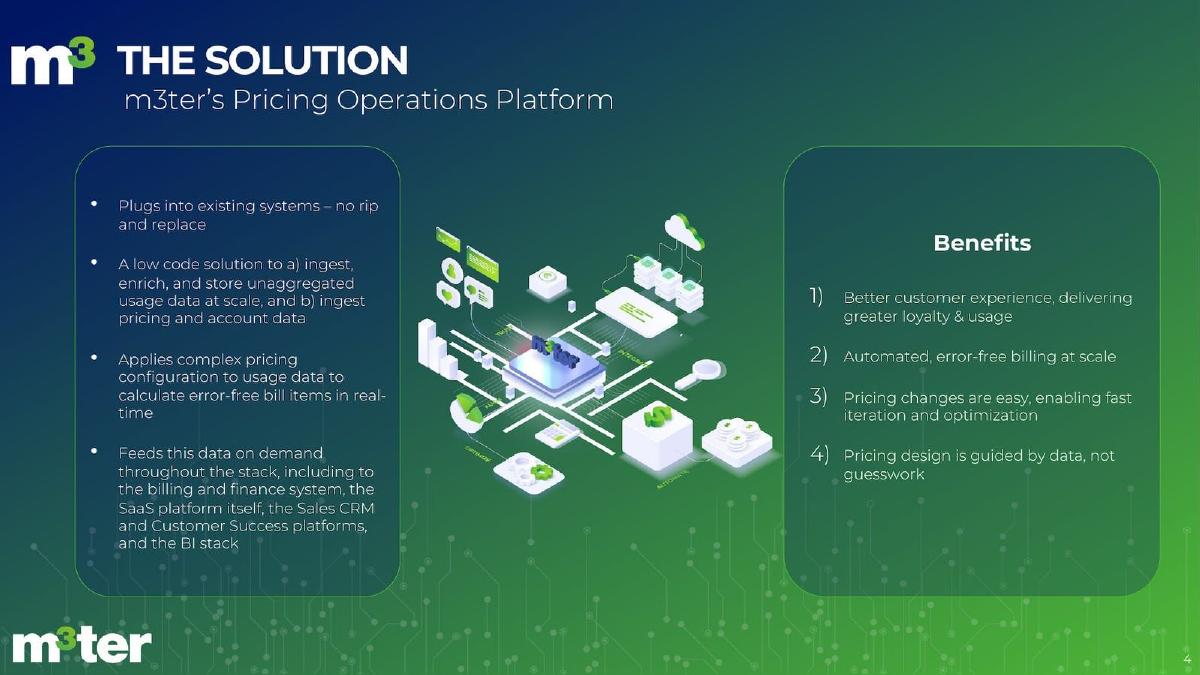
While the text for Slide 4 is minimal in the provided transcript, the narrative flow suggests this is where the platform is introduced as the bridge across the gap identified in the previous slide. In a Series A context, this slide usually functions to show how the product sits between the raw usage data generated by a cloud application and the final invoice generated by a billing system like Stripe or NetSuite.
Slide 5: Defining the Target Customer
M3ter is highly specific about who they sell to. They aren't looking for every startup; they are looking for 'Ambitious B2B software companies' with 'complexity.' They list five criteria: high volumes, multiple geos, multiple products, enterprise sales needs, and organizational 'heft.' This specificity is a strength; it tells investors that the founders know exactly where their product fits and where it doesn't. They also define the 'compelling events'—either a pricing transformation or 'acute operational pain'—which helps investors understand the sales triggers.
Slide 6: Product Depth
Slide 6 serves to reinforce the technical capability of the platform. In the infrastructure space, reliability and scalability are the primary concerns. This slide likely details how the metering engine handles high-velocity data streams without dropping events, which is a common failure point for companies trying to build this internally.
Slide 7: The Competitive Landscape
M3ter categorizes 'Their Alternatives' into four buckets. They dismiss 'Do nothing' as non-viable for mission-critical operations. They attack 'Build-it-yourself'—the biggest competitor for infrastructure startups—by highlighting the high cost, slow time-to-market, and long-term inflexibility. They distinguish themselves from 'established enterprise providers' by claiming those are service-heavy rather than product-led. Finally, they position themselves against other new vendors by claiming a focus on 'more complex organizations.'
Slide 8: Integration and Ecosystem
For a tool that sits in the middle of a tech stack, integrations are everything. This slide likely illustrates how M3ter connects to data sources (like AWS or Snowflake) and downstream systems (like CRM and ERP). The goal here is to prove that M3ter is 'plug-and-play' infrastructure that doesn't require a total overhaul of a company's existing systems.
Slide 9: The Future – Decisioning Software
This slide moves the conversation from 'what we do now' to 'what we will become.' Using a pyramid diagram, M3ter shows its evolution. It starts at the base with Billing Operations and Data Infrastructure. The middle layers add Specialist Reporting and Forecasting. The apex is 'Pricing Design,' which involves machine learning for experimentation and automated decisioning. This is the 'vision' slide that justifies a Series A valuation, moving the company from a utility to a strategic intelligence platform.
Slide 10: Market Momentum
Slide 10 likely focuses on the tailwinds of the UBP movement. As more SaaS companies move toward consumption-based models (following the lead of Snowflake and Datadog), the market for M3ter's infrastructure grows. This slide serves to validate the size of the opportunity.
Slide 11: Ready to Grow
This slide acts as a 'Traction and Team' hybrid. It lists several key milestones: a 'Minimum viable team' of 50, SOC 1 and 2 certifications (critical for enterprise trust), and a shift from founder-selling to an established sales motion. The mention of expanding in the US is a classic Series A goal, signaling that the company is ready to move beyond its European roots (as reported by Business Insider) into the largest software market in the world.
Slide 12: Conclusion
The deck concludes by reinforcing the brand. By the end of the 12 slides, the investor has a clear understanding of the problem (the UBP gap), the solution (metering infrastructure), the target (complex B2B SaaS), and the future (AI pricing design).
What Works in This Deck
The 'Problem' Framing: M3ter does an excellent job of naming the problem. 'The Pricing Operations Gap' is a sticky phrase that makes the need for a new tool feel inevitable. By listing the 'Consequences' on Slide 3, they attach a dollar value to the problem (revenue leakage, high opportunity costs).
ICP Clarity: Many startups try to be everything to everyone. M3ter’s Slide 5 is refreshingly honest about who they are for. By targeting companies with 'organizational heft,' they are signaling a high Contract Value (ACV) strategy, which is very attractive to Series A investors.
The Vision Pyramid: Slide 9 is a great way to show product roadmap without a boring list of features. It shows a logical progression from 'keeping the lights on' (billing) to 'strategic advantage' (automated pricing design).
What Is Missing from This Deck
Hard Metrics: The most glaring omission in this deck is the lack of specific financial or growth metrics. There is no mention of Annual Recurring Revenue (ARR), Net Revenue Retention (NRR), or customer count. While the publisher reports a $14M raise, the deck itself relies entirely on a qualitative narrative rather than quantitative proof of product-market fit.
Case Studies: While the deck describes the 'Target Customer,' it doesn't show a real-world example of a customer who moved from 'acute operational pain' to success using M3ter. A slide showing how a specific company reduced billing errors or increased revenue through pricing iteration would have strengthened the argument.
The 'Ask': There is no slide detailing how much capital is being raised or how it will be spent. While we know from external reports that the round was $14M, a standard pitch deck usually includes a slide outlining the use of funds (e.g., 50% R&D, 30% Sales/Marketing, 20% G&A).
Lessons for Founders
Don't just sell a tool; sell a bridge. M3ter doesn't just say 'we do billing.' They say 'there is a gap between your data and your revenue, and we are the bridge.' Founders should look for the 'missing' piece in their industry's workflow and name it.
Define your 'Compelling Events.' Knowing who your customer is is good; knowing when they are ready to buy is better. M3ter’s Slide 5 identifies the specific moments (pricing transformation or growth-blocking pain) when a lead becomes a high-intent prospect.
Build a 'Vision Pyramid.' If you are raising a Series A, you need to show that you aren't just building a feature. Use a diagram like Slide 9 to show how your current utility product will eventually become a strategic platform that uses data to provide higher-level value.
Frequently asked questions
- What is the primary problem M3ter solves according to the deck?
- According to Slide 3, M3ter solves the 'Pricing Operations Gap.' Existing billing tools are built for simple recurring subscriptions and lack the infrastructure to capture usage data, apply complex pricing, and deliver bill items across a business. This leads to revenue leakage and slow invoicing.
- Who is M3ter's ideal customer?
- Slide 5 defines the target as ambitious B2B software companies with high customer volumes, operations in multiple geographies, and multiple products. They specifically target companies with 'organizational heft' that require custom or private pricing for enterprise sales.
- How does M3ter differentiate itself from competitors?
- On Slide 7, M3ter argues that established enterprise providers are not optimized for SaaS, while other new vendors lack the platform depth to solve needs for complex organizations. They also position themselves against 'building it yourself,' citing high maintenance costs and inflexibility.
- What is the long-term vision for the M3ter platform?
- Slide 9 outlines a 'Future' where the platform moves beyond billing into 'Decisioning Software.' This involves applying machine learning to usage data to provide profit forecasting, gross margin analysis, and eventually fully automated pricing experimentation and design.
- What operational milestones does M3ter highlight for its Series A?
- Slide 11 highlights a team of 50, SOC 1 and 2 security certifications, and a transition to a sales-led motion. They also mention expanding into the US and having a corporate structure ready for global operations.