Diamond Finance, a subsidiary of Asia Pacific Investment Partners (APIP), used this July 2013 presentation to solicit individual lenders for a $3 million debt facility. Operating as a Non-Bank Financial Institution (NBFI) in Mongolia, the company reported a gross loan portfolio of $2.4 million and a notable 43% Return on Equity. The deck highlights a zero-percent default rate for loans over 30 days, contrasting sharply with the 6% industry average for NBFIs. The investment structure offers a high-margin return of 1,300 bps per annum, targeting individual lenders with a minimum $50,000 commitm…
Key takeaways
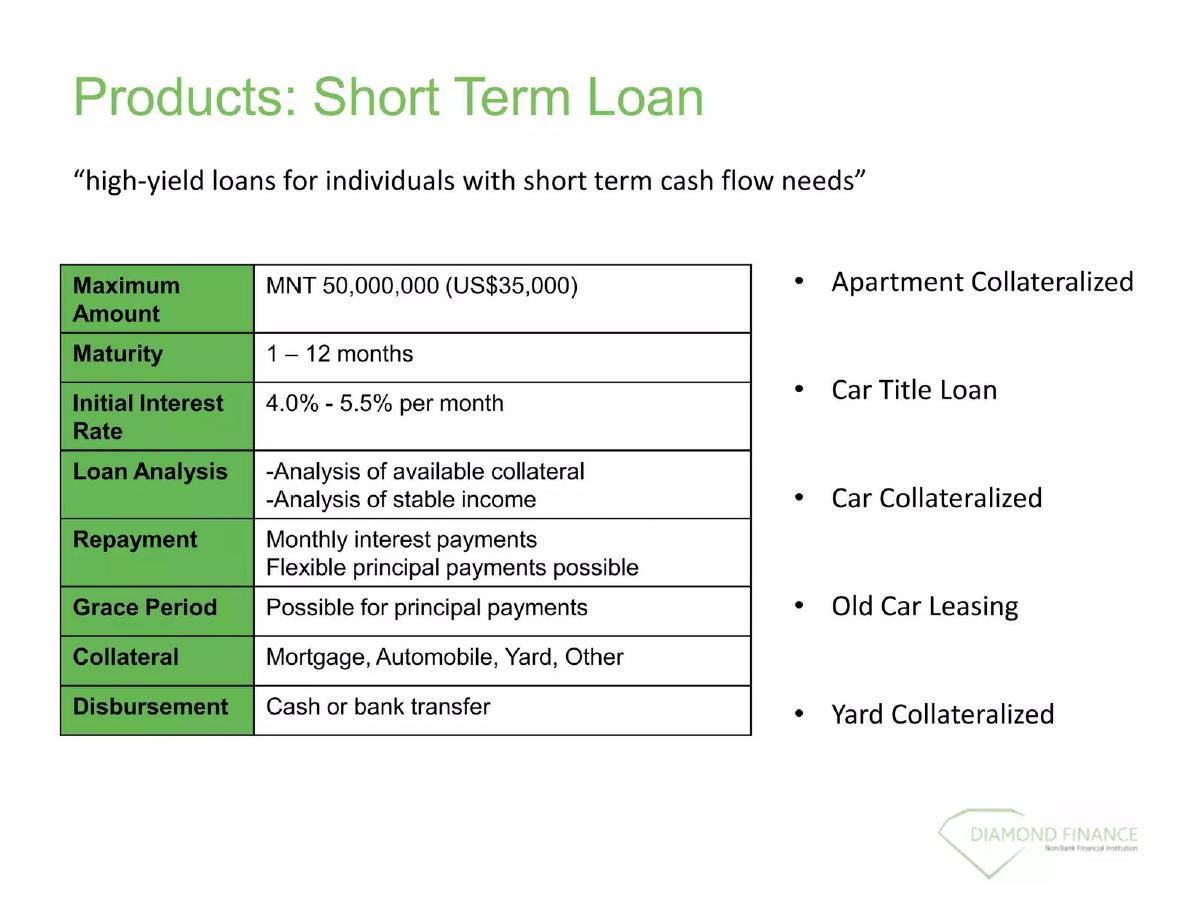
- The company reported a 43% Return on Equity and a gross loan portfolio of $2.4 million as of July 31, 2013 (Slide 4).
- Diamond Finance claims a 0% 'Portfolio at Risk > 30 Days,' significantly lower than the 6% NBFI industry average (Slide 4, Slide 7).
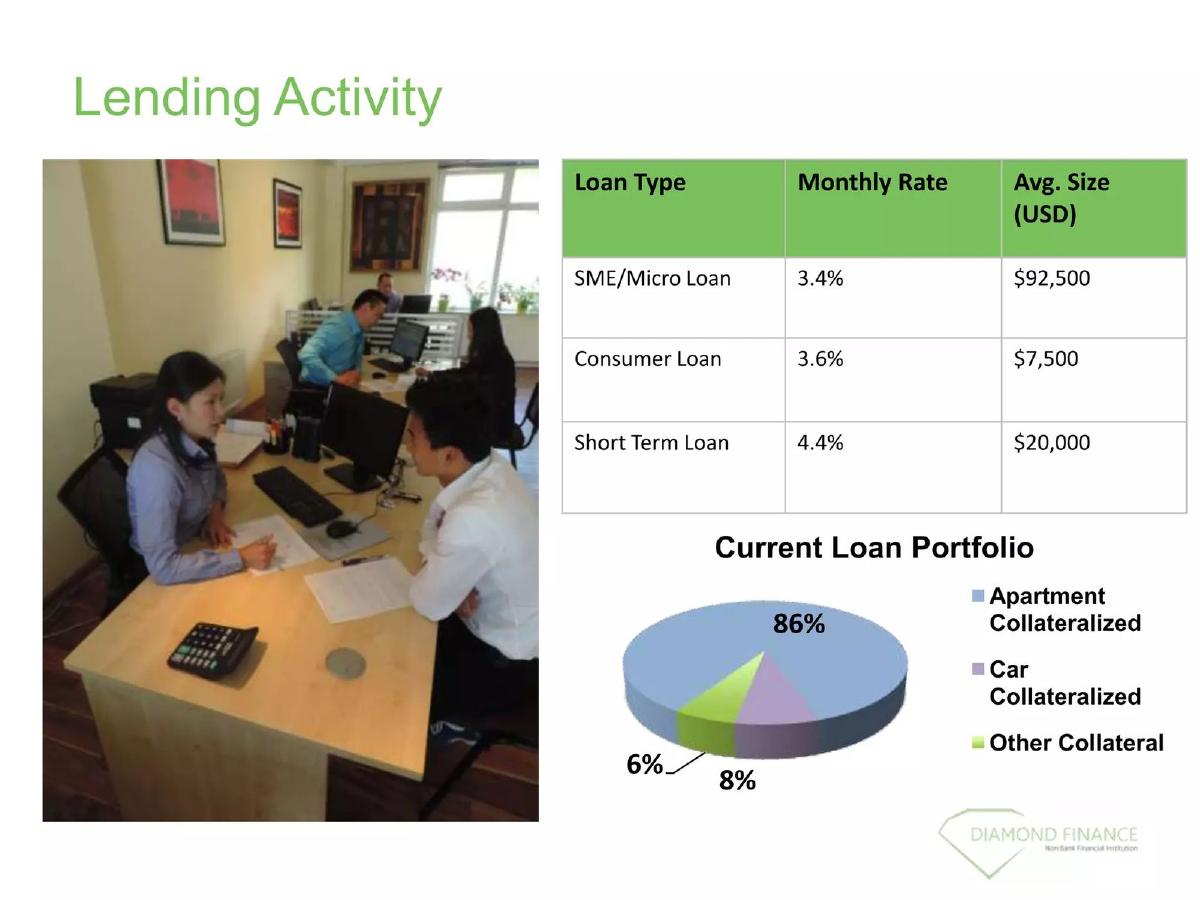
- The loan portfolio is heavily collateralized, with 86% of loans backed by apartments and 8% by cars (Slide 2).
- Average loan interest rates for Diamond Finance are stated at 46%, compared to 36% for other NBFIs and 27% for banks (Slide 7).
- The investment ask is for a $3 million facility, split into three $1 million tranches with a minimum individual lender size of $50,000 (Slide 9).
- The facility offers a margin of 1,300 bps per annum with a two-year term from the close of each tranche (Slide 9).
- Mongolian GDP growth is shown peaking at approximately 17% in 2011 and 2012, providing a high-growth macro backdrop (Slide 5).
- The deck omits a team slide, failing to identify the specific management personnel running the day-to-day lending operations.
Executive Summary: A High-Yield Debt Play in Emerging Markets
The Diamond Finance Investor Presentation from July 2013 is a focused debt-facility pitch. Unlike typical Silicon Valley equity decks that sell a vision of a disrupted future, this deck sells a high-yield financial instrument backed by a growing micro-lending portfolio in Mongolia. The company positions itself as a high-performance Non-Bank Financial Institution (NBFI) capable of generating a 43% Return on Equity while maintaining a 0% default rate. The goal of the presentation is to secure $3 million in debt capital to fuel the expansion of their loan book.
Slide 1: Title and Branding
The cover slide features a night-time cityscape of Ulaanbaatar, Mongolia, establishing the geographic focus immediately. It identifies Diamond Finance as a "Non-Bank Financial Institution." The branding is clean, using a green diamond logo that persists throughout the deck. The subtitle "Investor Presentation" is generic but appropriate for the professional, finance-heavy tone of the following slides.
Slide 2: Lending Activity and Portfolio Composition
This slide breaks down the core business. It lists three primary loan types: SME/Micro Loans (Avg. size $92,500, 3.4% monthly rate), Consumer Loans ($7,500 avg., 3.6% monthly), and Short Term Loans ($20,000 avg., 4.4% monthly). A pie chart titled "Current Loan Portfolio" reveals that 86% of their loans are collateralized by apartments, 8% by cars, and 6% by other collateral. This emphasizes a low-risk, asset-backed lending strategy despite the high interest rates.
Slide 3: Product Deep Dive - Consumer Loans
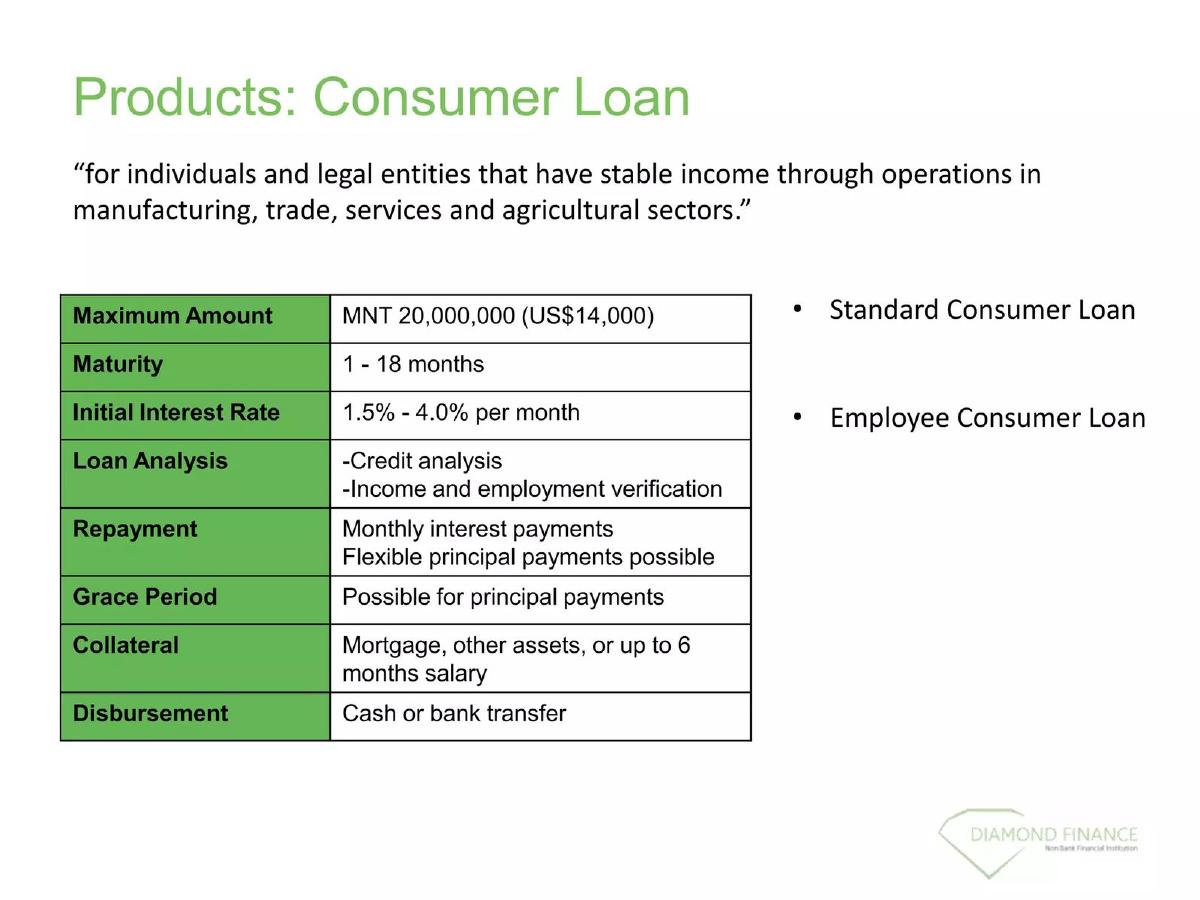
Focusing on the Consumer Loan product, this slide provides a technical table of terms. The maximum amount is MNT 20,000,000 (approximately $14,000 USD). Maturity ranges from 1 to 18 months with interest rates between 1.5% and 4.0% per month. The slide notes that loan analysis includes credit analysis and income/employment verification. Repayment is structured as monthly interest with flexible principal payments, and collateral includes mortgages or up to six months of salary.
Slide 4: Current Position and Financial Health
Slide 4 presents the company's vitals as of July 31, 2013. Key figures include:
Total Assets: $2.7 million · Gross Loan Portfolio: $2.4 million · Owners Equity: $733,765 · Return on Equity: 43% · Number of Borrowers: 64 · Average Maturity: 6 months · Portfolio at Risk > 30 Days: 0%
The 0% risk metric is the most aggressive claim in the deck, suggesting a perfect collection record at the time of the presentation. The slide also notes that the company is 100% owned by Asia Pacific Investment Partners LLC.
Slide 5: Macroeconomic Context - Mongolian GDP
To justify the opportunity, the deck pivots to macro data. A line chart shows Mongolian GDP growth compared to the World and BRIC nations. Mongolia is shown peaking at roughly 17% growth in 2011 and 2012, significantly outperforming the global average. Even with a forecasted dip to 12% in 2013, the slide paints a picture of a hyper-growth economy that requires significant capital for lending.
Slide 6: The Mongolian Banking Industry
This slide uses two charts to show the growth of the financial sector. "Banking Industry Assets" grew from $3 billion in 2009 to nearly $10 billion by April 2013. More importantly for the company, "NBFI Assets" grew from approximately $70 million to $200 million in the same period. This demonstrates that the non-bank sector is not just a niche but a rapidly expanding segment of the national economy.
Slide 7: Comparative Performance
Diamond Finance compares itself to the broader market on two metrics: Average Loan Interest Rate and Average Default Rate. Diamond Finance claims a 46% interest rate, compared to 36% for NBFIs and 27% for Banks. Critically, it shows its default rate at 0%, while NBFIs average 6% and Banks average 3%. This slide is intended to prove that Diamond Finance is a "best-in-class" operator that can charge premium rates while maintaining superior asset quality.
Slide 8: Growth Forecasts
The growth forecast slide is highly ambitious. It projects the Gross Loan Portfolio to scale from $2.4 million in 2013 to $12 million by 2015. Net Profit is projected to follow a similar trajectory, moving from $1.00 million in 2013 to $4.48 million in 2015. The chart shows 2011 and 2012 as historical data, with 2013 through 2015 marked as forecasts ("F").
Slide 9: The Investment Opportunity (The Ask)
This is the most critical slide for potential lenders. It outlines the terms of a $3 million facility:
Borrower: Diamond Finance Limited (Hong Kong incorporated). · Lenders: Individuals, minimum $50,000. · Facility: Up to $3 million in three $1 million tranches. · Term: Two years per tranche. · Margin: 1,300 bps (13%) per annum. · Security: Guaranteed by Asia Pacific Investment Partners HK. · Jurisdiction: Hong Kong.
The 13% annual return is positioned as a high-yield alternative for individual investors, backed by a corporate guarantee.
Slide 10: Contact Information
The final slide provides a contact email for "Will" at apipcorp.com and features the logo of the parent company, Asia Pacific Investment Partners. The background image of a handshake reinforces the nature of the deal as a professional financial agreement.
What Diamond Finance Does Well
The deck is exceptionally clear about the financial mechanics of the business. For a debt-focused investor, the most important details are the interest rates, the default rates, and the collateral. Diamond Finance provides all three in specific detail. The use of macro data (GDP and industry growth) successfully frames the Mongolian market as an attractive, high-growth environment rather than a risky frontier market. The comparison slide (Slide 7) is a powerful tool for showing competitive advantage, assuming the 0% default rate is verifiable.
What is Missing from the Deck
The most glaring omission is a Team Slide . While the parent company (APIP) is mentioned, there is no information about the individuals managing the credit risk, the local operations in Ulaanbaatar, or the legal team in Hong Kong. In lending, the quality of the people making the credit decisions is paramount. Additionally, there is no mention of Unit Economics beyond interest rates; we do not see the cost of customer acquisition or the operational overhead required to manage 64 (and eventually hundreds) of borrowers. Finally, the deck lacks a Risk Disclosure slide. Investing in a Mongolian NBFI involves significant currency risk, regulatory risk, and liquidity risk, none of which are addressed in these slides.
Founder's Guide: What to Copy and What to Avoid
Copy the Clarity of the Ask: Slide 9 is a masterclass in how to present a debt facility. It uses a simple table to define the borrower, the term, the return, and the security. There is no ambiguity about what the investor is being asked to do. If you are raising debt, use this format.
Copy the Macro-to-Micro Flow: The deck starts with what the company does, proves the market is growing (GDP/Banking assets), and then shows why the company is the best player in that market (Comparative Performance). This logical flow builds a strong case for the investment.
Avoid the "Too Good to be True" Trap: Claiming a 0% default rate while charging 46% interest (Slide 7) will trigger immediate skepticism from sophisticated investors. While it may have been true at that specific moment in time, it is statistically improbable to maintain as a business scales. Founders should provide a range or a historical average rather than a perfect zero, which can look like an accounting anomaly or a lack of transparency.
Avoid Omitting the Team: Especially in emerging markets, investors are betting on the integrity and experience of the founders. Never leave out the team slide, particularly when asking for $50,000 checks from individual lenders who need to trust the people handling their money.
Frequently asked questions
- What is the specific investment being offered?
- Diamond Finance is seeking individual lenders for a $3 million debt facility. This is not an equity round but a lending opportunity where investors provide capital in tranches of $1 million. The minimum investment for an individual is $50,000. The term is two years, and the return is structured as a margin of 1,300 basis points (13%) per annum, with interest paid six months in arrears.
- How does Diamond Finance justify its high interest rates?
- The deck shows that Diamond Finance charges an average loan interest rate of 46%, which is higher than the NBFI average of 36% and the bank average of 27%. They justify this through their 'Current Position' metrics, which claim a 0% default rate for loans over 30 days, suggesting superior risk assessment or collection capabilities compared to the 6% industry average for NBFIs.
- What kind of collateral does the company hold?
- The lending activity is highly secured. According to slide 2, 86% of the current loan portfolio is collateralized by apartments, 8% by cars, and 6% by other assets. For their specific consumer loan product, they accept mortgages, other assets, or up to six months of salary as collateral to mitigate the risk of their 1.5% to 4.0% monthly interest rates.
- What is the corporate structure of Diamond Finance?
- Diamond Finance Limited is a company incorporated in Hong Kong. It is a 100% wholly owned subsidiary of Asia Pacific Investment Partners Limited (APIP). The investment facility is also guaranteed by Asia Pacific Investment Partners HK, providing a layer of corporate backing from the parent entity rather than just the local Mongolian operations.
- What are the projected growth targets?
- The company anticipates significant scaling. Slide 8 forecasts that the Gross Loan Portfolio will increase from $1.45 million in 2012 to $12 million by 2015. Commensurately, Net Profit is projected to rise from $0.19 million in 2012 to $4.48 million in 2015, representing a very aggressive expansion of their lending book and bottom line.