Dharma’s 17-slide pitch memo presents a compelling case for 'passion-led' travel, positioning creators as the next generation of travel agents. By handling the complex logistics of supplier contracting, payments, and insurance, Dharma allows creators to monetize their captive audiences through curated group experiences. The deck leans heavily on the inefficiency of traditional Online Travel Agencies (OTAs), which spend up to 35% of revenue on customer acquisition. Dharma counters this with a $0 CaC model, claiming to have reached a $2M Booked Revenue ARR within a year of launching their MVP.…
Key takeaways
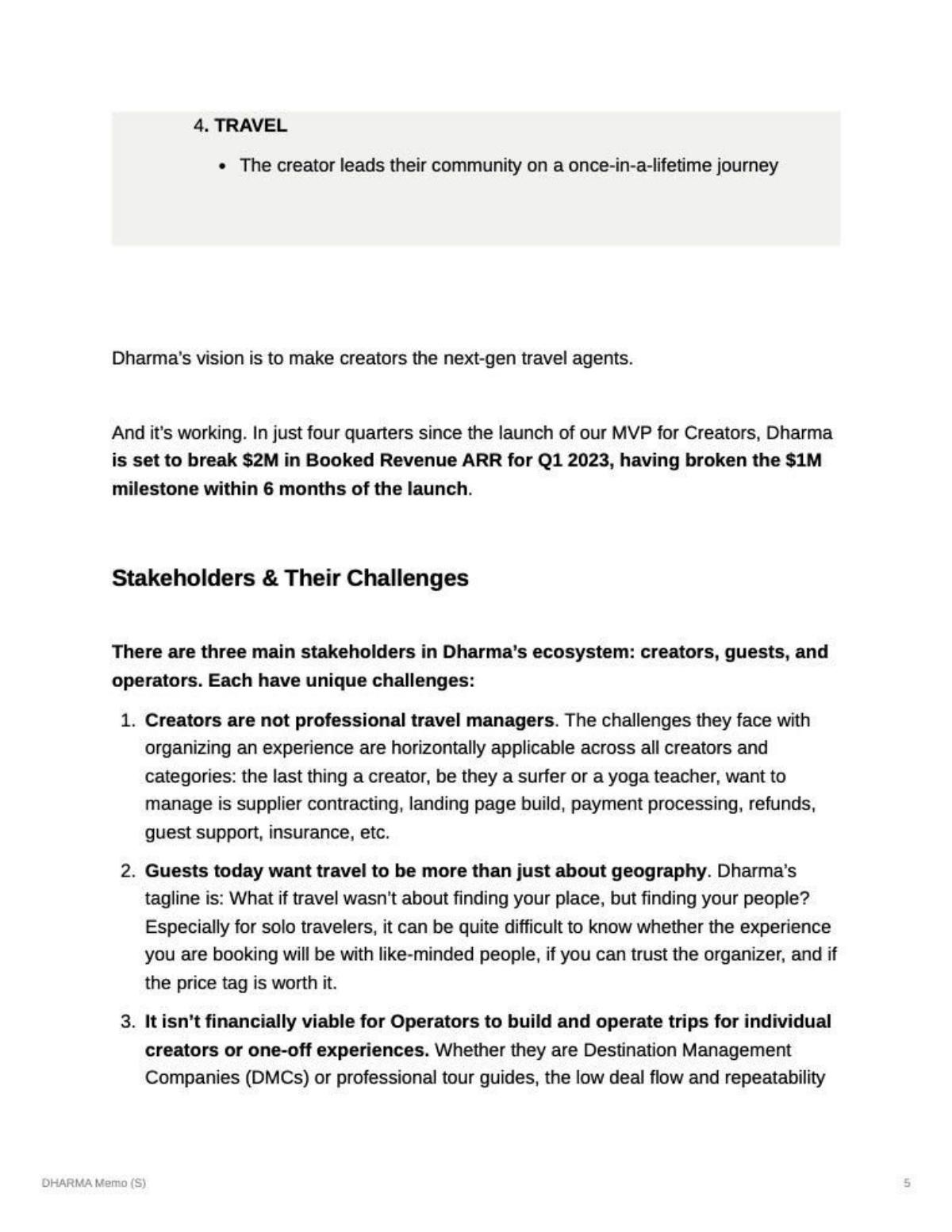
- Dharma reports reaching a $2M Booked Revenue ARR for Q1 2023, just four quarters after their MVP launch (Slide 5).
- The company identifies a massive inefficiency in travel, noting that OTAs like Trivago and Expedia spend between 25% and 50%+ of revenue on marketing (Slide 9).
- Dharma claims a $0 Customer Acquisition Cost (CaC) by utilizing creators' existing audiences for distribution (Slide 9).
- The platform targets the 'medium and long tail' of the 50M+ global creators to scale beyond iconic brands (Slide 1).
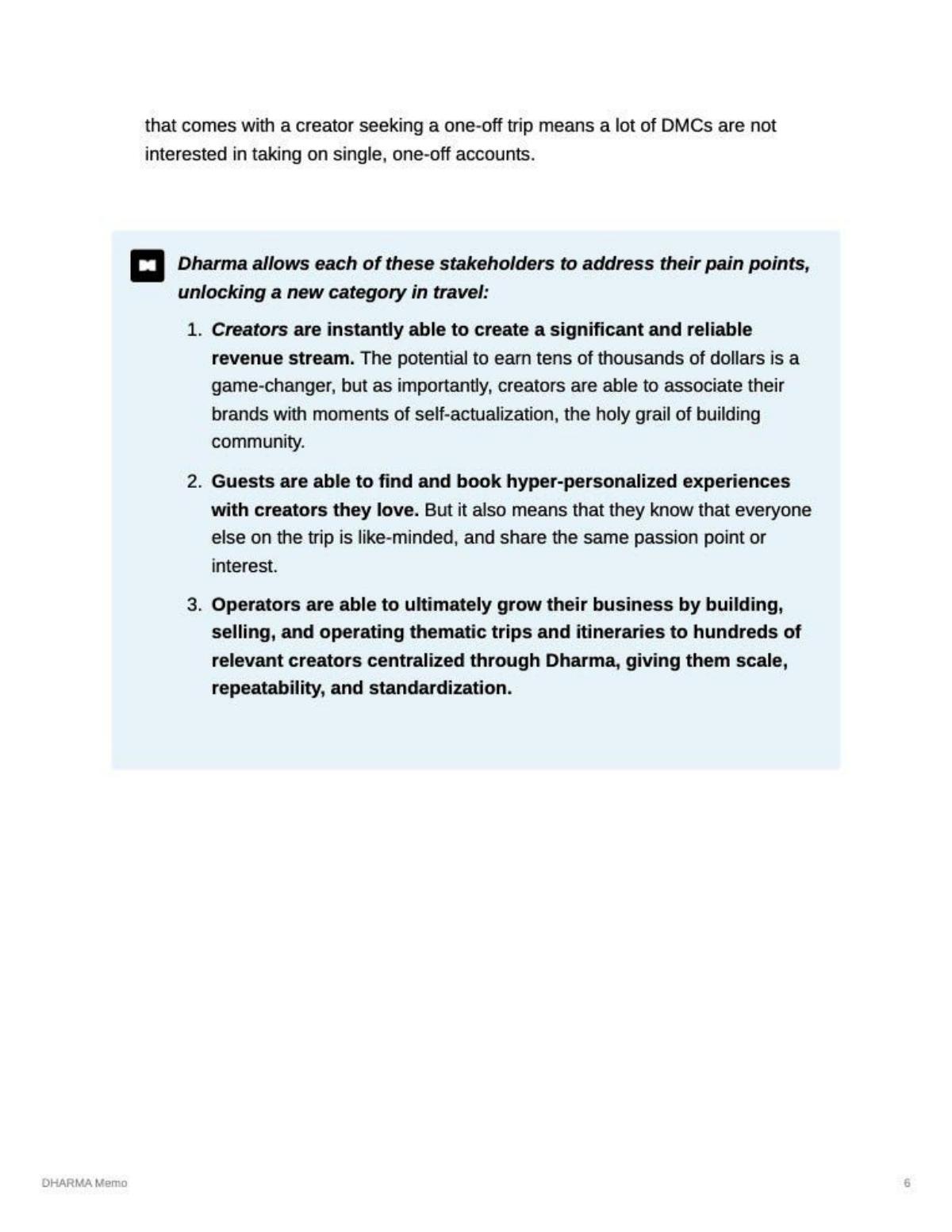
- The business model solves for three stakeholders: creators (logistics), guests (community/trust), and operators (deal flow) (Slide 5).
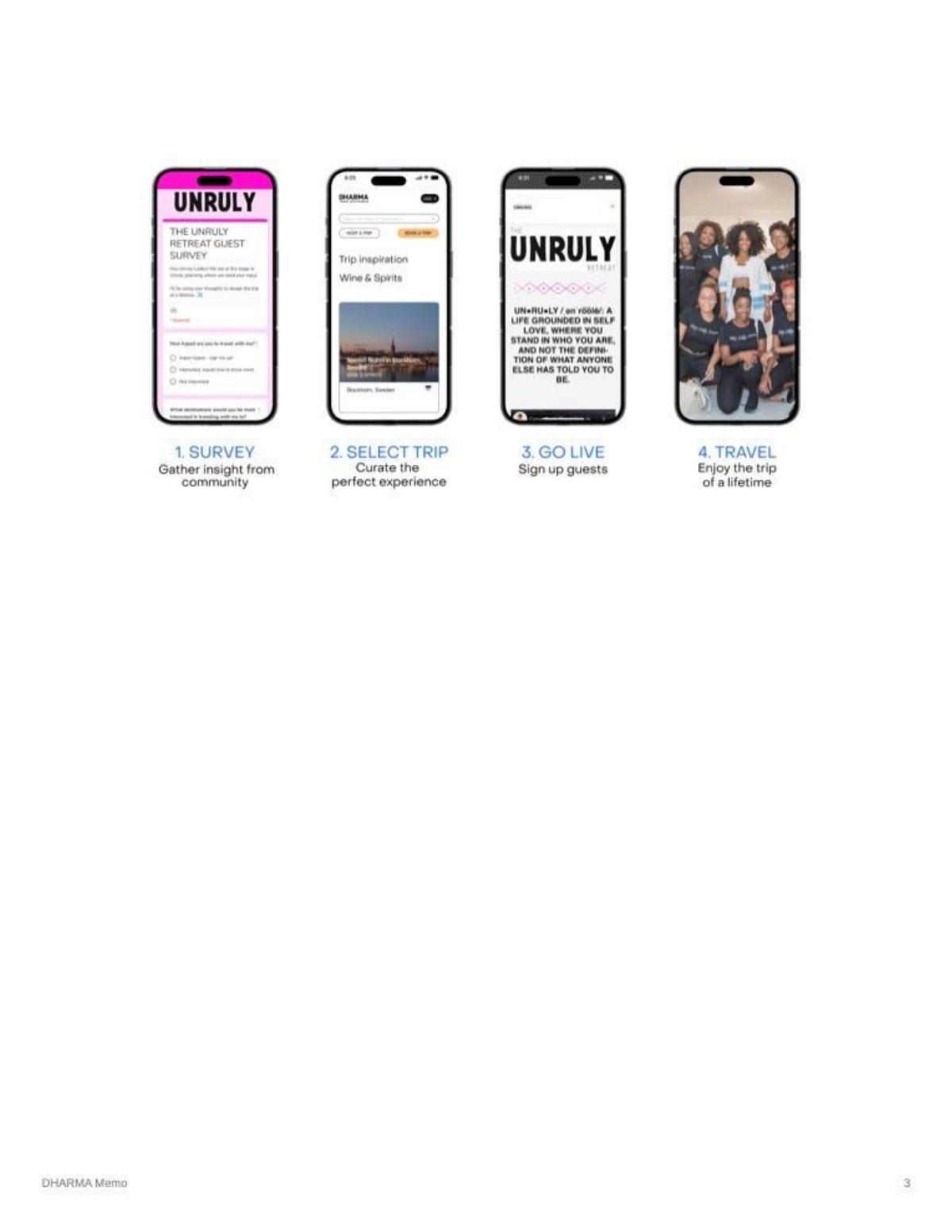
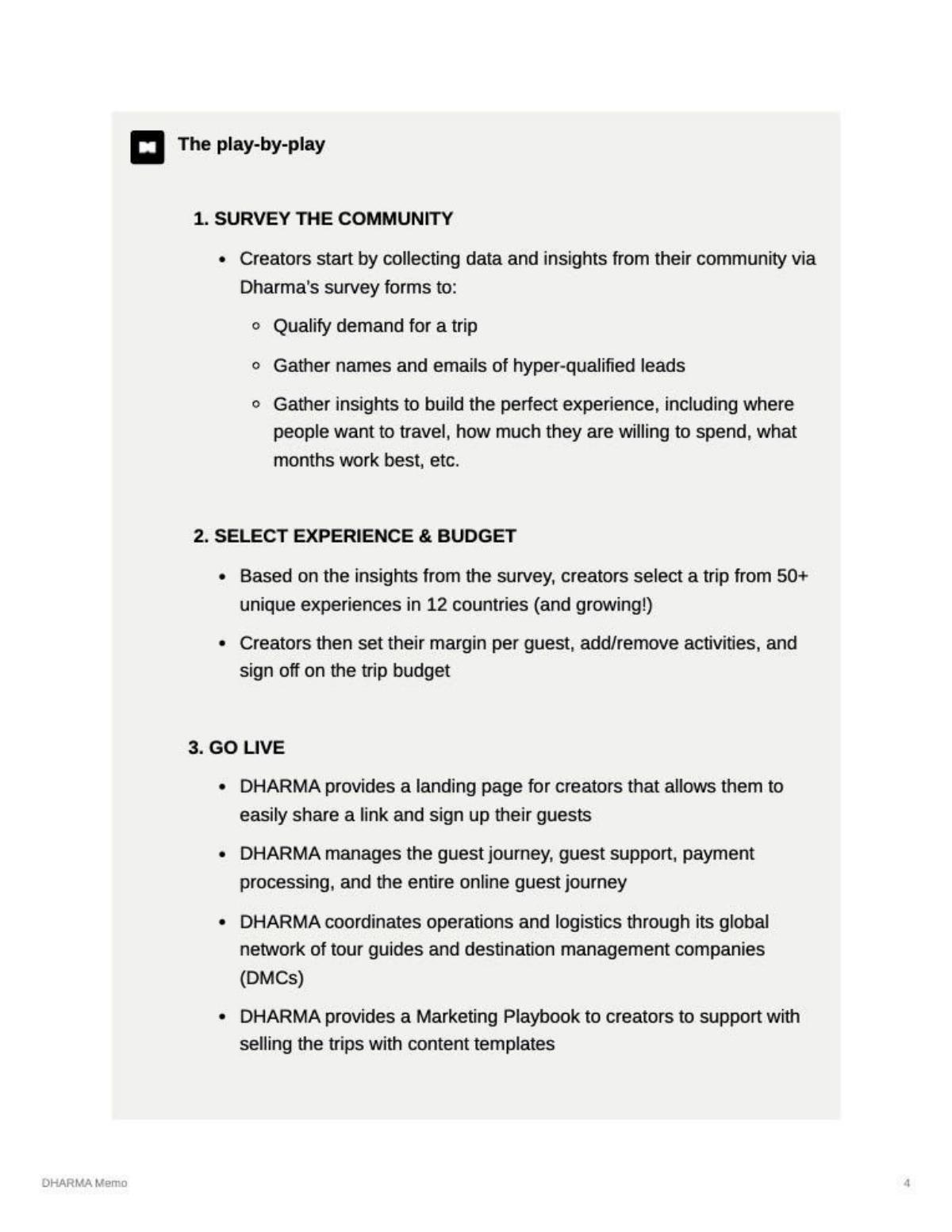
- Dharma provides a four-step user flow: Survey, Select Trip, Go Live, and Travel (Slide 3).
- The deck cites a 'Decline in Friendship' study as a social tailwind, suggesting travel is a tool for finding 'your people' rather than just 'your place' (Slide 13).
- The roadmap projects reaching the 10,000th guest booking by Q4 2024 (Slide 15).
Dharma Pitch Deck Teardown: The Memo-Style Approach to Travel Tech
Dharma’s pitch deck, or 'pitch memo' as they label it, represents a shift away from flashy, image-heavy slides toward a narrative-driven, data-backed document. This style is increasingly popular for Pre-Series A and Series A rounds where the business model's logic and early traction are more important than just the 'vibe' of the brand. As reported by Business Insider, Dharma raised $4.7M in 2024 to fuel this creator-led travel vision.
Slide 1: Introduction and Core Conviction
The deck opens with a high-level philosophical question: 'Where would your passion take you next?' It immediately anchors the brand in 'passion-led' travel. The slide lists high-profile examples like Equinox, Chef’s Table, and Hypebeast to establish the caliber of experiences Dharma facilitates. Crucially, it identifies the target market: the 50M+ creators globally, specifically focusing on the medium and long tail rather than just the top 1% of celebrities.
Slide 2-3: The User Experience and Product Flow
Slide 3 uses a clean four-step visual to explain how a trip comes to life: 1. Survey (gathering insights), 2. Select Trip (curation), 3. Go Live (sign-ups), and 4. Travel. This simplifies a very complex logistical process into a digestible workflow for potential investors. It demonstrates that Dharma isn't just a booking engine; it's a tool for creators to understand their community's desires before committing to a product.
Slide 4-5: Traction and Stakeholder Challenges
Dharma doesn't bury the lead on revenue. Slide 5 states the company is 'set to break $2M in Booked Revenue ARR for Q1 2023,' having hit the $1M mark within six months of launch. This is a strong signal of product-market fit. The slide also breaks down the 'Stakeholders & Their Challenges,' identifying that creators aren't travel managers, guests want community over just geography, and operators need repeatable deal flow. By addressing all three, Dharma positions itself as the essential glue in the ecosystem.
Slide 6-7: The Ecosystem Diagram
Slide 7 provides a technical look at how the platform functions. It shows the flow between the Creator, the Trip Inventory, the Dharma Technology, the Operator, and the Guest. The text emphasizes that this model disrupts the 'untenable CaC-heavy model in consumer travel.' It uses a real-world example—fitness creator Kelsey Wells with 3M followers—to ground the theory in reality.
Slide 8-9: The Broken Distribution Model
Slide 9 is perhaps the most important slide for a venture capitalist. It argues that 'Consumer travel distribution is broken.' It includes a bar chart showing marketing spend as a percentage of revenue for major players: Trivago (~50%+), Expedia (~45%), Tripadvisor (~45%), and Booking (~40%). By contrast, Dharma claims a $0 CaC. This is a powerful economic argument; if Dharma can truly acquire customers for free through creators, their margins will eventually dwarf those of the legacy OTAs.
Slide 10-11: The Creator Economy and Hierarchy of Needs
Dharma leans into the macro trend of the creator economy. Slide 11 features a 'Creator Hierarchy of Needs' pyramid, moving from 'Publish' to 'Grow' to 'Monetize.' It argues that creators are looking for 'Personal Monopolies' and reliable revenue sources beyond fickle influencer marketing contracts. Travel experiences are presented as the ultimate monetization tool for creators who have already built deep trust with their audience.
Slide 12-13: The Social Tailwind
In a surprising move, Slide 13 cites a study on the 'Decline in Friendship,' showing the percentage of people with few or no close friends has increased significantly since 1990. Dharma uses this to justify why 'finding your people' is a primary driver for travel today. It frames their product not just as a vacation, but as a solution to a modern social crisis of loneliness.
Slide 14-15: The Roadmap to 10,000 Bookings
Slide 15 provides a clear timeline of milestones. It tracks progress from Q1 2023 (launching 5 core verticals) to a projected Q4 2024 (reaching the 10,000th guest booking). It also notes a '1st Breakeven Month' in Q3 2024, which is a critical milestone for any startup in the current funding environment where profitability is prioritized over growth-at-all-costs.
Slide 16-17: Team and Investors
The deck concludes with the people behind the project. Slide 16 introduces Charaf, Nisma, Brice, and Leah, though it lacks specific bios or past company logos, which is a slight omission. Slide 17 lists the investors, providing social proof via established firms like Convivialite Ventures and Shorooq Partners. The inclusion of photos and locations (San Francisco, Abu Dhabi, Salzburg) suggests a global operation from day one.
What Dharma Does Well
Economic Contrast: The comparison of marketing spend between Dharma ($0 CaC) and legacy players like Expedia (45% of revenue) is the strongest part of the deck. It clearly articulates why this business should exist and how it can scale profitably.
Stakeholder Alignment: The deck does an excellent job of explaining why every party in the transaction wins. Often, marketplaces forget to explain the value to the supply side (operators) or the middleman (creators), but Dharma covers all bases.
Narrative Consistency: The 'memo' format allows the founders to build a logical argument page by page. It feels less like a sales pitch and more like a strategic briefing, which can build significant trust with sophisticated investors.
What is Missing from the Dharma Deck
Unit Economics: While the deck mentions 'Booked Revenue ARR,' it does not explicitly detail the take rate or the margin split between Dharma, the creator, and the operator. Investors would want to know exactly how much of a $2,000 trip ends up as net revenue for Dharma.
Competitive Landscape: There is no slide addressing other creator-travel platforms (like TrovaTrip). Acknowledging competitors and explaining Dharma's specific moat (perhaps their 'proprietary thematic/branded inventory' mentioned on Slide 7) would have strengthened the case.
Detailed Team Bios: Slide 16 is very vague. For a $4.7M round, investors usually want to see the specific pedigree of the founders—did they come from Airbnb, Expedia, or a successful creator agency? The deck simply says they are a 'mix of deep tech and deep travel.'
Founder Takeaways: What to Copy
Use the 'Memo' Style for Complex Models: If your business model requires a lot of 'if this, then that' logic, don't be afraid to use more text. Dharma proves that you don't need a 10-word-per-slide limit if the content is high-quality and the narrative is tight.
Highlight Macro Tailwinds: Dharma didn't just talk about travel; they talked about the creator economy and the loneliness epidemic. Connecting your startup to broad social or economic shifts makes the 'Why Now?' slide much more compelling.
Visualizing the 'Win-Win-Win': If you are building a multi-sided marketplace, copy the stakeholder challenge breakdown from Slide 5. It shows you understand the friction points for everyone involved, not just your primary customer.
Frequently asked questions
- What is Dharma's core business model?
- Dharma operates as a travel-as-a-service platform that enables creators and brands to launch their own travel businesses. They handle the 'unsexy' back-end logistics including supplier contracting, payment processing, insurance, and guest support. Creators provide the audience and curation, while professional operators handle on-the-ground execution. This allows Dharma to capture travel spend without the high marketing costs typical of the industry.
- How does Dharma acquire customers without spending on marketing?
- Dharma utilizes a $0 CaC model by leveraging the 'captive audience' of creators. Instead of buying ads on Google or Facebook like traditional OTAs, Dharma allows creators to market trips directly to their followers. The creator's margin essentially covers the cost of acquisition, making the distribution model highly efficient compared to Expedia or Booking.com.
- What specific problem does Dharma solve for travel operators?
- For Destination Management Companies (DMCs) and tour guides, building one-off experiences for individual creators is usually not financially viable due to low deal flow and lack of repeatability. Dharma provides these operators with a streamlined way to access creator-led demand at scale, handling the interface between the creator's brand and the operator's logistics.
- What are the key growth metrics mentioned in the deck?
- The deck highlights that Dharma broke the $1M revenue milestone within six months of launch and was set to break $2M in Booked Revenue ARR by Q1 2023. Additionally, the roadmap shows a trajectory from launching 5 core verticals in Q1 2023 to a projected 10,000 guest bookings by the end of 2024.
- Who are the founders and investors behind Dharma?
- The founding team consists of Charaf, Nisma, Brice, and Leah. The deck notes they possess a mix of 'deep tech and deep travel' expertise. Investors listed on the final slide include Wendy Wattebled (Convivialite Ventures), Abdallah Yafi (BY Venture Partners), Roland Steiner (L& Ventures), and Tamer Azer (Shorooq Partners).