The Diablo pitch deck, created by Condor, Inc. in 1994, is a text-heavy, 8-slide document that successfully defined a new sub-genre of role-playing games. Eschewing modern 'multimedia extravaganzas,' the deck focuses on core mechanics: an isometric perspective, turn-based combat (which famously changed during development), and the Dynamic Random Level Generation (DRLG) system. Notably, the deck proposes a business model based on $4.95 expansion disks inspired by Magic: The Gathering, aiming for long-term revenue through collectability. While it lacks a formal 'Ask' or financial projections, i…
Key takeaways
- The game was originally pitched as a turn-based system using a mouse to move from 'square' to 'square' (Slide 2).
- Condor, Inc. identified a 'neglected niche' in the market, moving away from complex multimedia toward 'hack and slash' (Slide 2).
- The deck introduces the 'Dynamic Random Level Generation (DRLG) System' as the core driver of replayability (Slide 2).
- A unique permadeath mechanic was proposed: if a character dies, they are 'erased completely from the hard-drive' (Slide 5).
- The marketing strategy was modeled after Magic: The Gathering, using $4.95 expansion packs to drive point-of-purchase sales (Slide 6).
- The development plan required a specific 12-person team, including one designer and three pixel artists (Slide 7).
- A detailed 12-month Gantt chart outlines the path from design to a 4-month testing and balance phase (Slide 8).
- The deck omits any mention of a specific funding amount, valuation, or existing investor interest (Slides 1-8).
The Concept: Reinvigorating the Hack and Slash
The Diablo pitch deck, authored by Condor, Inc. in 1994, is a foundational document in gaming history. At a time when the industry was moving toward high-budget 'multimedia extravaganzas,' Condor proposed a return to core gameplay values. The deck is remarkably text-heavy, functioning as a narrative proposal rather than a visual presentation. It sets a dark, gothic tone from the cover slide and maintains a focus on the 'neglected niche' of accessible, replayable action-RPGs.
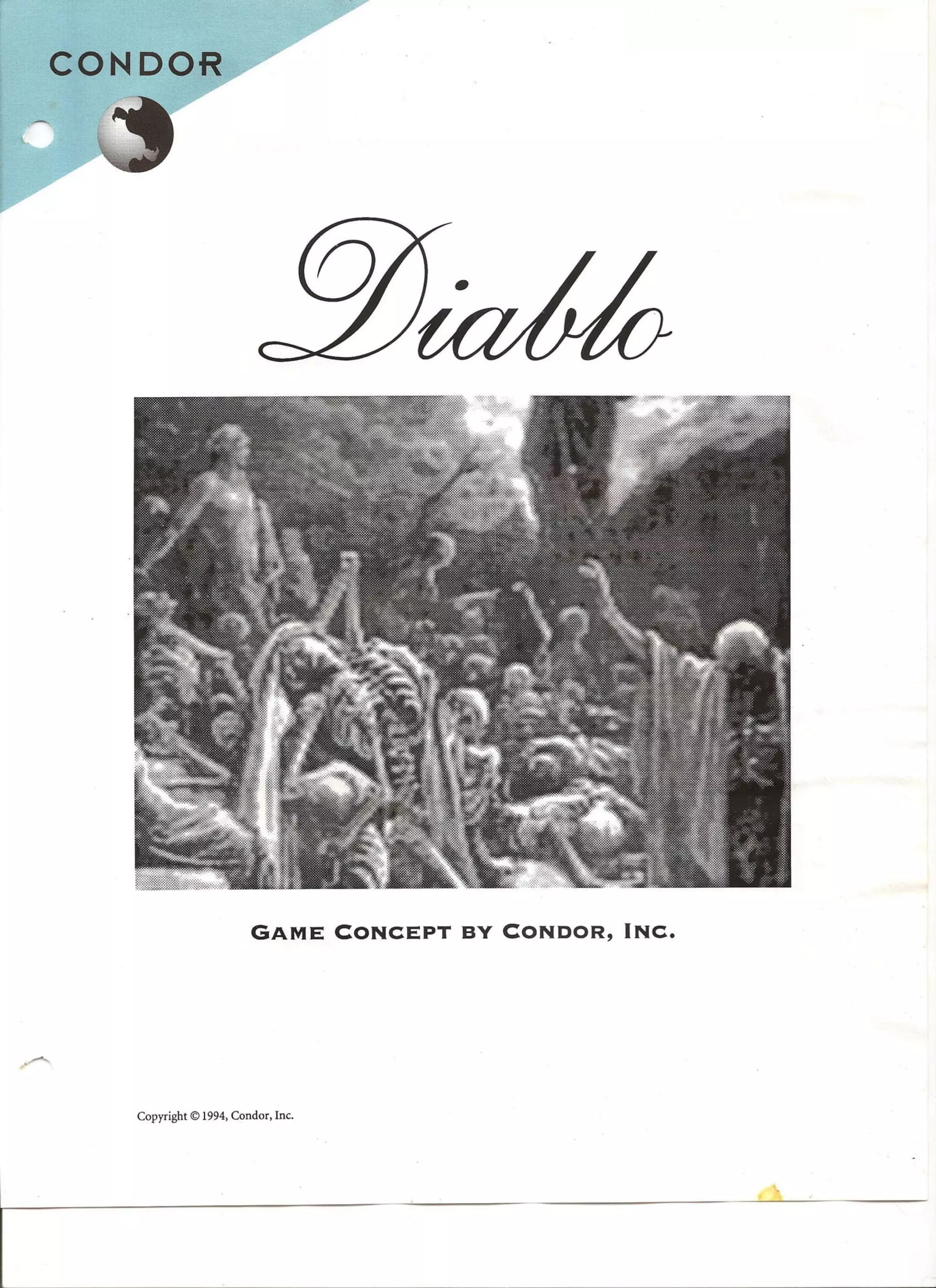
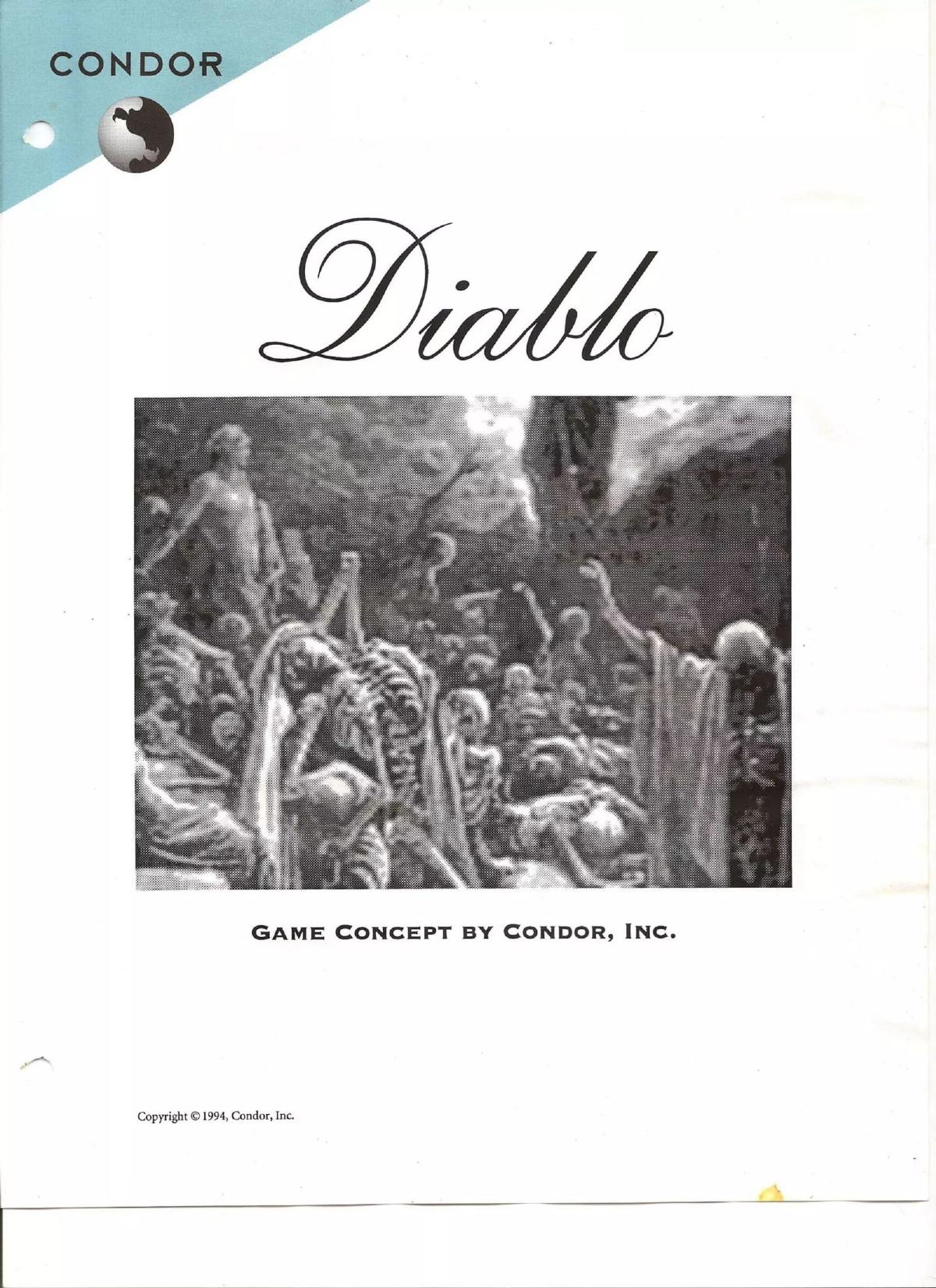
Slide 1: Title and Cover
The cover slide features the title 'Diablo' in a stylized script, accompanied by a black-and-white illustration of a chaotic, skeletal scene. The branding is minimal, identifying the project as a 'Game Concept by Condor, Inc.' and noting a 1994 copyright. There are no taglines or high-level value propositions here; the imagery does the work of establishing the 'dark quest for justice' mentioned later.
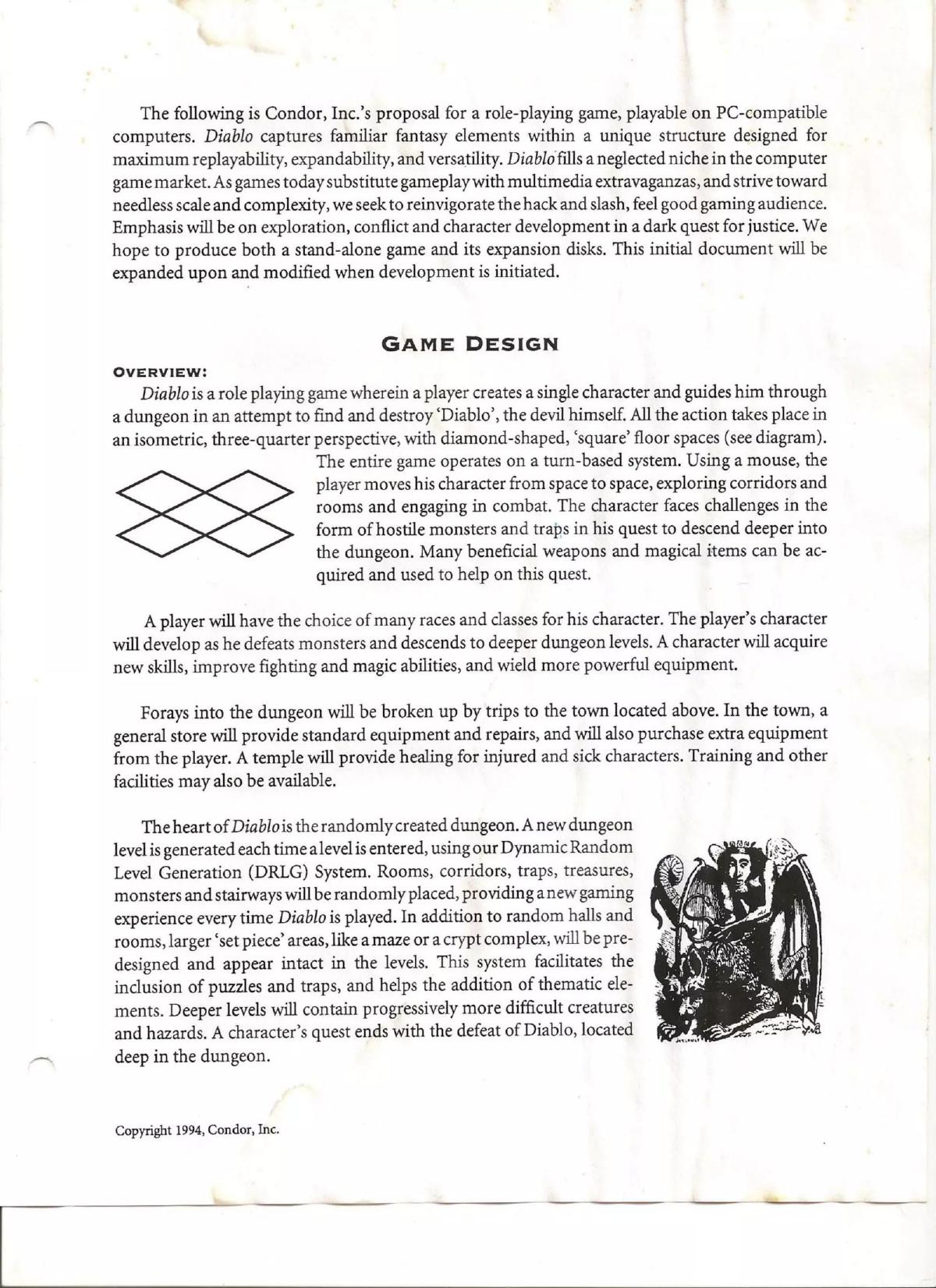
Slide 2: Game Design and The DRLG System
This slide serves as the executive summary of the product. It identifies the platform as 'PC-compatible computers' and explicitly states the goal: to reinvigorate the 'hack and slash' audience. The text highlights three pillars: replayability, expandability, and versatility. Crucially, it introduces the 'Dynamic Random Level Generation (DRLG) System,' which ensures that rooms, corridors, and monsters are randomly placed every time a level is entered. A simple diagram of 'diamond-shaped, square floor spaces' illustrates the isometric, three-quarter perspective. The slide also mentions that the game will operate on a 'turn-based system,' a detail that famously changed to real-time during the game's actual development.
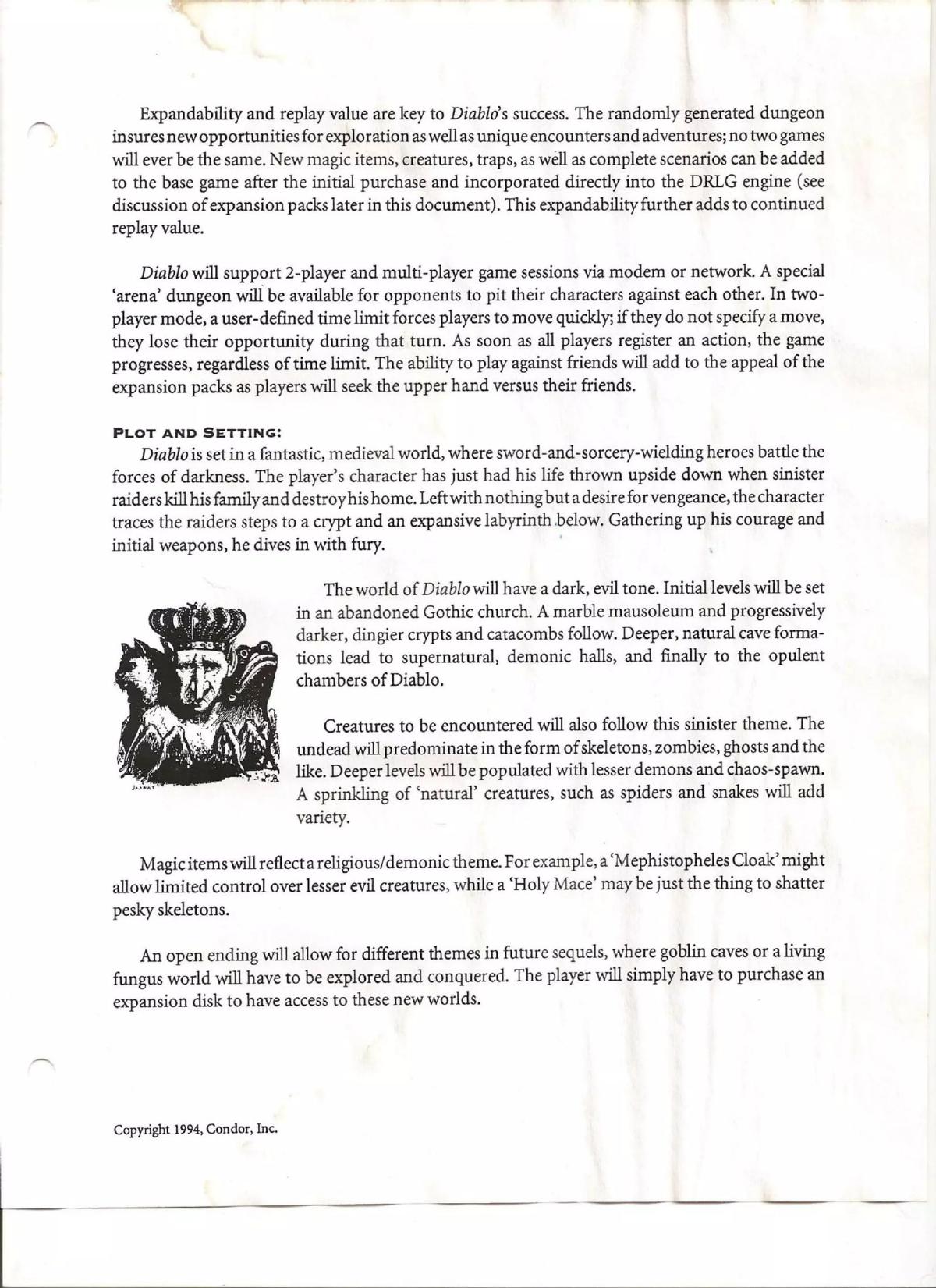
Slide 3: Plot, Setting, and Multiplayer
Slide 3 expands on the 'dark, evil tone' of the world. It describes a progression from an 'abandoned Gothic church' to 'demonic halls' and finally the 'opulent chambers of Diablo.' The deck promises a variety of creatures, including skeletons, zombies, and 'lesser demons.' A significant portion of this slide is dedicated to the multiplayer aspect, mentioning support for 2-player and multi-player sessions via modem or network. It introduces a 'special arena dungeon' for PvP (player vs. player) combat and notes that in two-player mode, a time limit forces quick moves, or the player loses their turn.
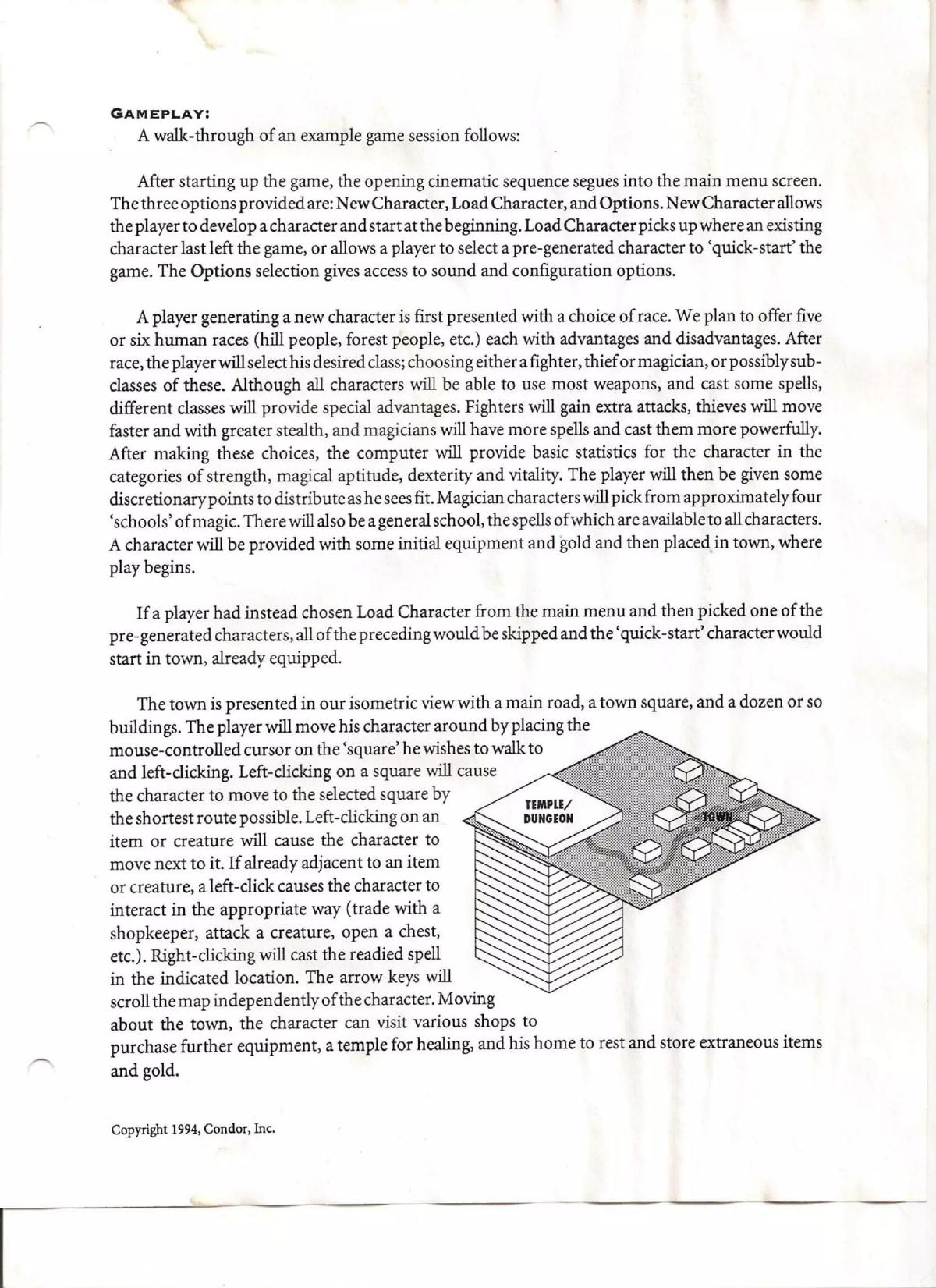
Slide 4: Gameplay Walkthrough (Part 1)
This slide provides a narrative walkthrough of a game session. It details the main menu options: 'New Character,' 'Load Character,' and 'Options.' It outlines the character creation process, proposing 'five or six human races' (such as hill people and forest people) and three classes: fighter, thief, or magician. The slide describes the attribute system (strength, magical aptitude, dexterity, and vitality) and the 'schools of magic.' A diagram shows the relationship between the 'Town' and the 'Temple/Dungeon,' explaining how players move their character by left-clicking on squares.
Slide 5: Gameplay Walkthrough (Part 2) and Permadeath
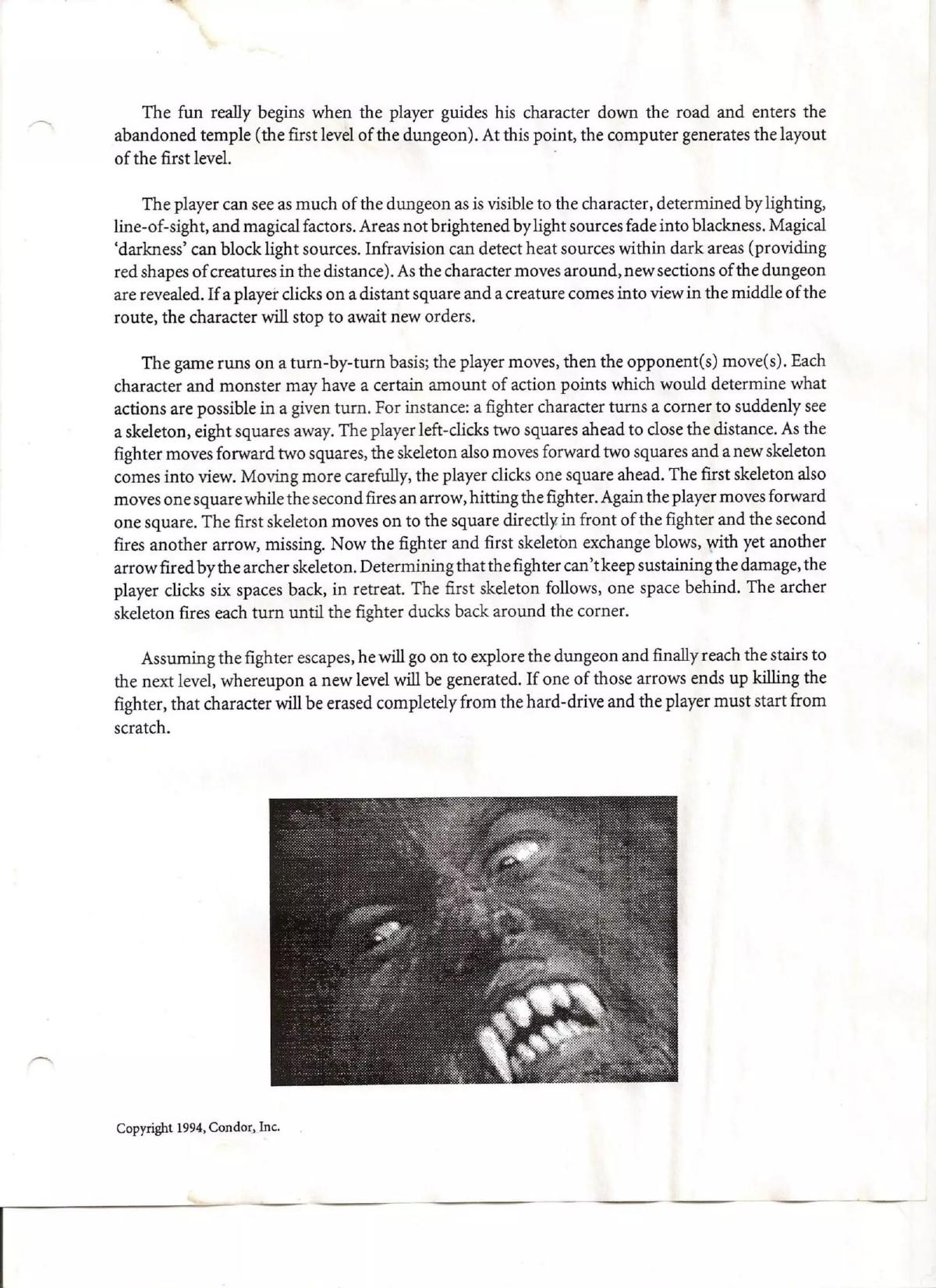
Continuing the walkthrough, this slide describes the transition into the dungeon. It explains the line-of-sight and lighting mechanics, where areas not brightened by light sources 'fade into blackness.' The slide includes a detailed example of turn-based combat involving a fighter and two skeleton archers. Most notably, it describes a high-stakes permadeath mechanic: 'If one of those arrows ends up killing the fighter, that character will be erased completely from the hard-drive and the player must start from scratch.' This extreme consequence highlights the 'sinister' theme the founders were aiming for.
Slide 6: Marketing and Expansion Packs
The 'Marketing' slide is perhaps the most business-oriented part of the deck. It proposes a model of 'sustained, long-term sales' through expansion packs. Condor explicitly cites 'Magic: The Gathering' as the inspiration for this model. They suggest $4.95 expansion disks containing random elements like 'one rare sword, three uncommon magic items, eight common items.' The goal was to create a 'collector-type' experience where players would buy packs as an afterthought at the cash register. This is an early precursor to the modern DLC and loot box models, though framed here as physical disks sold at 'Electronics Boutique stores.'
Slide 7: Development and Personnel
This slide breaks down the production requirements. Condor plans for a one-year development cycle with a 12-person team. The roster includes one designer, three programmers (one chief, two junior), six artists (two art directors, one illustrator/sculptor, three pixel artists), and one music/sound person. The slide specifies technical targets, such as 'Super VGA mode (640x480 pixels)' and the need for at least '50 frames of animations' for monster deaths. It emphasizes that the game will be 'art-intensive,' requiring sprites for different weapons, armor, and clothing.
Slide 8: The Development Schedule
The final slide is a Gantt chart mapping out the 12-month schedule. It begins with a two-month design phase, followed by overlapping tracks for Art, Programming, and Music/Sound. The 'Programming' track includes specific milestones for the 'Interface,' 'DRLG,' and 'Structure.' Notably, the schedule reserves the final four months (Months 9 through 12) for 'Testing/Balance.' This reflects a mature understanding of game development, acknowledging that the 'feel' of a hack-and-slash game requires significant iteration after the core systems are built.
What Works in This Deck
Clarity of Vision: The deck does an excellent job of defining exactly what the game is and, perhaps more importantly, what it isn't. By positioning itself against 'multimedia extravaganzas,' it carves out a specific market niche. Mechanical Detail: The explanation of the DRLG system (Slide 2) and the combat walkthrough (Slide 5) give the reader a clear sense of the player experience. Business Innovation: The expansion pack model (Slide 6) is a clever way to address the 'hit-driven' nature of the gaming industry by proposing a recurring revenue stream inspired by successful non-digital products like Magic: The Gathering.
What Is Missing
The Ask: There is no mention of how much money Condor, Inc. is seeking. While the personnel list (Slide 7) allows a reader to estimate burn, a formal pitch usually requires a specific funding request. Competitive Analysis: While the deck mentions 'familiar role-playing elements,' it does not name specific competitors or explain how Diablo will outperform them beyond a general 'hack and slash' appeal. Financial Projections: There are no estimates for unit sales, break-even points, or projected margins for the expansion packs. Team Bios: The deck lists roles but provides no names or backgrounds for the founders or key staff, which is a standard requirement for establishing credibility.
What a Founder Should Copy
The Narrative Walkthrough: Using a 'walkthrough of an example game session' (Slides 4 and 5) is a powerful way to demonstrate a product's value proposition. It moves the conversation from abstract features to concrete user experiences. The 12-Month Roadmap: The Gantt chart on Slide 8 is a model of transparency. It shows that the founders have thought through the dependencies between art, code, and sound. Market Parallels: Drawing a comparison to a successful product in a different category (Magic: The Gathering on Slide 6) helps investors understand a new business model by using a familiar reference point.
Frequently asked questions
- What was the original gameplay style pitched for Diablo?
- According to Slide 2, Diablo was originally conceived as a turn-based role-playing game. Players would move their character from 'space to space' on a grid-based, diamond-shaped floor layout. The deck notes that as soon as all players in a multi-player session registered an action, the game would progress. This is a significant departure from the real-time action-RPG format the game eventually adopted.
- How did the founders plan to make money beyond the initial game sale?
- Slide 6 outlines a 'Marketing' strategy centered on expansion disks priced at approximately $4.95. These disks were intended to be point-of-purchase items, similar to trading card packs. Each disk would contain a random assortment of new items, creatures, and level graphics (e.g., one rare sword, three uncommon items), leveraging 'collectability' to ensure sustained, long-term revenue.
- What technical innovation did the deck highlight?
- The primary technical innovation was the Dynamic Random Level Generation (DRLG) System, described on Slide 2. This system was designed to ensure that 'no two games will ever be the same' by randomly placing rooms, corridors, traps, and monsters. The deck emphasizes that this system allows for infinite expandability, as new elements could be incorporated directly into the DRLG engine via expansion packs.
- What was the proposed development timeline and team size?
- Slide 7 and Slide 8 detail a 12-month development schedule. The team was to consist of 12 people: one designer, three programmers, six artists/illustrators, one music person, and one sculptor. The schedule allocated the final four months of the year specifically for 'Testing/Balance,' highlighting the importance the founders placed on gameplay feel over mere technical completion.
- Is there a financial 'Ask' in this deck?
- No. The 8-slide deck is strictly a 'Game Concept' and development proposal. It lacks a slide dedicated to the amount of capital required, the equity offered, or any financial projections regarding sales units or overhead costs. It functions more as a product requirement document (PRD) used for pitching to a publisher rather than a venture capital pitch deck.