Deskdoo’s 19-slide deck presents a solution for the fragmentation of remote work tools, positioning itself as a 'Cloud Operating System' that integrates project management, file sharing, and business apps into one browser interface. Seeking a $600k Series A, the company highlights a shift toward remote work, citing that 36% of people would prefer working from home over a salary raise. The deck is notable for its specific financial projections through 2018 and its hardware ambitions with the 'Deskdoo Box' for TVs. However, the presentation suffers from significant typos, including 'Rasing' for…
Key takeaways
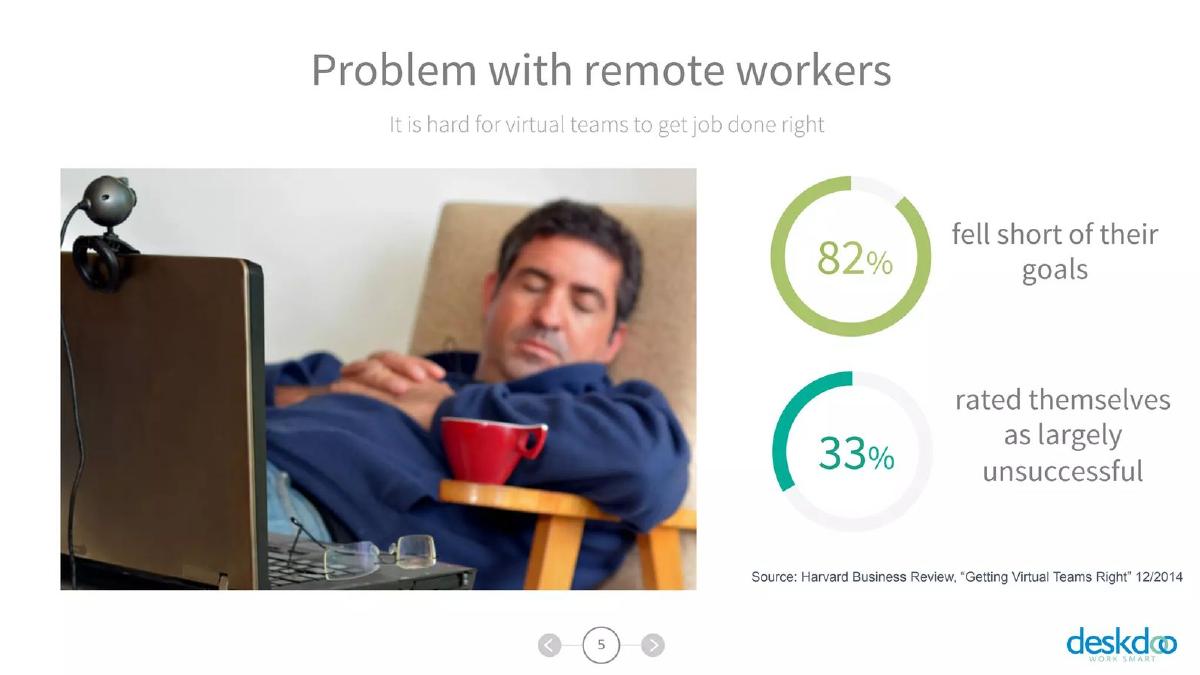
- The company identifies a massive productivity gap, stating that 82% of virtual teams fell short of their goals (Slide 5).
- Deskdoo positions itself as a 'unified cloud' that requires zero installation, running entirely on HTML5 browsers (Slide 8).
- The revenue model is based on a low-friction $4/month per user fee, aiming to turn fixed IT costs into variable ones (Slide 12).
- Financial projections were aggressive, targeting 200,000 registered users and $1.44M in gross profit by 2018 (Slide 15).
- The founders had already invested $100k of their own capital into the live product before seeking outside investment (Slide 14).
- The 'Deskdoo Box' hardware play suggests a pivot or expansion into turning any TV into a workstation via a plug-in device (Slide 16).
- The Series A ask of $600k was intended to double headcount every six months and expand into the US and EU markets (Slide 14).
- The deck leans heavily on third-party validation, citing wins at the IT Future Awards and Wolves Summit (Slide 18).
Deskdoo Pitch Deck Teardown: The Browser-Based Workspace Vision
Deskdoo’s pitch deck is a relic of the mid-2010s remote work movement. Long before the global pandemic forced a transition to home offices, Deskdoo was attempting to solve the 'fragmentation' problem—the friction caused by switching between dozens of different SaaS tools. By positioning themselves as a 'Cloud Operating System,' they aimed to be the glue for the distributed workforce. This teardown looks at how they structured their argument for a $600,000 Series A investment.
Slides 1-2: The Hook and the Vision
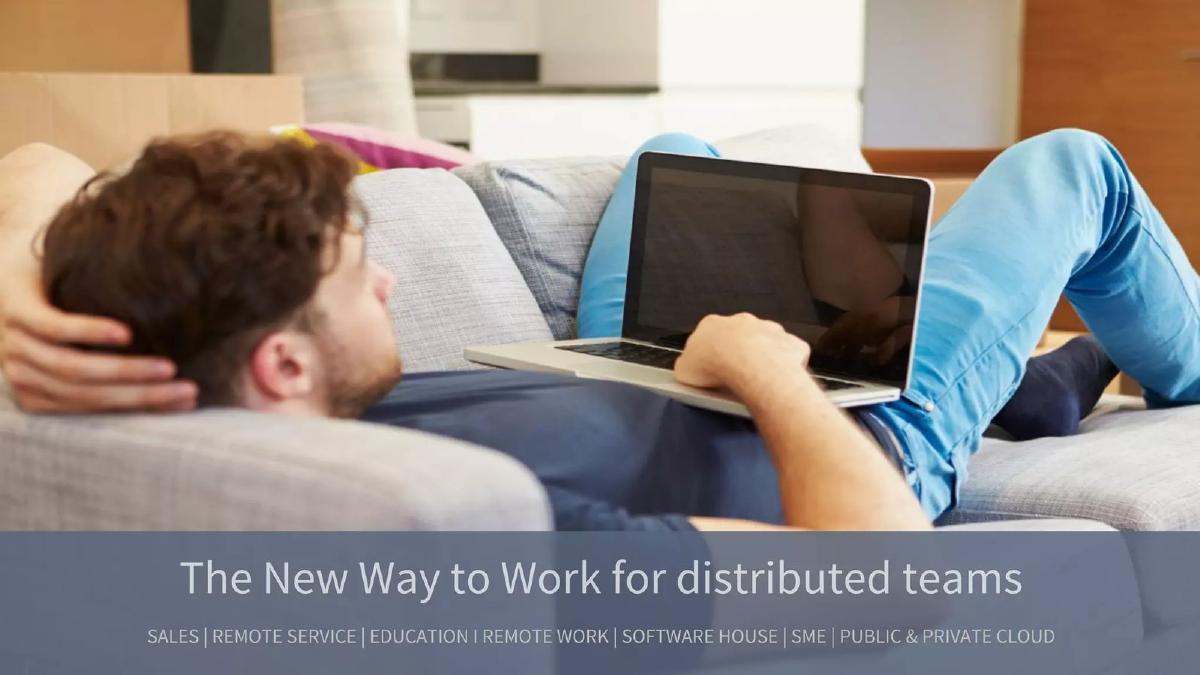
The deck opens with a scenic landscape and the tagline 'WORK SMART.' Slide 2 immediately defines the target audience: distributed teams across sales, education, and software houses. The imagery of a man working on a couch is a classic trope of the era, signaling the freedom of remote work. It establishes the 'New Way to Work' as the core brand identity.
Slides 3-5: The Market Need and Problem Statement
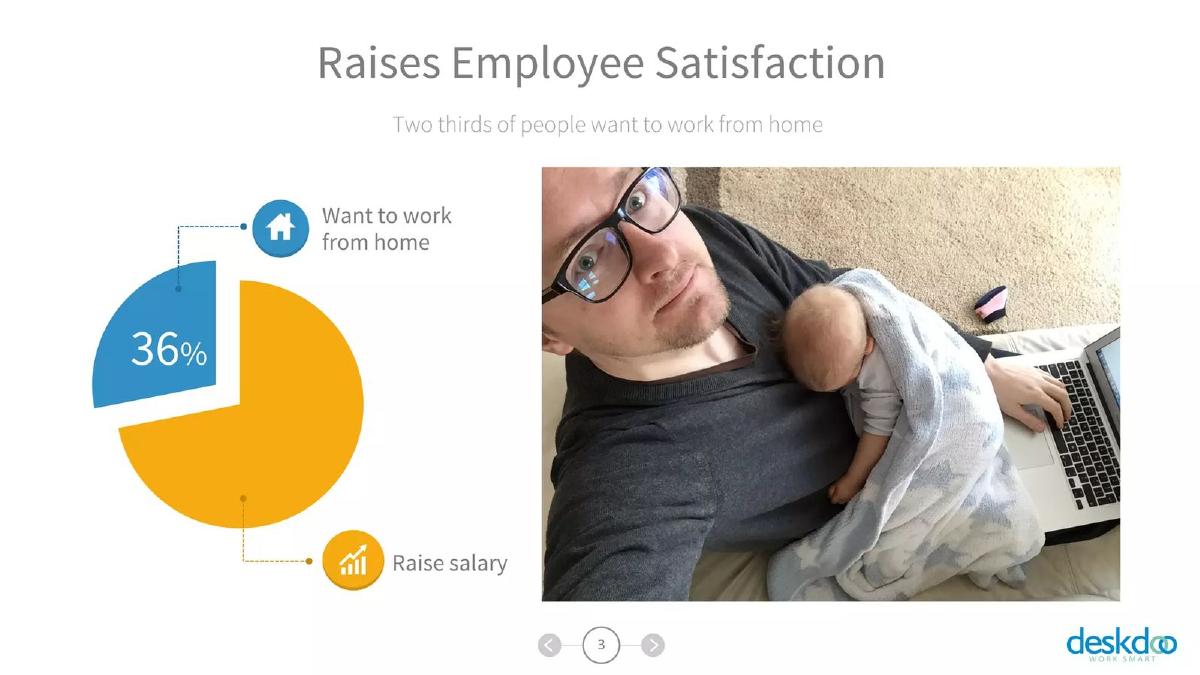
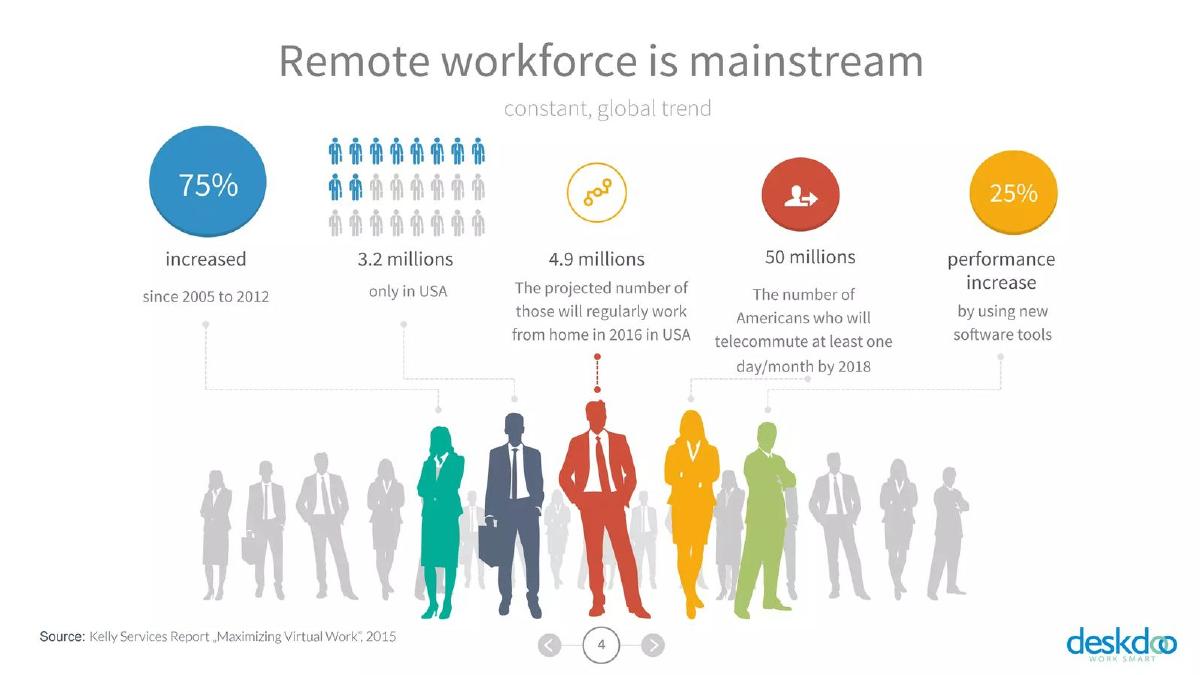
Deskdoo uses data to validate the remote work trend. Slide 3 claims that 36% of people would choose working from home over a salary raise. Slide 4 provides a historical context, noting a 75% increase in the remote workforce from 2005 to 2012, and projects 50 million Americans telecommuting by 2018. However, Slide 5 introduces the 'Problem': remote teams are struggling. Citing Harvard Business Review, they point out that 82% of virtual teams fall short of goals. This creates a clear gap between the desire to work remotely and the ability to do so effectively.
Slides 6-7: The 'Puzzle' and the Solution
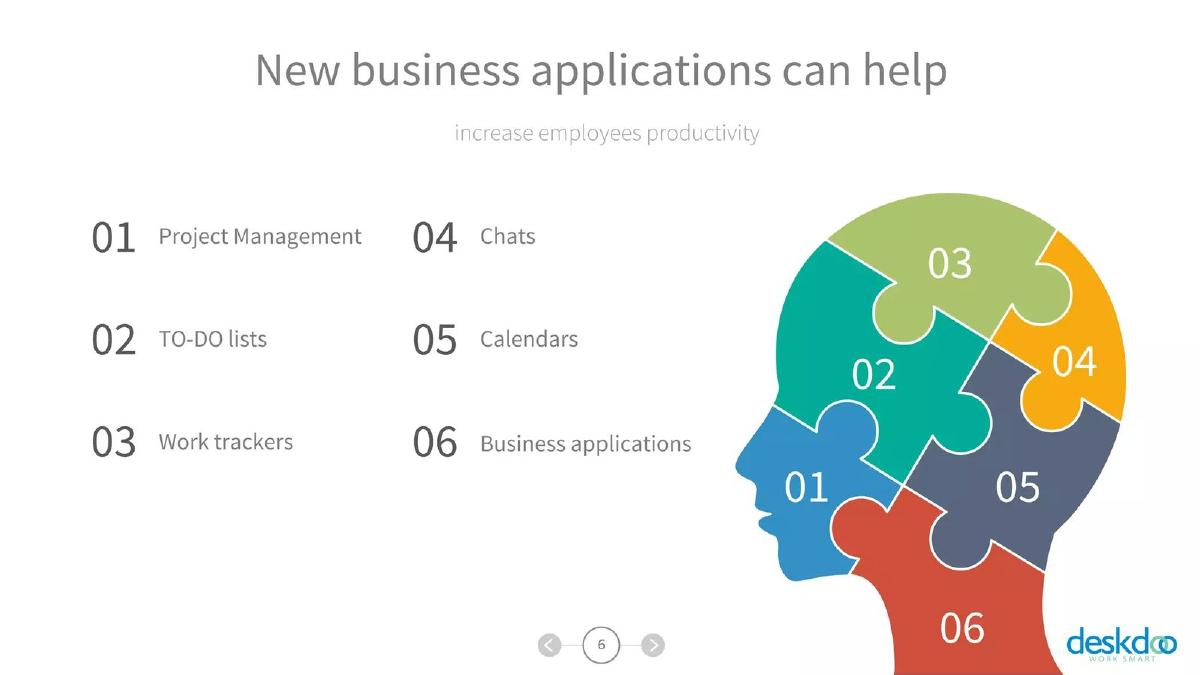
Slide 6 visualizes the current state of business applications as a fragmented puzzle inside a human head, listing project management, chats, and calendars as separate pieces. Slide 7 introduces the solution: 'One Virtual Cloud Desktop to rule them all.' Using a 'Lord of the Rings' ring as a visual metaphor is a bold, if somewhat cliché, choice to represent unity. The solution promises to integrate user management, workspaces, file sharing, and business apps like CRM and invoicing into one place.
Slides 8-11: Product Deep Dive and User Scenario
These slides focus on the technical advantages. The 'Cloud Operating System' is described as client-agnostic and 'Zero Install,' relying on HTML5. Slide 9 walks through a typical user scenario: Register, Personalize, Access Resources, and Invite Others. Slide 10 shows the interface—a desktop-like environment living inside a Chrome browser. Slide 11 emphasizes 'Single Login' for Google Apps, Disk Drives, and Collaboration tools, which is the primary value proposition for IT managers tired of managing multiple credentials.
Slide 12: The Revenue Model
Deskdoo proposes a marketplace model. The key figure here is $4 USD/month per user . They argue that this model turns fixed IT costs into variable ones, allowing businesses to pay only for the apps they need when they need them. It also suggests a 'new revenue stream' for third-party vendors who list their services on the Deskdoo platform.
Slide 13: Market Size
The market slide cites Gartner and IDC reports from 2015. It identifies a $335B Enterprise Software Market, with Cloud Software expected to surpass $100B by 2018. While the numbers are large, the deck doesn't clearly define Deskdoo's Serviceable Obtainable Market (SOM), instead leaning on the 'rising tide lifts all boats' logic of the SaaS industry.
Slide 14: The Ask ('Rasing')
Slide 14 contains a significant typographical error in the header: 'Rasing' instead of 'Raising.' Despite this, the content is specific. The founders have already invested $100k. They are seeking a $600k Series A to expand customer-facing teams, grow engineering, and double headcount every six months. They also explicitly state a goal to expand into the EU and USA by Q3 2016.
Slide 15: Financial Projections
This is one of the most detailed slides in the deck. It provides a three-year forecast (2016-2018). By 2018, they expected 200,000 registered users and 20,000 paying users. Interestingly, they projected the average price per user to rise from $4 in 2016 to $6 in 2018. The slide shows a path to profitability, moving from a -$276,000 EBIT in 2016 to a +$250,000 EBIT in 2018.
Slides 16-19: Hardware, Team, and Traction
Slide 16 introduces the 'Deskdoo Box,' a hardware play to turn TVs into workstations. This feels like a potential distraction from a pure software play, but it aligns with their 'work anywhere' theme. Slide 17 introduces the three key members, highlighting their 40+ combined years of IT experience. Slide 18 showcases traction through awards, including being a 'Cloud Computing contest winner' at the IT Leader Awards 2015. The deck concludes with standard contact information on Slide 19.
What Deskdoo Does Well
Specific Financials: Unlike many early-stage decks that hide behind vague percentages, Deskdoo provides hard numbers for user acquisition, pricing, and OPEX. This allows an investor to at least audit their logic, even if the assumptions are aggressive.
Clear Problem/Solution Fit: The 'puzzle' metaphor for fragmented apps is highly relatable for anyone managing a business. They successfully frame the problem as a productivity crisis (82% failure rate) rather than just a minor inconvenience.
Zero-Install Emphasis: In 2015, the friction of downloading desktop clients was a significant barrier to entry. By doubling down on the 'HTML5/Chrome is fine' message, they lowered the perceived barrier for IT departments to adopt the tool.
What Is Missing or Weak
Competitive Analysis: The deck completely omits a competitor slide. In 2015, Citrix, VMware, and even early versions of Slack and G Suite were direct or indirect competitors. Failing to address how they differ from a standard 'Remote Desktop' (RDP) solution is a major oversight.
The 'Google' Paradox: Slide 11 shows Google Apps as an integrated tool, but Slide 7 lists 'Office Editors' as a core part of the Deskdoo solution. It is unclear if they are building their own editors or simply wrapping existing ones. If they are wrapping them, the value of the 'Cloud OS' is purely organizational; if they are building them, the $600k ask is nowhere near enough to compete with Microsoft or Google.
Attention to Detail: The typo 'Rasing' on the most important slide (the funding ask) is a red flag for many investors. It suggests a lack of final review on a document intended to secure over half a million dollars.
What Other Founders Should Copy
The 'Typical User Scenario' Slide: Slide 9 is an excellent example of how to explain a product without getting bogged down in technical jargon. By breaking it into four simple steps (Register, Personalize, Access, Invite), they make the product feel accessible.
Third-Party Data Validation: Using Harvard Business Review and Gartner data to frame the market need gives the deck an air of authority. Founders should always look for reputable sources to back up their 'Problem' claims.
Founder Skin in the Game: Explicitly stating that the founders have already invested $100k of their own money (Slide 14) is a powerful signal to investors. It shows commitment and reduces the perceived risk of the 'Series A' round.
Frequently asked questions
- What is the primary problem Deskdoo is trying to solve?
- Deskdoo addresses the fragmentation and inefficiency of remote work. Citing a Harvard Business Review study, the deck notes that 82% of virtual teams fail to meet their goals and 33% rate themselves as unsuccessful. The company argues that while tools like chats and calendars exist, they are disconnected, leading to a 'puzzle' of applications that hinders productivity rather than helping it.
- How does Deskdoo define its 'Cloud Operating System'?
- It is described as a 'Unified Cloud' that provides one dynamic browser page for all business needs. It is client-agnostic, meaning it works on desktops, laptops, tablets, and even Smart TVs without requiring plugins, Flash, or desktop installations. It integrates file sharing, CRM, invoicing, and activity monitoring into a single interface with a single login.
- What are the specific financial targets mentioned in the deck?
- For 2016, Deskdoo projected 5,000 registered users and 500 paying users at $4/month. By 2018, they aimed to scale to 200,000 registered users and 20,000 paying users at a $6 price point. This growth was expected to lead to a Gross Profit of $1,440,000 and an EBIT of $250,000 (17% margin) by the end of 2018.
- What is the 'Deskdoo Box' and why is it included?
- The Deskdoo Box is a hardware component—a small media player with a remote and keyboard—designed to plug into a TV. By leveraging the 'future of television is apps' quote from Tim Cook, Deskdoo suggests its cloud OS can turn any screen into a full workstation, further emphasizing their 'work from anywhere' value proposition.
- Who are the key members of the leadership team?
- The team is led by CEO Adam Adamczyk (15+ years in IT, former CEO of Figaro Software), CTO Dawid Krawczykiewicz (developer for major Polish sites like demotywatory.pl), and COO Robert Pasternak (20+ years in IT and sales management). The deck notes that as of November 2015, the total team size was eight people.