Street Investor, operating as Bússola do Investidor in Brazil, utilized this 13-slide deck for a Start-Up Chile Demo Day. The presentation centers on the fragmentation of financial information for Latin American retail investors and positions their platform as the 'one place' solution. The company demonstrates strong early traction, growing from 37,600 users in May 2011 to 52,500 users by May 2012, including 1,000 paying subscribers. The deck leans heavily on the macroeconomic tailwinds of the Brazilian market, citing a 700% increase in stock investors over the previous decade. While the team…
Key takeaways
- The platform addresses a fragmented market where Latin American investors lack a centralized source for financial data (Slide 2).
- Brazil serves as the primary market with 4.9 million investors in funds and stocks, showing a 700% increase in stock investors over the last decade (Slide 4).
- The total addressable market in Latin America is estimated at over 18 million investors across Chile, Colombia, Peru, Mexico, and Argentina (Slide 4).
- Street Investor achieved profitability through a freemium model, reaching 1,000 paying users for their Portfolio Manager and Tax Calculator by May 2012 (Slide 5).
- User growth showed a steady upward trajectory, increasing from 37,600 registered users in May 2011 to 52,500 by May 2012 (Slide 5).
- The company established B2B credibility by having 7 of the 10 largest brokers in Brazil advertise on their platform (Slide 5).
- The founding team possesses deep domain expertise, with experience at major financial institutions including HSBC, Blackstone, and BTG Pactual (Slide 6).
- The deck omits a specific funding request, valuation, or detailed breakdown of how new capital would be deployed (Slide 7).
Street Investor: A Demo Day Teardown
The Street Investor pitch deck, presented at a Start-Up Chile Demo Day, is a classic example of a 'traction-first' presentation. Operating under the brand Bússola do Investidor in its home market of Brazil, the company seeks to capitalize on the rapid expansion of the retail investment class in Latin America. The deck is concise, totaling 13 slides (of which 7 are analyzed here), and focuses on market opportunity and proven user growth.
Slide 1: Title Slide
The title slide introduces the brand 'Street Investor' alongside the 'Start-Up Chile Demo Day' branding. The background is a watermark of stock tickers (e.g., VALE5, PETR4), which immediately establishes the industry context. The presence of two URLs at the bottom—bussoladoinvestidor.com.br and streetinvestor.com—indicates a dual-brand strategy: a localized Brazilian entity and a global/regional entity for expansion.
Slide 2: The Problem
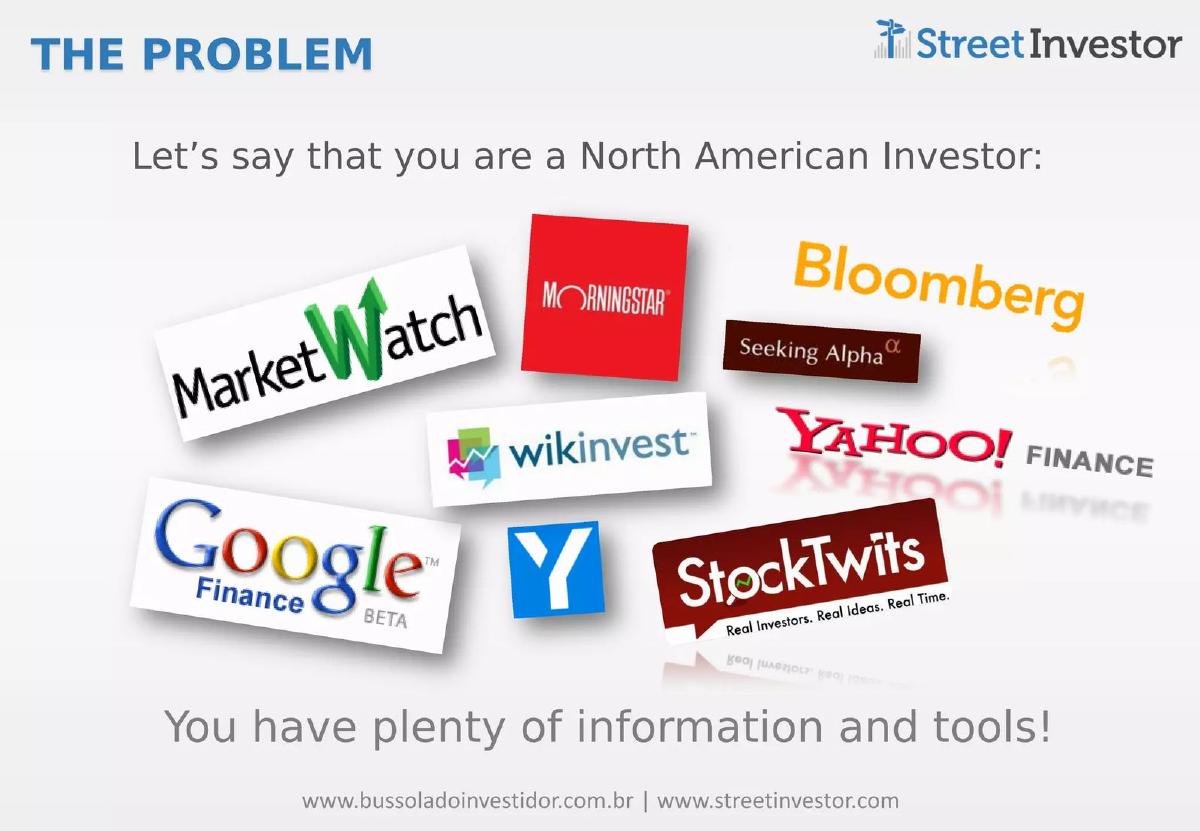
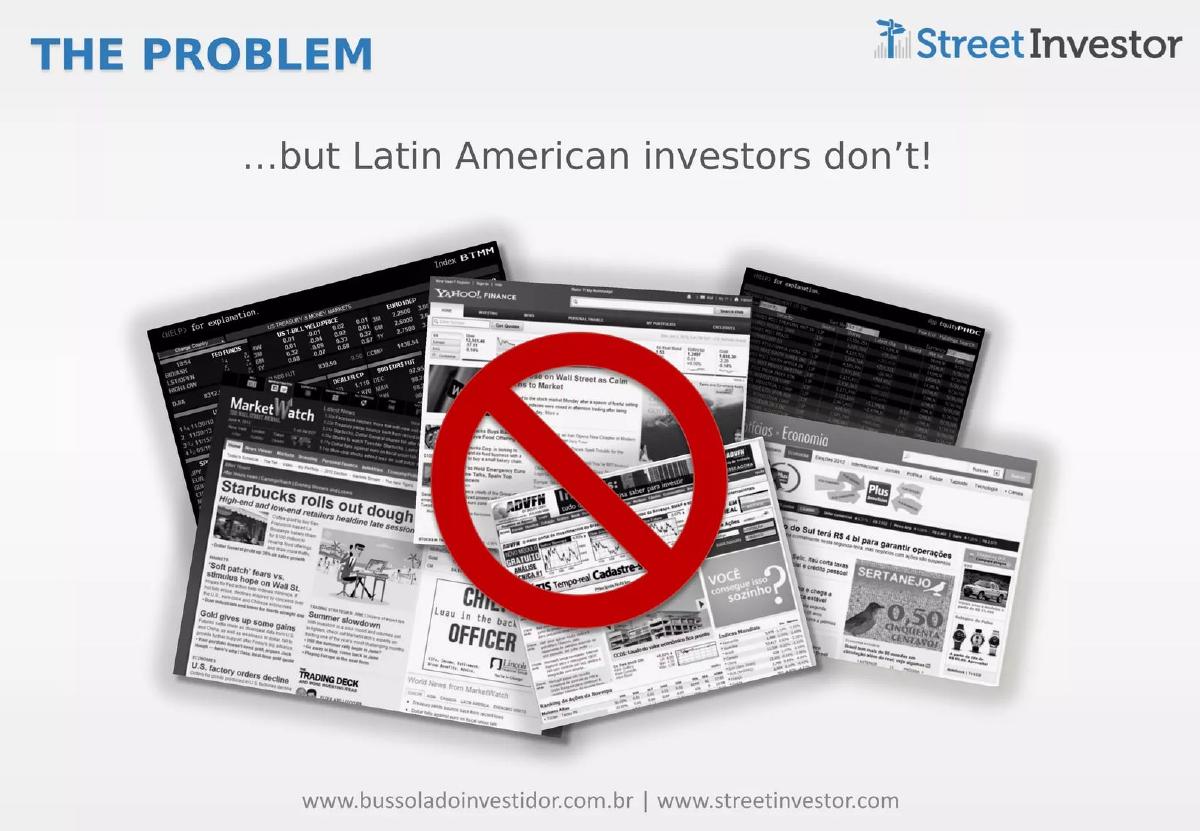
Slide 2 uses a visual collage of financial websites and newspapers (Yahoo Finance, MarketWatch, etc.) covered by a large red 'prohibited' sign. The headline '...but Latin American investors don’t!' follows a likely preceding slide about how global investors have tools. The core message is that the current financial information landscape is too fragmented or inaccessible for the specific needs of the Latin American retail investor.
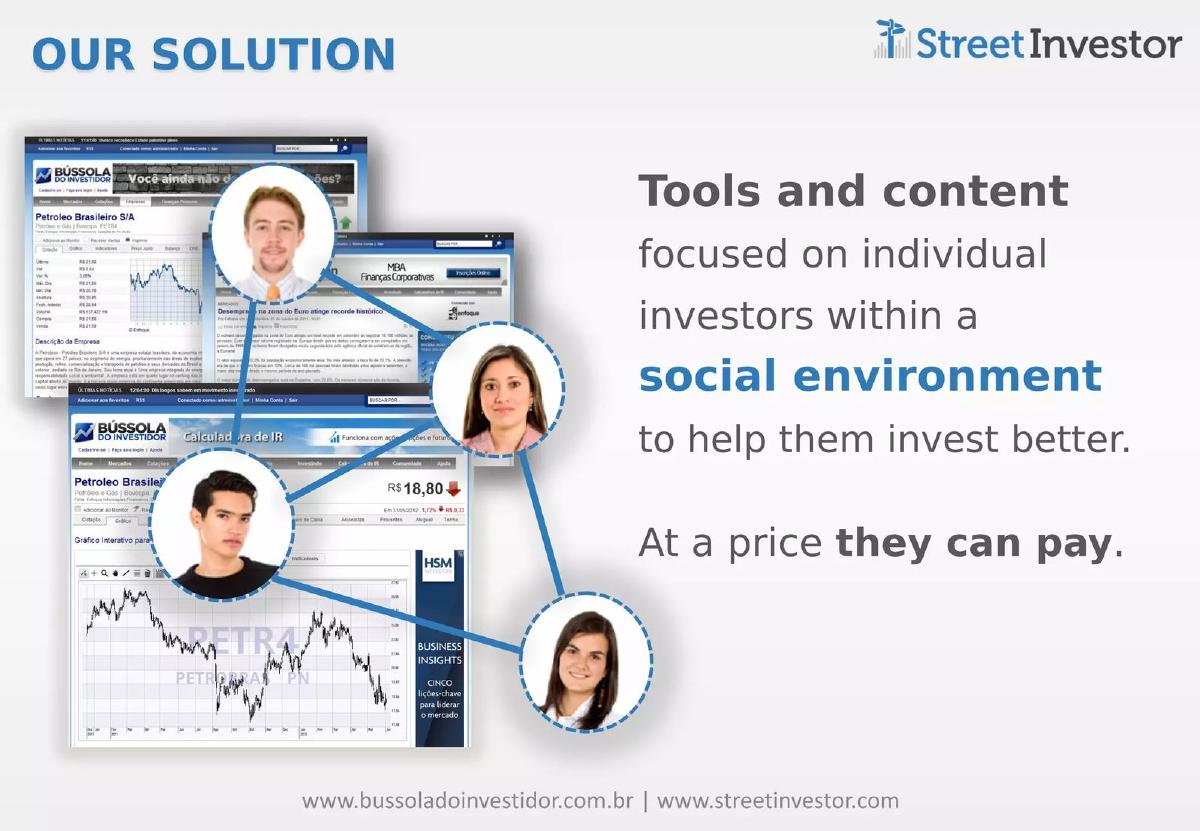
Slide 3: Our Solution
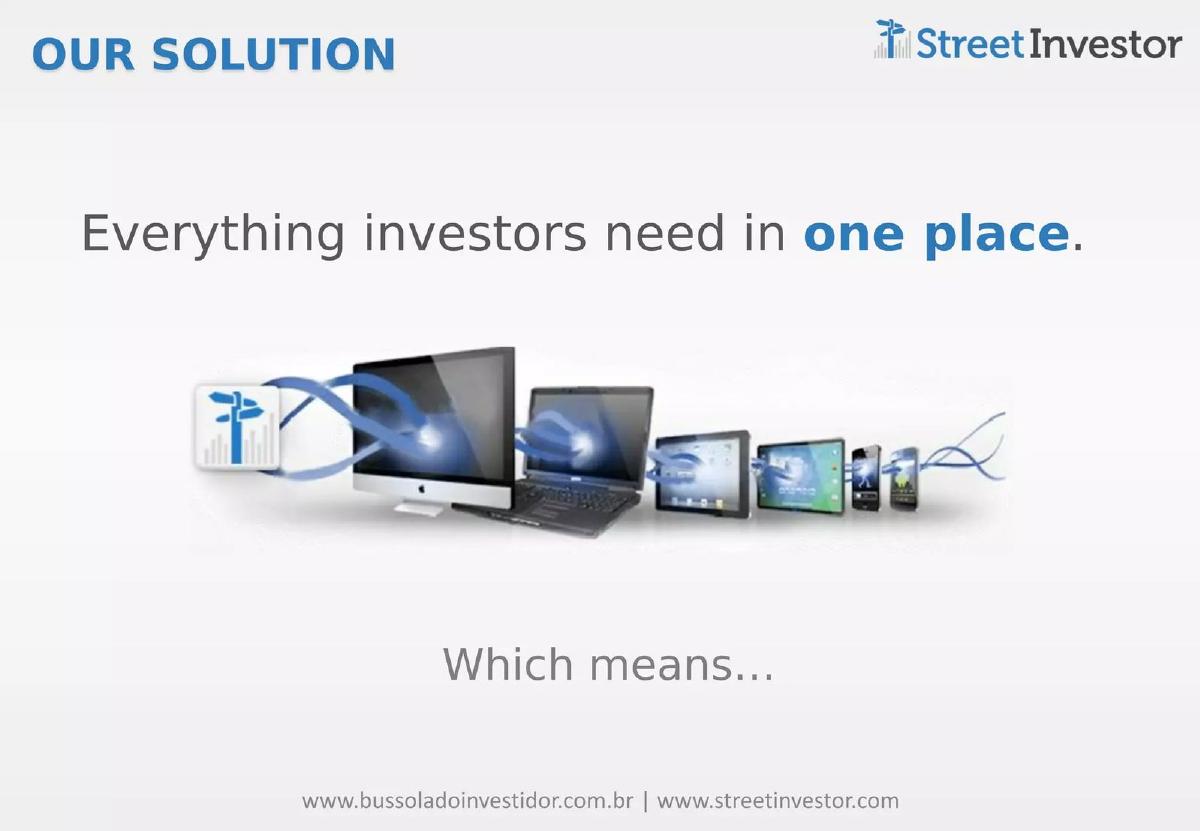
The solution slide is minimalist, stating 'Everything investors need in one place.' It features a graphic showing the platform synced across a desktop, laptop, and mobile devices. This emphasizes the cross-platform nature of the tool, though it lacks specific screenshots of the product interface, which is a missed opportunity to show the 'how' behind the 'what.'
Slide 4: Market Size
This is one of the strongest slides in the deck. It breaks down the market into three clear data points: 4.9 million current investors in Brazil, a potential 18 million+ investors across the rest of Latin America (Chile, Colombia, Peru, Mexico, Argentina), and a staggering 700% growth in Brazilian stock investors over the last decade. By highlighting the MILA (Mercado Integrado Latinoamericano) and various regional exchanges, the founders demonstrate a clear understanding of the regulatory and market integration happening in the region.
Slide 5: Traction and Conversion
Slide 5 provides the 'proof of life' for the business. It notes a 2010 launch in Brazil and claims a 'top 5' status among independent financial websites. The metrics are specific: growth from 37,600 users in May 2011 to 52,500 users in May 2012. Crucially, it mentions 1,000 paying users, proving that the market is willing to pay for their premium portfolio and tax tools. The mention of 7 out of 10 top brokers advertising with them adds significant B2B validation.
Slide 6: The Team
The team slide is exceptionally well-constructed for a seed-stage startup. Each of the five members (CEO, COO, CTO, CMO, CFO) has a defined role and a pedigree that matches the company's mission. The inclusion of names like HSBC, Blackstone, BTG Pactual, and FGV/USP (top Brazilian universities) signals to investors that this is a professional team capable of navigating the complex financial regulations of Latin America.
Slide 7: Conclusion and Contact
The final slide is a standard 'Thanks' page. It includes an email address, an AngelList link (angel.co/streetinvestor), and the Start-Up Chile logo. Like many Demo Day decks, it ends on a high note of contact rather than a specific financial ask, likely because the 'ask' was delivered verbally during the presentation.
What Works in This Deck
Macro-Trend Alignment: The deck does a fantastic job of tying the company's success to the broader economic growth of Brazil. The '700% growth' figure on Slide 4 is the kind of 'big number' that captures investor attention by suggesting a rising tide that will lift all boats in the sector.
Credibility through Association: By listing that 7 of the 10 largest brokers in Brazil have advertised with them, the founders bypass the need to prove their platform's utility. If the market leaders are paying to be there, the platform clearly has a high-value audience.
Team Pedigree: In fintech, trust is the primary currency. The team's background in major global and regional financial institutions (Blackstone, BTG Pactual) provides an immediate layer of trust that a team of pure 'techies' might lack in this specific vertical.
What Is Missing
Product Depth: For a platform that claims to be the 'one place' for everything an investor needs, there are no actual screenshots of the dashboard, the tax calculator, or the real-time data tools. Investors are left to guess what the user experience actually looks like.
The 'Ask': There is no mention of how much capital is being raised, the valuation, or the specific milestones the company intends to hit with the new funding. While common in Demo Day decks, it makes the deck less effective as a standalone document.
Competitive Landscape: The deck implies that existing tools are bad, but it doesn't name competitors or explain why Street Investor’s proprietary technology or data access is superior to local incumbents or international players like Bloomberg or Reuters entering the market.
Founder's Playbook: What to Copy
Use a 'Traction Arrow': Slide 5 uses a simple upward-sloping arrow to visualize user growth. This is a highly effective way to show momentum at a glance. Even with relatively modest numbers (52k users), the visual representation of the trend line is persuasive.
Highlight Local Nuance: The mention of a 'Tax Calculator' as a paid feature is a brilliant inclusion. In many emerging markets, tax compliance for retail stock trading is a significant pain point. Identifying a specific, localized problem that users will pay to solve is a great way to demonstrate product-market fit.
Clean Market Mapping: Slide 4 uses a map of Latin America with specific exchange logos. This shows that the founders aren't just thinking about 'Latin America' as a monolith, but as a series of specific, interconnected markets (MILA, Bovespa, Merval). Founders should always show they understand the specific geography of their expansion.
Frequently asked questions
- What is the core problem Street Investor is solving?
- According to Slide 2, the problem is the fragmentation of financial information for Latin American investors. The slide uses a 'no' symbol over a collage of various financial news sites and data terminals, suggesting that existing tools are either too complex, too scattered, or not localized enough for the retail investor in the region.
- How does the company generate revenue?
- The company utilizes a freemium model. Slide 5 specifies that they have over 1,000 paid users for their 'Portfolio Manager with Tax Calculator.' Additionally, the slide mentions that 7 of the 10 largest brokers in Brazil have advertised with them, indicating a dual revenue stream of subscriptions and B2B advertising.
- What is the significance of the 700% growth metric?
- Slide 4 uses this figure to demonstrate the massive tailwinds in the Brazilian market. By showing that the number of stock investors in Brazil grew by 700% over the last decade, the founders are arguing that they are riding a structural wave of financialization in the region, rather than just fighting for a static market share.
- Is the team qualified to build a fintech platform?
- Yes, the team slide (Slide 6) is a highlight of the deck. It features a CEO with trading desk experience at HSBC, a CMO who worked in Private Equity for a Blackstone affiliate, and a CFO from BTG Pactual. This combination of high-finance experience and technical capability (the CEO is a self-taught developer) provides significant credibility.
- What information is missing from this pitch deck?
- The deck is missing several critical components for a formal investment round. There is no 'Ask' slide detailing how much money they are raising, no slide on unit economics (CAC/LTV), no detailed competitive landscape, and no financial projections. It appears to be a 'Demo Day' deck designed for a quick pitch rather than a full due diligence process.