DeFi Technologies (NEO:DEFI) utilizes a 21-slide deck to position itself as a bridge between traditional equity markets and decentralized finance. The company operates three distinct business lines: DeFi ETPs (via their Valour acquisition), DeFi Governance (node operations), and DeFi Venture (direct protocol investments). As of September 2021, the company reported a total AUM of $208,280,000 across its ETP products, including BTC Zero and ETH Zero. The deck is heavily weighted toward capital market metrics, reflecting its status as a publicly traded entity, and highlights a venture portfolio…
Key takeaways
- The company operates as a publicly traded entity with tickers on the NEO, OTC, and FRA exchanges (Slide 7).
- Total Assets Under Management (AUM) reached $208,280,000 as of September 8, 2021, led by the BTC Zero product at $76,687,000 (Slide 16).
- The business model is split into three pillars: ETPs, Governance/Nodes, and Venture investments (Slide 13).
- The venture portfolio shows a 255% return, growing from $477,500 invested to a worth of $1,693,324 (Slide 19).
- Capital structure as of September 15, 2021, included 210.51M basic shares outstanding and a market capitalization of C$423.888M (Slide 7).
- The ETP business was bolstered by the acquisition of Valour, which provided the infrastructure for single-purpose and basket products (Slide 13).
- Institutional validation is emphasized through a logo wall featuring firms like Andreessen Horowitz, Coinbase Ventures, and JPMorgan Chase (Slide 10).
- The company reported being well-financed through 2021+ following a C$10.0M raise in February 2021 (Slide 7).
Executive Summary: The Public Proxy for DeFi
DeFi Technologies occupies a specific niche in the 2021 crypto landscape: the regulated proxy. While many crypto companies avoid the scrutiny of public markets in their early stages, DeFi Technologies uses its public status as a core part of its value proposition. The deck, dated September 2021, outlines a strategy to capture the massive influx of institutional and retail capital that is restricted to traditional brokerage accounts. By wrapping complex DeFi strategies—like node validation and protocol venture capital—into a publicly traded stock, they offer a simplified entry point for the 'Next Financial Revolution.'
Slide 1: Title and Positioning
The cover slide establishes the brand identity with a geometric, hexagonal logo and the tagline: "Equity Access to the Next Financial Revolution." The date is clearly marked as September 2021. The use of 'Equity Access' is a deliberate choice to signal to investors that this is a regulated, tradable security rather than a speculative token. The visual theme is dark and professional, aligning with the 'FinTech' aesthetic rather than the 'CryptoNative' aesthetic.
Slide 4: Mission and Strategy
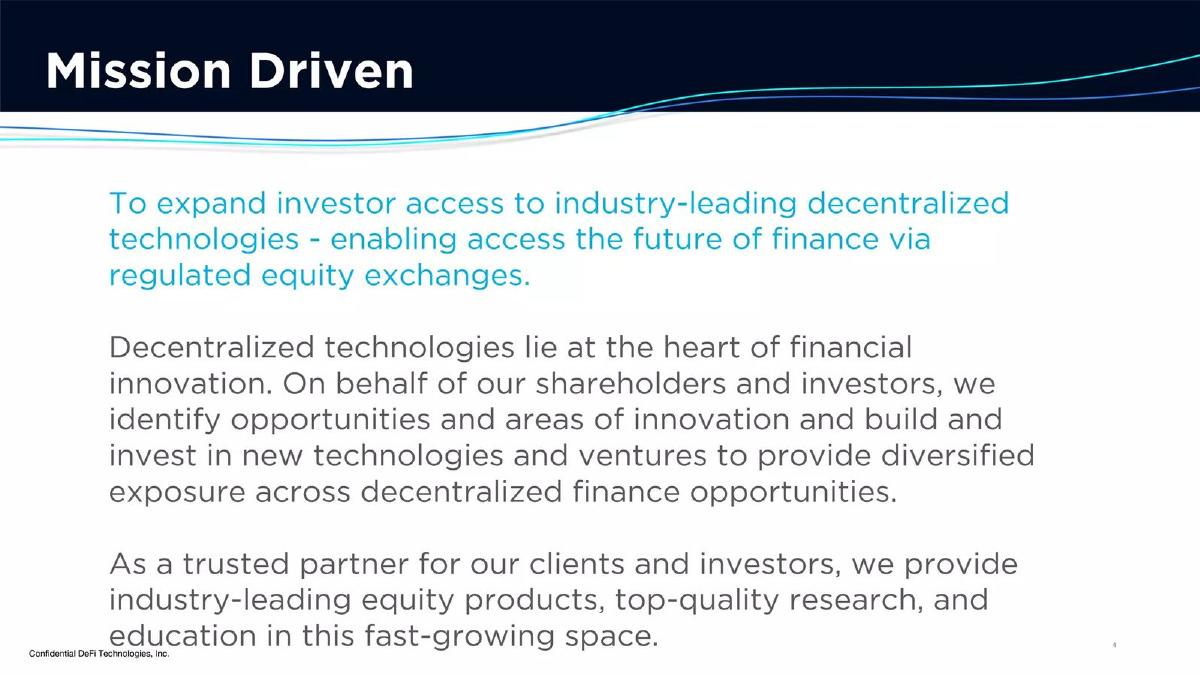
Under the heading "Mission Driven," the company defines its purpose: to expand investor access to decentralized technologies via regulated equity exchanges. The slide notes that they identify opportunities, build, and invest in new technologies to provide diversified exposure. Crucially, they position themselves as a "trusted partner" providing research and education. This suggests that the company views itself not just as an asset manager, but as an ecosystem player that bridges the gap between traditional finance (TradFi) and decentralized finance (DeFi).
Slide 7: Capital Markets Profile
This slide is essential for a public company teardown. It lists tickers on three exchanges: NEO:DEFI, OTC:DEFTF, and FRA:RMJR. As of September 15, 2021, the share price was C$2.0500 with a market capitalization of C$423.888M. The slide highlights "Excellent share liquidity" with an average daily value traded of over $1.83M in H2 2020. The capital structure table shows 210.51M basic shares and 252M fully diluted shares. A significant note at the bottom mentions they are "well financed through 2021+ after raising C$10.M in February 2021." This slide serves to reassure investors of the stock's stability and the company's runway.
Slide 10: Institutional Validation
This is a standard 'logo wall' slide, but the context is different. The headline "Leading institutions are getting behind decentralized finance" features heavyweights like Andreessen Horowitz, Coinbase Ventures, JPMorgan Chase, Visa, and Rothschild. It is important to note that these are not necessarily partners or investors in DeFi Technologies itself; rather, they are presented as evidence of the sector's legitimacy. For a company selling 'access' to a sector, proving that the sector is being adopted by the world's largest financial entities is a critical step in the sales process.
Slide 13: The Three Business Lines
This slide explains the mechanics of how the company operates. They divide the business into three pillars:
DeFi ETPs: Exchange Traded Products that track single protocols or baskets. They mention the acquisition of Valour provided the necessary infrastructure. Their first product, Bitcoin Zero , launched in December 2020 and reached $36M AUM without marketing. · DeFi Governance: Running nodes for protocols. They claim a unique position as a public company with inherent governance. They cite an initial contract with Paycase to provide a node for the Shyft network , earning a fee for each transaction. · DeFi Venture: Taking diversified positions in protocols. The slide claims the portfolio is up 255% since January and mentions that positions will be staked to generate additional yield.
Slide 16: ETP AUM Breakdown
This slide provides a snapshot of the Valour business as of September 8, 2021. The Total AUM is $208,280,000 USD. The breakdown is as follows:
BTC Zero: $76,687,000 · ADA ETP: $58,099,000 · ETH Zero: $55,645,000 · DOT ETP: $17,859,000
The rapid growth from the $36M mentioned on Slide 13 (referencing December 2020) to over $208M by September 2021 represents a significant scaling of the ETP business line.
Slide 19: Venture Portfolio Detail
The final slide in this selection provides a granular look at the DeFi Venture Portfolio. It lists 11 protocols with their invested amounts and current worth. The Total Invested is $477,500.00 and the Total Worth is $1,693,324.00 , resulting in a 255% return. Notable holdings include Luxor Technologies (Invested: $162,499, Worth: $562,499) and Oxygen Protocol (Invested: $20,000, Worth: $576,000). Interestingly, some entries like Clover, Blocto, and Shyft Technologies show $0 invested or $0 worth, which may indicate advisory shares or early-stage positions not yet valued.
What Works in This Deck
The deck excels at transparency regarding AUM and portfolio performance. For a public company, these are the metrics that drive share price. By clearly stating the $208M AUM and the 255% venture return, they provide hard data for analysts to model. The segmentation of the business model into three clear pillars also helps investors understand that this isn't just a 'Bitcoin fund,' but a diversified technology play. The emphasis on regulated access is the strongest recurring theme, addressing the primary pain point for institutional investors in 2021: compliance.
What Is Missing
Despite the strong AUM figures, the deck is missing a clear P&L or revenue breakdown. While AUM is a vanity metric in some contexts, investors need to know the 'take rate' or management fees associated with those ETPs. The node operation (Governance) business line is vague ; there are no projections for transaction fees or a list of upcoming node deployments beyond Shyft. Furthermore, the team slide is absent from this selection. In a sector as technical as DeFi, the pedigree of the engineering and compliance teams is paramount. Finally, there is no competitive landscape analysis. In 2021, companies like 21Shares and Grayscale were significant competitors in the ETP space, and the deck does not address how DeFi Technologies differentiates its products beyond the 'Zero' fee marketing.
Founder Lessons: The Public Market Pitch
Founders can learn two major lessons from this deck. First, leverage institutional momentum. Slide 10 doesn't show the company's own partners, but it frames the entire industry as 'inevitable' by showing who else is playing. This 'rising tide' argument is powerful for new sectors. Second, diversify your narrative. By presenting three business lines, DeFi Technologies protects itself against a downturn in any single area. If ETP volumes drop, the venture portfolio or node fees provide a buffer. When pitching a complex technology like DeFi, breaking the business into digestible 'pillars' makes it much easier for non-technical investors to grasp the value proposition.
Final Thoughts
DeFi Technologies' deck is a product of its time—a period of explosive growth in crypto AUM and a rush for regulated vehicles. It successfully bridges the gap between the 'wild west' of DeFi and the structured world of the NEO exchange. While it lacks the deep technical specifications of a protocol whitepaper, it provides exactly what a capital markets investor needs: liquidity data, AUM growth, and a diversified path to sector exposure. For any founder looking to take a crypto project public, this deck serves as a solid blueprint for communicating financial health and strategic breadth.
Frequently asked questions
- What is the primary value proposition of DeFi Technologies?
- DeFi Technologies aims to provide 'Equity Access to the Next Financial Revolution.' According to Slide 4, their mission is to expand investor access to decentralized technologies through regulated equity exchanges. This allows traditional investors to gain exposure to DeFi protocols and crypto assets through a familiar stock market vehicle rather than managing private keys or interacting directly with decentralized protocols.
- How does the company generate revenue across its three business lines?
- Revenue streams are diversified across three areas. The ETP business generates management fees (though BTC Zero is marketed as zero-fee, others likely carry costs). The Governance arm earns fees for each transaction on networks where they run nodes, such as their initial contract with Paycase for the Shyft network. The Venture arm generates returns through capital appreciation and staking yield from protocol positions (Slide 13).
- What specific crypto assets are included in their ETP portfolio?
- As of September 2021, the company offered four primary Exchange Traded Products under the Valour brand. Slide 16 lists these as BTC Zero ($76.6M AUM), ADA ETP ($58.1M AUM), ETH Zero ($55.6M AUM), and DOT ETP ($17.8M AUM). These products are designed to synthetically track the value of the underlying single protocols.
- What is the status of their venture investment portfolio?
- The venture portfolio is relatively small in terms of initial capital outlay ($477,500) but has seen significant appreciation. Slide 19 shows 11 protocol investments, including Luxor Technologies, Oxygen Protocol, and Sovryn. The largest gainers by value were Luxor Technologies (worth $562,499) and Oxygen Protocol (worth $576,000), contributing to a total portfolio worth of $1.69M.
- Is DeFi Technologies a private startup or a public company?
- DeFi Technologies is a public company. Slide 7 details its 'Capital Markets Profile,' listing its primary ticker as NEO:DEFI, with secondary listings on the OTC (DEFTF) and Frankfurt (RMJR) exchanges. The deck functions more like an investor relations presentation than a traditional venture capital pitch, focusing on share liquidity, market cap, and AUM growth.