Delivery Bros presents a concise 8-slide pitch deck focused on the logistics challenges within Nigeria’s rapidly growing e-commerce sector. The company positions itself as an on-demand delivery and retail fulfillment service, specifically targeting the traffic congestion in Lagos by utilizing a motorcycle fleet. They cite a 3-hour delivery guarantee and a goal to capture 20% of a market they value at $10 billion by 2018. While the deck effectively identifies the problem—weak infrastructure and traffic—and showcases a team with relevant local startup experience, it is notably missing a financi…
Key takeaways
- The company identifies weak road infrastructure and large traffic build-ups as the primary barriers to logistics in Nigeria (Slide 2).
- The target market is defined by 300,000 daily online orders in Nigeria, with a projected potential worth of $10 billion (Slide 3).
- Delivery Bros set a specific goal to capture 20% of the Nigerian e-commerce market by 2018 (Slide 3).
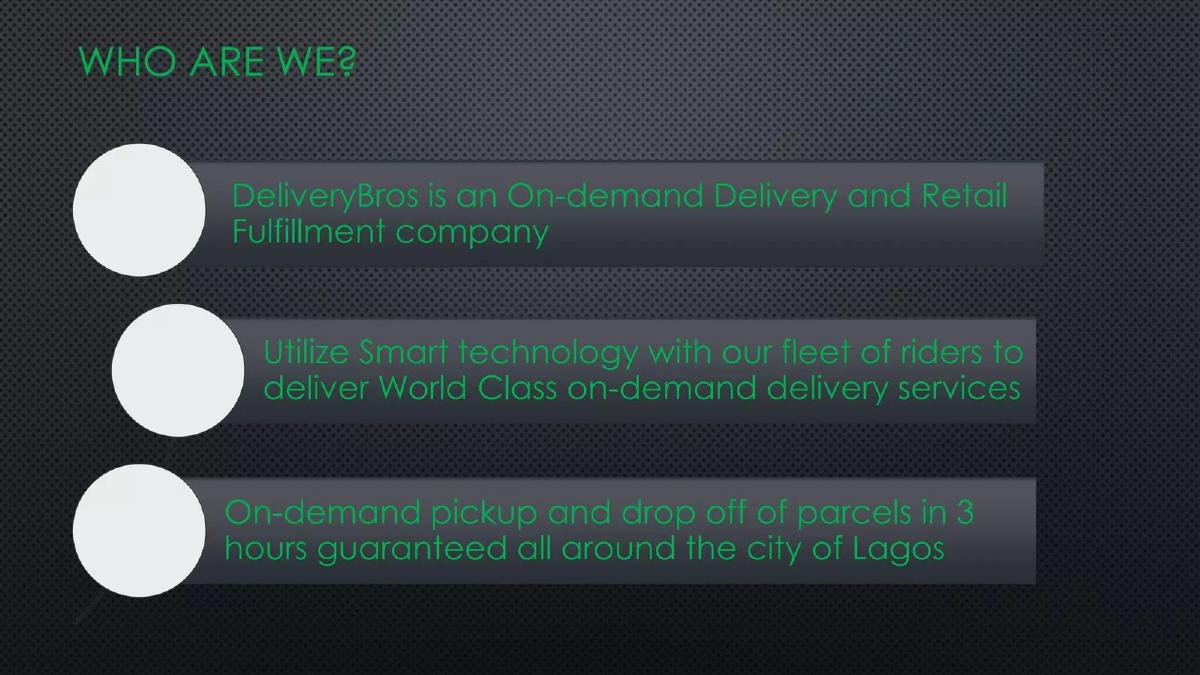
- The core value proposition is a 3-hour guaranteed pickup and drop-off service across the city of Lagos (Slide 4).
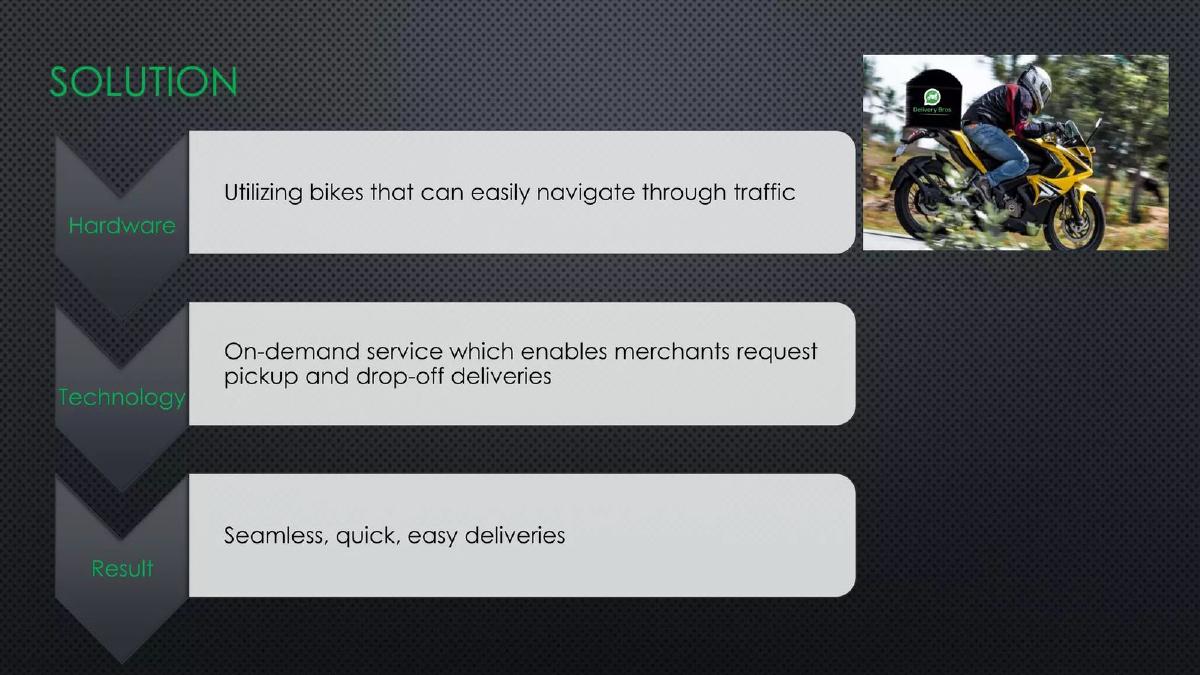
- The solution relies on a combination of 'Hardware' (bikes for traffic navigation) and 'Technology' (on-demand request platform) (Slide 5).
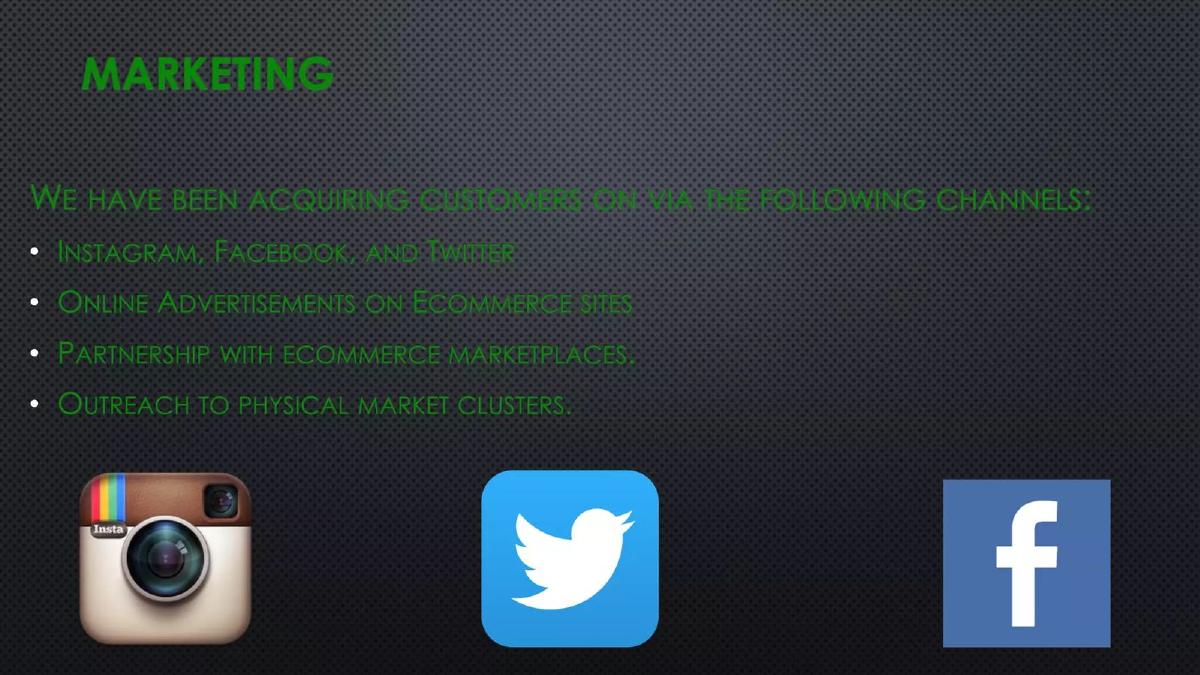
- Customer acquisition strategy leverages social media (Instagram, Facebook, Twitter) and partnerships with e-commerce marketplaces (Slide 6).
- The portfolio slide displays logos of major Nigerian platforms like Jumia, Konga, and OLX, though it does not specify the nature of these relationships (Slide 7).
- The management team consists of three co-founders with backgrounds in HR, digital marketing, and operations at other Nigerian startups like Pass.ng and Ojaplace.com (Slide 8).
Executive Summary: The Lagos Logistics Challenge
Delivery Bros enters the market with a very specific focus: solving the 'last mile' delivery problem in one of Africa's most congested cities, Lagos. The deck is short, consisting of only 8 slides, and follows a standard problem-solution-market flow. However, it leans heavily on the macro-opportunity of Nigerian e-commerce rather than the micro-details of their specific business operations or financial health.
Slide 1: Title Slide
The deck opens with the Delivery Bros logo—a motorcycle icon inside a green speech bubble, strongly reminiscent of the WhatsApp logo. The tagline is "The New Standard For Deliveries." It is a clean, minimalist start that immediately communicates the industry (logistics) and the medium (bikes).
Slide 2: The Problem
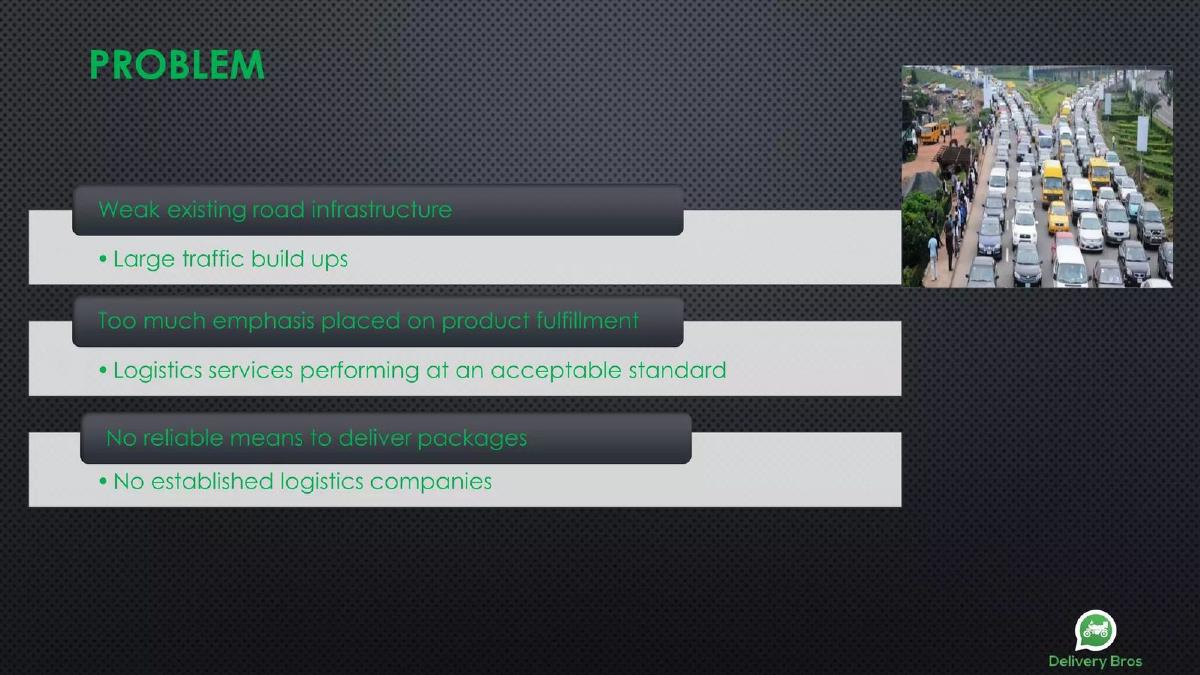
The problem slide identifies three main pain points: "Weak existing road infrastructure," "Too much emphasis placed on product fulfillment," and "No reliable means to deliver packages." The slide includes a photo of a dense traffic jam, which is a visceral reality for anyone living in Lagos. By stating that there are "no established logistics companies" performing at an acceptable standard, they are positioning the entire current market as a failure, creating a vacuum for their service to fill.
Slide 3: Target Market
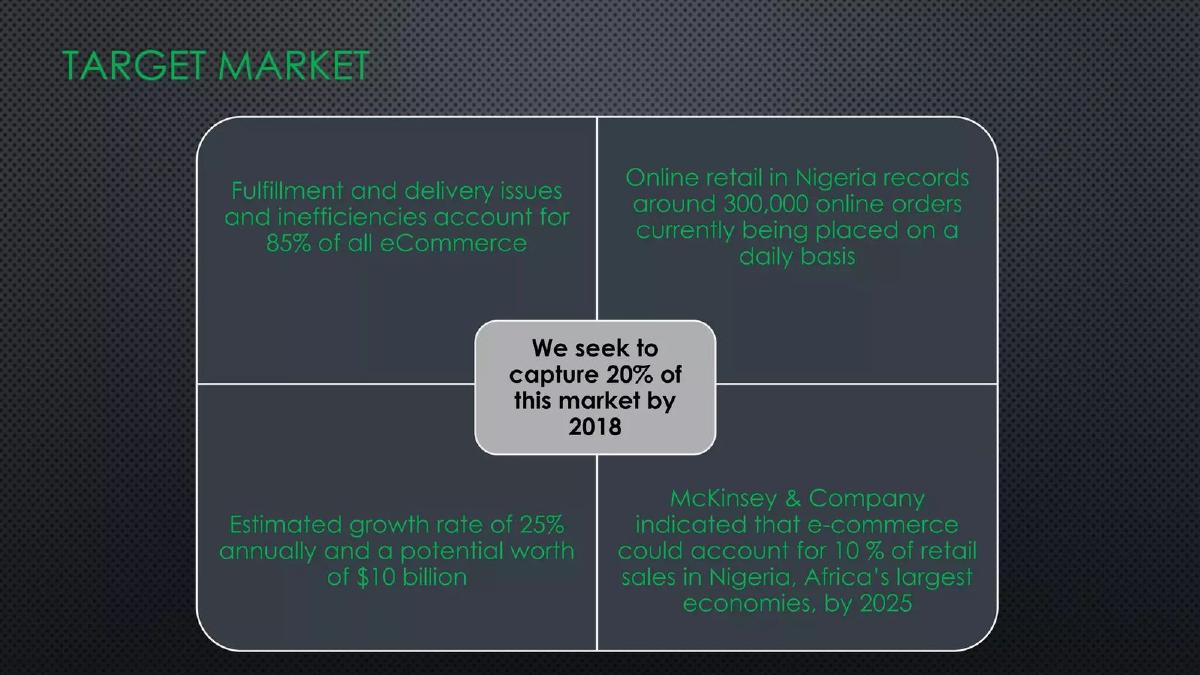
This slide provides the macro-economic justification for the business. It cites four key data points:
Fulfillment and delivery issues account for 85% of all e-commerce inefficiencies. · Nigeria records approximately 300,000 online orders daily. · The market has a potential worth of $10 billion with a 25% annual growth rate. · McKinsey & Company predicts e-commerce could be 10% of retail sales in Nigeria by 2025.
The central claim is bold: "We seek to capture 20% of this market by 2018." This gives the deck a timestamp, suggesting it was likely produced around 2016 or 2017.
Slide 4: Who Are We?
This slide defines the company as an "On-demand Delivery and Retail Fulfillment company." It introduces the concept of "Smart technology" paired with a "fleet of riders." The most important metric on this slide is the "3 hours guaranteed" delivery time for all of Lagos. This is their primary competitive advantage against traditional logistics providers.
Slide 5: The Solution
Hardware: Utilizing bikes that can navigate traffic. · Technology: An on-demand service for merchants to request pickups. · Result: Seamless, quick, and easy deliveries.
The visual shows a rider on a sport-style motorcycle with a Delivery Bros branded box, reinforcing the professional nature of their fleet.
Slide 6: Marketing
The marketing strategy is straightforward and focused on digital acquisition. They list Instagram, Facebook, and Twitter as primary channels. They also mention "Partnership with ecommerce marketplaces" and "Outreach to physical market clusters." This indicates a B2B2C approach, where they acquire the end-user by serving the merchant.
Slide 7: Our Portfolio
This slide is a logo cloud featuring prominent Nigerian e-commerce and classifieds brands, including Jumia, Konga, OLX, Jiji.ng, Efritin.com, and Slot. While the slide is titled "Our Portfolio," it is unclear if these are active paying clients, pilot partners, or simply the types of companies they intend to serve. In a professional teardown, this lack of clarity is a red flag; investors generally prefer to see these categorized as "Current Clients" or "Integration Partners."
Slide 8: Management Team
The final slide introduces the three co-founders. Adaora Nweje (CMO) is described as an adept professional with experience at HCDC Limited and Pass.ng. Akinbolaji Brand (COO) co-founded Ojaplace.com and worked at PathCare Africa. Animashaun Abiodun co-founded Kassafrica.com and was an Operations Manager at Pass.ng. The team appears to have solid local experience in the Nigerian tech ecosystem, particularly in operations and retail marketplaces, which is highly relevant to a logistics startup.
What Works in This Deck
Local Context: The founders clearly understand the specific pain points of Lagos. By focusing on traffic and infrastructure, they aren't just building a "delivery app"; they are building a workaround for a broken physical system. The 3-hour guarantee is a powerful, quantifiable promise that addresses the core frustration of the target market.
Market Data: The use of McKinsey data and specific daily order counts (300,000) helps ground the opportunity in reality. It moves the conversation from "delivery is hard" to "delivery is a multi-billion dollar bottleneck."
Team Relevance: The founders aren't outsiders. Their previous roles at Pass.ng and their own retail startups suggest they have dealt with the friction of the Nigerian market before. This builds founder-market fit.
What Is Missing
The Ask: This is the most glaring omission. A pitch deck is a tool to raise money, yet there is no mention of how much capital is needed, what the valuation is, or what the milestones for the next 18 months look like.
Unit Economics: Logistics is a low-margin, high-volume business. The deck does not explain the cost per delivery, the commission structure, or how they achieve profitability while maintaining a fleet of riders. Without these numbers, an investor cannot judge the scalability of the business.
Competitive Landscape: Lagos has many informal and formal delivery services. The deck claims there are "no established logistics companies," which is a dangerous exaggeration. Acknowledging competitors like MAX.ng or Gokada (which were active in similar spaces) and explaining why Delivery Bros is superior would have strengthened the pitch.
Traction: While they show a "Portfolio" of logos, they don't provide actual growth metrics. How many deliveries have they completed to date? What is the month-over-month growth? Without traction data, the deck feels like a proposal rather than a business already in motion.
Founder Takeaways
Be Specific with Partnerships: If you put a logo on a slide, be prepared to explain the relationship. Are you a preferred partner, or did you just deliver one package for them? Vague "Portfolio" slides can lead to difficult questions during due diligence.
Address the 'How': Using bikes to beat traffic is a good start, but the "Smart technology" mentioned on Slide 4 is never explained. Is it a proprietary routing algorithm? A simple WhatsApp integration? Founders should provide at least a high-level overview of their tech stack to prove it isn't easily replicable.
Include the Financials: Never leave out the 'Ask.' Even if you are just looking for a conversation, stating your funding goals shows that you have a plan for the capital. A logistics company, in particular, needs to show they understand their burn rate and their path to sustainability.
Frequently asked questions
- What is the primary problem Delivery Bros is trying to solve?
- According to Slide 2, the company is tackling the lack of reliable means to deliver packages in Nigeria. They specifically point to weak road infrastructure and significant traffic congestion as the main obstacles that existing logistics services fail to navigate effectively.
- How does Delivery Bros differentiate its service from competitors?
- Slide 4 highlights their 'World Class' on-demand delivery service which guarantees pickup and drop-off of parcels within 3 hours throughout Lagos. Slide 5 emphasizes that their use of motorcycles (bikes) allows them to bypass the traffic jams that stall traditional four-wheel delivery vehicles.
- What is the size of the market opportunity presented?
- Slide 3 cites McKinsey & Company data suggesting e-commerce could account for 10% of retail sales in Nigeria by 2025. They value the potential market at $10 billion with a 25% annual growth rate, noting that 300,000 orders are currently placed daily.
- Who are the founders and what is their background?
- The team (Slide 8) includes Adaora Nweje (CMO), Akinbolaji Brand (COO), and Animashaun Abiodun. Their experience includes roles at Nigerian companies like PathCare Africa and Pass.ng, as well as founding campus-based retail marketplaces like Ojaplace.com and Kassafrica.com.
- What critical information is missing from this pitch deck?
- The deck lacks several standard investment slides. There is no 'Ask' slide detailing how much capital they are raising, no financial projections or unit economics, no slide detailing the competitive landscape, and no roadmap for future expansion beyond the 2018 market share goal.