Diced presents a straightforward brick-and-mortar investment opportunity, seeking $500,000 to launch a fast-casual salad concept. The deck, dated October 2012, focuses heavily on the physical footprint and operational costs required to establish a presence in the Greater Seattle area. By highlighting existing market successes in New York and identifying specific high-traffic neighborhoods like South Lake Union and Downtown Bellevue, the founders attempt to de-risk the venture through location-based strategy. While the deck provides a granular breakdown of the initial capital expenditure, it l…
Key takeaways
- The company is seeking a total raise amount of $500,000 to launch its first location (Slide 9).
- Initial expansion is targeted at high-density Seattle areas including South Lake Union and Downtown Bellevue (Slide 6).
- The deck identifies '50+ Million Profit' and 'Long Lines' in the NYC salad market as a proof of concept for the business model (Slide 2).
- Diced plans a multi-phase expansion strategy, eventually aiming for 5 locations in Vancouver BC and 6 in San Francisco (Slide 7).
- The largest single expense in the use of proceeds is $190,000 for equipment, fixtures, and leasehold improvements (Slide 9).
- Regional competition is benchmarked against Saladworks and Tossed, citing their store counts and revenue (Slide 4).
- The business model includes a dedicated catering service to utilize kitchen capacity and reach corporate meetings (Slide 3).
- The deck omits a dedicated team slide, leaving the founders' backgrounds and operational experience unaddressed in this selection (Slides 1-10).
Executive Summary: The Fast-Casual Salad Play
Diced is a pitch for a regional fast-casual salad chain, primarily targeting the Pacific Northwest. The deck, dated October 2012, follows a traditional retail expansion narrative: identify a proven model in a distant market (NYC), highlight the lack of local saturation, and provide a detailed roadmap for physical store growth. With a requested investment of $500,000, the company is focused on the capital-intensive nature of opening a flagship location in high-traffic urban centers like Seattle's South Lake Union.
Slide 1: Title Slide
The deck opens with a textured green background featuring stylized vegetable icons (carrots, radishes, mushrooms). The branding is clear: DICED: a salad experience . The visual language immediately communicates health, freshness, and a modern aesthetic suitable for an urban professional demographic.
Slide 2: Our Story and Market Validation
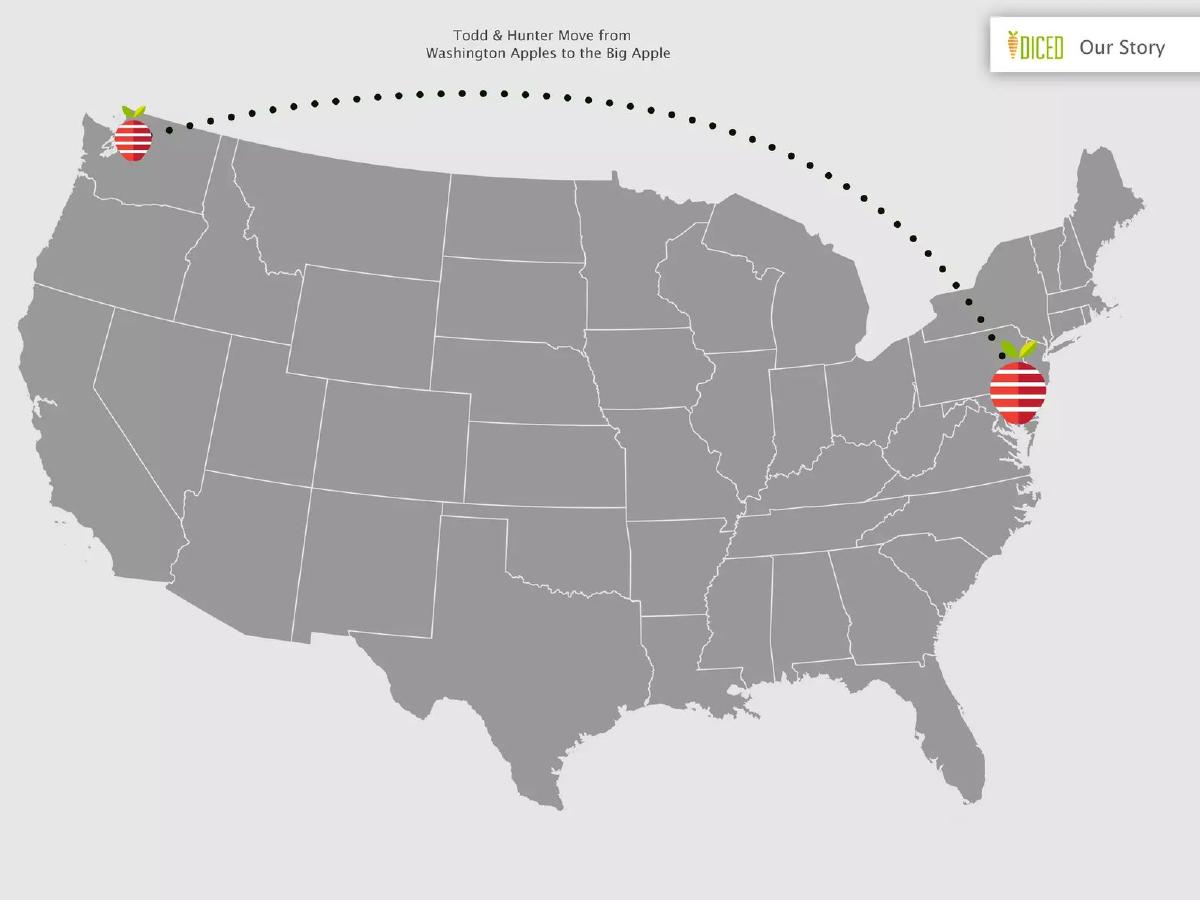
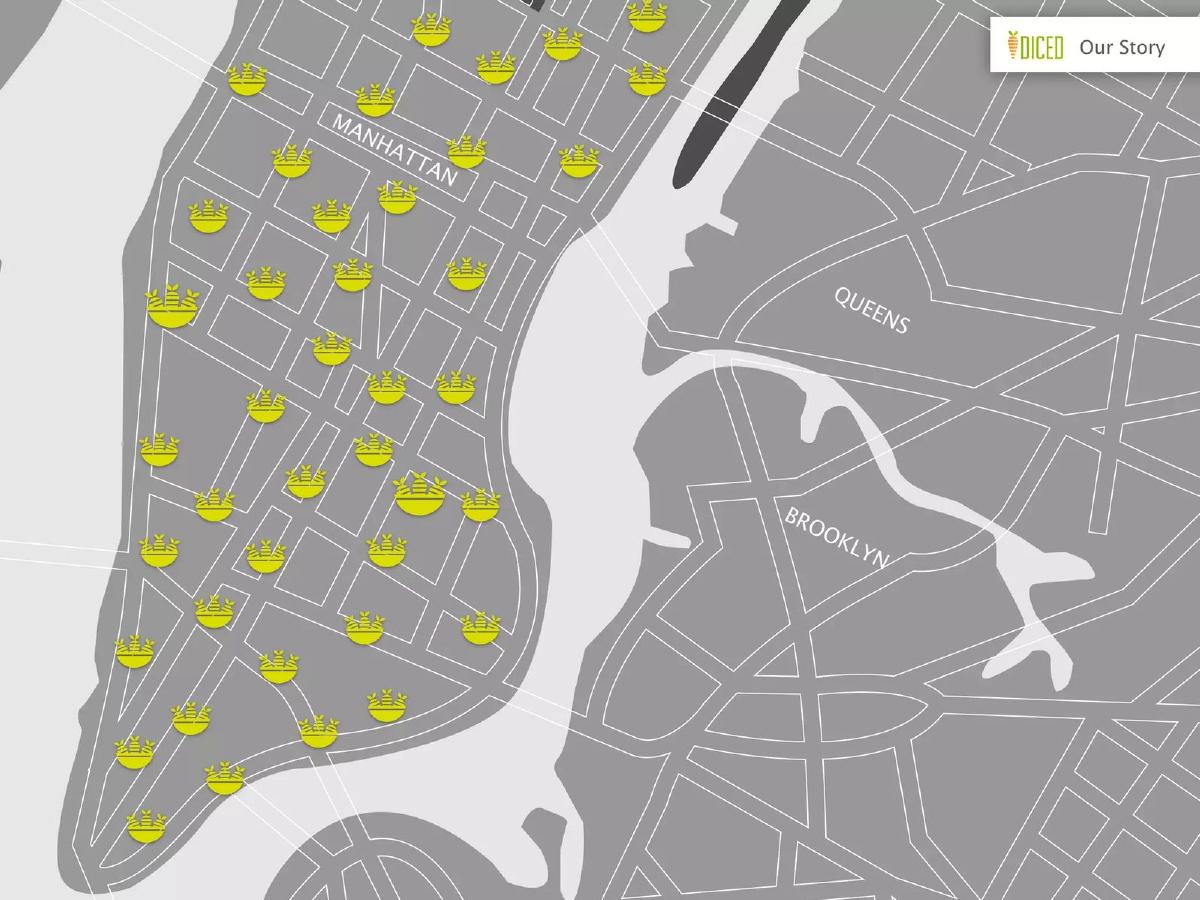
Slide 2 uses a four-quadrant layout to establish market demand. It references the New York City market, citing 50+ Million Profit and Long Lines at existing establishments. By mentioning Hundreds of Salad Spots in NYC , the founders argue that the 'Fresh, Healthy & Quick' model is a proven winner in dense urban environments. This slide serves as the 'Why Now' and 'Market Proof' combined into one, though it lacks specific source citations for the profit figures.
Slide 3: The Catering Revenue Stream
Slide 3 introduces CATERING as a secondary business pillar. The text notes that catering for corporate meetings, group picnics, and dinner parties will allow the company to better utilize kitchen capacity . This is a crucial operational point for restaurants, as it suggests a way to generate revenue during non-peak hours and increase the overall ROI of the physical footprint.
Slide 4: Regional Competition Analysis
The competition slide uses a simple grid to compare two players: Saladworks and Tossed . Saladworks is listed with 50 stores and $35 M + in revenue, while Tossed is listed with 20 stores and $30 M+ in revenue. Interestingly, the founders include a Fear Factor column, giving both competitors an '8' out of 10. This is a subjective metric, but it indicates the founders take the competitive threat seriously while implying there is still room for a new brand with higher 'Brand Strength.'
Slide 5: The In-Store Experience
Slide 5 focuses on the 'Dicing' process. It emphasizes a smile-friendly staff and colorful visuals of ingredients prepped in front of the customer. The goal stated is that customers leave with a refreshing "taste in their mouths" . This slide highlights the transparency of the food preparation process, which was a major trend in fast-casual dining during the early 2010s (pioneered by brands like Chipotle).
Slide 6: Target Locations - Phase 1
The deck gets specific about geography on Slide 6. It identifies South Lake Union and Downtown Bellevue as the primary targets for the first store. These are high-income, high-density employment hubs (notably the home of Amazon and various tech satellites), which aligns with the target demographic of office workers seeking quick, healthy lunches.
Slide 7: Long Term Vision and Expansion
Slide 7 outlines a four-stage expansion plan. It starts with establishing a model in Seattle, then expanding to 11 specific Seattle neighborhoods (including Capitol Hill, Ballard, and Fremont ). The final stages involve moving into Tacoma (1), Portland (3), Vancouver BC (5), and San Francisco (6) . This shows the founders are thinking about a regional platform rather than a single-store lifestyle business.
Slide 8: Marketing Strategy Transition
Slide 8 is a simple transition slide for the Marketing Strategy . While the specific tactics are not detailed in this slide, it signals the importance of brand awareness in a crowded food service market.
Slide 9: Use of Proceeds and Financial Ask
This is the most detailed slide in the deck. The total raise is $500,000 . The line items are granular:
Equipment, fixtures, construction: $190,000 · Additional Funds (Contingency): $75,000 · Pre-Open Comp/Wages: $40,000 · Security deposits: $32,000 · POS system/Software: $25,000 · Consultant: $25,000 · Initial Advertising and PR: $20,000 · Dead rent (3 months): $22,500
The inclusion of 'dead rent' shows a realistic understanding of commercial real estate timelines, where rent must be paid during the months required for permitting and construction before the doors open.
Slide 10: Closing Branding
The final slide in this selection repeats the cover art, reinforcing the brand identity. It lacks a 'Contact Us' or 'Call to Action' in this specific view, though such information typically appears at the very end of a full 64-slide deck.
What Works in This Deck
Granular Budgeting: The use of proceeds slide is excellent. Many founders ask for a round number without explaining the math. Diced breaks it down to the level of 'Small Wares' ($4,000) and 'Uniforms' ($2,000), which builds trust with investors that the founders have researched the actual costs of opening a restaurant.
Geographic Specificity: By naming specific neighborhoods like South Lake Union and University Village, the founders demonstrate a 'boots on the ground' understanding of their target market. They aren't just targeting 'Seattle'; they are targeting specific blocks with high foot traffic.
What Is Missing
The Team: In this 10-slide selection, there is no mention of who is running the company. In the restaurant industry, the 'jockey' matters as much as the 'horse.' Investors need to know if the founders have managed high-volume kitchens or scaled retail brands before.
Unit Economics: While the deck mentions the revenue of competitors, it does not provide the projected unit economics for a Diced location. What is the average check size? What are the expected food costs (COGS) and labor margins? Without these, the $500,000 ask is hard to evaluate against a potential return.
Founder Takeaways
Account for the 'Dead Zone': Diced’s inclusion of $22,500 for 'dead rent' is a professional touch. Founders in the physical space (retail, gyms, restaurants) often forget that they will be paying rent for months before they can legally serve a single customer. Always include a buffer for permitting delays.
Leverage Proven Proxies: If you are launching in a secondary market (like Seattle was for specialized salad bars in 2012), use the primary market (NYC/LA) as your proof of concept. Showing that a model has already generated '$50M+ Profit' elsewhere makes your local execution feel like a lower-risk arbitrage play rather than an unproven experiment.
Frequently asked questions
- What is the primary value proposition of Diced?
- Diced positions itself as 'a salad experience' that combines fresh, healthy, and quick options. The deck emphasizes the visual nature of the service, where ingredients are prepped and diced in front of the customer to ensure a 'refreshing taste' and a 'smile-friendly' atmosphere (Slide 5). It aims to replicate the high-demand, high-profit salad models seen in New York City for the Pacific Northwest market.
- How does Diced plan to use the $500,000 investment?
- The capital is strictly allocated to the launch of the first store. Major costs include $190,000 for construction and equipment, $75,000 in 'Additional Funds' for contingency, $40,000 for pre-opening labor and training, and $32,000 for security and utility deposits. The budget even accounts for $22,500 to cover three months of 'dead rent' during the build-out phase (Slide 9).
- What is the long-term expansion strategy?
- The strategy is a phased regional rollout. Phase 1 focuses on the Greater Seattle area. Phase 2 expands to 11 additional Seattle-area neighborhoods. Phase 3 moves outside the immediate area to Tacoma, Portland, Vancouver BC, and San Francisco. The ultimate vision includes reaching 5-6 stores in major West Coast hubs like San Francisco and Vancouver (Slide 7).
- Who are the main competitors identified by Diced?
- The deck specifically names Saladworks and Tossed as regional competitors. It notes that Saladworks has 50 stores and $35M+ in revenue, while Tossed has 20 stores and $30M+ in revenue. Diced uses a 'Fear Factor' and 'Brand Strength' metric to compare itself, though it does not explicitly list its own projected metrics in this specific table (Slide 4).
- Does the deck provide information on the founding team?
- No. In the 10 slides provided, there is no mention of the founders, their previous restaurant experience, or their management team. This is a significant omission for a brick-and-mortar pitch, as operational expertise is the primary driver of success in the food and beverage industry.