Dig’s 9-slide Series A deck is a lean, visually-driven presentation that successfully secured $14M in 2024. The company positions itself as 'Social Intelligence 2.0,' moving beyond simple keyword tracking to analyze deep narratives within video content. The deck relies heavily on market timing, highlighting that video will cross 50% of all social posts by 2025. While the deck is light on traditional financial metrics and team bios, it compensates with high-tier social proof—claiming trust from over 70 brands and governments, including Ferrari and Google. By focusing on the technical shift to…
Key takeaways
- The deck positions the company as 'Social Intelligence 2.0,' emphasizing a 'Video-First' approach over traditional text-based monitoring (Slide 2).
- Dig claims significant market traction, stating they are 'Trusted by 70+ brands & governments' including Ferrari, Starbucks, and Google (Slide 2).
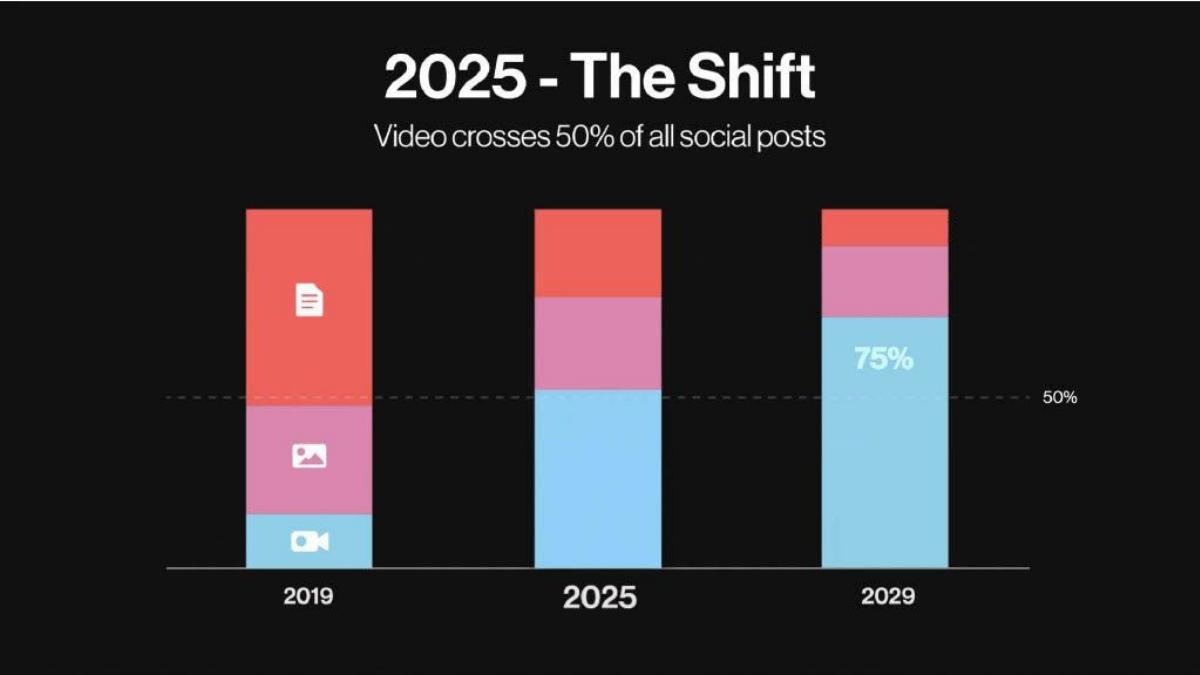
- A core thesis of the deck is 'The Shift,' predicting video will account for 75% of social posts by 2029 (Slide 4).
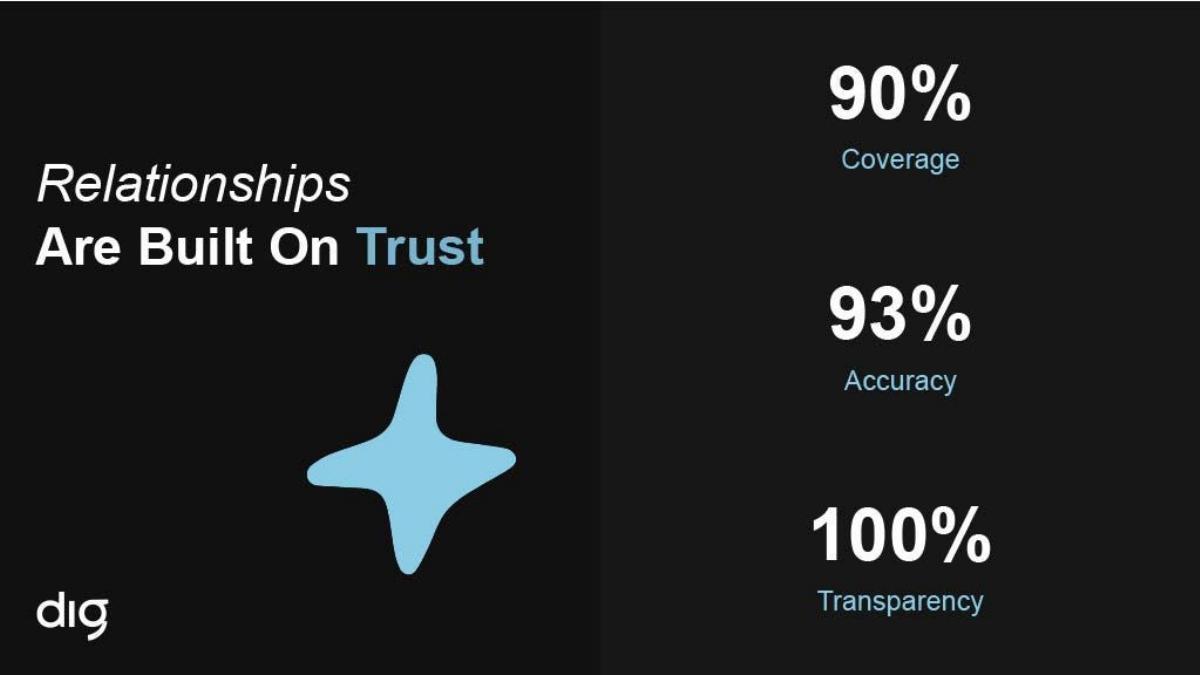
- The platform claims high performance metrics: 90% coverage, 93% accuracy, and 100% transparency (Slide 6).
- Product functionality is demonstrated through a 'Dig Chatbot' and a detailed 'Posts Feed' for deep-diving into specific risks (Slide 7).
- The deck includes four diverse case studies covering the Met Gala, political narratives, Eurovision predictions, and F1 sponsorship analysis (Slide 9).
- Dig raised $14M in a 2024 Series A round, as reported by Business Insider, despite the deck omitting a specific 'Ask' slide.
- The presentation completely omits a team slide, financial projections, and a competitive landscape analysis.
The 9-Slide Narrative: Dig's Series A Teardown
Dig's pitch deck is a study in brevity and narrative focus. In an era where social media is increasingly dominated by short-form video, Dig raised $14M in 2024 by arguing that the old ways of monitoring the internet—primarily keyword-based text searches—are obsolete. Based in the Middle East and operating in the AI and advertising sectors, Dig uses this deck to establish a 'New Guard' status in the social intelligence space.
Slide 1: Title Slide
The opening slide is minimalist, featuring the Dig logo centered against a dark background with a stylized perspective grid. A small 'AI' tag in the bottom left corner immediately categorizes the technology. It sets a professional, tech-forward tone without clutter.
Slide 2: Social Intelligence 2.0
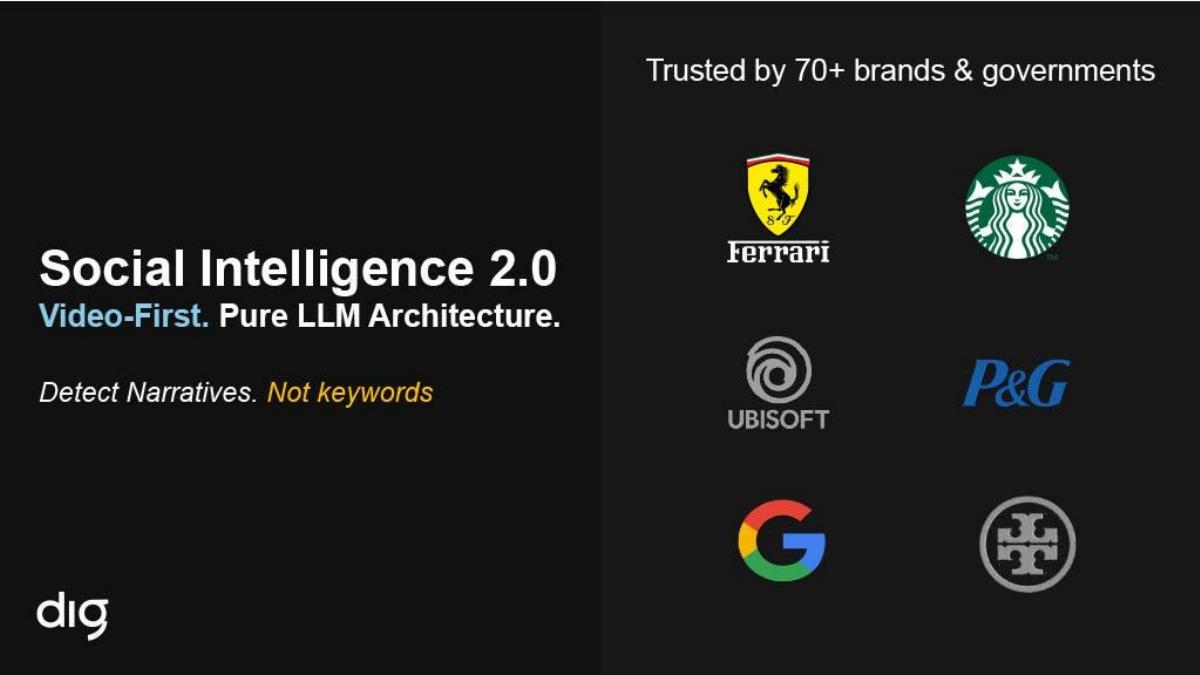
This is the 'Hook' slide. Dig defines its category as 'Social Intelligence 2.0' and highlights three key pillars: 'Video-First,' 'Pure LLM Architecture,' and the ability to 'Detect Narratives. Not keywords.' This is a direct shot at legacy social listening tools. The right side of the slide provides massive social proof, claiming the platform is 'Trusted by 70+ brands & governments.' The inclusion of logos like Ferrari, Starbucks, Google, and P&G suggests the product is already enterprise-ready and battle-tested.
Slide 3: The Visual Problem
Slide 3 uses high-impact imagery—a woman looking overwhelmed by floating video screens—to illustrate the chaos of modern social media. The headline 'Video is taking over social media' sets the stage for the market data that follows. It appeals to the investor's intuition that the volume of video content is becoming unmanageable for traditional human or text-based monitoring.
Slide 4: 2025 - The Shift
This is the 'Why Now' slide. Dig presents a bar chart showing the evolution of social media content types from 2019 to 2029. The data points are specific: video crossed a minority threshold in 2019, is projected to cross 50% of all social posts in 2025, and will reach 75% by 2029. By highlighting 2025 as 'The Shift,' Dig creates a sense of urgency for investors to back a video-native solution before the market fully tips.
Slide 5: The Power of Video
Using a play on the phrase 'a picture is worth a thousand words,' slide 5 claims 'A Video Is Worth A Million Words.' It features a screenshot of a TikTok video where a creator is criticizing a product (a Stanley-style cup) with the caption 'The Worst Purchase.' This slide emphasizes that sentiment and brand risk are now communicated through visual nuances and spoken word in video, which are harder to track than written reviews.
Slide 6: The Trust Metrics
Dig moves from the 'Problem' to their 'Performance.' The slide lists three key metrics: 90% Coverage, 93% Accuracy, and 100% Transparency. While these are self-reported, they address the primary concerns of AI-driven monitoring: missing content (coverage) and false positives (accuracy). The '100% Transparency' claim likely refers to the platform's ability to explain why a post was flagged, which is a common pain point in 'black box' AI tools.
Slide 7: Product - Democratization of Insights
This slide shows the UI. It highlights two features: the 'Dig Chatbot' for 'zero time' insights and the 'Posts Feed' for 'deep dives.' The screenshot of the Posts Feed is particularly effective; it shows a flagged Instagram post with a detailed explanation of why it is a risk ('Leaked Sensitive Information Raises Security Concerns'). This demonstrates that the AI isn't just finding videos; it's interpreting them and providing actionable intelligence.
Slide 8: The Tagline
A simple transition slide featuring the logo and the tagline: 'Get a grip on social video.' It serves as a summary of the company's mission before moving into the evidence of their work.
Slide 9: Case Studies
The final slide provides four concrete examples of Dig in action. These include: 1) Analyzing the Met Gala (9,570 posts, 2.11B views), 2) Tracking the 'Fake Luxury' narrative on TikTok (7,888 posts, 1.2B views), 3) Predicting Eurovision 2025 results with 57% vs 42% accuracy over bookies, and 4) F1 Monaco sponsor exposure analysis. These case studies prove the platform's versatility, showing it can handle everything from high-fashion brand sentiment to political disinformation and sports sponsorship ROI.
What Dig Does Well
Dig excels at category creation. By labeling themselves 'Social Intelligence 2.0,' they immediately frame existing competitors as '1.0' or legacy. The deck is extremely focused on a single narrative: the world has moved to video, and text-based tools are no longer sufficient. This clarity of message is likely what resonated with investors during the $14M Series A round.
The use of social proof is also top-tier. For a Series A company to claim 70+ brands and governments, including some of the most recognizable logos in the world, removes a significant amount of 'product-market fit' risk for an investor. The case studies on the final slide further reinforce this by showing the platform's utility across vastly different use cases.
What is Missing from the Deck
The most glaring omission is a Team Slide . In early-stage venture capital, the 'who' is often as important as the 'what.' There is no mention of the founders' backgrounds in AI, data science, or social media. Additionally, the deck lacks a Competition Slide . While they imply that '1.0' tools are the competition, they don't name specific rivals or explain their technical moat beyond 'Pure LLM Architecture.'
There is also no Financials or Ask Slide . We know from publisher reports that they raised $14M, but the deck itself doesn't state how much they were seeking or how they planned to allocate the capital (e.g., R&D, sales expansion, geographic growth). Finally, the deck is light on Unit Economics . While they show '70+ brands,' there is no mention of Average Contract Value (ACV), churn rates, or revenue growth percentages.
Founder Takeaways: What to Copy
Focus on 'The Shift': If your startup relies on a changing market dynamic, dedicate a slide to 'The Shift' (Slide 4). Use clear, projected data to show that the window of opportunity is now. · Show, Don't Just Tell: Instead of just saying the AI is powerful, Dig shows a screenshot of the AI explaining a specific risk (Slide 7). This makes the 'magic' of the technology feel real. · Diverse Case Studies: If your product is horizontal, show it. Dig’s final slide (Slide 9) proves they can work for a luxury brand (Met Gala), a government (political narratives), and a sports sponsor (F1). This broadens the perceived Total Addressable Market (TAM). · Minimalist Design: The dark theme and high-quality imagery make the company look 'expensive' and modern. Avoid cluttered slides; let one big idea breathe per page.
Frequently asked questions
- What is Dig's core value proposition?
- Dig positions itself as a 'Social Intelligence 2.0' platform. Unlike traditional tools that rely on keywords, Dig uses a 'Pure LLM Architecture' to detect narratives within video, image, and text. This allows brands and governments to identify risks like disinformation and deepfakes that text-only monitoring might miss.
- How does Dig justify the market need for their product?
- The deck relies on a 'market shift' argument. It shows that video content is rapidly displacing text and images on social media. According to slide 4, video is expected to cross the 50% threshold of all social posts in 2025 and reach 75% by 2029, making video-native analysis tools essential.
- Which major brands are using Dig according to the deck?
- Slide 2 displays logos for several high-profile clients, stating the platform is trusted by over 70 brands and governments. The logos shown include Ferrari, Starbucks, Ubisoft, P&G, Google, and Tory Burch.
- What specific product features are highlighted?
- The deck showcases two primary interfaces on slide 7: the 'Dig Chatbot,' which allows users to uncover insights using natural language queries, and the 'Posts Feed,' which provides a granular view of specific social posts identified as risks, including descriptions of why they are flagged.
- What is missing from the Dig pitch deck?
- The deck is notably brief at only 9 slides. It lacks several standard components: a team slide featuring founder backgrounds, a competition slide, detailed unit economics or revenue growth, and a specific 'Ask' slide detailing how the $14M would be spent.