Alba's pitch deck is a masterclass in brevity, focusing on a clear market gap in Latin America's childcare sector. By 2016, the startup had achieved $150,000 in annual Gross Merchandise Volume (GMV) with a lean 1,000+ paying customer base. The deck identifies a massive $30 billion total addressable market encompassing babysitting, pet care, and elder care, while focusing on a $6 billion babysitting beachhead. Despite its minimalist design, the deck successfully communicates strong traction—specifically 22% month-over-month growth—and a simple $10 monthly subscription model. While it lacks det…
Key takeaways
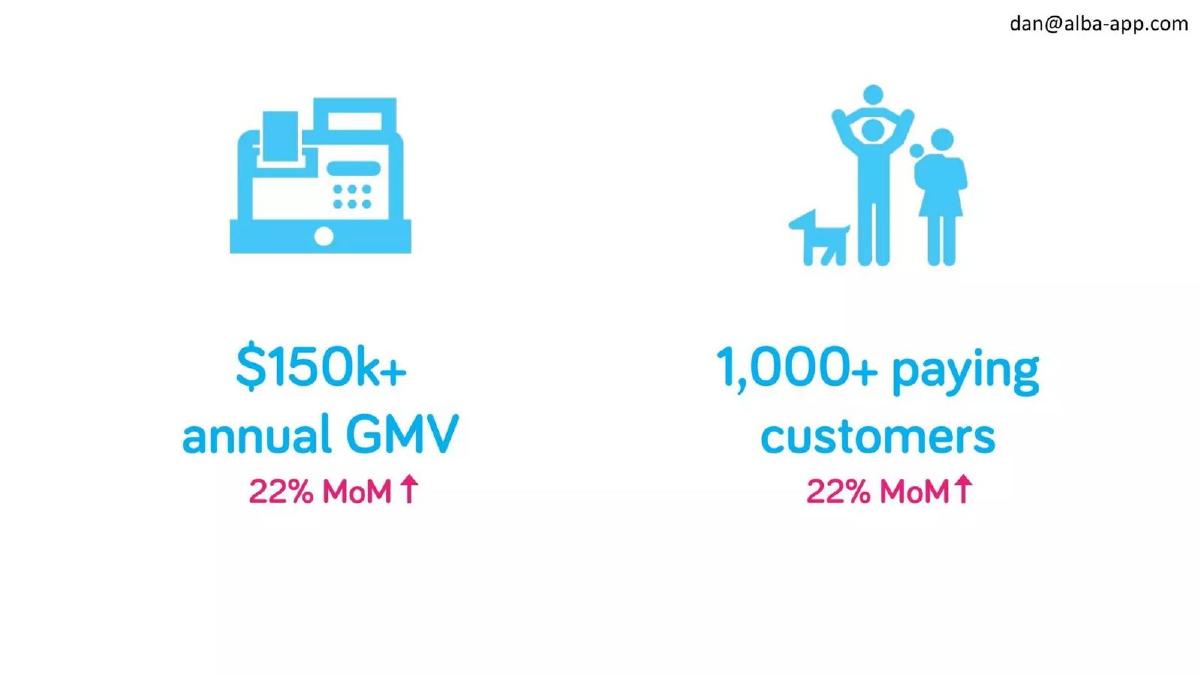
- The company reported over $150,000 in annual GMV with a 22% month-over-month growth rate as of slide 2.
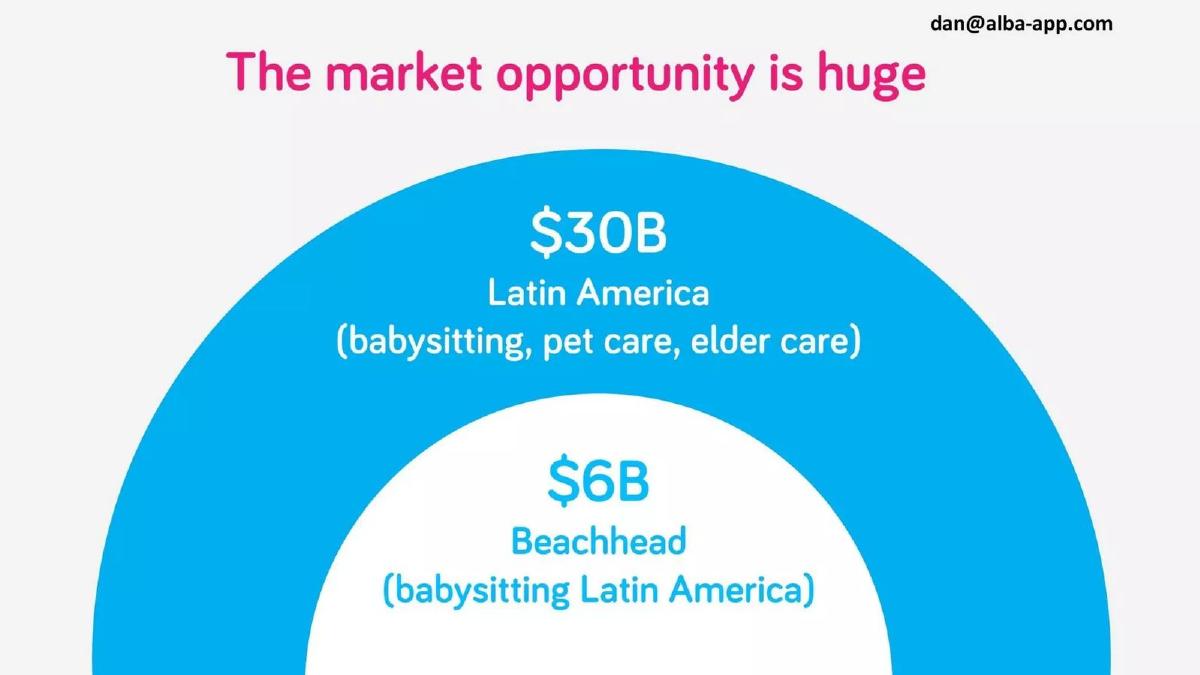
- Alba identifies a total market opportunity of $30 billion in Latin America for babysitting, pet care, and elder care on slide 5.
- The initial beachhead market is valued at $6 billion, specifically targeting babysitting in Latin America (slide 5).
- The platform operates on a simple $10 USD monthly subscription revenue model, as stated on slide 8.
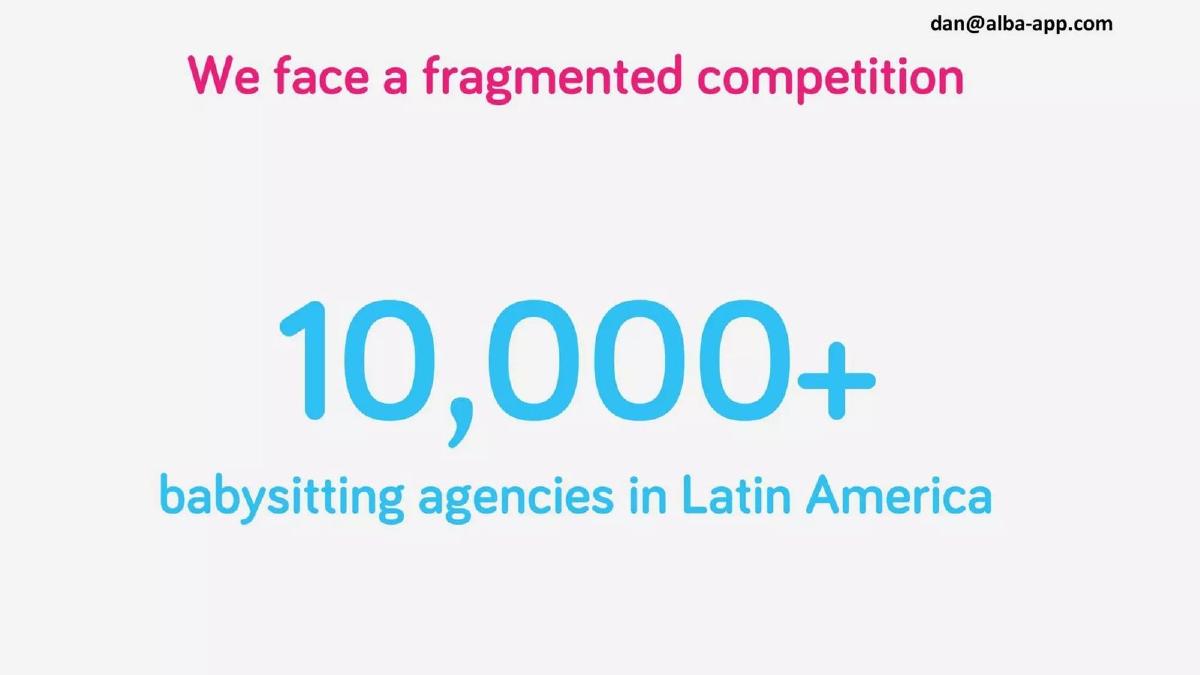
- Competition is described as highly fragmented, consisting of over 10,000 babysitting agencies across the region (slide 6).
- The startup reached a milestone of 1,000+ paying customers while maintaining 22% MoM growth (slide 2).
- The team includes founders with backgrounds from MIT Sloan School of Management and Universidad de Chile (slide 9).
- The deck completely omits a specific financial 'Ask' slide, leaving the desired funding amount and use of proceeds unknown.
Introduction: The Lean Marketplace Play
Alba’s 2016 pitch deck is a 10-slide presentation that prioritizes clarity and growth metrics over complex narrative. Operating in the Latin American childcare space, the company positions itself as a modern solution to a highly fragmented, trust-dependent market. The deck is characterized by high-contrast visuals, minimal text, and a heavy reliance on a few key growth figures to tell the story of a platform gaining rapid momentum.
Slides 1-3: The Hook and Immediate Traction
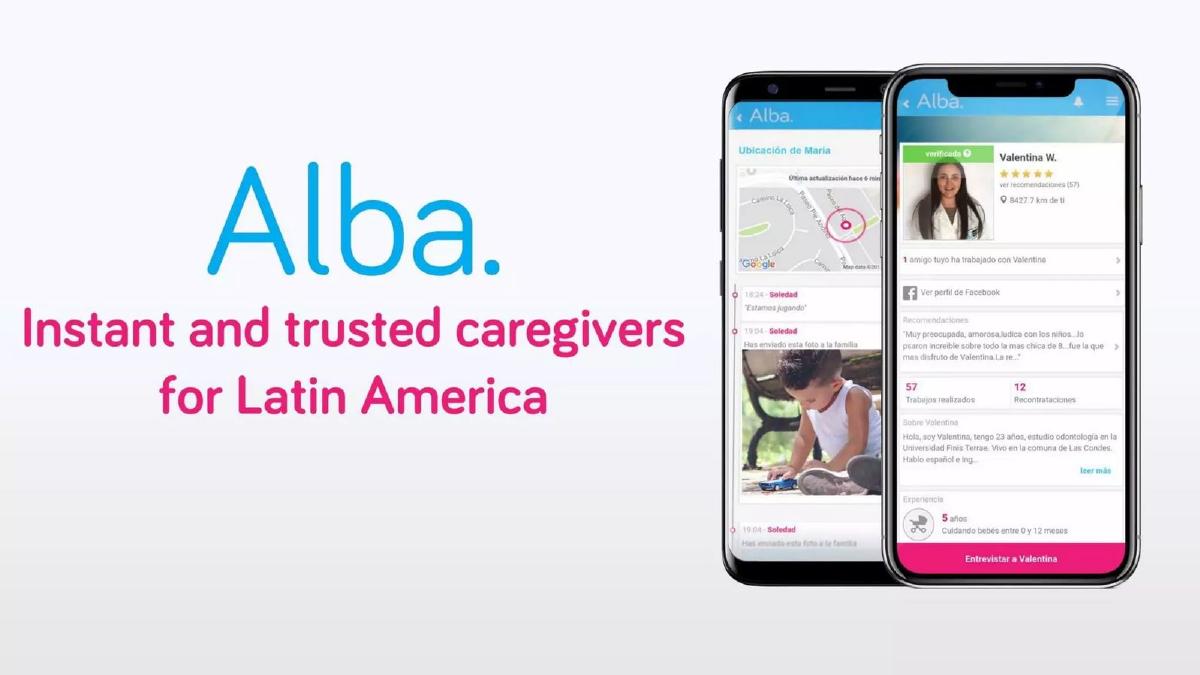
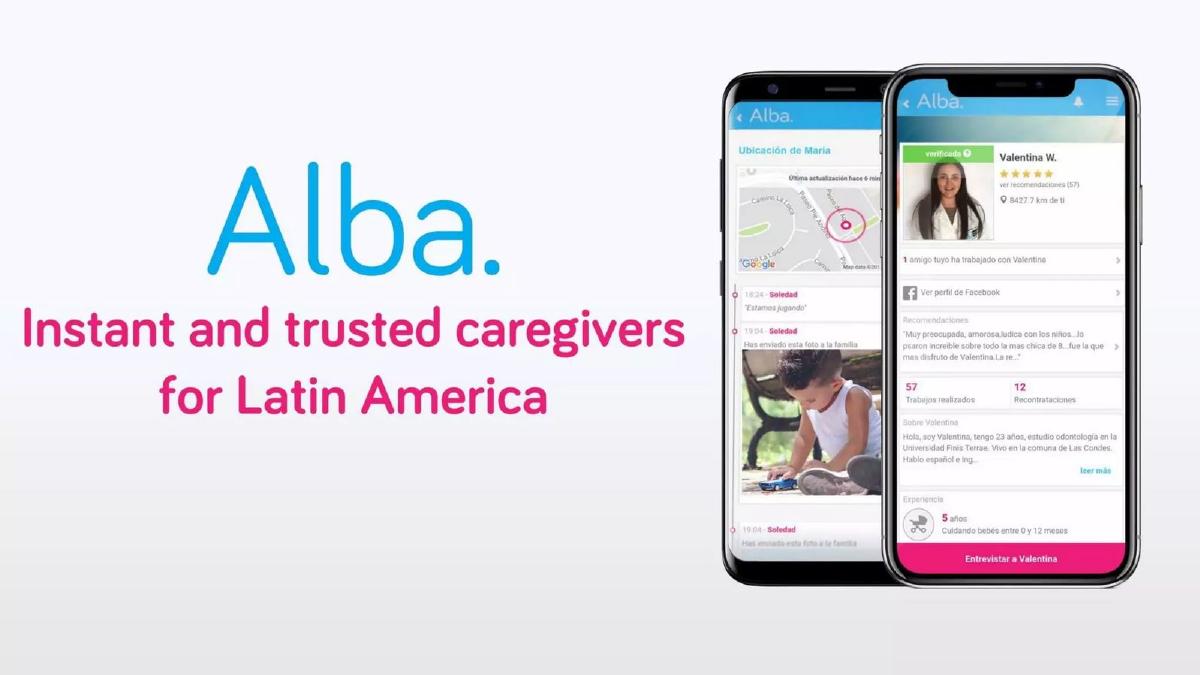
Slide 1: Title and Vision The deck opens with a clear value proposition: "Instant and trusted caregivers for Latin America." The visual includes two smartphone mockups showing the app interface. One screen displays a map with the "Ubicación de María" (Maria's location), indicating real-time GPS tracking. The other shows a caregiver profile for "Valentina W.," featuring a 5-star rating, verification badge, and the number of previous jobs (57) and re-hires (12). This immediately establishes that the product is functional and centered on safety and social proof.
Slide 2: Traction Metrics Alba moves straight to the numbers, a bold choice that suggests their growth is their strongest selling point. They report two primary figures: "$150k+ annual GMV" and "1,000+ paying customers." Crucially, both metrics are accompanied by a "22% MoM" (Month-over-Month) growth indicator. By leading with these figures, Alba attempts to de-risk the investment early in the presentation.
Slide 3: Emotional Connection This slide is a full-bleed photograph of a smiling woman and two children on a ride. There is no text. It serves as a brief emotional beat to remind the investor of the end-user experience—happy families—before diving back into market data.
Slides 4-6: The Problem and Market Scale
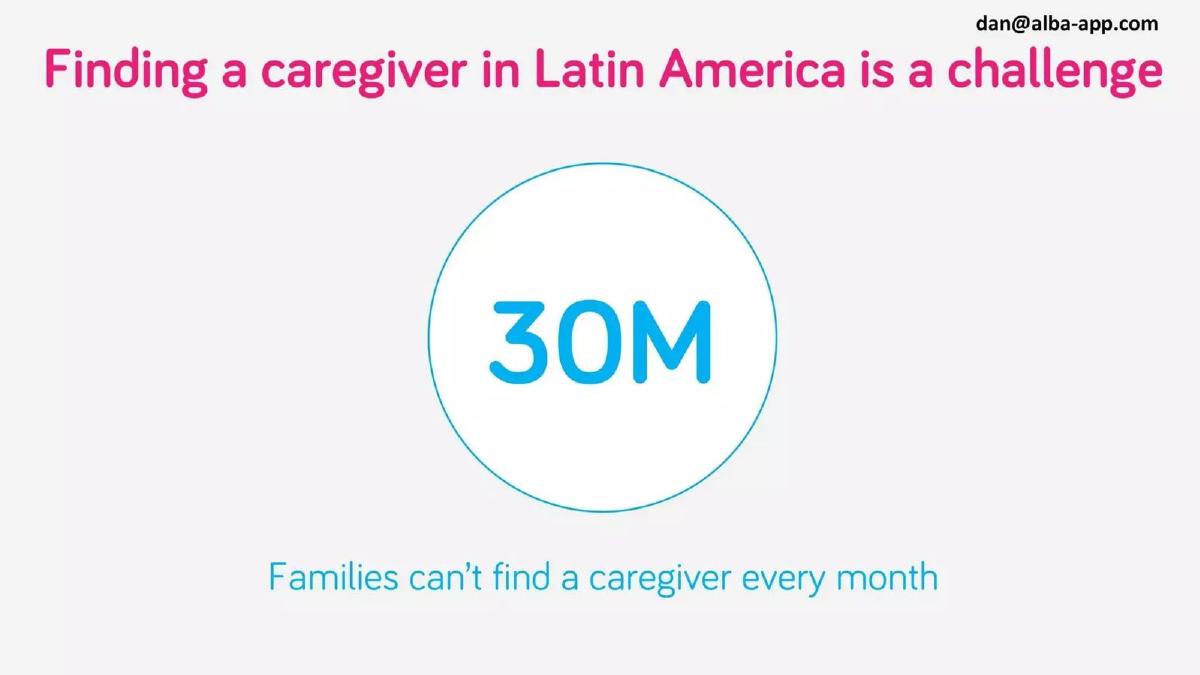
Slide 4: The Problem Statement The deck identifies the core issue: "Finding a caregiver in Latin America is a challenge." It highlights a massive figure of "30M" families who "can't find a caregiver every month." This slide frames the problem as one of accessibility and frequency, suggesting a recurring need that is currently unmet by existing solutions.
Slide 5: Market Opportunity Alba uses a concentric circle diagram to visualize market size. The outer ring represents a "$30B" opportunity in Latin America covering babysitting, pet care, and elder care. The inner circle defines their "Beachhead" as a "$6B" market for babysitting in Latin America. This shows a clear path for expansion while maintaining a focused starting point.
Slide 6: Competitive Landscape Rather than naming specific startups, Alba focuses on the structural weakness of the current market. They state they face "fragmented competition" consisting of "10,000+ babysitting agencies in Latin America." The implication is that these traditional agencies lack the scale, technology, and standardized trust that a centralized platform like Alba can provide.
Slides 7-8: The Solution and Revenue Model
Slide 7: Product Features The solution is described as a "comprehensive care solution" built on three pillars: "Perfect Match," "Live Updates," and "Credit Card Payments." This slide is light on technical detail but emphasizes the three biggest pain points in informal care: finding the right person, knowing they are safe in real-time, and handling friction-less payments.
Slide 8: Revenue Model Alba keeps its monetization strategy simple. They state, "We have a subscription revenue model," specifically a "$10 USD monthly subscription for our service." This is a significant piece of information as it indicates they are not taking a marketplace take-rate (commission) on the hourly wages, or at least that the subscription is their primary focus for the pitch. This model prioritizes user retention and predictable MRR (Monthly Recurring Revenue).
Slides 9-10: Team and Conclusion
Slide 9: The Team The team slide features three founders: Dan Stern (CEO), Tesi del Sante (COO), and Mauricio Giadach (CTO). The slide relies heavily on institutional logos for credibility, including MIT Sloan Management School, Idep Barcelona, LAVA, and Universidad de Chile. There is no mention of specific years of experience or previous successful exits, focusing instead on their educational background and the prestige of their alma maters.
Slide 10: Summary The final slide reiterates the core thesis: "There is a huge opportunity and we are on the right track to solve the problem." It repeats the three most important numbers from the deck: the "$30B" market opportunity, the "$150K" annual GMV, and the "22%" MoM growth. It functions as a summary for an investor to remember the scale and the velocity of the business.
What Works in the Alba Pitch Deck
The most effective element of this deck is its unwavering focus on growth velocity . By repeating the 22% month-over-month growth figure on both the second and last slides, the founders ensure that the investor leaves with a clear sense of momentum. In early-stage fundraising, the rate of change is often more important than the absolute numbers, and Alba leans into this successfully.
The market segmentation on slide 5 is also well-executed. By distinguishing between the total $30B care market and the $6B babysitting beachhead, the founders demonstrate that they have a realistic go-to-market strategy. They aren't trying to boil the ocean on day one; they have a specific entry point but a clear path to a much larger exit.
Finally, the simplicity of the business model (slide 8) is a strength. A flat $10 subscription is easy for an investor to model and understand. It removes the complexity of variable take-rates and suggests a high-value service that parents are willing to pay for just to access the vetted network.
What is Missing from the Alba Pitch Deck
The most glaring omission is a specific "Ask" slide . The deck never states how much money the company is looking to raise, the valuation they are targeting, or what the milestones will be for the next 18 months. Without this, the deck feels more like a company update than a fundraising tool. An investor cannot evaluate the opportunity without knowing the price and the intended use of proceeds.
There is also a complete lack of unit economics . While the $10 subscription is mentioned, there is no data on Customer Acquisition Cost (CAC) or Lifetime Value (LTV). In a consumer-facing marketplace, these metrics are vital to prove that the business can eventually become profitable. Without them, it’s unclear if the 22% growth is being bought at an unsustainable price.
The team slide is also somewhat thin. While the educational pedigree is impressive, there is no information about the founders' operational history. Have they built marketplaces before? Do they have experience in the care industry? The deck relies on the MIT brand to do the heavy lifting for the CEO's credibility, which may not be enough for more seasoned investors.
What a Founder Should Copy
Founders should emulate the visual hierarchy of this deck. Alba uses large fonts and plenty of white space, making the deck extremely easy to read in under two minutes. They avoid the common mistake of crowding slides with paragraphs of text. Every slide has one job and one main message.
The use of social proof and trust indicators on the cover slide is another excellent tactic. By showing the app interface with "Verified" badges and "5-star" ratings, they show rather than tell that their platform solves the trust problem. This is far more effective than a bulleted list of security features.
Lastly, the framing of competition as "fragmented" (slide 6) is a smart way to handle a market where there isn't one dominant player. Instead of listing small competitors, they highlight the inefficiency of the status quo (10,000+ agencies), which makes the case for a centralized, tech-enabled disruptor much stronger.
Frequently asked questions
- What is Alba's primary business model?
- According to slide 8, Alba utilizes a subscription-based revenue model. They charge users a flat fee of $10 USD per month to access their service. This differs from many marketplace models that take a percentage of every transaction, suggesting a focus on recurring user engagement rather than just high-frequency transactional volume.
- How does Alba define its market opportunity?
- Slide 5 breaks the market into two tiers. The total addressable market (TAM) is $30 billion, which includes babysitting, pet care, and elder care across Latin America. Their immediate beachhead market (SAM) is $6 billion, focused exclusively on babysitting services within the Latin American region.
- What traction did Alba demonstrate in this deck?
- On slide 2, Alba highlights two key metrics: they have surpassed $150,000 in annual Gross Merchandise Volume (GMV) and have acquired over 1,000 paying customers. Most importantly for investors, they show a consistent growth trend of 22% month-over-month (MoM) for both GMV and customer acquisition.
- Who are the founders of Alba?
- Slide 9 introduces the three-person leadership team: Dan Stern (CEO), who attended MIT Sloan; Tesi del Sante (COO), associated with Idep Barcelona and LAVA; and Mauricio Giadach (CTO), an alumnus of Universidad de Chile. The slide emphasizes their educational pedigree rather than specific past work experience.
- What are the main product features highlighted?
- Slide 7 outlines a 'comprehensive care solution' through three pillars: 'Perfect Match' (likely an algorithmic pairing), 'Live Updates' (real-time monitoring for parents), and 'Credit Card Payments' (modernizing a traditionally cash-based informal economy). The cover slide also shows a mobile interface featuring GPS tracking and verified caregiver profiles.