The Alan Series A deck from November 2017 portrays a company transitioning from a regulatory pioneer to a scaling healthcare platform. Having secured the first new French insurance license in three decades, Alan focuses its narrative on the radical efficiency of a 'full-stack' digital insurer. By eliminating brokers, automating onboarding for SMBs to under five minutes, and leveraging payroll integrations like PayFit, Alan positions itself as a high-margin technology company rather than a traditional service provider. The deck emphasizes their elite hybrid team—combining Silicon Valley engine…
Key takeaways
- Regulatory Moat: Holding the first new French insurance license since 1986 is a massive barrier to entry for competitors.
- Zero-Touch Onboarding: Automating employer and employee signup to 5 minutes drastically lowers operational overhead.
- Direct Distribution: By cutting out brokers, Alan retains higher margins and maintains a direct customer relationship.
- Product Cross-Selling: A 59% cross-sell rate for disability insurance (Prévoyance) demonstrates strong expansion potential within the existing user base.
- Blue-Chip Team: The combination of high-growth tech experience (Facebook, Square, Mixpanel) and senior insurance expertise (AXA, Generali, ACPR) provides a 'full-stack' talent advantage.
- Capital Efficiency: Achieving significant ARR growth with almost zero paid marketing spend indicates strong product-market fit and organic word-of-mouth.
What this deck actually is
The Alan Series A deck from November 2017 is a masterclass in establishing regulatory defensibility as a competitive moat. Unlike many "insurtech" startups that operate as mere brokers or MGAs (Managing General Agents) leveraging another firm’s balance sheet, Alan leads with the fact that they are a fully licensed, independent carrier. This deck captures the company at a critical inflection point: having secured the first new French insurance license since 1986, they are moving from a "proof of concept" seed stage into a scaling phase targeting SMBs and freelancers.
The single most important finding in this deck is its focus on structural efficiency over traditional sales . By automating the onboarding process for both employers and employees to under five minutes and eliminating the need for a legacy sales force through a 100% online distribution model, Alan argues that its margin isn't just a byproduct of pricing, but a result of a fundamentally lower cost of operation. The deck serves to prove that "insurance-as-a-service" can have the unit economics and growth loops of a pure SaaS business.
Slide-by-slide walkthrough
Slide 1: Title Slide
The title slide is minimalist, featuring the "Alan" logo—a stylized, friendly seal mascot—and the subtitle "L'assurance santé simple" (Simple health insurance). The date, November 2017, places this deck exactly one year after their high-profile seed round.
For an investor, the branding immediately signals a departure from the "stuffy" and bureaucratic visual language of traditional European insurers like AXA or Generali. The use of the word "simple" is the core value proposition. It sets an expectation that the rest of the deck must prove how a notoriously complex industry can be reduced to a streamlined user experience.
A stronger version of this slide might include a one-sentence "traction teaser," such as mentioning the number of members or companies already signed, to immediately hook the Series A investor before they even turn the page.
Slide 2: Value Proposition
Slide 2 defines the "who" and the "what": "We are Alan. Health insurance made simple. We are reinventing health insurance for companies and self-employed workers." This is a standard mission statement slide that narrows the focus to two specific segments: B2B (companies) and B2B2C (freelancers/self-employed).
Investors read this as a declaration of the initial Go-To-Market (GTM) strategy. By specifying companies and self-employed workers, Alan is signaling they are targeting the "New Economy" and SMBs rather than attempting to unseat massive enterprise incumbents on day one. It suggests a focus on agility and digital-native users.
The strongest version of this slide would add the "Why Now?" element. In 2017, the French market was undergoing regulatory shifts (like the ANI law) that made health insurance mandatory for all employees, creating a massive tailwind for a digital-first provider.
Slide 3: The License Moat
This is arguably the most important slide in the deck. It states: "Alan is the first digital health insurance in Europe And first independent insurer to be licensed in France since 1986." The word "first" is bolded twice.
To a Series A investor, this is a massive de-risking event. Obtaining an insurance license from the ACPR (the French regulator) is an arduous, multi-year process that requires significant capital and regulatory expertise. By stating they are the first in 30 years, Alan is telling investors they have a "regulatory moat" that competitors cannot easily replicate. They aren't just a software layer; they are the full stack.
The slide is perfect as is because it highlights a binary achievement: you either have a license or you don't. It justifies the €12M seed round mentioned later in the deck by showing what that capital bought: a seat at the table.
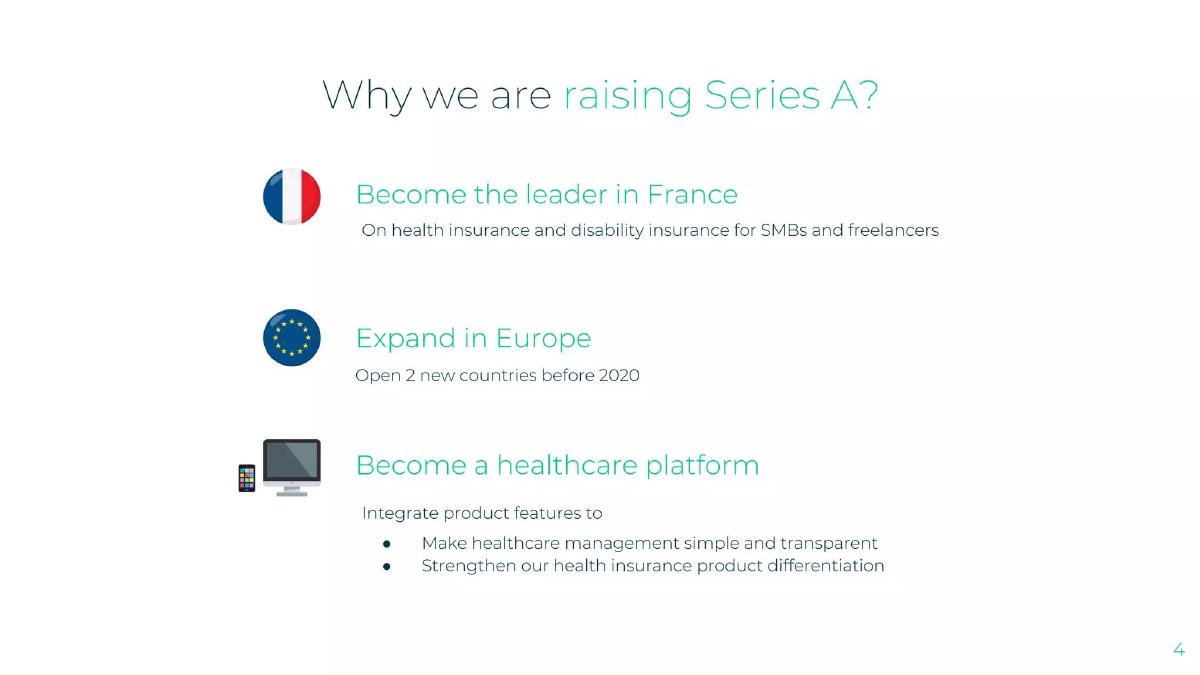
Slide 4: Why we are raising Series A?
The deck outlines three pillars for the raise: 1) Becoming the leader in France for SMBs/freelancers, 2) Expanding in Europe (2 new countries before 2020), and 3) Becoming a "healthcare platform" beyond just insurance. It also mentions strengthening product differentiation.
This slide tells an investor that the company is shifting from "license & build" to "scale & expand." The mention of "2 new countries before 2020" provides a concrete timeline for internationalization, which is essential for a VC-backed company aiming for a unicorn valuation in the fragmented European market.
To be stronger, this slide should quantify these goals. Instead of just "Become the leader," it could say "Scale from X to Y members." VCs like to see exactly what "milestone" their Series A capital is buying.
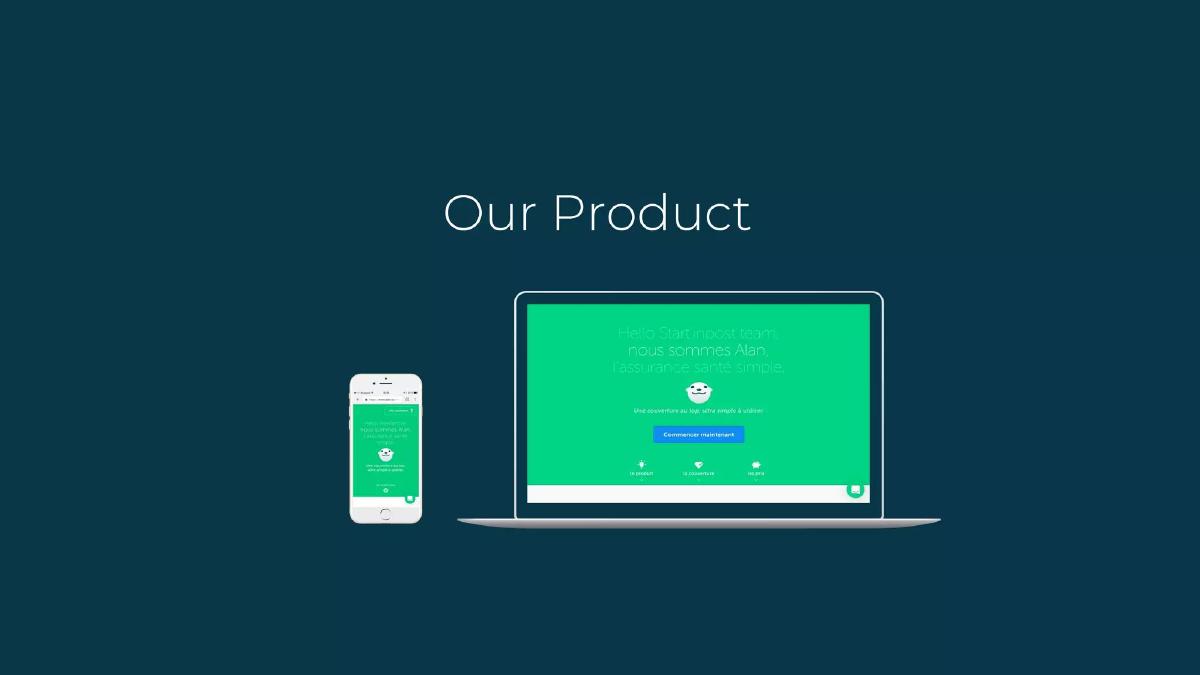
Slide 5: Product Mockup
This slide shows the UI on a smartphone and laptop. The text emphasizes "Une couverture au top, ultra simple à utiliser" (Top coverage, ultra-simple to use). It showcases a clean, green-and-white interface that looks more like a modern fintech app (like Revolut or N26) than a traditional insurance portal.
Investors look for "product sense" here. Insurance is traditionally a "low-touch" product that people hate interacting with. By showing a polished, modern UI, Alan is betting that a better user experience will lead to higher NPS and lower churn, which are critical SaaS metrics.
The strongest version would include a "before and after" or a specific "magic moment" in the UI—for example, showing how a claim is filed in three taps. The current images are a bit generic.
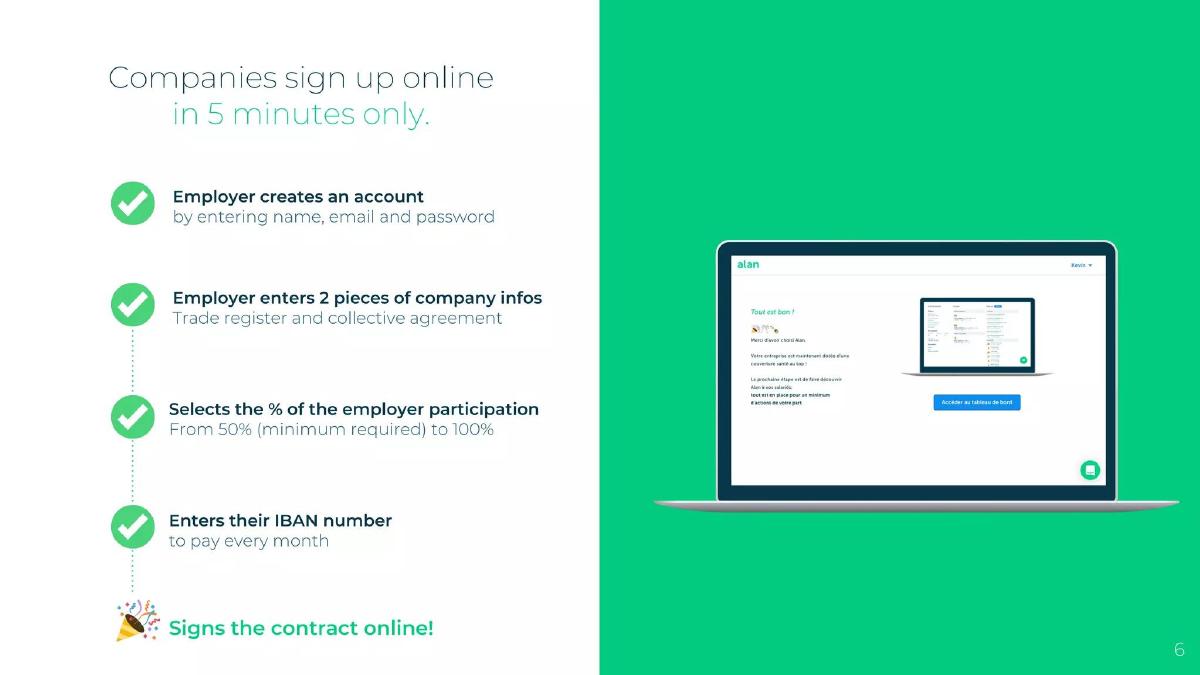
Slide 6: Employer Onboarding
The slide details a 5-minute online signup for employers: account creation, company info (Trade register), selecting employer participation (50-100%), IBAN entry, and e-signing. It uses a laptop mockup to show the dashboard.
This slide is about "Zero Touch" sales. In traditional insurance, a company would have to talk to a broker, exchange PDFs, and wait days for a quote. By automating this, Alan drastically reduces its Customer Acquisition Cost (CAC) and allows it to scale without a proportional increase in sales headcount.
The slide is effective, but it lacks a "Proof of Speed." It says 5 minutes, but adding a testimonial from a CEO who actually did it in 5 minutes would make the claim more credible.
Slide 7: Employee Onboarding
Mirroring the employer slide, this shows the 5-minute employee signup: IBAN for reimbursements, Social Security number, and address. It features a photo of a person comfortably using a laptop.
For an investor, the "Employee Onboarding" is the other half of the B2B2C flywheel. If employees find it easy to join, the HR manager’s life is easier. This reduces the "support burden" on Alan and the client company, making the product "sticky."
A stronger version would mention the "activation rate." If 95% of employees complete their profile within 24 hours of the company joining, that is a powerful metric for the efficiency of the onboarding flow.
Slide 8: Employer Admin Tools
This slide highlights the dashboard features: no paperwork, inviting employees in clicks, tracking subscriptions, and—most importantly—integration with payroll systems like PayFit.
The PayFit integration is a critical detail. In 2017, PayFit was a fast-growing payroll startup in France. By integrating, Alan becomes part of the "company operating system." This creates high switching costs; if you leave Alan, you have to manually fix your payroll workflows. This is "SaaS-like" defensibility.
The slide is well-structured. To improve it, they could list the number of hours saved for an HR manager per month. Quantitative savings are always more persuasive than qualitative "simplicity."
Slide 9: Pricing and Coverage
Alan breaks down its plan: covering the "remaining part" not covered by Social Security (GPs, Dental, Hospital, Glasses). It gives clear pricing: €50 for This transparency is revolutionary for insurance. Traditional players often hide pricing behind "Get a Quote" buttons and complex actuarial tables. By offering flat rates based on age buckets, Alan makes the buying decision instantaneous. It also shows they have a firm grip on their actuarial model.
The slide is a bit text-heavy. The pricing table is the most important part, but it's squeezed into the bottom right. A stronger version would make the "Flat Rate" pricing the hero of the slide.
Slide 10: The Alan Card
This slide introduces the "Alan Card" for direct payment, eliminating the need for reimbursement. It shows a physical card and a smartphone screen.
This is the "Fintech-ification" of insurance. "Tiers Payant" (third-party payment) is common in France, but Alan is positioning its card as a modern, digital-first version. For the user, it turns insurance into a "payment experience" rather than a "claims experience."
The slide is a bit thin on content. It uses a "detective emoji" which feels slightly out of place. It would be stronger if it explained the underlying tech—does it use a specific network? Is it a virtual card too?
Slide 11: Reimbursements Made Simple
Three steps: No upfront payment (Tiers Payant), Direct bill upload via photo, and Automatic reimbursement via connection to the French Healthcare System (Noémie).
This slide tackles the biggest pain point in insurance: the "reimbursement lag." By connecting directly to the national healthcare system, Alan can automate the flow of data. This reduces operational overhead (less manual claims processing) and increases customer delight.
The claim "Automatic reimbursement" is the strongest selling point. The slide would benefit from showing a timeline: "From doctor visit to money in bank: X hours."
Slide 12: The Journal
Alan introduces a "Journal" that lists all doctor visits and pharmacy purchases in one place. It calls this the "starting point for future development in health management."
This is the "Platform Play." By aggregating health data, Alan moves from being a "payer" to being a "partner." Investors love this because it hints at a future where Alan provides value-added services (telemedicine, wellness, etc.) that aren't tied to the insurance premium margin.
The slide is a bit vague on what "future development" means. A stronger version would list 2-3 specific features coming to the Journal (e.g., "AI-driven health tips" or "Prescription reminders").
Slide 13: Customer Testimonials
A collection of chat bubbles in French showing users praising the UI, the speed of support, and the signup process. Phrases like "BRAVO!!!!!!" and "C'est vraiment top" are used.
In a Series A deck, social proof is vital. These aren't just polite quotes; they are specific about the UI and the "onboarding." They prove that the "simple" value proposition is actually being felt by the market.
The slide is visually a bit messy. It would be stronger if it highlighted the source of these quotes (e.g., Intercom, NPS surveys) to show they are representative of a broader sentiment rather than cherry-picked emails.
Slide 14: Social Media Proof
Screenshots of two tweets featuring photos of the physical Alan welcome pack. One user says they never thought they'd love a "mutuelle" (health insurer).
This slide highlights "unboxing" culture applied to insurance. When was the last time someone tweeted a photo of their AXA welcome letter? This demonstrates high organic brand love and low-cost "word-of-mouth" marketing, which are key for sustainable growth.
The slide is effective, but it only shows two tweets. A stronger version would include a metric like "NPS Score: 70+ (vs industry average of 10)" to quantify this love.
Slide 15: Market Transition
A transition slide for the "Market" section. It uses emojis: a clover, a crystal ball, and a doctor.
This is purely a stylistic choice. It maintains the "friendly" brand voice but adds no informational value. In a 42-slide deck, these transition slides can feel like filler.
Slide 16: The French Health Market
The numbers: €36bn market size in France, 96% coverage, >500 players with "very little differentiation." The top 20 players have 50% market share.
This is a classic "Large, Fragmented, Stagnant" market slide. It tells the investor that the prize is huge and the incumbents are weak because they don't differentiate. It frames the opportunity as a "market share grab" from dinosaurs.
The strongest version of this slide would show the CAGR (Compound Annual Growth Rate) of the market or the specific segment (SMB) Alan is targeting. "€36bn" is the total market, but how much of that is the addressable "Digital SMB" market?
Slide 17: Prévoyance (Disability/Death)
The slide introduces "Prévoyance" as a "good upsell" with an €11bn market size. It notes it is mandatory for most employees and will be mandatory for platform workers in 2018.
This is a "Land and Expand" strategy. Once Alan is in the door with health insurance, they can cross-sell disability insurance. This increases LTV (Lifetime Value) without increasing CAC. The mention of "platform workers" (Uber-likes) shows Alan is positioning itself to capture the "Gig Economy."
The slide mentions 33 players with "little differentiation." It should specify why Alan's digital-first approach wins in this specific product, which is often even more paperwork-heavy than health insurance.
Slide 18: European Expansion
Alan states that its French license is enough to operate across Europe (passporting rights). They are studying markets and will finalize a decision by year-end 2017.
This is a crucial "Scalability" slide. For a VC, a French-only company is a smaller bet. A company that can take a hard-to-get license and "passport" it into Germany, Spain, and Italy is a global contender. It shows the license is a portable asset.
A stronger version would name the top 2 target countries and provide a brief rationale (e.g., "Spain: Similar regulatory structure, high digital adoption"). "Studying several markets" sounds a bit indecisive for a Series A.
Slide 19: Competitive Landscape
The slide is titled "Competitive landscape (start-ups)" but is essentially blank white space.
In pitch deck teardowns, this is usually a red flag. However, in this context, it likely intended to show that there are no direct digital-first competitors with their own license in France. But as it stands, it looks like a missing slide or a formatting error.
If the message was "We have no direct competitors," the slide should say so explicitly. Leaving it blank is confusing and looks like an incomplete draft.
Slide 20: Metrics Transition
A transition slide for "Key Metrics & Growth." Similar to slide 15, it’s a design choice to break up the deck.
For a 42-slide deck, these transitions contribute to the length. While they fit the brand, they don't help the investor get to the data faster.
Slide 21: Unit Economics
Alan lists ARR per insured, Gross Margin, and distribution costs. However, the actual numbers are replaced with "X." It mentions a "50% [margin] experienced since the beginning of the year" and that for Prevoyance, they distribute a product from CNP, so there is no Loss Ratio risk.
The fact that the numbers are redacted in the public version of the deck is standard, but for the actual pitch, these are the "Make or Break" numbers. The 50% gross margin is extremely high for insurance (where 10-20% is more common) and likely refers to their operational margin before claims, or a very healthy Loss Ratio.
The most important detail here is "No Loss Ratio risk" for Prevoyance because they are distributing for CNP. This shows Alan is being smart about risk—taking the full risk on health (where they have data) and acting as a broker for the riskier disability products initially.
Slide 22: Contract Growth
The slide has a placeholder for a graph. It notes that the market is seasonal (contracts start Jan 1st) and that growth is currently word-of-mouth, with paid acquisition just starting in September.
This is a "Growth Narrative" slide. Even without the graph, the text tells us two things: 1) The business is about to see a massive spike in January due to the October/November signing season, and 2) They haven't even "turned on the taps" of paid marketing yet.
A stronger version would show the "Word of Mouth" growth rate quantitatively. If they are growing 10% MoM without spend, that is a powerful indicator of Product-Market Fit.
Slide 23: ARR Growth
Another placeholder for a graph. It mentions that 59% of the portfolio has already signed for disability insurance (launched in July).
The 59% cross-sell rate is the "Star Metric" on this slide. It proves the "Prévoyance" upsell theory from slide 17 is working in practice. It means for every company Alan signs, they have a >50% chance of nearly doubling the revenue through the second product.
The slide would be stronger if it showed the "Revenue per Account" increasing over time as a result of this cross-selling.
Slide 24: Distribution Strategy
Alan identifies three segments: Startups (30k-50k people), Self-employed (3m), and SMEs (12.5m). The strategy is "100% online, direct distribution only."
This is an "Efficiency" slide. By refusing to use traditional brokers (who take 10-20% commissions), Alan is keeping more margin and maintaining a direct relationship with the customer. It’s the "Direct-to-Consumer" model applied to B2B insurance.
The slide is clear. To be stronger, it should explain how they reach these people online. "100% online" is a method, not a strategy. What are the specific channels for each segment?
Slide 25: Acquisition Channels
Alan details its sources: Organic (Intercom/email), Marketing (Blog, PayFit integration, VC partnerships), and a small €3k test on Facebook.
This slide reinforces the "Capital Efficiency" theme. They raised €12M and spent only €3k on Facebook ads. This tells investors that the growth to date is "Real"—it’s driven by product value, not by buying users.
The mention of "identifying low CAC and repeatable strategies" is exactly what a Series A investor wants to hear. The Series A is the money used to scale those "repeatable strategies."
Slide 26: Seasonality and September/October Efforts
This slide explains the Q4 focus: legacy contracts must be canceled by Oct 31st. They used billboards in the Paris underground (RATP) and Facebook/LinkedIn ads.
The admission that "First results were not super effective on online" is refreshingly honest. It shows the team is data-driven and willing to pivot. The billboard campaign is a classic "brand play" to establish trust in a market where trust is the primary barrier to entry.
The strongest version of this slide would show the "Lift" from the billboards. Did search volume for "Alan" increase? Did the CAC of online ads drop during the billboard run?
Slide 27: ARR Objectives
A placeholder for a graph showing future objectives. It explains that marketing costs hit now, but revenue hits on January 1st due to contract cycles.
This slide prepares the investor for the "J-Curve" of their cash flow. It explains why they need the Series A capital now—to fund the acquisition costs for the January 1st cohort.
Without the actual graph, this slide is just a promise. For the real pitch, this needs to be a very aggressive but believable hockey stick, backed by the "September/October" signing data mentioned previously.
Slide 28: Execution Transition
A transition slide for "It’s all about execution." Emojis: tools, laptop, bicep.
Again, a stylistic choice. It signals the shift from "Market/Data" to "Team/Operations."
Slide 29: What makes us proud
Alan lists: 1) Insurance license in This is a "Team Credibility" slide. It proves they can navigate complex bureaucracies faster than anyone else and that they are "Operationally Lean." For VCs, a team that can get an insurance license in 8 months is a team that can solve almost any regulatory or technical problem.
The "€0 CAC" is a bit of a hyperbole (surely salaries and overhead count?), but as a marketing metric for paid spend, it is impressive. The slide is very strong as is.
Slide 30: Capital Efficiency
Redacted metrics for ARR and Burn. It mentions a subsidy/debt from BpiFrance and an "Excess cash position at end of 2017."
This slide is the "Financial Health" check. By showing they have excess cash and non-dilutive funding (BpiFrance), Alan is telling investors they aren't raising because they have to, but because they want to accelerate. This is the best position to be in when negotiating a Series A.
The term "Excess cash position" is vague. A stronger version would state exactly how many months of runway they have left at the current burn rate.
Slide 31: The Team
Focuses on the founders: CEO (exited Expliseat), CTO (Facebook, Instagram, Twitter). It also mentions a team of 40+ years of insurance experience from AXA, Generali, and the regulator (ACPR).
This is the "Dual Competence" slide. You have the "Tech/Startup" DNA from the founders and the "Insurance/Regulatory" DNA from the senior hires. Most insurtechs fail because they lack one of these. Alan is showing they have both.
The photo of the team is good for "humanizing" the company. The slide is very balanced.
Slide 32: Founder Bios
Detailed bios for Jean-Charles Samuelian (CEO) and Charles Gorintin (CTO). It highlights their elite education (Ecole des Ponts, UC Berkeley, etc.) and their specific technical/entrepreneurial backgrounds.
Investors look for "Founder-Market Fit." Jean-Charles is an actuary and successful entrepreneur; Charles is a data scientist from top-tier US tech firms. This is a "blue-chip" founding team.
The bios are impressive. One small fix: the text is very dense. Bullet points would make it more readable during a presentation.
Slide 33: Engineering Team
Bios for six software engineers, highlighting backgrounds at BlaBlaCar, Mixpanel, Square, and Facebook.
This slide is intended to show "Engineering Density." By hiring from "Product-First" companies like Square and Mixpanel, Alan is signaling that they are building a software company that happens to sell insurance, rather than an insurance company with an IT department.
The bios are excellent. They show a mix of seniority and specialized knowledge (e.g., anti-fraud at Square, personalized medicine algorithms).
Slide 34: Insurance Team
Bios for Bertrand Robert (25y exp, AXA/Mercer), Paul Sauveplane (ACPR supervisor), and Fabrice Staad (Generali Head of Life Actuary).
This is the "Trust" slide. If you are a Series A investor, you worry about the "Black Swan" of an insurance company: bad underwriting or regulatory trouble. Having the former "Head of Life Actuary" at Generali and a former "Insurance Supervisor" from the regulator on your team almost entirely mitigates that risk.
This is arguably one of the most impressive "Team" slides in the startup world. It shows they can attract top-tier talent from the industry they are trying to disrupt.
Slide 35: Design, Support, and Growth
Profiles for Edouard Wautier (Withings design), Anna Debernardi (Captain Train support), and Kevin Aserraf (Growth). It also mentions two upcoming hires from Buffer and Trainline.
This slide rounds out the "Full Stack" team. Hiring from Captain Train (known for the best customer service in France) and Withings (known for top-tier hardware/UX design) reinforces the "Simple" brand promise.
The "Joining in next months" section is a great way to show momentum. It shows that high-quality people are already committed to the vision.
Slide 36: Internal Organization
Alan shares its "Scalable internal organisation": no meetings, no Product Managers, decisions tracked on GitHub, and radical transparency.
This is a "Culture as a Competitive Advantage" slide. It mirrors the radical transparency of companies like Buffer or GitLab. To an investor, this suggests high operational velocity. No meetings and no PMs mean fewer bottlenecks and more "doing."
The slide is a bit "inside baseball," but for a Series A investor looking for a company that can scale from 20 to 200 people without breaking, these organizational principles are reassuring.
Slide 37: Seed Round Recap
A recap of the €12M seed round with logos of CNP, Partech, and Power Corp, plus a list of high-profile angels (Criteo, Lastminute, etc.).
This slide establishes "Institutional Validation." If Partech and the CEO of a major insurer (Guillaume Sarkozy) already invested, the Series A investor feels they are in good company. It creates a "Fear Of Missing Out" (FOMO) effect.
The list of angels is particularly strong because it includes both Tech and Insurance heavyweights. It’s the perfect "Social Proof" slide.
Slide 38: Next Steps Transition
A transition slide for the final section. Emojis: fast-forward, telescope, target.
Standard transition, though perhaps unnecessary this late in a long deck.
Slide 39: Product Roadmap
A timeline from June 2017 to Jan 2018. It shows the launch of Prévoyance, a referral program, and mobile apps.
This proves the team hits milestones. The fact that "Prévoyance" is already shipped (August) validates the "Expand" part of the strategy. The "Mobile Apps" launch in October is a key milestone for reaching the "Self-employed" market.
The timeline is very short-term. A "Series A Roadmap" should usually look 18-24 months into the future, not just 3 months. Where does the Healthcare Platform start?
Slide 40: Data and Underwriting
Alan discusses using data for "better decision and prevention tools" rather than personalizing pricing (which they believe creates misalignment). They aim for better retention and better loss ratios through prevention.
This is a sophisticated "Ethical AI" stance. By rejecting personalized pricing (which usually means charging sick people more), they align themselves with the user. They argue that using data for prevention is a better way to lower the Loss Ratio than just being a better "actuary."
This is a high-level philosophical slide. It would be stronger with a specific example—e.g., "Our data shows that users who use X prevention tool have a 10% lower claim rate."
Slide 41: Team Evolution
Another blank slide titled "Team evolution: until early 2020."
Like slide 19, this is a missed opportunity. It should have been a chart showing the planned headcount growth across Engineering, Sales, and Support. A blank slide at the end of a deck suggests a lack of final polish or a missing data visualization.
Slide 42: Vision and Closing
The final slide: "We are building the best and most comprehensive healthcare platform in Europe." It features a photo of a welcome card.
It brings the narrative back to the "Platform" vision. It’s a solid, brand-aligned ending, but it doesn't leave the investor with a "call to action" or contact info (though that was likely on a separate closing sheet or provided via the platform).
The "Bienvenue chez Alan" text adds a nice touch of hospitality, consistent with their "WoW Expert" support philosophy.
Concrete fixes in priority order
Fill the "Ghost" Slides: Slides 19 (Competitive Landscape) and 41 (Team Evolution) are essentially blank. These are critical sections for a Series A. Slide 19 needs a "competitive map" showing Alan vs. Legacy Insurers vs. MGAs, and Slide 41 needs a hiring ramp-up chart to justify the raise amount. · Quantify the "Healthcare Platform": The vision of moving beyond insurance to a "healthcare platform" is mentioned on slides 4, 12, and 42, but never defined. The deck needs a specific slide detailing what a "platform" looks like (e.g., Telemedicine, Pharmacy delivery, Health records) and how it generates non-premium revenue. · Extend the Roadmap: Slide 39 only goes to January 2018 (two months after the deck's date). A Series A deck needs a 24-month horizon. Investors need to see the "Series B milestones"—what does the company look like in late 2019? · Strengthen the "Unit Economics" Slide: Redacting numbers for a public version is fine, but Slide 21 is very sparse. It needs to clearly define the LTV/CAC ratio, even if the numbers are placeholders. It should also clarify what "50% gross margin" includes, as that is an outlier in the insurance industry. · Add "Why Now?" Regulatory Context: The French health insurance market underwent massive structural changes around 2016-2017. Adding a slide on the regulatory tailwinds would explain why the market is ripe for a digital player right now. · Consolidate and Shorten: At 42 slides, the deck is long. Several "emoji transition" slides could be removed, and the team bios (slides 31-35) could be condensed to focus on the top 5-6 leaders, moving the rest to an appendix. This would keep the momentum high for the core growth data.
Frequently asked questions
- Is Alan an insurance broker or a carrier?
- Alan holds its own independent insurance license from the ACPR in France (the first new one since 1986). This allows them to act as a full-stack carrier rather than just a broker or software layer.
- What market segments does Alan target?
- Alan targets companies (SMBs) and self-employed workers/freelancers in France, with plans to expand into Europe.
- How does Alan reduce Customer Acquisition Costs?
- The deck claims a 5-minute online onboarding process for both employers and employees, eliminating traditional paperwork and broker interactions.
- What is Alan's cross-sell strategy?
- Alan uses a "Land and Expand" strategy, initially selling health insurance and then upselling "Prévoyance" (disability and death insurance) to the same customers.
- What is Alan's long-term product vision?
- The deck outlines a vision to move from a "payer" (insurance) to a "healthcare platform" by integrating features like a health "Journal" and decision-support tools for users.
- Does Alan use brokers for distribution?
- Alan utilizes a 100% online direct distribution model, avoiding the 10-20% commissions typically paid to traditional insurance brokers.